Showing posts with label Asian hornet. Show all posts

Thursday, 5 October 2017

Asian killer hornet discovered in Devon posing threat to dwindling native bee populations


Insect incursion discovered near beehives

Tuesday 26 September 2017 16:34 BST

An Asian hornet has been seen in near Woolacombe in Devon, the National Bee Unit has said.

While the foreign species does not pose a risk to human health, its presence does threaten native honey bees.

The sighting, near an apiary, is the first since last year, when a nest was discovered in Gloucestershire.

Bee keepers tracked down and destroyed that nest, containing the incursion.

Honey bees are in decline and play an important role in maintaining British crops.

Nicola Spence, Defra Deputy Director for Plant and Bee Health, said in a statement: "We recognise the damage (Asian hornets) can cause to honey bee colonies.

"That’s why we are taking swift and robust action to locate and destroy any nests in the Devon area following this confirmed sighting.

"Following the successful containment of the Asian hornet incursion in Gloucestershire last year, we have a well-established protocol in place to eradicate them and control any potential spread.

"We remain vigilant across the country, working closely with the National Bee Unit and their nationwide network of bee inspectors."

Authorities are setting up a surveillance zone stretching one to two kilometres around the initial sighting.

Read on  

Wednesday, 12 October 2016

Asian hornet nest discovered in Gloucestershire


Hive the size of a large pumpkin found at top of 17-metre tree
 
Wednesday 5 October 2016

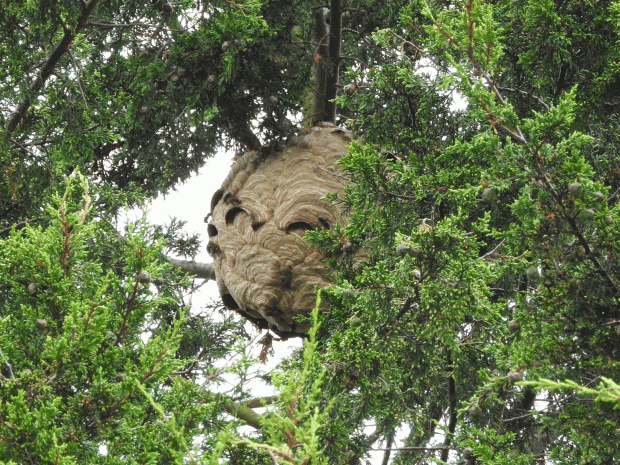
A giant Asian hornets' nest has been found in a tree in Gloucestershire, prompting concern from Government experts about the species' threat to bee populations. 

asian-hornet-nest.gif
National Bee Unit
The hive, which was located at the top of a 17-metre tree and is the size of a large pumpkin, has now been destroyed.

The Asian hornet is smaller than bees native to the UK and they pose a risk to honey bees. 
Steps are being taken to locate, destroy and remove any nests that are found and experts have been deployed across the area. 

Nicola Spence, Defra Deputy Director for Plant and Bee Health, said the bees pose no greater risk to human health than those already present in the UK.

“We have been anticipating the arrival of the Asian hornet for some years and are implementing our well-established protocol to eradicate them and control their spread,” Ms Spence said.

“It is important to remember they pose no greater risk to human health than a bee, though we recognise the damage they can cause to honey bee colonies. That’s why we are taking swift and robust action to identify and destroy any nests.

 “We remain vigilant across the country, working closely with the National Bee Unit and their nationwide network of bee inspectors.”

It comes after sightings of the Asian hornet in Somerset. 

Tim Lovett, of the British Beekeepers Association, said the evidence suggests the invasion started a while ago. 


Friday, 23 September 2016

Asian hornet has arrived in Britain, government confirms, and could destroy precious resources

The insects wait outside bees’ hives and bites their heads off as they emerge so that they can steal honey
 
Andrew Griffin


Tuesday 20 September 2016

The first Asian hornets have been spotted in Britain and could be about to cause huge damage to bees, one of our most precious resources.

The hornets pose no risk to human health. But they pose a huge risk to the life of honey bees, one of our most precious and threatened natural resources.

Authorities are now launching a plan to find and destroy any nests belonging to the species, in an attempt to wipe them out in the UK.

Honey bees are in decline and are central to the life of many of the crops we use to feed ourselves. But the hornets pose a huge risk to them – waiting outside their hive’s entrance, biting their head off to kill them, getting rid of the entire group and then stealing their honey.

Our own bee colonies haven’t evolved to cope with the threat of attack from the hornets, and so could be at risk from them.

The hornets have long been the subject of worry in the media that the “killer” insects would make their way to British shores. That has now been confirmed after one was spotted in Gloucestershire, the government has said.
 
The hornets have become widespread in central and southern France. For years, authorities have worried that they could arrive in imported plantpots, timber or even flying over themselves.


Continued..

Wednesday, 22 April 2015

Britain's beekeepers told to be alert for arrival of Asian hornets

Vespa velutina, which preys on honey bees, is already spreading rapidly across mainland Europe and could pose a serious risk to the UK’s apiculture


Tuesday 21 April 2015 14.04 BSTLast modified on Tuesday 21 April 201518.31 BST

Beekeepers have been told to be alert for invading hornets that have killed six people in France and could pose to serious risk to Britain’s honey bees.

The Asian hornet, which preys on honey bees, is spreading rapidly across France and other parts of mainland Europe, and there are fears its arrival in Britain is only a matter of time – particularly in light of the unusually warm spring weather.

The hornets’ sting can cause deadly allergic reactions in humans but officials are particularly worried about their impact on the crucial ecological role played by honeybees, and the possibility they could permanently affect Britain’s biodiversity.

A spokesman for the Department for Environment, Food and Rural Affairs said: “It’s not great news for bees because they are not a friend to the humble honey bee, and that’s why we don’t want them here.”

Thursday, 21 August 2014

France fights back Asian hornet invader

Saint-Paul-lès-Dax (France) (AFP) - They slipped into southwest France 10 years ago in a pottery shipment from China and have since invaded more than half the country, which is fighting back with drones, poisoned rods and even chickens.

The Asian hornet, or vespa velutina nigrithorax, is considered a "public enemy" in parts of France where it devours native bees and, experts say, threatens biodiversity.

"It's exploding (in numbers) and causing trouble," said Eric Darrouzet, a biologist at the Research Institute for the Biology of Insects (IRBI) at the University of Tours.

But some kind of solution may be in sight.

Thursday, 24 April 2014

VIDEO: Killer Asian hornet may have been caught on camera in Devon

By North Devon Journal | Posted: April 23, 2014

A DEVON man has captured video and pictures of what he believes is the first 'killer' Asian hornet seen in the county.

LJ Marley, from Plymouth, captured the images of the insect at his home in Efford in Monday.

The Asian hornets have killed six people in France since they arrived in a shipment of Chinese pottery in 2004.


Friday, 18 April 2014

Giant Asian Hornet heading for Kent after 'causing deaths' of six people in France

17 April 2014
by KentOnline reporter

Giant Asian hornets which have been blamed for the deaths of six people in France are heading to Kent, according to reports.

Experts believe the insects, whose sting can be fatal, are likely to enter Britain by flying across the Channel. Kent and other parts of the South East are at the highest risk.

The likelihood of them entering the UK has been highlighted in a report by the Government's Environmental Audit Committee, which says they could arrive "within days".

The report adds: "Some invasive species have direct human health effects. The Asian Hornet, which might soon arrive here, has killed six people in France."

The hornets are believed to have entered France in a shipment of Chinese pottery in 2004.

Related Posts with Thumbnails

ShareThis