Showing posts with label bottlenose dolphin. Show all posts

Sunday, 5 July 2020

Good night? Satellite data uncovers dolphins on the move at nighttime


Date: June 2, 2020
Source: Florida Atlantic University
More than 1,000 bottlenose dolphins live in the Indian River Lagoon year-round. This estuarine system along the southeast coast of Florida is a narrow and convoluted ecosystem with interconnected bodies of water, a handful of ocean inlets, and numerous small rivers, creeks and canals that release freshwater into the lagoon. While this population of dolphins in the lagoon has been studied extensively, what they do at nighttime is still a mystery.
Researchers from Florida Atlantic University's Harbor Branch Oceanographic Institute in collaboration with Seven Degrees of Mapping LLC, and Hubbs-SeaWorld Research Institute, are the first to use satellite telemetry on this dolphin population, providing unique insights into their behavioral ecology during the overnight hours. Detailed information about their nocturnal movements and habitat use will give scientists a more complete ecological understanding of this population. These dolphins face many direct and indirect threats including boat strikes, entanglements, and environmental contamination.
Results of the study, published in the journal Animal Biotelemetry, provide the first documentation of Indian River Lagoon dolphins regularly leaving the brackish waters of the estuarine system and, not only traveling into the ocean, but swimming substantial distances -- up to 20 kilometers -- up freshwater rivers, creeks, and canals. These journeys do not appear to be extended stays in freshwater, which can be detrimental to dolphin health, but instead involve many brief trips upriver. Findings reveal that they have a larger range that encompasses more habitats than previously thought.

Continued

Monday, 1 January 2018

Boat traffic threatens the survival of Panama's Bocas Del Toro dolphins

Geneticists recommend designating isolated dolphin population as 'endangered'

Date:December 22, 2017

Source:Smithsonian Tropical Research Institute

Summary:Bottlenose dolphins in Panama's Bocas Del Toro Archipelago should be designated as endangered say the authors of a new study. Biologists have discovered that the roughly 80 dolphins in the archipelago do not interbreed with other Caribbean bottlenose dolphins. Their low numbers jeopardize their long-term survival, which is threatened by increasing local boat traffic that killed at least seven dolphins in 2012.

Monday, 17 October 2016

Dolphin pictured killing porpoise by flipping it into air


 11 October 2016


A bottlenose dolphin has been pictured flipping a porpoise into the air in a deadly attack. The rarely seen event was witnessed by gig rowers in Newlyn Harbour in Cornwall.

Dolphin attacks on porpoises accounted for about one death a year on average, said Cornwall Wildlife Trust (CWT).

It is unclear why dolphins attack porpoises but it could be an aggressive response to feeding competition or even "misdirected sexual aggression".

Image copyright Lizzie Warner Image caption No-one is quite sure why dolphins attack porpoises but it could be an aggressive response to feeding competition 

The pictures were captured by the Pendeen Pilot Gig Club in a training session.

CWT said: "We are unsure of why this happens and it is certainly not predation.

"Many theories have been put forward, including misdirected infanticide (bottlenoses will kill calves), misdirected sexual aggression or play behaviour and an aggressive response to feed competition are just some."

Marine Strandings Network said it found the carcass of the porpoise, which had "multiple severe injuries as a result of the attack".

"We do have a number of dead porpoise, and more unusually common dolphin, reported to us with injuries resulting from bottlenose dolphin aggression."

Sunday, 24 July 2016

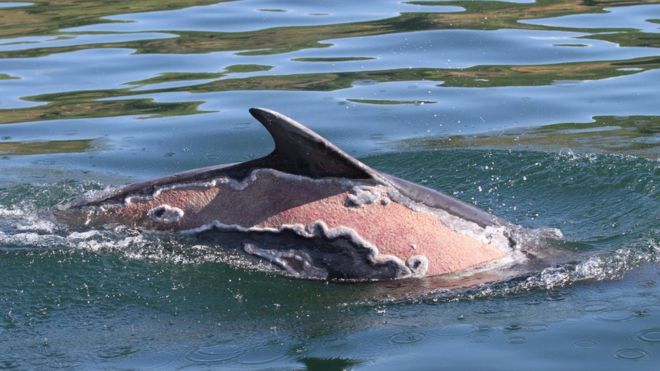
Sunburned dolphin spotted in Moray Firth


By Steven McKenzieBBC Scotland Highlands and Islands reporter

22 July 2016 

A bottlenose dolphin that was sunburned while stranded out of water on mudflats for 24 hours in May appears to be recovering from its injuries.

The young animal was found by chance at the Cromarty Firth by a couple who had got lost trying to drive to a dolphin-watching spot at the Moray Firth.

Animal welfare officers and members of the public refloated the dolphin.

University of Aberdeen
It was sighted again for the first time this month in the Moray Firth by University of Aberdeen scientists.

The university and the Inverness-based Scottish Marine Strandings Scheme (SMSS) said that for the first time in the UK scientists have been able to track a dolphin's behaviour following a stranding.

There are hopes the dolphin might eventually breed and raise young.
Normal behaviour

SMSS said the blistering on the right side of the juvenile female looked "horrific", but because of the make-up of dolphins' skin it has survived a burn that other animals might not have.

Also, crucially, the wound does not appear to be infected and shows signs of healing.

Wednesday, 30 March 2016

Taiji legal battle: court backs activist over baby dolphin kept in aquarium

Victory for animal rights after Japanese court awards Australian activist 110,000 yen after museum refused her entry to check on captive bottlenose

Justin McCurry in Osaka
Saturday 26 March 2016 01.04 GMTLast modified on Saturday 26 March 201601.12 GMT

Animal rights activists have claimed a significant victory in its battle to end Japan’sdolphin slaughter after a court ruled that an aquarium in Taiji – where hundreds of dolphins are killed every year – acted illegally when it refused entry to an Australian campaigner.

The court in Wakayama, western Japan, on Friday awarded 110,000 yen (£690) to Sarah Lucas, head of Australia for Dolphins, who had attempted to enter the Taiji whale museum in 2014 but was turned away and shown a cardboard sign saying “anti-whalers” were not welcome.

Lucas had intended to check on the welfare of a baby albino bottlenose that had been kept at the museum since being separated from its pod and captured earlier in the year. The museum reportedly paid $500,0000 (£354,000) for the animal.

Lucas said the rare dolphin, called Angel, was being kept in a tiny crowded tank full of chlorine, and was being bullied by other dolphins.

“The legal battle to save Angel is much bigger than a rescue mission to save one albino dolphin calf,” Lucas said after the verdict.

“This win proves the Taiji whale museum, the institution at the heart of the dolphin hunting trade, behaved illegally. It also shows the Taiji dolphin hunts are not above the law, which means the Japanese legal system can be used to end the cruel dolphin hunts for good.”

Tetsuo Kirihata, deputy chief of the Taiji museum, said he was satisfied with the verdict because the initial demand for damages had been for about 3m yen.

“We feel much of our case was taken into account by the court,” he told Associated Press. Kirihata said the dolphin was eating well and getting along with other dolphins, with regular blood tests showing it was healthy. What to some might look like bullying was, in fact, “part of regular activity in nature,” he added.

The museum is owned by the town government in Taiji, the setting for the Oscar-winning 2009 documentary The Cove, which showed fishermen driving pods of dolphins into shallow water before killing them with knives.


Friday, 5 December 2014

Internationally famous dolphin turns up in Scotland

An internationally famous solitary Bottlenose Dolphin known as Clet has been identified making a surprise appearance in Scotland’s Sound of Mull, according to researchers from the Hebridean Whale and Dolphin Trust. 

The rare sighting of a lone bottlenose dolphin following a ferry between Oban and the Isle of Mull triggered some rapid detective work at the conservation charity. 

Bottlenose dolphins are not unusual in the Hebrides, even during winter – but the species usually occurs in small groups, with individuals rarely being seen alone.

By studying the dolphin’s distinctively scarred dorsal fin and using photo identification techniques, the Trust’s experts identified the animal as one that made international headlines with its unusual behaviour when it was last seen in September. That was in Galway in Ireland, some 600 kilometres away from the Sound of Mull.

“To our knowledge, this is the first time that Clet has been recorded in Scotland, and in fact this is the furthest north he has been recorded to date,” says Dr Conor Ryan, Sightings Officer at Hebridean Whale and Dolphin Trust.

Saturday, 11 October 2014

First ever evidence of two dolphin species cross breeding

For the first time proof has emerged that shrinking dolphin populations may be causing different species of dolphins to breed and create hybridised species, says Whale and Dolphin Conservation.

Part of the the evidence submitted includes three photographs taken during fieldwork off Lewis, Scotland between 2010 and 2014 showing four 'atypical' dolphins with mixed morphological characteristics, suggesting that Bottlenose dolphins in the area have been mating with resident Risso’s dolphins.

The reasons behind this cross-breeding remain unknown, but the occurrence of four atypical dolphins consistent with hybridism in one small geographical region is highly unusual.

Bottlenose dolphins on the west coast of Scotland are few and far between. The "known" population is around 45 individuals off the west coast, another 10 or so off the Isle of Barra.

Tuesday, 12 August 2014

Warning after dolphin 'aggressively pushed man underwater' off Irish coast


A bottlenose dolphin has "aggressively" pushed a man underwater off the County Cork coast, according to a report made to the Irish Whale and Dolphin Group.

The report stated that the dolphin attacked the man twice and "lashed out with its tail", during the incident off Sherkin Island about two weeks ago.
A bottlenose dolphin
It prompted the IWDG to repeat warnings that swimmers should be extremely cautious if interacting with dolphins.
The dolphin, known as Clet, is a new visitor to Irish waters this year.
'Bit of a shock'

Start Quote

Do not confuse the shape of their jawline with a smile. They can and do cause serious injury to humans and have killed in the past”
Irish Whale and Dolphin Group
The adult bottlenose is believed to have originated in French waters, but has been sighted off the Cork coast throughout the summer.
The incident took place on 26 July and the IWDG's sightings log said: "We are aware of a report of an adult swimmer nearby in wetsuit and mask, from a yacht at anchor, being aggressively pushed underwater by the dolphin.
"They got a bit of a shock as a result."

Sunday, 11 August 2013

Feds declare 'unusual mortality event' as dolphin deaths expand

First Indian River Lagoon bottlenose dolphins, now dolphins as far away as New York are dying of some mysterious ailment.

Federal biologists have opened a formal investigation into an unusually high number of bottlenose dolphins that have died from coastal areas of New York to Virginia over the past several weeks.

NOAA Fisheries declared the “Unusual Mortality Event” after about 100 bottlenose dolphins died in the region this year, most of them in July.

The declaration frees up federal resources for a more in-depth investigation.
Last month, a federal panel made a similar determination, officially declaring the deaths of more than 50 bottlenose dolphins this year in the Indian River Lagoon as unusual.

More than seven times the historical average of bottlenose dolphin died during July in the Mid-Atlantic Region, including New York, New Jersey, Delaware, Maryland and Virginia, NOAA officials said.

As with the dolphin deaths in the Brevard County region, all age groups of dolphins have been involved in the Mid-Atlantic deaths and all but a few of the dolphins found have died.

Tuesday, 6 August 2013

Don't swim with this dolphin: Temperamental 'Dusty' filmed attacking a woman

Dolphins are known for their gentle and friendly personality - but 'Dusty' the celebrity dolphin is different.

The female dolphin is a well-known personality in Doolin Harbour, County Clare, Ireland, but is known for her temperamental behaviour.

In this video Dusty lives up to her reputation, as she can be seen bathing next to a wall and stone steps, with two swimmers treading water nearby.

The memorable day swimming with the bottlenose dolphin soon turns sinister as she begins to bash her tail on the surface of the water in a sign of aggravation, causing enormous splashes.

Suddenly the dolphin surges through the water and jabs a woman in the kidney area with its nose, leaving her screaming in pain and shouting for help.

The injured woman is dragged onto the steps by a bystander but Dusty soon comes back and menacingly raises her head out of the water before swimming away.

Dusty, who was first spotted in the waters as far back as 2000, has had a checkered past. At times she can seem friendly and welcoming of the attention, but she can quickly turn nasty.

The hotheaded dolphin was reported to have tried to drown a swimmer in 2004 and the latest 'attack' is the fourth since May this year.

Lifeguards in the area are now putting out red flags whenever Dusty is spotted in the area and have asked tourists not to swim with the dolphin.

Watch video:

Sunday, 7 July 2013

Refloated dolphin seen with a calf a year on.

Refloated dolphin confirmed with calf a year later - Courtesy of the Irish Whale and Dolphin Group

July 2013. A bottlenose dolphin that live-stranded in North Kerry and was refloated in June 2012, and was subsequently photographed from dolphin tour boats in the Shannon Estuary, has now been sighted at least three times this year, and each time with a calf. Remarkably, this means that the dolphin was about 9 months pregnant when she stranded last year.

Refloating stranded cetaceans
There is occasionally some debate about the effectiveness of refloating stranded dolphins (and whales) as it is sometimes thought that they strand for a reason, usually that they are ill. Refloated whales often restrand shortly afterwards. However the experience with this dolphin shows that it is absolutely worthwhile making the effort. This dolphin is one of a small population that live in and around the Shannon Estuary, and her genes have now been passed on to the next generation. 

Stranded in Co Kerry
The female bottlenose dolphin live-stranded at Béal, Co. Kerry, on the shores of the Shannon Estuary, on 1 June 2012. The 3.5m female bottlenose dolphin was lying on the sand about 10m from the waterline, but appeared to be in perfect condition and had no signs of injury. She didn't seem in a very distressed state despite her predicament and her skin was still moist, but she was starting to overheat.

Friday, 7 December 2012

Minke whale and bottlenose dolphin sighting


Minke whales can also be found in the Atlantic, Pacific, Indian and Arctic Oceans

The sighting of a minke whale swimming with bottlenose dolphins off the Isle of Man coast has been described as "incredibly rare," by a marine expert.

Members of the Manx Whale and Dolphin Watch made the sighting on Thursday.

Sea Watch Foundation director Dr Peter Evans said: "Although this association is known to occur, it is incredibly rare to witness in the British Isles".

The sighting was made from Marine Drive in Douglas in clear conditions at around 13:00.
Manx Whale and Dolphin Watch members Becca Crow and Sarah Kaye described the sighting as "once in a lifetime".

'Clear identification'
Ms Crow said: "Although they were a little way out, the distinct surfacing patterns along with calm water conditions enabled us to make a clear identification through our binoculars.

"They would go one way and then the next. Dive and then reappear. It was incredible.

"Potentially I believe the two species could have been co-operatively hunting and feeding on herring stocks that move round to the east side of the island, during autumn and winter months.

Tuesday, 23 October 2012

Dolphin 'sponging' spans centuries


Bottlenose dolphins using sponges to protect their noses while foraging is a technique that the animals discovered in the 19th century, a study has found.
Scientists analysed data on the dolphins of Shark Bay, Australia, to model the appearance and transmission of the skill over generations.
The study found that "sponging" could have begun with a single "innovation event" between 120 and 180 years ago.
It suggested that mothers passed on the skill by teaching their offspring.
The analysis is published in the journal Animal Behaviour, and used previous field studies to investigate how sponging was established and maintained.
"It has been thought that behaviours which are exclusively learnt from one parent are not very stable. With our model we could now show that sponging can be a stable behaviour," said Dr Anna Kopps, a biologist at the University of New South Wales.

Saturday, 29 September 2012

Dolphin shot in Louisiana

Dead dolphin found in Louisiana died from bullet lodged in animal's lung
September 2012. Marine law enforcement staff (NOAA) and US marine mammal experts received a report a bottlenose dolphin that had been found dead on Elmer's Island in Louisiana. A necropsy revealed the dolphin died of a gunshot wound; the dolphin had been shot on the right side just behind the blowhole, probably with a small calibre firearm. The bullet was discovered lodged in the dolphin's lung. 

Not the first time a dolphin has been shot
In June 2006, Don G. Walker, the Captain of a fishing boat in Alabama, pleaded guilty to shooting of a dolphin in the Gulf of Mexico.

Members of a fishing party complained to officials that Don Walker had shot at a dolphin that was attempting to eat a fish off a fishing line. A member of the party took a picture of a bullet spraying the water near the dolphin.


Don Walker pleaded guilty and was sentenced to one year probation and ordered to pay $1,000.00 fine. In addition, he was required to make a $1,000.00 contribution to the Mote Marine Laboratory in Sarasota, Florida for the development of a public service announcement reminding others of the consequences of harassing bottlenose dolphins.


Reward offered
The Whale and Dolphin Conservation Society (WDCS) is offering a $1,500 reward for information leading to the identification, arrest and conviction of the person or persons responsible for the illegal and cruel acts that led to the death of a protected bottlenose dolphin.
NOAA officials seek information from anyone who may have details of this incident. Please call the NOAA Enforcement Hotline as soon as possible at 1-800-853-1964. Tips may be left anonymously.
Harassing, harming, killing or feeding wild dolphins is prohibited under the Marine Mammal Protection Act of 1972. Violations can be prosecuted either civilly or criminally and are punishable by up to $100,000 in fines and up to one year in jail per violation.

Wednesday, 8 August 2012

First confirmed successful refloat of stranded dolphin

Refloated dolphin seen 3 weeks later - Courtesy of the Irish Whale and Dolphin Group
August 2012. A bottlenose dolphin that live-stranded in North Kerry and was refloated, was recently photographed from dolphin tour boats in the Shannon Estuary. This is one of just a few occasions when there is proof that refloating a dolphin had some long-term sucess.
Stranded in Co Kerry
A bottlenose dolphin live-stranded at Béal, Co. Kerry, on the shores of the Shannon Estuary, on 1 June 2012. The 3.5m female bottlenose dolphin was lying on the sand about 10m from the waterline, but appeared to be in perfect condition and had no signs of injury. She didn't seem in a very distressed state despite her predicament and her skin was still moist, but she was starting to overheat.
Rather than wait for the whale pontoons to arrive from Kilrush in Co. Clare on the other side of the estuary, those present at the stranding decided to try using a tractor equipped with a large transport box on the back to lift her out of the sand and put her slowly into the water. Once in the water, they stabilised the dolphin for a few minutes and allowed her to become acclimatised, before she started to swim away from the shore. She quickly increased her swimming speed and was observed swimming for about 10 minutes before she was out of view.

Monday, 2 July 2012

Louisiana's Rogue Dolphin Entertains ... and Bites


(NEWSER) – Residents of an upscale New Orleans suburb have been warned to stay away from their friendly neighborhood dolphin. The young bottlenose dolphin, who arrived in a canal off the north shore of Lake Pontchartrain after Hurricane Katrina, is a big hit with boaters and swimmers, but has bitten at least three people who got too close to him. Wildlife officials have met with residents to tell them how to co-exist with the dolphin—and to remind them that feeding or harassing wild dolphins is banned by the Marine Mammal Protection Act.
Signs have been put up urging people to stay at least 50 feet away from the dolphin. "He’s like a friendly neighborhood dog, but the dog will bite," the manager of the local homeowner's association explains to King5. "He's a wild animal and you have to treat him like he's a wild animal and not jump on him, not go swimming with him. He's not Disney World." Officials say that relocating the dolphin could kill him—and if he survived, he would probably return to the canal he calls home. One resident has another solution. "Maybe they should find him a girlfriend," he says.

Wednesday, 20 June 2012

Octopus Hitches Ride on Dolphin's Genitals


An octopus got the joyride of its life last week when it somehow became stuck on the belly of a bottlenose dolphin in the Ionian Sea. More specifically, the tentacled sea creature had a seat on the dolphin's genital slit.

Researchers with the Ionian Dolphin Project, part of the Tethys Research Institute, were observing a foursome of dolphins near the island of Kalamos off the west coast of Greece. Suddenly, one of the dolphins leapt out of the water with something strange dangling from its stomach. It wasn't until the researchers examined their photos of the leap that they realized the unidentified object was an octopus.

The tentacled hitchhiker was attached to the dolphin's genital slit. Photographer Joan Gonzalvo isn't sure what the octopus was up to, though he told New Scientist that perhaps the dolphin tried to eat the octopus and the animal lodged itself along the dolphin's genital slit to escape.

Related Posts with Thumbnails

ShareThis