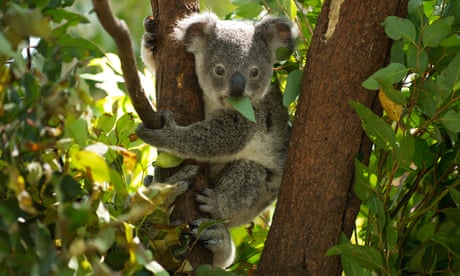
Showing posts with label Koalas. Show all posts

Monday, 9 July 2018

Saving koalas: Gene study promises solution to deadly sex disease


By Matt McGrathEnvironment correspondent
2 July 2018

Australia's most famous tree hugger has been ravaged by sexually transmitted disease, attacks from dogs, being hit by cars and habitat loss.

Chlamydia has spread fast in koalas, causing infertility and blindness.

But scientists say decoding the genome should lead to an effective vaccine for the STD.

In fact, researchers say they've been amazed by the information that's been hidden in the marsupial's DNA.

While they didn't find a gene for cuteness, they've worked out how koalas can survive solely on a diet of eucalyptus - which poisons most other creatures that consume it.
Genes that are switched on in the koala's "cast-iron livers" appear to be responsible for the ability to detoxify the leaves.


Wednesday, 11 April 2018

Tree clearing, not urban sprawl, wiping out koalas in Queensland, WWF says


Analysis shows 94% of the 5,000 estimated koala deaths due to habitat loss from 2012 to 2016 occurred outside the state’s heavily developed south-east

Mon 9 Apr 2018 19.00 BSTLast modified on Mon 9 Apr 2018 21.11 BST

Environmentalists estimate that tree clearing in regional and rural Queensland is now 15 times more destructive to the state’s koala populations than urban sprawl.

Development, and the loss of koala habitat for housing and infrastructure, was considered a key reason why the koala was added to the “vulnerable” species list in 2012.

But analysis by WWF conservation scientist Martin Taylor challenges the idea that the state’s koala populations are most at threat by the growth of Brisbane, the Gold Coast and sunshine coast.

Taylor concludes that of more than 5,000 estimated koala deaths due to loss of habitat in Queensland from 2012 to 2016, almost 94% occurred outside the heavily developed south-east.
Can Queensland Labor end broadscale land clearing, as promised?

The analysis comes amid a heated debate in Queensland about new tree-clearing laws. The Palaszczuk government has tabled a bill to restore many of the restrictions that were removed by the Newman government in 2013.

Taylor said once thriving populations of koalas in the south-east corridor had “collapsed” over several decades. But he said the scale of that problem is now dwarfed by the clearing of agricultural land, putting the species under further threat.


Wednesday, 24 May 2017

Tree clearing may have killed 180 koalas in Queensland in two years, says wildlife group


World Wildlife Fund calls for public pressure on the Palaszczuk government to reduce habitat destruction

Joshua Robertson

Thursday 18 May 2017 10.52 BST 

Tree clearing may have killed as many as 180 koalas in south-east Queensland in the two years after the former state government relaxed vegetation protection laws, according to an analysis by the World Wildlife Fund.

The environmental group says a crisis gripping koala populations has its root in a surge in tree clearing given the political green light in both Queensland and New South Wales.

The koala deaths in south-east Queensland, compounding a trend that has wiped out half the koala population statewide in the last two decades, came from the bulldozing of 44 sq km of bushland between mid-2013 and mid-2015, WWF scientist Martin Taylor argues.
The wave of deaths pushed the iconic animal further towards local extinctions in former strongholds, particularly to Brisbane’s north.

They were followed by an ongoing surge in fatal koala injuries from vehicles and dog attacks that has the RSPCA fearing for their long-term survival in the region.

In NSW, there are also fears of local koala populations being wiped out after total numbers fell by an estimated 26% in the past two decades, according to a separate WWF report by University of Queensland academic Christine Adams-Hosking.

The report declared tree clearing, also relaxed by the NSW state government in late 2016, a major factor.

Thursday, 23 February 2017

Cars and chlamydia killing Queensland koalas

Date: February 21, 2017
Source: University of Queensland

Being hit by cars and chlamydia were the top causes of a dramatic rise in south-east Queensland koala deaths over the past two decades, according to a new University of Queensland-led study.

UQ School of Veterinary Science's Associate Professor Rachel Allavena and Dr Joerg Henning worked with the Queensland Government's Moggill Koala Hospital to analyse data about koala disease and death from 1997 to 2013.

"It's important data collected over the span of the koala population crash," Dr Allavena said.

"Populations throughout 'Koala Coast' declined by about 80 per cent over this period, so this iconic and famous species is in real trouble in our area."

The senior researchers and PhD student Viviana Gonzalez-Astudillo, determined that at least a quarter of the koalas hit by cars were otherwise in good health, meaning it was healthy, breeding animals that were killed.

About half of the population that died over the study period was affected by more than one disease or health problem, including trauma.

Chlamydia was particularly devastating for koalas, because of the potential to render females infertile and cause bladder and eye problems, making predator avoidance and food foraging harder.

Animal attacks, particularly from dogs, and wasting away from starvation, disease and poor teeth were other prominent causes of koala deaths.

continued 

Friday, 11 November 2016

Koalas 'under siege' from policy changes set to destroy habitat, report finds


New South Wales government is failing to protect koalas by allowing further land clearing, logging and habitat destruction, National Parks Association says

Michael Slezak

Sunday 6 November 2016 19.15 GMT Last modified on Sunday 6 November 2016 19.17 

Koalas are “under siege” across NSW, with three separate policies poised to be implemented set to destroy their remaining habitats, according to a briefing paper written by the National Parks Association of NSW.

In light of the increasing threats, the paper calls on the NSW EPA to protect koala habitats.

“The NSW government is completely failing to conserve and protect koala habitat,” the report says. “Koalas can lay claim to be the most poorly managed species in eastern Australia at present – which is hugely disappointing in light of their beloved status.”

The report finds the habitats of the declining koala populations are being threatened on public land by plans to renew agreements allowing the logging of native forests; on private lands by weakened clearing laws proposed by the Baird government; and by a failure of local government protections to identify more koala habitats as they are intended.

Between 1990 and 2010, Koala populations in NSW were estimated by the federal government to have declined by 30%. And a report released in May by the NSW Environmental Protection Agency found that all koala populations in NSW, with one possible exception, have continued to decline, with at least one population now considered endangered.

That EPA report also found there were more koalas in forests that were more mature. It therefore concluded that logging was bad for koalas, since even if the forests are replaced, it reduced the maturity of the forests.


Continued

Monday, 8 August 2016

Can you teach koalas new tricks?


Date: August 4, 2016
Source: Griffith University

In a paper titled Using complementary remote detection methods for retrofitted eco-passages: a case study for monitoring individual koalas in south-east Queensland published by the CSIRO on Tuesday (July 26), the Environmental Futures Research Institute team verified 130 crossings by koalas involving a retrofitted structure or a road surface over a 30-month period.

Professor Darryl Jones said nobody knew whether the structures would actually keep koalas safe from being hit by cars or if they would work.

"We expected the animals to take a while to get used to them," he said.

"To our great surprise they were using them three weeks into it. Can you teach koalas new tricks? You can, that's the point. I was the first sceptical person to say they're not that smart."

The team used a range of technologies that allowed them to not just generically monitor whether koalas passed through the crossing but pinpointed individual koalas and the exact time they entered and left the tunnel.

Using camera traps, audio radio transmitters and RFID tags that are similar to microchips in pets, they gathered more information than any researcher ever has or would be necessary to monitor koala movements and habits.

"This is all about trying to make absolutely sure that koalas are using some of the structures we've put out for them to get safely under roads," Professor Jones said.

"Knowing how they do that is really difficult. You can get photos but you don't know if it's the same animal each time.

"The essence of this you can get really import information using a range of technologies at the same time. That's a world first. Nobody has done that so comprehensively before.
"We really wanted to know what individual koalas were doing, whether they crossed at the same time each day. We wanted more information than most people ever need and we did that using this range of technologies."

Professor Jones said most people living in suburban Brisbane or parts of the Gold Coast did not realise koalas lived all around them and that these structures were keeping them safe in their backyards and off the roads.


Friday, 19 February 2016

Crucial koala habitats lost in mass land clearing in Queensland


More than 40,000 hectares of koala habitat in Queensland has disappeared since the state’s land-clearing controls were weakened, a conservation group says.

WWF Australia has warned the vulnerable species will continue to decline unless the controls are strengthened as soon as possible.

The group’s scientist, Dr Martin Taylor, said his mapping of koala habitat loss illustrated what was a “cruel blow” for the species.

He said his analysis showed 40,312 hectares of habitat disappeared between the Newman government’s weakening of land-clearing controls in 2012 and 2014.

“The area is the equivalent of nearly one million house blocks – gone in just two years,” he said.

“That’s more than 1,300 house blocks per day of koala habitat being bulldozed.”


Monday, 28 September 2015

Victoria's Otway koalas: 'If we don’t intervene, they will die a painful death'

Koalas around Cape Otway, south-west of Melbourne, are facing a struggle for survival that will persist unless a long-term solution can be agreed on

Koalas in Cape Otway, Victoria, are captured and tracked (and, controversially, in some cases euthanised) in a bid to control population. Link to video


Monday 28 September 2015 02.23 

If you’re keen on spotting a wild koala, you can improve your chances by gazing at the eucalypts that host the largest of the marsupial species, in the Otways of Victoria.

The koalas around Cape Otway, a good three-hour drive south-west of Melbourne, off the famed Great Ocean Road, can weigh in at 14kg – roughly double the size of koalas found in Queensland.

But something is terribly amiss in this koala population. Many of the animals are starving, prompting the largest intervention yet by the state government, with a fortnight of health checks ending this week.

More controversially, this intervention also involves the sterilisation of all captured female koalas and the euthanisation of those deemed too frail to survive much longer in the wild.

Thursday, 9 July 2015

Male koalas raise their voices to avoid conflict

Shedding light on koala social system

Date: July 8, 2015

Source: University of Queensland

Summary: A team of international scientists has tracked the love lives of koalas, uncovering some curious behaviors and finding that male koalas make their distinct bellows to avoid confrontation with competitors.The researchers have mapped what they believe to be the first-look inside the social system of a large group of wild koalas at St. Bees Island near Rockhampton, Queensland, Australia.

Wednesday, 13 May 2015

Koalas have a funny diet: Do they have funny bacteria?


Date:May 13, 2015

Source:Forschungsverbund Berlin e.V. (FVB)

Summary:With their specialized diet of almost exclusively eucalyptus leaves, do koalas require specialist microbes to help them digest their food? Scientists investigated the composition of bacterial communities in different digestion-associated organs but found no unusual or special microbial communities when they compared these with those of other mammals. 

Thursday, 5 March 2015

Koalas could be culled in overpopulated areas to prevent starvation, says expert

Call to cull healthy koalas comes as the Victorian government reveals 700 sick and starving koalas were euthanised at Cape Otway in 2013 and 2014


Wednesday 4 March 2015 05.34 GMT

Australia needs to consider allowing healthy koalas to be euthanised in order to control numbers in overpopulated areas, where the animals risk dying painfully from starvation, a koala expert says.

Although not endangered in any state, koalas are listed as vulnerable in the eastern states of Queensland and New South Wales, where their habitat is dwindling.

But in parts of Victoria and South Australia, overpopulation of koalas has left them competing for food.

On Wednesday, the Victorian government confirmed almost 700 sick and starving koalas were euthanised at Cape Otway, in the state’s south-west, in 2013 and 2014.

A sustainable koala density in Victoria was considered to be less than one koala per hectare, but densities at Cape Otway had peaked at 20 per hectare, the state’s environment minister, Lisa Neville, said.

“This is a challenging and complex issue that we need to address humanely and effectively,” she said.

“We will be guided by the advice of experts in the field to assess the best options to prevent suffering and we will be open and transparent with the community whilst doing so.”

Sunday, 11 January 2015

Conservation groups appeals for mittens for koalas with burned paws


Friday 09 January 2015

Conservation groups have appealed for people to make cotton mittens for koalas whose paws were burned in major wildfires in Australia.

The International Fund for Animal Welfare published a pattern to make the mittens on its Facebook page, saying: “Koalas urgently need your help.”

“We may see more koalas coming into the care of wildlife groups for treatment of burns. We urgently need mittens made from 100 per cent cotton sheets or tea towels to protect injured paws,” it said. “Please cut out our pattern and get your friends to get sewing too.”

It said it would pass the mittens to vets and other groups looking after the injured animals.

The Australian Marine Wildlife Research & Rescue Organisation (AMWRRO) also issued an appeal for donations to help look after injured koalas.


Thursday, 20 November 2014

Individual Koalas can be told apart by their noses


Individual Koala Bears can be identified by their nose says new research, as each Koala has a unique ‘noseprint’, just like a human fingerprint.

Janine Duffy from the wildlife tour operator Echidna Walkabout, which carried out the research, said: “A few years ago I was looking up at one Koala thinking, ‘Gee, I wish I could tell you guys apart’ and I just looked at the nose through my binoculars and I thought ‘Oh my God! They’re all different.’ I knew this could be important because I’d found a way of learning about Koalas without having to touch them.

“Up until then, Koalas could only be monitored by catching them and releasing them with a GPS collar. They are animals that get stressed easily, and wild ones like to keep their distance from humans. Catching and dragging them out of a tree to do research can be very harsh.”

After the initial discovery, Janine and her team have recorded the nose patterns of 108 wild koalas over 16 years, and identified that not one has changed substantially in that time. 

Thursday, 30 October 2014

Koala chlamydia vaccine trial raises hope Koala waiting to be vaccinated in Maroochydore, Queensland, Australia. 29 Oct 2014 Chlamydia causes blindness and infertility in koalas, and can be fatal Continue reading the main story Related Stories Threat to an Australian icon Koalas 'could face extinction' Australian scientists say they have successfully tested a vaccine aimed at protecting wild koalas from chlamydia. The disease has ravaged the native marsupial, which is under increasing threat. Microbiologists in Queensland now hope to protect some of the remaining population after successfully trialling a vaccine developed over five years. Koala numbers have plummeted in recent years and there are believed to be as few as 43,000 left in the wild. In some areas, numbers have dropped by as much as 80% in the past 10 years. The strain of chlamydia that affects koalas can lead to blindness, infertility and death among the animals. In the trial, microbiologists from the University of the Sunshine Coast in Queensland gave 30 koalas the vaccine while 30 others were left unvaccinated. All 60 were then fitted with radio collars so they could be monitored in their natural habitat at Moreton Bay, north of Brisbane. Of the 30 vaccinated, some were already infected with chlamydia, some were healthy and some were showing symptoms of the disease such as eye infections and reproductive tract infections. Researchers said that seven out of eight koalas suffering from eye infections who received the vaccine showed an improvement. But in the unvaccinated group, four of six koalas with eye infections saw their conditions worsen. Koala map The researchers also found that koalas infected with the chlamydia strain did not go on to develop the full-blown disease after they were vaccinated. "It's all very promising and it's not just that it's doing the right thing from an immune response point of view, but it's actually protecting a significant number of them out in the wild climbing around trees," Professor Peter Timms told AFP news agency. The Australian government has classified the koala as a vulnerable species as its numbers plummeted due to habitat loss, disease and other factors. Prof Timms said chlamydia was one of the "tipping points" contributing to the decline of the animal and it was crucial to stop its spread. "The vaccine would actually make a difference," he said. Researchers intend to continue the trial in areas where koalas are most at risk. More on This Story Related Stories Threat to an Australian icon 25 APRIL 2013, MAGAZINE Koalas 'could face extinction' 10 NOVEMBER 2009, ASIA-PACIFIC From other news sites Japan Times Scientists hope vaccine can save koala population ravaged by chlamydia 4 hrs ago TheStar.com.my Marsupial STD cure? Koala chlamydia gets a vaccine 11 hrs ago Mail Online UK Koalas CURED of chlamydia after Australian scientists carry out successful vaccine trial 24 hrs ago Bangkok Post Hopes raised after 'success' of koala chlamydia vaccine trial 29 hrs ago ABC Online Chlamydia 'breakthrough' in fight to protect koalas 35 hrs ago About these results Share this page ShareFacebookTwitter EmailPrint More Australia storiesRSS A gloved hand on keyboardData retention bill introduced Data about phone and computer use will be kept by telecommunications companies for two years if a bill introduced to the Australian parliament is passed. No impact study for wetlands dumping Peris emails 'part of family dispute' Top Stories

Australian scientists say they have successfully tested a vaccine aimed at protecting wild koalas from chlamydia.

The disease has ravaged the native marsupial, which is under increasing threat.

Microbiologists in Queensland now hope to protect some of the remaining population after successfully trialling a vaccine developed over five years.

Koala numbers have plummeted in recent years and there are believed to be as few as 43,000 left in the wild.

In some areas, numbers have dropped by as much as 80% in the past 10 years.

The strain of chlamydia that affects koalas can lead to blindness, infertility and death among the animals.

In the trial, microbiologists from the University of the Sunshine Coast in Queensland gave 30 koalas the vaccine while 30 others were left unvaccinated.


Wednesday, 30 July 2014

Australian Citizens Are Helping To Save Koalas


July 29, 2014

Australian citizens are pitching in to help save the koala, one of our most iconic and vulnerable species, environmental scientists say.

By linking the public’s sightings of koalas with changes in the landscape and climate, scientists from the National Environmental Research Program’s Environmental Decisions Hub (NERP EDH) have quantified how many threats affect koala populations in New South Wales (NSW) and have identified the impact of these threats across the state.

“Using data collected through citizen science projects, we found that koalas in the west of NSW are substantially more at risk of decline compared with those in the east of the state,” says Dr Jonathan Rhodes of NERP EDH and The University of Queensland. “The major threats to koalas are the loss of forest combined with drought and higher temperatures. In the east, the major threats are associated with forest loss and urban development.

“In Eden, NSW, for example, climate, fire and human population growth have combined to cause the local koala population to decline significantly over the past 35 years.”

Currently, koalas are distributed widely across eastern Australia, Dr Dan Lunney of the Office of Environment and Heritage NSW explains. While this reduces the chance of the species as a whole going extinct, it also means that the animals are spread across a wide range of different lands, climate zones and vegetation types.

“So they’re exposed to different threats in different places, and this makes it incredibly difficult to plan for their recovery because we can’t apply a ‘one-size-fits-all’ strategy. The challenge, then, is to identify the key threats that are driving the decline in a particular area,” Dr Lunney says.

Wednesday, 18 December 2013

NSW bushfires: koala sighting gives conservationists hope

First report of the species in upper Blue Mountains for 70 years allays fears that it had been wiped out

Conservationists are hopeful that wildlife coped better with the NSW Blue Mountains fires than first feared after a koala was spotted in the upper reaches of the mountains for the first time in 70 years.

The koala was seen crossing the Great Western Highway near Wentworth Falls, which is 900m above sea level.

The sighting is the first of its kind in the upper Blue Mountains since the 1940s. It is thought that the koala, and others, managed to escape October’s fierce bushfires, which burned through about 140,000 hectares, by fleeing to areas they usually don't inhabit.

Saturday, 13 April 2013

Genome Mapping of Koalas Is Promising Start for Understanding How Koalas Respond to Infectious Diseases


Apr. 10, 2013 — The "holy grail" for understanding how and why koalas respond to infectious diseases has been uncovered in an Australian-led, world-first genome mapping project.

The joint undertaking between QUT and The Australian Museum has unearthed a wealth of data, including the koala interferon gamma (IFN-g) gene -- a chemical messenger that plays a key role in the iconic marsupial's defence against cancer, viruses and intracellular bacteria.
Professor Peter Timms, from QUT's Institue of Health and Biomedical Innovation (IHBI), said the IFN-g gene was the key to finding a cure for diseases such as Chlamydia and Koala Retrovirus (KoRV), currently threatening the vulnerable species.

"We know koalas are infected with various strains of Chlamydia, but we do not know why some animals go on to get severe clinical disease and some do not," Professor Timms said.

"We also know that genes such as IFN-g are very important for controlling chlamydial infections in humans and other animals. Identifying these in the koala will be a major step forward in understanding and controlling diseases in this species. "

The research team -- made up of Professor Timms, Dr Adam Polkinghorne, Dr Ana Pavasovic and Dr Peter Prentis from QUT; The Australian Museum; veterinarians from Australia Zoo and the Port Macquarie Koala Hospital; and bioinformaticians from Ramaciotti Centre and UNSW -- have sequenced the complete transcriptome from several koala tissues.
Dr Polkinghorne from QUT's School of Biomedical Sciences said data sets from immune-related tissues of Birke, a koala who was euthanized following a dog attack, have revealed a wealth of information about the species' immune system including the sequences of at least 390 immune-related genes.


Related Posts with Thumbnails

ShareThis