Showing posts with label big cats. Show all posts

Thursday, 3 November 2016

Wild cat brains: An evolutionary curveball


Date: October 31, 2016
Source: Michigan State University

The brains of wild cats don't necessarily respond to the same evolutionary pressures as those of their fellow mammals, humans and primates, indicates a surprising new study led by a Michigan State University neuroscientist.

Arguably, the fact that people and monkeys have particularly large frontal lobes is linked to their social nature. But cheetahs are also social creatures and their frontal lobes are relatively small. And leopards are solitary beasts, yet their frontal lobes are actually enlarged.

So what gives? Sharleen Sakai, lead investigator of the National Science Foundation-funded research, said the findings suggest that multiple factors beyond sociality may influence brain anatomy in carnivores.

"Studying feline brain evolution has been a bit like herding cats," said Sakai, MSU professor of psychology and neuroscience. "Our findings suggest the factors that drive brain evolution in wild cats are likely to differ from selection pressures identified in primate brain evolution."

Saturday, 23 May 2015

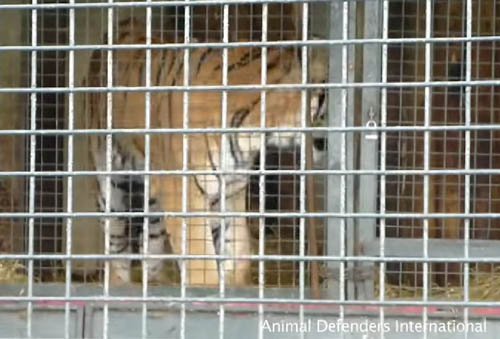
Police feared for safety of spectators at big cat show

POLICE stopped a show starring the UK’s last circus big cats because of concerns about audience safety.

Lion tamer Thomas Chipperfield was due to put on a show at a former airbase in Aberdeenshire on May 4 but the local council refused to provide an entertainment licence.

It has now emerged that it was Police Scotland who objected to the granting of the licence.

The three tigers and two lions involved have spent the winter on a croft in Fraserburgh

Officers’ concerns included “lack of detail” about safety arrangements for the audience.

Police also believed – it appears incorrectly – that Mr Chipperfield’s licence to keep dangerous animals was due to expire shortly before the show.

Posters for ‘An Evening with Lions and Tigers’ at Crimond Airfield, Fraserburgh, appeared around Aberdeenshire in March advertising tickets for sale at £6 for adults and £4 for children.

The three tigers and two lions involved have spent the winter on a croft in Fraserburgh.

The show drew huge objections from animal rights groups, and a children’s charity which was supposed to receive part of the proceeds, withdrew its backing for that performance.

Approved bill says big cats need to be micro-chipped

(WBIR - ROANE COUNTY) - A bill awaiting Gov. Bill Haslam's signature will require all big cats in the state, like lions and tigers, to be micro-chipped.

Senate Bill 1273 passed the state house Monday and if signed, will add regulations to a couple of East Tennessee groups.

The chips are responsible for identification. That way, keepers can know who is who.One East Tennessee group has been adapting to this plan, even before it hit the Capitol.

Tiger Haven, an animal sanctuary for big cats, works closely with University of Tennessee Veterinary Hospital, and when they take the big cats in for veterinary care, vets implant a microchip as a matter of routine.

"We have been putting these chips in for quite some time. We don't knock an animal down just to put the chip in. Probably 75 percent of our animals are probably already chipped," said Tiger Haven director Mary Lynn Haven.

She said the group works to make surrounding neighbors feel safe.

"We have really tried to help the community feel safer. I don't know if they do or not, but we have done everything we can," said Haven.

Wednesday, 15 January 2014

Ghost of the Guadalupe Mountains - via Chad Arment


Via Kevin Stewart:

Ghost of the Guadalupe Mountains: Jaguars have been spotted in national park for more than a century

By Valerie Cranston
Special to the Current-Argus
01/12/2014

Have the Guadalupe Mountains been home to the black panther in the late 1800s and 1900s? Some say yes and sightings have been recorded. Others discount the black cat's existence in the mountain range.

A chapter in W.C. Jameson's book "Legend and Lore of the Guadalupe Mountains" tells of several encounters and sightings of a black panther.

The first known sighting took place in the 1940s when a rancher in Dog Canyon watched a black panther creep from its hiding place in a nearby arroyo and leap into a herd of grazing sheep. After killing a lamb, the black cat clutched his kill in his mouth and disappeared up the
slope of Manzanita Ridge, explained Jameson.

"Since that time, sightings of a large black cat in the Guadalupes, though not frequent, have occurred," Jameson wrote. "Ranchers, forest service employees, hunters, hikers and campers have reported encountering a black mountain lion in and near the range for over six
decades."

Other documented sightings along with the shooting of black panthers date back to the late 1800s. In the book, "Pearl of the Pecos," complied by Lee Myers, there are numerous newspaper accounts mentioning the elusive black cat and bounty received for its killing.

On Sept. 6, 1890, in the Eddy Argus a reporter wrote an account of panthers and mountain lions. It read: "L.T. Ward of Dark Canon, who was in town this week, reports crops excellent and stock in fine shape. He says the ranchers would have nothing to complain of if the varmints would let him alone. Panthers and mountain lions are numerous and ravenous, and are continually committing bold depredations. Mr. Ward says there are many bears in Dark Canon and thousands of game."

On Nov. 18, 1892, an Eddy Argus reporter wrote, "Jeff Chisum, chief cow puncher of the Eddy Bissel Company, sent in last Tuesday a young mountain lion or panther. It weighed 30 pounds. Mr. Eddy will have it mounted. Chisum killed the animal with a stone. The panther, like a coyote, can always be run down on horseback, and when frightened will squat upon the ground and can be approached and stoned."

On Jan. 27, 1893, a reporter for the Eddy Argus reported: "John Dunaway killed a big panther in Dark Canon a few days ago and got a bounty of $5 thereon."

A forest ranger documented a story that took place in the late 1950s when he was followed for three days in the Guadalupe Mountains by what he referred to as a black mountain lion. In telling his story he made it clear that the black cat never threatened him. It just seemed to be curious.

Many locals remember or knew long time Pine Springs resident Bertha Glover and her husband Walter Glover. She related a story to Jameson about her encounter with a black panther one night in 1960.

"As she was carrying garbage to a location behind her cafe to be burned, she said she saw a lion seated on a rock about 20 yards away," Jameson wrote. "Glover said the cat was blacker than the pit of Hades but it made no move toward her during the few minutes she remained"

Jameson added the lion simply watched Glover dump the trash into an old oil drum and return for more. However, when she returned with more, the lion was gone.

Glover saw another panther in 1966. This time she was just sitting on the porch of their Pine Springs cafe. She watched the black cat chase a jack rabbit across the flat ground near the old Butterfield Overland Mail station ruins some 100 yards away, wrote Jameson.

The next reported sighting was in 1976 by a backpacker in the high country of the Guadalupe Mountains. The backpacker reported that while exploring the range, he was followed by a black mountain lion. When he stopped the lion stopped, always staying some 20 yards away.

"When he continued, the lion fell in step, always maintaining the same distance," Jameson wrote. "He said the black cat was lighter and thinner than a normal mountain lion and the skull was shaped differently."

The last night the backpacker was in the mountains, he watched the black cat from his tent doorway. The black panther remained in the same place, a small moonlit clearing. The backpacker eventually fell asleep only to be awakened by a noise at the door of his tent.

"He opened his eyes and saw the face of the panther pushing into the screen door flap as if to get a better view of what was within," Jameson wrote. "The camper grabbed his camera and took a photograph. The flash frightened the animal away. He saw no more of it after that.
The photograph, after it was developed, showed only a blur."

The last recorded sighting was in 1990, also in the Guadalupe Mountains. A couple of high country backpackers returned from a two day and two night stay in the range and described an encounter with a black panther. The cat, as in the other reports, sat quietly at a safe distance. It made no attempt to approach. the campers.

When one of the men walked toward the panther, it casually rose and walked several paces away, wrote Jameson.

"The panther goes by many other different names in the Western Hemisphere such as puma, painter, catamount, cougar, lion and mountain lion," Jameson wrote adding populations are decreasing as human settlement increases.

According to BlackPantherAnimal.com, Black panthers, like all members of the big cat family, have no greater enemy in nature than man himself. Farmers have killed them with poison and traps to protect livestock or people. Hunters have killed them for adventure and for their beautiful and precious furs.

Jameson writes that when early Guadalupe Mountains ranchers began bringing large herds of sheep and goats into the area, their problems with the mountains lions started. The lions learned quickly that the sheep and goats were easier prey than the deer and elk.

"Soon, according to the ranchers, the cats were reducing the herds at an alarming rate," wrote Jameson.

Jameson added that one Dog Canyon rancher claimed he witnessed a large mountain lion run into the middle of a sheep herd and indiscriminately slaughter 20 of them in just a matter of minutes. The rancher said it looked like the lion was just having fun.

"Consistent and enduring attacks on Guadalupe livestock invited the hunting and trapping of mountain lions, and soon the population of these big cats in the Trans-Pecos region of Texas dwindled sharply," Jameson wrote. "Though hundreds of mountain lions were killed between
the 1920s and the present, not a single one of them was black."

The mountain lion was placed on the federal government's endangered species list. However, today, ranchers still report lion predation and in spite of legislation continue to hunt them.

Jameson wrote that despite all of the sightings, the black panther has never been authentically recorded in North America, according to late lion hunter, researcher and writer Jim Bob Tinsley. Each year reports of black panther sightings are filed from Florida to Arizona. However, one has yet to be killed, captured, or photographed.

It is possible that one migrated from Mexico into the Guadalupes. Jaguars have been sighted along the Rio Grande in recent years some 100 miles to the south of the Guadalupe Mountains.

Jameson believes it is possible, as others have suggested, that one or more black panthers migrated from Mexico and took up residence in the Guadalupe Mountains.

"It is also possible they are producing offspring. It is rare for a mountain lion to live more than 20 years in the wild, and since black panthers have been reported in the range since the 1940s, the consensus is that several must have resided in the area over the years," Jameson wrote.

Do they still reside in the Guadalupe Mountains today? The answer to that question remains a mystery still today.

http://www.currentargus.com/carlsbad-news/ci_24896200/sunday-living

----

Adios
Chad

Thursday, 5 December 2013

Can Big Cats Co-Exist? Study Challenges Lion Threat to Cheetah Cubs

Dec. 2, 2013 — New research into cheetah cub survival has refuted the theory that lions are a cub's main predator and that big cats cannot coexist in conservation areas. The study, published in theJournal of Zoology, found that cubs in the Kgalagadi Transfrontier Park were seven times more likely to survive then on the Serengeti Plains and that lions were not found to be the cubs' main predatory threat.

Previously, research on the Serengeti Plains found that only 4.8% of 125 cheetah cubs (Acinonyx jubatus) monitored from the den to adolescence survived. The theory that cheetah cubs are at high risk from lions has impacted conservation strategies as it is believed protected areas may not be suitable for cheetahs if they cannot coexist with large predators.

Monday, 14 October 2013

The Surprising Product Used to Attract Jaguars

When Brian Fantana (Paul Rudd) wants to impress buxom newcomer Veronica Corningstone (Christina Appelgate) in the movie "Anchorman," he opts for "sex panther," a vile concoction that gets him sprayed with a fire hose. "They done studies, you know — 60 percent of the time, it works every time," Fantana says.

But while a (fake) big cat's scent fails to attract people, a (real) human scent attracts jaguars. When Miguel Ordeñana, a biologist with the Natural History Museum of Los Angeles, wants to lure jaguars to his camera traps, which he uses to study the big cats in Nicaragua, he uses a surprising product: Calvin Klien Obsession for Men, according to Scientific American.

Apparently the scent has civetone in it, a chemical which originally derives from the scent glands of civets, nocturnal cats native to the Asian and African tropics. One Bronx Zoo researcher tried many types of cologne, and this was the one that attracted jaguars, Scientific American reports. "What we think is that the civetone resembles some sort of territorial 

marking to the jaguar, and so it responds by rubbing its own scent on it," Ordeñana said.

Sunday, 6 October 2013

Reports Of Mountain Lion Roaming Streets of D.C.

With national parks closed during the government shutdown, it appears nature is coming to us.

Police in the District of Columbia say they have received reports that a mountain lion is prowling the streets of Southeast.

There have been two alleged sightings of a big cat so far, but reports remains unconfirmed, CBS DC reported.

Mayor Vincent C. Gray's Office of Neighborhood Engagement took to Twitter and Facebook Wednesday night to warn residents of the potential threat (in all caps, no less).

“DANGER — PUBLIC SAFETY ALERT MOUNTAIN LION SPOTTED 3600 BLOCK OF HIGHWOOD DR SE.," the posts read.

Linda Miley called police Wednesday night to report she had seen what appeared to be a mountain lion in her back yard, the Washington Post reported.

“It was really scary,” Miley said. “I got the shock of my life.”

Her neighbors, along with some experts, aren't buying it.

“I’m 99 percent sure it’s not real,” said Ken Miller, co-founder of the Cougar Network, a nonprofit group devoted to studying cougar habitat.

While police are on the lookout, officers haven't been able to corroborate the reports.

This isn't the first time D.C. has received reports of a mountain lion. Two years ago, a woman claimed to have seen a large cat stalking about. Police, park rangers and biologists looked into the report, but ultimately found no sign of a big cat.

Mountain lions are most common in the West. In 2011, a mountain lion was found perched in a tree on the University of Colorado campus in Boulder. It was successfully tranquilized and relocated, the CU Independent reported.

Thursday, 19 September 2013

Genomes of big cats revealed

International scientists have mapped the genomes of the tiger, lion and snow leopard, in conservation efforts to protect endangered species.

The research give clues to how big cats evolved to become top predators with superior muscle strength and a carnivorous diet.

The tiger shares 96% of its genes with the house cat, the study in Nature Communications reveals.
Taeguek

Until now, the only cat to have its DNA mapped was the domestic one.

A team led by Yun Sung Cho at the Personal Genomics Institute, Genome Research Foundation in Suwon, South Korea, sequenced the genome of a Siberian tiger.

The individual, Taegeuk, is a nine-year-old male from Everland Zoo in South Korea.

Friday, 30 August 2013

MOUNTAIN LION: Big Cat Reported Near School


A big cat caused a big scare at a metro elementary school Wednesday.

The playground at Clay Elementary School in Altoona was unusually quiet Wednesday during recess. Kids were kept inside the building amid fears over a mountain lion.

A witness told school officials she saw a mountain lion cross the street about a mile away from the school. Police checked out the area, but didn’t spot any sign of a big cat.

On Monday the manager of an apartment complex on East Hubbell Road reported seeing a mountain lion. The complex is about three miles west of the school. Experts say it wouldn’t be surprising for a mountain lion to travel that far.

“Absolutely because those big cats can move 30, 40, 50 miles a day pretty easily.” says Kevin Baskins with the Iowa Department of Natural Resources, ”Sometimes greater distances.”

This wouldn’t be the first time a big cat was spotted in the area. Des Moines police shot and killed a mountain lion near the east mixmaster last October.

Experts say mountain lions rarely attack people.

Thursday, 13 June 2013

Asian tigers at risk from domestic dog distemper virus

By Mark Kinver, Environment reporter, BBC News

Some of the world's rarest big cat species are facing a potentially deadly threat from a virus carried by domestic dogs, a wildlife expert has warned.

John Lewis, director of Wildlife Vets International, said there was evidence that Indonesian tigers were at risk.

Canine distemper virus has evolved in recent decades from infecting only dogs to affecting other animal groups.

Dr Lewis plans to work with Indonesian vets to develop a strategy to protect the nation's tigers from the virus.

A close relative of measles, Canine distemper virus (CDV) was first described at the beginning of the 20th Century and has been cited as contributing to the demise of the thylacine (commonly known as the Tasmanian tiger as a result of the black stripes on its back).

"If you wind the clock back about 30 or 40 years, it was a dog disease - it was a canine virus and only affected dogs," Dr Lewis explained.

"But in the intervening years, the virus has evolved and has changed its pattern of animals it can infect to include marine mammals (such as seals) and big cats."

Tuesday, 18 September 2012

A Trail of Tears: Big Cat Ownership


"Here we go again," I thought as I hung up the phone. Another private owner has eight tigers and can't afford to care for them anymore. "Where can we possibly put them this time?"
A week later a team of rescuers is on site, but not before countless hours of planning. Calls fly among sanctuaries to see who might have room. Someone else is lining up a vet team to tranquilize and perform an exam, acquiring permits and other paperwork to take the animals across state lines. Another team member is obtaining climate-controlled trailers to accommodate the long trek to the cats' new homes. And then there's funding. It takes a significant amount of money to build new enclosures, bring in teams, and pay for drugs, vaccinations, fuel, and other necessities for the move. These are just some of the logistics involved in finding these animals adequate lifetime care.

Thursday, 13 September 2012

A bird in the hand ... is a pretty good effort for a leopard


THESE are the amazing pictures of a hungry leopard caught carefully selecting its dinner from a flock of unsuspecting birds - before snatching it from the air and tucking in.

The big cat was caught on camera slyly patrolling through grassland ready to pounce on the Sandgrouse birds making their early morning appearance at a well-stocked watering hole.

Photographer Matt Prophet, 37, snapped the rare encounter at Kgalagadi Transfrontier Park, an exclusive animal hideaway which crosses the borders between Botswana and South Africa.

The young leopard can be seen leaping through the air under the African sun to catch one of the Namaqua or Burchell breeds of the Sandgrouse birds.

Balancing on its two back legs, the incredible predator opens wide and snatches an unsuspecting bird from out of the sky before wasting no time in devouring the creature.

These solo hunting skills are a trait picked up from the cat’s mother who is also a specialist Sandgrouse hunter.

Read more and see pictures:
http://www.thesun.co.uk/sol/homepage/news/4532861/A-bird-in-the-hand-is-a-pretty-good-effort-for-a-leopard.html#ixzz26DYcJY8L

Sunday, 2 September 2012

Wash. 'cougar' sightings turn out to be house cat

LYNDEN, Wash. —

Police in Lynden, Wash., say the multiple reports they received of a "cougar" sighting near the fairgrounds turned out to be a very muscular orange-colored domestic cat.

Police Chief Jack Foster tells the Bellingham Herald (http://is.gd/DXbhYv)that one woman said she saw the cat twice. Police first learned of the sightings on Tuesday.

On Wednesday afternoon, a new sighting was reported. This time Foster says an officer was able to get within a few feet of the creature and report that it WAS a big cat - a big domestic cat.

The chief acknowledges that from a distance the animal did resemble a cougar.

He says the original witness confirmed it was the same cat she had seen earlier.

Foster says cougars have been seen in the community near the Canadian border - twice in the past two decades.


Tuesday, 28 August 2012

Police Call Off Search For Essex Lion


Police have called off a search for a lion reportedly on the loose in Essex.

Officers have spent almost 24 hours combing the countryside around Clacton-on-Sea after a group of residents yesterday claimed to have seen the king of the jungle near Earls Hall Drive in St Osyth.

But after search teams found no evidence of the big cat, the force this afternoon decided to stop looking.

Witnesses reported seeing a lioness in fields stalking up and down a hedgerow before it was disturbed by a farmer and ran off.

Armed officers and Colchester Zoo workers armed with tranquiliser guns searched for pawprints after sightings of the animal were reported at 7pm on Sunday.

Police urged residents in the village to remain inside their homes as the search for the big cat continued.

But on Monday an Essex Police spokesman said: "We believe what was seen on Sunday evening was either a large domestic cat or a wildcat.

"Extensive searches have been carried out, areas examined and witnesses spoken to; yet nothing has been found to suggest that a lion was in the area.

"We would like to thank the local community and holidaymakers for their patience and support throughout the past 24 hours as the police and media presence would have been somewhat overwhelming for them."

David and Susan Wright said they photographed the lioness from their back garden after spotting it in the field.

Mrs Wright told Sky News: "It definitely looked like a lion, the head, the body. When it stood up you could see the tail as well and it was massive.


Continued:
  http://uk.news.yahoo.com/police-investigate-lion-loose-212334109.html

Tuesday, 17 July 2012

UPDATE: Ashland Police Give Warnings After Bobcat Sightings


ASHLAND, Ky. (WSAZ) -- Ashland Police are asking residents to be cautious after several big cat sightings in the area, one of which they confirmed.
They say a bobcat made its way through the Midland Heights neighborhood Saturday morning, and they're doing their best to track down the animal.
"It's going to be a daunting task," Major Mark McDowell of Ashland Police said. "It's much easier said than done when trying to capture an animal like that, but we are going to make an effort."
Residents are asked to keep an eye on kids and pets playing outside, and to call police right away if they see anything.
"We're so densely populated, and we don't want a tragedy to unfold as a result of somebody trying to kill an animal like that within the city limits," McDowell said.
Police say they're working with wildlife experts and are investigating the possibility of more than one big cat in the area.
UPDATE 7/14/12 @ 10:00 p.m.
ASHLAND, Ky. (WSAZ) -- Several residents in the Middland Heights neighborhood say they have spotted a big cat.
Mark Conley says he heard his dog barking Saturday, and went to check it out. That's when he says he was face to face with the wild animal. Conley says the cat had just killed a deer.
"Is one going to pounce down on me, you know?" Conley said. "I guess I'm confined to my home after 9 o'clock when it gets dark."
The incident has alarmed many in the community, even prompting some to put up fliers to warn other neighbors.
"I will not go out in the backyard, even though it's fenced at night," Ashland resident Nan O'Hara said. "I'm not going to walk my dog at night. I'm not going to take walks at night until this is settled somehow."
Ashland Police are now classifying this as a confirmed sighting. They're alerting residents in the area to exercise caution with children and pets that may play in the area.


UPDATE 7/6/12 @ 11:30 p.m.
ASHLAND, Ky. (WSAZ) -- There has been another report of a big cat sighting in Ashland, according to the Ashland Police Department.
About 8:30 a.m. Friday, officers responded to Cheer Street regarding an unconfirmed big cat sighting.
A resident observed what appeared to be a large cat with a long tail in the area.
Police responded, but nothing was located.
This is the third unconfirmed sighting of a large cat (believed to be a cougar/mountain lion) seen in Ashland since June 28. Previous sightings were in the vicinity of Eloise Street and Forest Avenue.
The public is encouraged to call 911 and not attempt to pursue the animal.


UPDATE 6/29/12 @ 5:10 p.m.
ASHLAND, Ky. (WSAZ) -- A police alert has Ashland neighbors keeping a close eye and short leash on their dogs and cats.
The cause for concern is reported sightings of mountain lions and/or cougars.
A resident who lives along Forest Court in Ashland and did not want to be on camera pointed out where earlier this week he saw a cougar.
He says the big cat was just lying down where the backyard meets a wooded area.
Across town, someone living along Eloise Street say they spotted a mountain lion or cougar.
Mary McKinney, who lives along Eloise Street, was skeptical.
"Someone probably saw a big dog," McKinney said. "I don't think we have a big cat roaming around.”
Big cat sightings in two neighborhoods by different people prompted Ashland Police to put out a citywide mountain lion alert.
“We've seen fox and even wolves in the city,"
Ashland Police Major Todd Kelley said. "We're surrounded in Ashland by hunting area, so wild animals in the city are not unheard of.”
Kelley and WSAZ wildlife expert Tom Clay agree -- if mountain lions or cougars are on an Ashland neighborhood prowl, pets and small children would be prime targets for a fearsome feline predator.
“Big cats can come in from out of the mountains, across creeks and rivers looking for a new area to feed," Clay said. "People leave dog food out, and mountain lions will come in to look for something to eat.”
Kelley advises, “Don't approach them. Don't try and make them your friend. Call 911 and we will come out with animal control.”
Recent history shows reports of mountain lion or cougar sightings is West Virginia and southern Ohio, as well as the Kentucky Wildcats.
If you see a big cat, remember don't approach it, call 911.


ORIGINAL STORY
ASHLAND, Ky (WSAZ) -- The Ashland Police Department is advising the community to be on high alert Thursday.
In the past 48 hours, police have been notified of two alleged sightings of a mountain lion or cougar type species.
The sightings have been in the areas of Eloise Street on the west side of Ashland and on the Forest Avenue area of South Ashland.
No confirmations have been made by police or animal control officers at this time.
Police are urging caution. They said do not approach the animal and call 911 immediately.

Related Posts with Thumbnails

ShareThis