Showing posts with label dingo. Show all posts

Wednesday, 12 February 2020

They were once domestic pets, then natural selection made dingoes wild

FEBRUARY 11, 2020


Believed to have been pets at one stage in their evolution, the origins of the Australian dingo are shrouded in mystery, compelling generations of biologists to snoop for clues about their early history. New evidence has recently been revealed by a genomic study that offers tantalizing details about their adaptation from domesticated to wild animals.

The study's lead author Peter Savolainen, professor at the Department of Gene Technology at KTH Royal Institute of Technology, says that thousands of years ago these outback predators were pet dogs in Asia. According to the genetic analyses, dingoes began their journey of feralization—and their migration to Australia—8,300 years ago when they split off from their ancestors, which today are known as Indonesian village dogs.

"Our analyses of phylogeny, population structure, and demography as well as selection analysis, show that the dingo is a genetically distinct population clearly differentiated from the domestic dog," Savolainen says. "Genes related to behaviour, food digestion and reproduction have evolved in order to adapt dingoes to living in the wild instead of together with humans."

Thursday, 7 November 2019

Lost pup turns out to be a rare purebred dingo

NOVEMBER 6, 2019


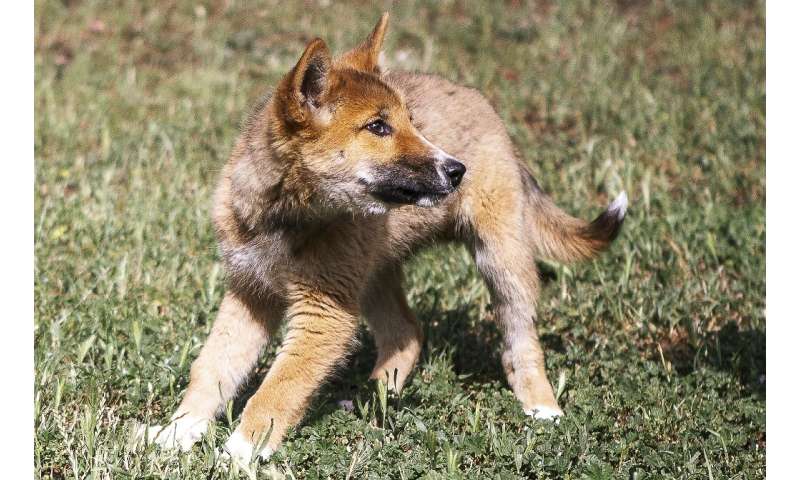
Dingo pup Wandi romps at the Australian Dingo Foundation headquarters near Melbourne

He's furry, playful, and has puppy eyes. It's little wonder Wandi was mistaken for a dog when he was found in an Australian backyard—but DNA testing has confirmed he's a rare 100 percent dingo.

The pup was discovered whimpering and alone in a country town in Victoria in August with talon marks on his back, leading to speculation it could have been dropped by a large bird of prey.

Rescuers at first thought Wandi was either a dog or a fox, but months later DNA samples have revealed that he is in fact a purebred dingo.

Most of the creatures seen in the wild are usually, to some degree, dingo-dog hybrids.

Australian Dingo Foundation director Lyn Watson said that when Wandi "fell out of the sky" it was an "answer to a prayer"—he can now join 40 other dingoes in a breeding program at the charity's sanctuary.

"When we sent his DNA off we were hoping that he would be of high content, but we were pleasantly surprised to find he was as much dingo as you could get," she told AFP.

Watson hopes Wandi—whose unusual origins story and endearing looks have attracted global attention—will help recast the narrative surrounding dingoes and change government policies toward the much-maligned animal.

Sunday, 10 March 2019

Australian dingo is a unique Australian species in its own right


Date:  March 5, 2019
Source:  Flinders University
Since the arrival of British settlers over 230 years ago, most Australians have assumed dingoes are a breed of wild dog. But 20 leading researchers have confirmed in a new study that the dingo is actually a unique, Australian species in its own right.
Following previous analyses of dingo skull and skin specimens to come to the same conclusion, these latest findings provide further evidence of specific characteristics that differentiate dingoes from domestic dogs, feral dogs, and other wild canids such as wolves.
The finding that a dingo is a dingo, and not a dog, offers an opposing view compared to a another recent study that the Government of Western Australia used to justify its attempt to declare the dingo as 'non-fauna', which would have given more freedom to landowners to kill them anywhere without a license.
Co-author Professor Corey Bradshaw of Flinders University in South Australia says the classification of dingoes has serious consequences for the fragile ecosystems they inhabit, and state governments are required to develop and implement management strategies for species considered native fauna.
"In fact, dingoes play a vital ecological role in Australia by outcompeting and displacing noxious introduced predators like feral cats and foxes. When dingoes are left alone, there are fewer feral predators eating native marsupials, birds and lizards."
"Dingoes can also increase profits for cattle graziers, because they target and eat kangaroos that otherwise compete with cattle for grass in semi-arid pasture lands,," says Professor Bradshaw.
Lead author, Dr Bradley Smith from Central Queensland University, says the scientific status of the dingo has remained contentious, resulting in inconsistency in government policy.
"The dingo has been geographically isolated from all other canids, and genetic mixing driven mainly by human interventions has only been occurring recently," Dr Smith says.

Thursday, 3 April 2014

Australia’s Dingo Is One-of-a-Kind

April Flowers for redOrbit.com – Your Universe Online

When I think of a dingo, I think of a sad scene in the Tom Selleck movie, “Quigley Down Under” where the dingoes are attacking and Cora has to decide if she will repeat her mistakes, or let the aboriginal child cry. Like many of you, I’m sure, I considered them to be just another version of a coyote, no different from any other.

A new study from the University of New South Wales (UNSW) and the University of Sydney, however, reveals that the dingo is a distinctly Australian animal. The findings, published in the Journal of Zoology, shed new light on the dingo’s defining physical characteristics. The research team also resurrects the name Canis dingo, which was first given to the species by German naturalist Friedrich Meyer in 1793.

The research team, led by USNW’s Dr. Mike Letnic and Dr. Mathew Crowther of the University of Sydney, explain that the confusion over whether the dingo is a distinct species began, in part, with the scientific classification of the Australian dingo, which was based on a simple drawing and description in the journal of Australia’s first governor, Arthur Phillip. This classification had no reference to a physical specimen.

Finding a specimen of a dingo that was unlikely to have bred with domestic dogs was a challenge. The team searched museum collections across Europe and the US, looking for specimens that were known, or were likely, to pre-date 1900, including those from archaeological sites.


Saturday, 15 March 2014

The death of dingoes proves to have negative effects on Australian biodiversity

March 2014: The poisoning of dingoes, which are the top predators in the Australian bush, has a deleterious effect on small native mammals such as marsupial mice, bandicoots and native rodents. These were the recent findings of a research group from the Universities of Sydney and Western Sydney.

Dingoes are poisoned by farmers concerned about their predation on domestic livestock. The research, which set out to discover the long-term effects of this routine dingo control, was conducted in forested National Parks in New South Wales. Its conclusions were that loss of dingoes is associated with greater activity by foxes, which prey on small marsupials and native rodents. The numbers of kangaroos and wallabies were also found to increase when dingoes disappeared, and grazing by these herbivores reduces the density of the understorey vegetation in which the small ground-dwelling mammals live.


Thursday, 14 June 2012

Aussie coroner: Mom's suspicious tale was true -- dingo took baby from Outback


CANBERRA, Australia— Australians have overwhelmingly welcomed the final chapter of a mystery that has captivated the nation for 32 years: Did a dingo really take a baby that vanished from an Outback campsite in 1980?

A nation that was once bitterly divided on whether baby Azaria Chamberlain had been dragged away by a wild dog or murdered by her mother now largely agrees that the parents deserve the vindication a coroner's court provided Tuesday.

A day after Azaria Chamberlain would have turned 32, a coroner found that a dingo had taken her as a 9-week-old baby from a tent near Ayers Rock, the red monolith in the Australian desert now known by its Aboriginal name Uluru. That is what her parents had maintained from the beginning.

The eyes of Lindy Chamberlain-Creighton and her ex-husband, Michael Chamberlain, welled with tears as the findings of the fourth inquest into their daughter's disappearance were broadcast from a courtroom in the northern city of Darwin to televisions around Australia.

The first inquest in 1981 had also blamed a dingo. But a second inquest a year later charged Chamberlain-Creighton with murder and her husband with being an accessory after the fact. She was convicted and served more than three years in prison before that decision was overturned.

A third inquest in 1995 left the cause of death open.

The case became famous internationally through the 1988 Meryl Streep movie "A Cry in the Dark."

Many Australians initially did not believe that a dingo was strong enough to take away the baby. Public opinion swayed harshly against the couple; some even spat on Chamberlain-Creighton and howled like dingoes outside her house.

Saturday, 5 May 2012

Dingoes may have wiped out Tasmanian tiger on mainland


Dingoes were twice the size of female thylacines and could have caused their extinction on mainland Australia through direct attacks, a new Sydney study suggests.
A comparison of museum specimens has found that thylacines on mainland Australia were smaller than those that persisted into modern times in Tasmania, and significantly smaller than dingoes, which arrived with human seafarers between 3500 and 5000 years ago but did not spread to Tasmania. The last known Tasmanian thylacine died in 1936.
Measurements of the head size and thickness of limb bones of the semi-fossilised remains of thylacines and dingoes from caves in Western Australia have revealed that, on average, dingoes were larger than thylacines.
“In particular, dingoes were almost twice as large as female thylacines, which were not much bigger than a fox,” said ecologist Dr Mike Letnic, an ARC Future Fellow in the UNSW School of Biological, Earth and Environmental Sciences, who led the study with colleagues at the University of Sydney. The findings are published in the journal PLoS One.

Friday, 2 March 2012

Dingoes: How dangerous are they?


A new inquest is being launched into the death of a baby who disappeared in 1980 from an Australian camping site. Her parents insist she was killed by a dingo, but polls show some Australians are unconvinced. So how dangerous are the animals?
It is the fourth inquest into the world-famous case of nine-week-old Azaria Chamberlain, which has haunted Australia for 31 years, and her parents hope it will be the last.
Lindy Chamberlain was convicted of murdering her daughter in 1982. Michael, her now former husband, was convicted of being an accessory. Both were later cleared after new evidence emerged supporting their story.
The case divided the nation and for a long time made Chamberlain - who now goes by the name of Chamberlain-Creighton - the most hated woman in Australia.
A body has never been found and the official coroner's record still states the cause of death remains "unknown". Officials have reopened the case after receiving fresh information from Azaria's parents. They hope to finally, and definitively, determine how she died.

Tuesday, 20 December 2011

Dingo baby case that divided a nation could be closed at last

Fourth inquest launched into Lindy Chamberlain's missing daughter which will take in fresh evidence about dog attacks


An Australian coroner is to launch a new inquest into the death of baby Azaria Chamberlain in a move that could finally end a 31-year dispute over whether she was killed by a dingo.

Elizabeth Morris, the coroner for the Northern Territory, has said she will open a fourth inquiry into the world-famous case, which centred on the disappearance and presumed death of nine-week-old Azaria in 1980 as her family camped in the shadow of Uluru, formerly known as Ayers Rock.

The case divided Australia and was turned into a film, A Cry in the Dark, which earned an Oscar nomination for Meryl Streep in the role of the accused mother.

In October 1982 Lindy Chamberlain, who now goes by the name of Chamberlain-Creighton, was found guilty of murdering her daughter after a jury dismissed her claim that a dingo took the baby.

She was later freed and her conviction quashed after new evidence emerged supporting her story. However, the official coroner's record still states that the cause of death remains "unknown".

A legal team representing Chamberlain-Creighton and her former husband, Michael Chamberlain, have now cited 10 serious dingo attacks on people since 1980, two of them fatal, as new evidence which will be heard at the inquiry starting on 24 February.

Michael Chamberlain said he was surprised and grateful the coroner had announced a fresh investigation. "At long last there's a meaningful attempt … to determine the proper cause and truth about how my daughter died," he said.

"I don't think people open inquests without thinking there's good reason for it and that means there'd have to be a change from the status quo of the open finding in 1995. It's now looking at dingoes, not people, as to the cause of death."

Azaria's body has never been found but her bloodstained clothes were and formed the main basis of an investigation that split the country into those who believed Azaria had been killed by her mother, possibly in a warped religious ritual, and those who believed she was killed by a wild dog or dogs in a tragic accident.

Chamberlain-Creighton gave evidence that she had seen a dingo near the family's tent. Initial media coverage of the incident focused on whether dingoes were physically able to carry a baby off or even inclined to do so and quickly shifted onto the parents as suspects.

"Close shots of the Chamberlains in interviews came nearer and nearer," John Bryson, a barrister who has closely followed the incident has said.

"Then 'Seventh Day Adventists believe in child sacrifice' and 'Baby Azaria was always dressed in black to represent a devil's child'. And 'the Chamberlains' bible had a child-sacrifice passage underlined in red'. And 'the name Azaria means sacrifice in the wilderness'. And on and on."

At her trial in 1982 Lindy Chamberlain said in her defence that dingo saliva was not found on Azaria's jumpsuit because the baby was wearing a jacket on top. No jacket was found in the initial searches but in 1986, while Mrs Chamberlain was serving a life sentence, an Englishman, David Brett, fell to his death from Uluru, landing beside the jacket which was half-buried close to dingo lairs.

Within days Chamberlain was released and a Royal Commission later exonerated her and her husband who had also been convicted as an accessory to the murder. The three previous inquests resulted in mixed verdicts, the first stating that a dingo had taken the baby.

Then further investigations, involving a British pathologist, suggested the wounds could not have been caused by a dingo and indicated a cut throat. That inquiry concluded that Chamberlain-Creighton should be sent for trial for murdering Azaria. The third returned an open verdict.

John Lawrence, a lawyer involved in the Royal Commission, said the new inquest would be a final legal chapter that would conclude a dingo was responsible.

"I think that the void will be filled by the new evidence on the dingo," he told Australian Broadcasting Corporation radio.

Last year, on the 30th anniversary of Azaria's disappearance, Chamberlain-Creighton pleaded in an open letter on her website for her daughter's death certificate to state that a dingo was to blame.

"She deserves justice," she wrote. "Come on Australia. Surely you cannot be proud of the fact that you can let yourself be duped again and again and come back for more of the same. We used to be a proud nation who saw through corruption and were willing to give a fair go. How many times do you have to be hoodwinked and led along by the nose before you demand something better from our courts, police force, politicians and media?"

Bryson said: "I think it is time really for it to be at an end. The people involved have been through enough. It has not been yet put to bed and so we hope that this coroner will."

http://www.guardian.co.uk/world/2011/dec/20/dingo-baby-lindy-chamberlain-inquest

Wednesday, 4 May 2011

Dingoes Didn't Run Tasmanian Tigers Out of Australia

Though highly similar in their skull anatomy, specialized for a carnivorous diet, the thylacine, front, and the dingo very likely had different hunting styles. Researchers analyzing skeletons of the forelimbs found important differences
CREDIT: Carl Buell
by Jennifer Welsh, LiveScience Staff Writer
Date: 03 May 2011 Time: 07:01 PM ET

The extinct thylacine, more commonly known as the "Tasmanian tiger" or "marsupial wolf," hunted more like a cat than a dog, meaning the tiger moniker may be the more appropriate nickname.

The thylacine had the striped coat of a tiger, the body of a dog and like other marsupials (including kangaroos and opossums) carried its young in a pouch. These carnivores were last seen in Australia 3,000 years ago, having died out after the introduction of dingoes by humans. The last remaining populations were sheltered by their isolation on the island of Tasmania, surviving until the 1900s, when a concentrated eradication effort wiped the thylacine out.

Researchers hypothesized that the dingoes were a main cause of the thylacine decline in Australia, because the two species were in direct competition -- using the same hunting strategies to hunt the same prey. [Top 10 Creatures of Cryptozoology]

"Dingoes are a species of wolves, they are runners," study researcher Borja Figuerido of Brown University said. "If the thylacines are ambushers, the hypothesis of the extinction of the thylacine outcompeted by dingoes is less probable."

Elbow joints connected to...

By looking at the elbow joint bones of the thylacine and 31 other mammals, the researchers noticed they resembled those of cats, which can rotate their paws upward to pounce and attack prey. Dogs and wolves don't have this rotation capability.

"These anatomical characters reveal something about the hunting strategies of the thylacine. They are more ambushers than previously suspected," Figueirido said. "Ambush predators usually manipulate the prey with the forearms, they have very good mobility. Running predators lack this ability, because the elbow is locked."

The limited rotation of their arm bones makes dogs and wolves (including dingoes) faster runners, which changed their hunting behaviors. Dogs and wolves hunt in packs, following their prey over longer distances. The researchers determined that the thylacine was more of a solitary, ambush-style predator, similar to cats.

Mammalian cousins

Marsupial mammals, found mainly in Australia and other areas of the Southern Hemisphere, are similar to placental mammals (such as humans, dogs and cats), but their evolution diverged from ours during the Cretaceous Period, the earliest example of a marsupial appearing about 125 million years ago.

The evolution of these two groups of mammals is an example of convergent evolution, where two separate groups in different locations evolve similar morphologies to deal with similar habitats. The thylacine was thought to be the marsupial equivalent, or ecomorph, of the wolf, with similar body size and eating habits.
Now, Figueirido said, "this designation will need to be revised."

The study was published today (May 3) in the journal Proceedings of the Royal Society B: Biology Letters.


http://www.livescience.com/14006-thylacine-hunting-behavior.html

Tuesday, 12 October 2010

Dingo baby case re-opens in Australia with new inquest

11 October 2010

Australia is launching a new inquiry into the 1980 death of baby Azaria Chamberlain, whose parents always said she was killed by a dingo.

Lindy and Michael Chamberlain were convicted over the 10-week old baby's death in 1982 but later cleared after evidence indicated a dingo attack.

A third inquest, held in 1995, recorded an open verdict, but the parents say that has left room for doubt.

Mr Chamberlain said he had been told an inquest could take place in early 2011.

Both he and his now former wife, Mrs Chamberlain-Creighton, had been asked to submit new evidence to the Northern Territories registrar of births, deaths and marriages, he said.

Mr Chamberlain told ABC News there would always be people who "out of prejudice and lack of knowledge or lack of facts" would blame him and his former wife.

He said the open verdict in 1995 had "sullied the waters" and "made us look like we might have been potentially guilty again".

"It's justice for Azaria. Her spirit does not rest because the truth was never told about how she actually died," he said.

Mr Chamberlain said his lawyers were now gathering evidence about other dingo attacks, including the killing of a nine-year-old child by two dingoes in 2001.

"They confuse human prey with animal prey and look upon them as fair game no matter what they are, a kangaroo, a calf, a lamb, a wallaby or a baby," he said.

Any inquest should also investigate the original police investigation, said Mr Chamberlain, following long-standing accusations from both parents that the forensics teams lost or mishandled evidence.

Chance discovery

Virtually ever since Azaria disappeared from a campsite near Uluru (Ayers Rock) in 1980, Australia has been engrossed by the question of whether she was taken by a dingo, says the BBC's Nick Bryant in Sydney.

Two years after her death, Mrs Chamberlain-Creighton was found guilty of her baby's murder and sentenced to life imprisonment, while Mr Chamberlain was found guilty of being an accessory.

Both were later exonerated on all charges, after the chance discovery of a fragment of Azaria's clothing in an area dotted with dingo lairs.

In August this year, Mrs Chamberlain-Creighton issued an emotional open letter calling for the dingo attack to be officially acknowledged.

Three coronial inquests, two appeals and a Royal Commission have so far failed to conclusively find the cause of Azaria's death.

But while her parents have been exonerated by law, they remain the victims of innuendo and gossip, says our correspondent, and as long as the cause of death officially remains unknown, the rumours will continue.

http://www.bbc.co.uk/news/world-asia-pacific-11511581
(Via CFZ Australia)
Related Posts with Thumbnails

ShareThis