Showing posts with label hobbit. Show all posts

Saturday, 22 December 2012

Facial Approximation Used To Reconstruct The Face Of The Hobbit, Homo Floresiensis


One of the major features of the Australian Archaeological Association’s (AAA) Conference at the University of Wollongong this week was the unveiling of the face of Homo floresiensis – popularly known as the “Hobbit.”

Hosted by UOW’s Centre for Archaeological Science, which was created in 2010 to develop, integrate and apply modern scientific methods to the questions of human evolution, the conference consists of over 400 participants and 250 presentations.

Dr. Susan Hayes, Honorary Senior Research Fellow at UOW and specialist facial anthropologist, conducted interactive 3D and 2D workshops in evidence-based facial approximation – involving the creation of the likely facial appearance of a deceased person based on the skull and soft tissues – as a precursor to the conference. Dr. Hayes has been instrumental in the facial approximation of the “Hobbit.”

“In the media it’s often called ‘facial reconstruction‘, but because I’m evidence-based and work in archaeological science, we prefer the term ‘facial approximation’,” Dr Hayes said.

Dr. Hayes has a background in forensic science. Last year, she worked on the remains of a young woman found in Belangelo State Forest at the request of the Sydney Homicide team.
The facial approximation of H. floresiensis involved Dr. Hayes applying her methods to a very different female individual, unearthed in 2003 by Professor Mike Morwood and the Liang Bua archaeological team in Flores, Indonesia.

The facial approximation of an archaic hominin was an extraordinary challenge, according to Dr. Hayes.

“She’s taken me a bit longer than I’d anticipated, has caused more than a few headaches along the way, but I’m pleased with both the methodological development and the final results. She’s not what you’d call pretty, but she is definitely distinctive,” Dr Hayes said. “She doesn’t have those hyper-feminine features such as big eyes; there isn’t much of a forehead.” Dr. Hayes asserts, though, that the image of the tiny hobbit species is about scientific accuracy, not aesthetics.

Tuesday, 11 January 2011

Researchers to drill for ancient DNA in 'hobbit' tooth

Prospects of recovering ancient DNA from boosted by study on teeth.

January 5, 2011

Nature News

By Cheryl Jones


Scientists are planning an attempt to extract DNA from the "hobbit" Homo floresiensis, the 1-meter-tall extinct distant relative of modern humans that was unearthed in Indonesia, following a study that suggests problems in standard sampling methods in ancient-DNA research could have thwarted previous efforts.

This year, geneticists at the Australian Centre for Ancient DNA (ACAD) at the University of Adelaide hope to recover DNA from a roughly 18,000-year-old H. floresiensis tooth, which was excavated in 2009 from the Liang Bua site on the Indonesian island of Flores.

The premolar has been kept cold, and has been handled as little as possible to prevent contamination with modern DNA. But little, if any, of the ancient DNA is likely to have survived the heat and moisture of the tropics, and any that has may be highly fragmented.

Tony Djubiantono, director of the Indonesian National Centre for Archaeology in Jakarta, where the tooth is held, says that developments in DNA extraction techniques could overcome previous sampling problems, and have exciting potential for understanding the evolutionary history of H. floresiensis.

If the DNA can be extracted, comparing its sequence to that of other species could settle disputes over classification. For instance, Peter Brown, a paleoanthropologist at the University of New England in Armidale, Australia, who described and named the species in 2004, is rethinking his initial classification. At first he put the species in the human genus Homo, but he now suspects that the hobbit's ancestors left Africa before Homo evolved so the species could belong to a different or new genus.

Teething troubles

Five years ago, two teams, one from ACAD and one from the Max Planck Institute of Evolutionary Anthropology in Leipzig, Germany, attempted to recover DNA from another H. floresiensis tooth excavated in 2003. Both attempts failed.

Now, a team led by Christina Adler, a geneticist at ACAD, has found that standard sampling procedures could be responsible for the failure to get DNA from the hobbit and some other ancient specimens.

Adler's team--which included some researchers involved in the original H. floresiensis DNA recovery attempt--compared the impacts of various sampling techniques on DNA from the mitochondria of 40 human specimens from around the world, which had been dated up to 7,500 years old. The results have been accepted for publication in the Journal of Archaeological Science.

Most genetics research on ancient teeth has focused on the inner tooth tissue, dentine, but Adler's team found that cementum, the coating of the root, was a richer source of DNA.

Drilling is a technique commonly used to sample teeth and bone, because it minimizes damage to the precious specimen. But Adler's team found that the heat generated at standard drill speeds of more than 1,000 revolutions per minute (RPM) destroys DNA rapidly, causing yields to be up to 30 times lower than for samples pulverized in a mill. Reducing the drill speed to 100 RPM alleviated the problem.

The Max Planck team sampled dentine from the hobbit tooth in its early attempt to recover DNA, but it is unclear what drill speed was used. And although the ACAD scientists used the lower drill speed, they also concentrated on dentine. They will target cementum in their next attempt.

Small chance

Adler says that several ancient specimens that previously failed to yield DNA might now warrant re-sampling. She is surprised that ancient-DNA researchers commonly choose to drill at high speeds for samples, because dentists have long known that this harms their patients' teeth. "This is a case of a lack of communication between two specialist fields that are both working on similar things independently," she says.

Matthew Collins, a specialist in ancient-protein analysis who is based at the University of York, UK, says that Adler's team's results will "help to ensure that we minimize the destruction of molecules during sampling of precious fossils, and potentially enable us to reach even further back in time to recover sequence information."

However, he is pessimistic about the chances of winkling DNA out of H. floresiensis, saying that the molecules are probably too fragmented owing to high temperatures at the excavation site.

But the ACAD scientists think that it is worth making an attempt on their H. floresiensis tooth. They have been encouraged by their successful extraction of DNA from a 6,000-year-old pig tooth from the site in 2007.

http://www.scientificamerican.com/article.cfm?id=researchers-to-drill-for-hobbit

Wednesday, 6 October 2010

Indiana Jones and the Sasquatch of Doom

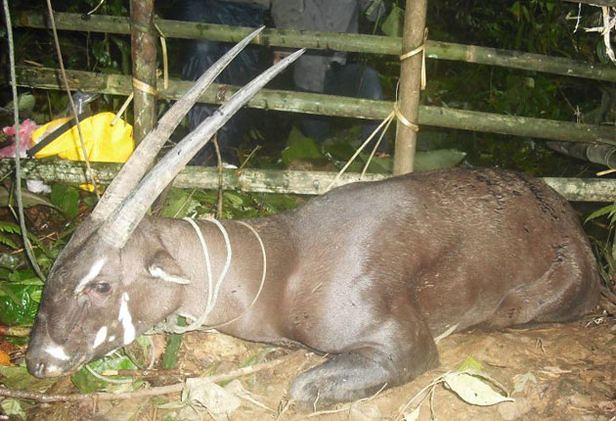
A female saola or Vu Quang ox (Pseudoryx nghetinhensis). One of the world's rarest mammals, it is a forest-dwelling bovine found only in Vietnam (Vu Quang Nature Reserve) and in Laos, near the Vietnam-Laos border
Image: Bolikhamxay Provincial Conservation Unit. [bovidize]
The recent discovery of the saola - a large mammal - shows that we don't know everything ... that big mysteries still await

They get you, don't they? Those big, unanswered questions of existence. What is dark matter? How did the universe get started? Why is Miley Cyrus? Who put the Benzedrine in Mrs Murphy's Ovaltine?

Science presented as a list of pre-digested facts that we must obediently learn is rightly condemned as dull - but that's not what science is about. No, science is a long list of unanswered questions, a voyage into the unknown, a quest to reach for things slightly beyond our grasp. Be honest, now: who'd really rather go on an adventure with Indiana Jones than be lectured at by Richard Dawkins?

Even today, when science is so often a world of pristine laboratories and humming machinery, the old-fashioned, down-and-dirty spirit of adventure pokes through.

Just when you'd imagine that everyone has an iPod, and that we'd shaken every tree and looked behind every bush on the planet, some creature walks into view that is entirely new to science.

Not tiny creatures, either, such as sea urchins living obscurely on the ocean floor, miles below the surface; or near-microscopic wasps that lay their eggs in the pupae of jungle-living butterflies; or bacteria only found in sulphurous slag heaps. Sure, such things are being found all the time, and each and every one is a wonder. Oh noes, I'm talking about big creatures that everyone would recognise as such, living on land accessible to people with no special equipment except their own eyes.

As recently as 1993, a scientific paper landed on my desk at Nature describing a species of antelope hitherto unknown to science. And not some cute little creature that could slip between your knees and hide coyly behind a leaf, but a beast big enough to bump into, and do you serious injury if it stepped on your foot. How could people in this overcrowded world have missed it?

The location was a start. The saola, for such is its name (its more formal handle is Pseudoryx nghetinhensis), comes from the remote and deeply inaccessible Annamite Mountains on the border between Laos and Vietnam, a kind of Lost World known for hosting other rare species. Even if you can hack your way in, the saola is pathologically shy, and goes out of its way to go out of its way.

The scientific description was not based on a live animal, or even a dead one, but hunting trophies - horns, skulls and skins of several animals collected from the houses of local hunters. The live animal had not been seen. To my perhaps jaded editorial eye, the report seemed to have come straight out of King Solomon's Mines. How romantic!

The saola is, in fact, so shy and secretive that it wasn't until 1998 that it was photographed alive in the wild - and then only fleetingly. In 1999 it disappeared from view altogether. It was only in September 2010 that a live saola was captured. It obligingly stayed alive long enough to pose for its portrait whereupon it expired, presumably unaccustomed it its unwanted celebrity. The number of saola in existence is unknown, but it is likely to be small, and getting smaller all the time.

The saola joins a select band of large mammals discovered relatively recently, all of which are (not surprisingly) rare to the point of vanishment. A wild pig, the Chacoan peccary, Catagonus wagneri, was known only from fossils until it turned up on the wild borders of Bolivia, Paraguay and Argentina in 1975, and is believed to be hanging on by its trotters.

A wild ox called the kouprey, Bos sauveli, a cousin to the saola, was described in Cambodia in 1937. There were around 1,000 of them in 1940; down to around 100 in 1969; and it hasn't been seen at all since 1983. This strongly suggests extinction, as creatures as big and beefy as the kouprey would be hard to miss.

Other creatures hardly touch the zoology texts before disappearing entirely: the red gazelle, Eudorcas rufina, is only known from skins discovered in Algerian souks in the nineteenth century. It has never been seen alive.

That such large creatures roamed the Earth until present times before dying out is a reminder of humanity's remorseless conquest - hackneyed, to be sure, only because of its frequency of repetition. But there's a wider point to be made here, about how little we know even about large mammals (let along squashy creatures from the abyss, or microbes), and the degree to which the documentation of recently extinct creatures grades from certain knowledge into myth. The Chacoan peccary was known from fossils until live ones were found. The saola was described from trophies before live examples were seen. The red gazelle is only known from such trophies. And where antelopes, oxen and pigs lead, humans will follow.

If stone tools are any guide, human beings - of one sort or another - have been living on the relatively far-flung island of Flores in Indonesia for a million years at least. By "one sort or another" I mean exactly that - as far as we know, modern humans didn't arrive on Flores until a little before 10,000 years ago. The previous residents were (presumably) related to the extinct form Homo erectus.

The announcement in 2004 of an entirely unknown species of extinct human that lived on Flores - Homo floresiensis, or "The Hobbit" - caused a sensation.

The small size and unique morphology of this creature is still a field of battle between those who contend that it is a real species, against those who think it is a diseased form of modern human. But what is really remarkable is the age. Initial findings showed that H. floresiensis lived on Flores from before 38,000 years ago to as recently as 18,000 years ago. Further work extended the range from as long ago as 95,000 years to as recently as 12,000 years ago.

Given the great age of the Earth, 12,000 years is very much less than an eyeblink. That an animal became extinct 12,000 years ago, or yesterday, hardly matters, for in the great scheme of things, this difference is insignificant. If the Chacoan peccary came to life from fossils, and if the saola emerged alive - if only just - from the Annamites, it is entirely legitimate to ask whether H. floresiensis, or something like it, still exists, or, perhaps, became extinct in historical times: a human version of the red gazelle, perhaps.

And if one admits H. floresiensis to the canon, what of other celebrated mythical beasts - if not necessarily Nessie, then the orang pendek of Malaysia? The yeti? The sasquatch? Bigfoot? Are all such creatures the products of delusion, conspiracy theories and hoax? Perhaps - but not necessarily. The little we know of those large mammals on the fringes of knowledge suggests that they live in remote places, are very shy, are extremely rare, and that to find them before they become extinct requires a degree of luck. So far, no hard evidence for yetis (say) has emerged. But in a world that hosts H. floresiensis and the saola, the kouprey and the red gazelle, one should keep an open mind.

Henry Gee is a senior editor of Nature. He blogs at The End Of The Pier Show. He will be speaking at the Grant Museum, University College London, on 26 October. [630pm; UCL Darwin Lecture Theatre; free admission]

http://www.guardian.co.uk/science/punctuated-equilibrium/2010/oct/05/saola-homo-floresiensis

Wednesday, 29 September 2010

'Hobbit' Was an Iodine-Deficient Human, Not Another Species, New Study Suggests

ScienceDaily (Sep. 28, 2010) — A new paper is set to re-ignite debate over the origins of so-called Homo floresiensis -- the 'hobbit' that some scientists have claimed as a new species of human.

The University of Western Australia's Emeritus Professor Charles Oxnard and his colleagues, in a paper in PLoS ONE have reconfirmed, on the post-cranial skeleton, their original finding on the skull that Homo floresiensis in fact bears the hallmarks of humans -- Homo sapiens -- affected by hypothyroid cretinism.

The remains, allegedly as recent as 15,000 years, were discovered in 2003 in the Liang Bua caves on the Indonesian island of Flores by archaeologists seeking evidence of the first human migration from Asia to Australia.

When Professor Oxnard and fellow Australian researchers suggested in a 2008 paper that the skull showed evidence of endemic dwarf cretinism resulting from congenital hypothyroidism and were not a new species of human, their claim caused controversy.

In order to test their thesis, in their new paper Professor Oxnard and his team summarised data on the rest of the skeleton and mathematically compared the bones of cretins in relation to chimpanzees, unaffected humans and H. floresiensis. They used two methods with different statistical bases: principal components analyses (PCA) and non-metric multi-dimensional scaling (MDS).

Their work confirms the close grouping of H. floresiensis with the hypothyroid cretins, and the clear separation from both modern humans and from chimpanzees. This leads them to conclude that the Liang Bua remains were indeed most likely cretins from a population of unaffected H. sapiens. They have, further, provided a series of predictions for the further testing of the cretin hypothesis.

"This is consistent with recent hypothyroid endemic cretinism throughout Indonesia, including the nearby island of Bali," Professor Oxnard said.

"Cretinism is caused by various environmental factors including iodine deficiency -- a deficiency which would have been present on Flores at the period to which the dwarfed Flores fossils are dated."

Professor Oxnard has received the Charles R. Darwin Award for Lifetime Achievement in Physical Anthropology; was honoured as the dedicatee on a book Shaping Primate Evolution, Cambridge University Press; and was awarded the Chancellor's Medal of The University of Western Australia.

His co-authors in his most recent paper are Professor Peter Obendorf, School of Applied Sciences, RMIT University, Melbourne; and Professor Ben Kefford, Centre for Environmental Sustainability, Department of Environmental Sciences, University of Technology Sydney.

http://www.sciencedaily.com/releases/2010/09/100928025514.htm

-----
Charles Oxnard, Peter J. Obendorf, Ben J. Kefford. Post-Cranial Skeletons of Hypothyroid Cretins Show a Similar Anatomical Mosaic as Homo floresiensis. PLoS ONE, 2010; 5 (9): e13018

http://dx.doi.org/10.1371/journal.pone.0013018

Abstract:

Human remains, some as recent as 15 thousand years, from Liang Bua (LB) on the Indonesian island of Flores have been attributed to a new species, Homo floresiensis. The definition includes a mosaic of features, some like modern humans (hence derived: genus Homo), some like modern apes and australopithecines (hence primitive: not species sapiens), and some unique (hence new species: floresiensis). Conversely, because only modern humans (H. sapiens) are known in this region in the last 40 thousand years, these individuals have also been suggested to be genetic human dwarfs. Such dwarfs resemble small humans and do not show the mosaic combination of the most complete individuals, LB1 and LB6, so this idea has been largely dismissed. We have previously shown that some features of the cranium of hypothyroid cretins are like those of LB1. Here we examine cretin postcrania to see if they show anatomical mosaics like H. floresiensis. We find that hypothyroid cretins share at least 10 postcranial features with Homo floresiensis and unaffected humans not found in apes (or australopithecines when materials permit). They share with H. floresiensis, modern apes and australopithecines at least 11 postcranial features not found in unaffected humans. They share with H. floresiensis, at least 8 features not found in apes, australopithecines or unaffected humans. Sixteen features can be rendered metrically and multivariate analyses demonstrate that H. floresiensis co-locates with cretins, both being markedly separate from humans and chimpanzees (P<0.001: from analysis of similarity (ANOSIM) over all variables, ANOSIM, global R>0.999). We therefore conclude that LB1 and LB6, at least, are, most likely, endemic cretins from a population of unaffected Homo sapiens. This is consistent with recent hypothyroid endemic cretinism throughout Indonesia, including the nearby island of Bali.

(Submitted by Chad Arment)

Sunday, 5 September 2010

Researchers offer alternate theory for found skull's asymmetry (via Chad Arment)

Friday, September 3, 2010

University Park, Pa. -- A new turn in the debate over explanations for the odd features of LB1 -- the specimen number of the only skull found in Liang Bua Cave on the Indonesian island of Flores and sometimes called "the hobbit" -- is further evidence of a continued streak of misleading science regarding the development of a new species, according to researchers.

Robert Eckhardt, professor of developmental genetics and evolutionary morphology at Penn State, and Maciej Henneberg, Wood Jones professor of anthropological and comparative anatomy at the University of Adelaide, dispute that the skull represents a new species in the Aug. 31 issue of American Journal of Physical Anthropology.

"We have a case in which the majority of workers in paleoanthropology support the idea that a single asymmetrical skull is the representative of a new species rather than an individual abnormal human," said Eckhardt. "Instead, LB1 provides a fantastic example of how biomedical research methods can be used to study the evidence for human developmental patterns whenever and wherever they occur."

What Eckhardt called an "unscientific" dialogue has eclipsed core facts in the debate -- the existing data on LB1's development, he said.

The facts concern left-right asymmetry of LB1's face and braincase. In 2006, Eckhardt and colleagues showed that the face and braincase of LB1 were abnormally asymmetrical.

"Virtually everyone is asymmetrical to a minor degree," he noted. Normal becomes abnormal when that asymmetry exceeds about 1 percent. LB1 surpasses this cutoff for developmental abnormality -- all eight measurements on either side of the facial midline exceed 6 percent asymmetry, most by a large margin. The unusually large differences between the two sides of the skull provided evidence of disordered development, reinforcing their idea that the tiny brain of LB1 signaled not a new species, but a malformed human ancestor.

Over the past three years, a series of papers written by other researchers argued a contrasting opinion -- that the LB1 skull was symmetrical, not malformed.

In 2009 published research by Yousuke Kaifu of the University of Tokyo and his collaborators showed that the skull of LB1 was asymmetrical, as Eckhardt and his colleagues had maintained all along. But Kaifu and his collaborators then proposed the explanation that LB1 suffered from an environmentally caused disease known as posterior deformational plagiocephaly (PDP) -- a skull condition caused by too much pressure put on one part of an infant's head.

In their journal article last month, Eckhardt and Henneberg respond that this diagnosis is impossible.

The first reason, they point out, is that widespread PDP is a relatively modern problem. The 1990s witnessed a large increase in the incidence of PDP because parents began putting infants to sleep on their backs to reduce the risk of sudden infant death syndrome (SIDS). The constant pressure on the back of the skull can cause a permanent deformation, which is PDP.

If LB1 represents a novel species with ancient roots, its ancestors predate PDP, say Eckhardt and Henneberg.

According to Eckhardt, Kaifu noted that PDP became evident only after the development of secondary altriciality, which forced modern humans to deliver a helpless newborn with soft and malleable cranial bones. The primate ancestors of humans probably were less dependent on their mothers than modern human infants. As the size of the neonate skull increased through time, human babies left the womb earlier in development to keep brain function intact.

This shift to more altricial comes much later than the hypothesized evolutionary branch point that led to "Homo floresiensis." LB1's discoverers invented this term to name LB1's species, which they believe to be different than direct human ancestors. Eckhardt and Henneberg disagree with this proposal. There is debate among paleoanthropologists over when hominids evolved to become extremely altricial, but these estimates generally range from about 500,000 to 200,000 years ago.

"The original claim by its discoverers, Peter Brown and Michael Morwood, was that the hypothetical new species originated from Homo erectus during total isolation on Flores more than 800,000 years ago," said Eckhardt. Brown and Morwood later modified their explanation, instead deriving their new species from some earlier African species around 2 million years ago, with brain and body size supposedly having been reduced before the ancestors of LB1 ever reached Flores.

"No one outside of our research group seems to have recognized this contradiction," said Eckhardt. "With a chimp-sized brain, there is no basis for invoking plagiocephaly to explain the asymmetry seen in LB1."

Eckhardt said that, aside from having a tiny brain, LB1 resembles the normal people who still live on Flores in many features (such as jaws and teeth). But that tiny brain of LB1 is inside an asymmetrical skull, which is powerful independent evidence for abnormal development. He believes that many researchers in the field of paleoanthropology tend to favor differences as evidence of a new species rather than looking at characteristics as reflecting child development.

http://live.psu.edu/story/48238

Sunday, 21 March 2010

“Hobbit” island's deeper history

March 20, 2010
Jonathan Amos

Long before a ‘hobbit' species of human lived on Indonesia's Flores island, other human-like creatures colonised the area.

That much was clear.

But scientists have now been able to date their presence to at least one million years ago — some 120,000 years earlier than previously recognised.

The team reports the discovery of these humans' tools in the journal Nature.

The group says the finds bring a new dimension to our understanding of the history of Flores.

Lead author Adam Brumm told BBC News that the location and circumstances of the tools' preservation meant human occupation of the island could extend deep into the past.

“What's really exciting about this is that we effectively have no idea how long hominids have been on Flores,'' said University of Wollongong, Australia.

The remains of the hobbit, known to science as Homo floresiensis, were discovered five years ago at Liang Bua cave.

The diminutive creature's unearthing was a sensation because it indicated a separate human species was living alongside us just 18,000 years ago. Flores has witnessed intensive paleontological investigation ever since.

The famous H. floresiensis cave is located in the west of the island. The new discoveries come from the Soa Basin, an area in central-west Flores.

A dig site there, known as Mata Menge, had already revealed tools dated to 880,000 years ago. Now, just 500m away but much deeper in the sediments, an international team has identified even older artefacts.

The site, referred to as Wolo Sege, has yielded more than 40 stone flakes.

These were hand tools, probably used to butcher meat among other tasks.

Many show evidence of being swept along in a stream before being laid down.

Critically, however, their burial is capped by a layer of volcanic ash that has been accurately dated to just over one million years ago.

The scientists can say nothing about who used these tools.

There is an insufficient number at this stage to assess which culture produced them.

But their mere discovery raises some interesting issues.

For example, the Mata Menge discoveries are associated with the disappearance in the deposition record of a number of animal species, such as a pygmy elephant and a giant tortoise.

The conclusion that had been drawn from their extinction was that human hunters arriving on the island had hunted them out of existence.

But the Wolo Sege findings put a new perspective on this story because they show humans must have been living side by side with the animals for at least 120,000 years.

Brumm and colleagues tell Nature that it may be difficult to find artefacts in the Soa Basin that are older than the Wolo Sege flakes. The reason is that the tools were lying just on top of what is the rock base in the area (the flank of a volcano).

“Anything inside that bedrock, or within any layers we identify in the bedrock, if they contain stone tools they must be at least 1.86 million years old,'' said Dr. Brumm.

The notion that Flores may have a very deep history of occupation will feed into the debate over H. floresiensis' origins.

Many scientists believe the creature evolved from a much larger-bodied species, Homo erectus, that became isolated and shrunk over time.

Others point to features in the hobbit's body — such as the length its feet to the shape of its shoulder girdle — that are very primitive and not what one would expect in dwarfed H. erectus.

These researchers have put forward the idea that H. floresiensis may have evolved from more archaic creatures that left Africa to colonise Asia even before erectus. “Our discovery at Wolo Sege will certainly open the door to this contentious theory," said Dr Brumm. — © BBC News/Distributed by the New York Times Syndicate

http://beta.thehindu.com/arts/history-and-culture/article258675.ece
(Submitted by Chad Arment)

Friday, 19 March 2010

'Hobbit' Island Shows Signs of Ancient Civilization

Gregory Mone
Contributor

(March 17) -- In 2005, archaeologist Adam Brumm was in the midst of a dig on the sweltering Indonesian island of Flores when he decided to embark on a midday walk. While the rest of the crew was napping to stay out of the heat, Brumm, from Australia's University of Wollongong, came across a large, deep gully and ventured down. "I found some stone tools lying around on the surface," he recalled. But these weren't just any tools. Brumm suspected they were very, very old. "I quickly realized the significance and brought the rest of the team back."

Now, after painstakingly excavating a section of the gully over several years, Brumm and his colleagues reveal in a new paper in the journal Nature that the site is indeed important. Their findings suggest that ancient humans occupied the island as long as 1 million years ago, or 120,000 years earlier than previously believed. The species that used these simple tools could be the ancestors of the famous so-called "hobbits of Flores," the tiny, small-brained species discovered there in 2003 and named after the little folk of the "Lord of the Rings" books.

The work has also overturned the going theory on what happened to certain species of animal life on the island and sparked new questions about when premodern humans actually reached Flores.

Before this discovery, scientists believed that ancient humans appeared there 880,000 years ago. Archaeological discoveries from around that period reveal a significant change in animal life. Several species, including a small elephantlike creature and a giant tortoise, were wiped out. "We always thought the premodern humans arrived on Flores and caused the extinction," archaeologist Gert van den Bergh, a co-author of the Nature paper, told AOL News.

While no actual bones or fossilized remains were found at the site Brumm wandered across, the presence of the tools suggests that ancient humans were on Flores long before that extinction. So this idea that they arrived and killed off the giant tortoise and pygmy elephant no longer holds. "Either this means that the first humans to arrive didn't have an enormous impact," van den Bergh said, "or maybe the extinctions were caused by other events, like volcanic eruptions."

If volcanic activity killed off the two species, he explained, its effects on the island's ancient humans is hard to determine. They may have survived the event. Or they might have been wiped out as well. In this case, van den Bergh said, it could be that the island was colonized later, by another group.

"The find is exciting," Brumm told AOL News, "but it's also really frustrating because now we have absolutely no idea when hominins first reached Flores."

One way out of this evolutionary maze would be to dig deeper into the past. But that is not going to happen at the site Brumm discovered. The archaeologists literally hit rock bottom on their dig. Now they're in search of a new hot spot of ancient activity.

"We want to look for other places on the same island for sequences that may be older than 1 million years," van den Bergh said. "We might be able to see there when the first humans actually arrived."

To put it another way, the time has come for Brumm to go for another stroll.

http://www.aolnews.com/science/article/hobbit-island-shows-evidence-of-million-year-old-civilization/19403582
(Submitted by T. Peter Park)

Monday, 22 February 2010

Nepalese man, 22 inches tall, seeks title of the world's shortest man

Associated Press
February 21, 2010

KATMANDU, Nepal - A man who is only 22 inches (56 centimeters) tall left his home country of Nepal on Sunday in a quest to be recognized as the world's shortest man. Khagendra Thapa Magar is traveling to Europe to campaign for the Guinness World Record title. He applied to London-based group for a place in the record book in October, soon after turning 18, but said he has not received any response.

Magar's family initially filed a claim when he was 14, but it was rejected because he was not an adult and there was a chance he might grow.

They say doctors in Nepal have not been able to explain why Magar is so small.

"We are going to Italy to try to record his name in the Guinness Book of World Records," his father, Rup Bahadur Thapa Magar, told reporters in Katmandu. They plan to appear on an Italian television show to talk about his bid for the title.

Once in Italy, Magar, his father and a supporter will decide on their next destination.

His supporters saw him off from the Nepalese capital on Sunday, offering flower bouquets and garlands.

The current record is held by He Pingping of China, who is 29 inches (73 centimeters) tall.

http://www.startribune.com/world/84903467.html?elr=KArksLckD8EQDUoaEyqyP4O:DW3ckUiD3aPc:_Yyc:aUUT
(Submitted by D.R. Shoop)

Wednesday, 27 January 2010

Is the Hobbit's brain unfeasibly small?

25 January 2010 BioMed Central Limited

Homo floresiensis, a pygmy-sized small-brained hominin popularly known as ‘the Hobbit’ was discovered five years ago, but controversy continues over whether the small brain is actually due to a pathological condition. How can its tiny brain size be explained? Researchers writing in the open access journal BMC Biology have tackled this question in the context of a comprehensive assessment of the evolution of brain and body size throughout the larger primate family.

Nick Mundy and Stephen Montgomery, from the Department of Zoology at Cambridge University, UK, and colleagues from Durham University used previously published data from living and extinct species to reconstruct the pattern of brain and body mass evolution in primates. According to Nick Mundy, “Our results provide robust confirmation for the suggestion that strong evolutionary trends have governed the expansion of the primate brain. In contrast, body size evolution has not tended to increase in primates, implying brain and body mass have been subject to separate selection pressures and supporting the findings of previous studies in other taxonomic groups that these two highly correlated traits can show differences in their patterns of evolution”.

Brain expansion began early in primate evolution and has occurred in all major groups, suggesting a strong selective advantage to increased brainpower in most primate lineages. Despite this overall trend, however, Mundy and his colleagues have identified several branches/lineages within each major group that have shown decreasing brain and body mass as they evolve, for example in marmosets and mouse lemurs. According to Mundy, “We find that, under reasonable assumptions, the reduction in brain size during the evolution of Homo floresiensis is not unusual in comparison to these other primates. Along with other recent studies on the effects of ‘island dwarfism’ in other mammals, these results support the hypothesis that the small brain of Homo floresiensis was adapted to local ecological conditions on Flores."

http://www.biomedcentral.com/bmcbiol/

Full bibliographic information
Reconstructing the ups and downs of primate brain evolution: implications for adaptive hypotheses and Homo floresiensis
Stephen H Montgomery, Isabella Capellini, Robert A Barton and Nicholas I Mundy
BMC Biology (in press)

(Submitted by Tim Chapman)

Saturday, 21 November 2009

'Hobbits' Are a New Human Species, According to Statistical Analysis of Fossils

ScienceDaily (Nov. 19, 2009) — Researchers from Stony Brook University Medical Center in New York have confirmed that Homo floresiensis is a genuine ancient human species and not a descendant of healthy humans dwarfed by disease. Using statistical analysis on skeletal remains of a well-preserved female specimen, researchers determined the "hobbit" to be a distinct species and not a genetically flawed version of modern humans.

Details of the study appear in the December issue of Significance, the magazine of the Royal Statistical Society, published by Wiley-Blackwell.

In 2003 Australian and Indonesian scientists discovered small-bodied, small-brained, hominin (human-like) fossils on the remote island of Flores in the Indonesian archipelago. This discovery of a new human species called Homo floresiensis has spawned much debate with some researchers claiming that the small creatures are really modern humans whose tiny head and brain are the result of a medical condition called microcephaly.

Researchers William Jungers, Ph.D., and Karen Baab, Ph.D. studied the skeletal remains of a female (LB1), nicknamed "Little Lady of Flores" or "Flo" to confirm the evolutionary path of the hobbit species. The specimen was remarkably complete and included skull, jaw, arms, legs, hands, and feet that provided researchers with integrated information from an individual fossil.

The cranial capacity of LB1 was just over 400 cm, making it more similar to the brains of a chimpanzee or bipedal "ape-men" of East and South Africa. The skull and jawbone features are much more primitive looking than any normal modern human. Statistical analysis of skull shapes show modern humans cluster together in one group, microcephalic humans in another and the hobbit along with ancient hominins in a third.

Due to the relative completeness of fossil remains for LB1, the scientists were able to reconstruct a reliable body design that was unlike any modern human. The thigh bone and shin bone of LB1 are much shorter than modern humans including Central African pygmies, South African KhoeSan (formerly known as 'bushmen") and "negrito" pygmies from the Andaman Islands and the Philippines. Some researchers speculate this could represent an evolutionary reversal correlated with "island dwarfing." "It is difficult to believe an evolutionary change would lead to less economical movement," said Dr. Jungers. "It makes little sense that this species re-evolved shorter thighs and legs because long hind limbs improve bipedal walking. We suspect that these are primitive retentions instead."

Further analysis of the remains using a regression equation developed by Dr. Jungers indicates that LB1 was approximately 106 cm tall (3 feet, 6 inches) -- far smaller than the modern pygmies whose adults grow to less than 150 cm (4 feet, 11 inches). A scatterplot depicts LB1 far outside the range of Southeast Asian and African pygmies in both absolute height and body mass indices. "Attempts to dismiss the hobbits as pathological people have failed repeatedly because the medical diagnoses of dwarfing syndromes and microcephaly bear no resemblance to the unique anatomy of Homo floresiensis," noted Dr. Baab.

http://www.sciencedaily.com/releases/2009/11/091119101034.htm
(Submitted by T. Peter Park)

See also: http://www.eurekalert.org/pub_releases/2009-11/w-aa111709.php
(Submitted by Chad Arment)

Monday, 26 October 2009

Flores Hobbits: New analyses show the mini-humans as stranger & more primitive than previously thought

SCIENTIFIC AMERICAN staff editor and writer Kate Wong, in "Rethinking the Hobbits of Indonesia," SCIENTIFIC AMERICAN, November 2009, pp. 66-73, reports that new analyses show the mini-humans to be even stranger than previously believed, and hint that theories of human evolution need revision.

In 2004, Australian and Indonesian scientists excavating Liang Bua cave in Indonesia's Flores Island found bones of a miniature human species, formally named Homo floresiensis and nicknamed the "hobbit" for J.R.R. Tolkien's fictional creatures, that lived as recently as 17,000 years ago--far more recently than any other pre-sapiens hominids like Homo erectus or Homo neanderthalensis. Scientists initially suggested that Homo floresiensis was a dwarfed descendant of Homo erectus, a human ancestor with body proportions similar to our own and generally considered the first hominids to leave Africa. The "hobbits'" small size compared to H. erectus and modern humans was explained as an adaptation to island conditions.

New investigations, however, show that the "hobbits" were more primitive than researchers had thought--a finding that could could overturn prevailing assumptions about human evolution. The "hobbits" have been found to display features more primitive than those of Homo erectus, suggesting that H. erectus may not have been the first hominid to leave Africa. The Flores "hobbits" could have been a late-surviving relict population of a primitive hominid species that left Africa even before H. erectus. Homo erectus arose about 1,8 million years ago. while H. floresiensis may have appeared either shortly before or shortly after Homo habilis, who emerged about 2 million years ago.

To date, excavators have recovered the remains of about 14 individual "hobbits" from Liang Bua cave on Flores. Some of their features resemble those of apes and of australopithecines like the 3,2 million year old "Lucy." Other traits, however, resemble those of our own genus, Homo. The "hobbit" brain was about the size of a chimpanzee's. However, a virtual reconstruction, generated from CT scans of the interior of the braincase, indicates that despite its small size it had a number of complex, advanced features. Such features may help explain how a creature with a chimp-sized brain was able to make stone tools.

SCIENTIFIC AMERICAN, November 2009

(Submitted by T. Peter Park)

Friday, 2 October 2009

Hobbit species may not have been human

Cheryl Jones September 30, 2009
Article from: The Australian

AFTER five years of arguments over the so-called hobbits, the University of New England paleoanthropologist who formally described the tiny new hominin species from the Indonesian island of Flores is facing another wave of controversy.

This time, Peter Brown could raise the ire of some of the scientists who supported him in an academic debate that degenerated into an international scandal.

Brown, who initially placed the species in the human genus Homo and named it Homo floresiensis, is considering stripping the hobbits of their human status.

More remains have been found, and the species is now represented by six to nine individuals, depending on how the partial skeletons are put together. The skeletons range in age from 17,000 to 95,000 years.

And a big body of research, including Brown's own, since the publication of the first papers on the find has forced a rethink of his initial classification.

In a paper accepted for publication in an upcoming special Homo floresiensis edition of the Journal of Human Evolution, Brown and colleague Tomoko Maeda, also of UNE, say the hobbits' lineage left Africa "possibly before the evolution of the genus Homo". (The root of the human family tree stretches back about two million years to Homo habilis, or Handy Man, in Africa.)

Brown says assigning the Flores hominin to a different genus would worry some scholars. "They will think it somehow marginalises Homo floresiensis; that it's a clear statement that it is not a member of our genus, and it's extinct, so we don't have to worry about it any more," he says. "That's nonsense, because it's part of the broader evolutionary story of our species."

The hobbit drama started when an Australian and Indonesian team led by archeologist Mike Morwood, now of the University of Wollongong, and Radien Soejono of the Indonesian Centre for Archeology published details of the discovery of the 18,000-year-old partial skeleton, LB1, in the British journal Nature in 2004.

The 1m-tall hominin, discovered at the Liang Bua cave site in 2003, had a low, receding forehead and no chin. Its brain capacity was well under the 500cc of the typical chimp, yet it had stone tools, had possibly tamed fire and had hunted the dwarfed elephant-like stegodon and giant rats.

Brown initially argued that the hominins had evolved on Flores from Homo erectus, then thought to be the species that had left 840,000-year-old stone tools at another Flores site. Like many island species, the hobbits had dwarfed under evolutionary pressure in an environment with limited food and few competitors.

The classification struck at the heart of the debate over two competing models of human evolution, the "out of Africa" and multiregionalist theories.

The out of Africa model states that modern humans, Homo sapiens, evolved in Africa up to 200,000 years ago. Our species then dispersed across the globe, replacing the descendants of earlier migrants, classified variously as Homo erectus and Homo heidelbergensis, who left Africa more than a million years ago. The modern human wave washed through southeast Asia, reaching Australia about 50,000 years ago.

Multiregionalists contend that our species evolved in various regions from the earlier African migrants. Interbreeding pushed the species in the same evolutionary direction.

In this scheme, the Africanists' different Homo species are lumped together. Multiregionalism cannot accommodate two different human species in the same region concurrently. The Flores hobbit had overlapped with modern humans, at least in the region, so Brown's assignment of it to Homo challenged the multiregionalist model.

Rival researchers led by veteran Indonesian paleoanthropologist Teuku Jacob, a multiregionalist, "borrowed" the Liang Bua excavators' LB1 specimen in 2004, causing a storm in the international scientific community. Jacob later returned the remains but, to Brown's horror, the precious type specimen - the material on which the formal species definition is based - had been damaged.

A row erupted in the media. Multiregionalists, including Alan Thorne of the Australian National University and Maciej Henneberg of the University of Adelaide, argued that LB1 was not a new human species but a modern human with a brain disorder (called microcephaly) that gave it a tiny skull.

Much research since has tested claims that the hobbits were sick modern humans, healthy pygmies or sick pygmies. Several papers made or countered claims of disorders such as cretinism or congenital hypothyroidism.

Various international teams have exhaustively compared hobbit anatomy with that of ancient hominins and with sick and healthy modern humans.

Evidence has been mounting that the hobbits' direct ancestor preceded Indonesian Homo erectus, says Brown, an Africanist.

Some teams, including one led by the ANU's Debbie Argue, dispute the disease theories but leave Homo floresiensis in the human genus, albeit close to the base of the family tree. Others say hobbits are more closely related to our more distant ancestors the australopithecines, epitomised by Lucy, a 3.2 million-year-old Australopithecus afarensis from Ethiopia.

In their latest research, Brown and Maeda compared two Homo floresiensis lower jawbones and the attached teeth, along with an isolated hobbit premolar, with those of more than 2000 modern humans as well as ancient hominins. They took in data from the 1.8 million-year-old Dmanisi skeletons from the Republic of Georgia, thought to be from a species intermediate between Homo habilis and Homo erectus or its close relative Homo ergaster.

Until now, the Dmanisi material was thought to represent the first hominin species out of Africa.

Mandibles and teeth are powerful diagnostic features because they are preserved preferentially in the fossil record, Brown says. "Because we have lots of this type of information, we have developed methods for interpreting it and comparing it between species."

The two drew some of the data from the scientific literature but made many measurements themselves. They scrutinised about 40 characteristics, including the thickness of tooth enamel, measured in fractions of a millimetre, the shape of tooth crowns and their roots, and diagnostic parts of the chin region. Deep statistical analysis put Homo floresiensis way outside the range of modern humans, including microcephalics.

Combined with other anatomical evidence, the results ruled out Asian Homo erectus as the progenitor. Both jawbones shared characteristics with Australopithecus and early Homo, and were closer to them than the Dmanisi skeletons were. The ancestral hobbits must have left Africa before the hominins who reached Dmanisi, Brown and Maeda reasoned.

"What will come from this is either the redefining of the genus Homo or the argument that this species has so many unique characteristics and so many features shared with australopithecines that it probably belongs in its own genus," Brown tells HES.

If the hobbits wind up outside Homo, it will mean they were never a threat to multiregionalism anyway.

That such a primitive species got to an island so far from the African homeland and survived there until a volcanic eruption wiped it out 17,000 years ago would make the Flores find even more spectacular than previously thought.

Far from being marginalised, the species Brown describes as "out of time and out of place" might just have played a big role in hominin evolution: "Surely it's possible that in some part of Asia, an isolated group of australopithecine-like hominins evolved in a particular direction - towards Homo floresiensis - and spread backwards towards Africa."

Cheryl Jones is a science journalist and co-author of The Bone Readers: Atoms, Genes and the Politics of Australia's Deep Past, published by Allen & Unwin.

http://www.theaustralian.news.com.au/story/0,24897,26143116-12332,00.html

Friday, 21 August 2009

Hobbits walked out of Africa

Leigh Dayton, Science writer August 19, 2009

THE identity of the tiny human-like creature discovered on the Indonesian island of Flores in 2004 has become clearer -- and more astonishing -- thanks to a new analysis by Australian and Indonesian scientists.

According to a team led by Australian National University doctoral student Debbie Argue, not only is Homo floresiensis, nicknamed the hobbit, not a deformed modern human, as a handful of critics claim, but the small-brained, long-armed biped was the first human-like creature to walk out of Africa.

And it did so nearly two million years ago, roughly 100,000 years before a species most scientists believed was the first migrant. That was a somewhat more modern hominin -- a member of a group including humans and their ancestors -- that was discovered in Dmanisi, Republic of Georgia, variously identified as H.georgicus, H. ergaster or H. erectus.

"We're looking at a very archaic being indeed, one that appears to have gone its own evolutionary way long before our species emerged," Ms Argue said.

She noted that a population of hobbits lived on Flores from roughly 76,000 to about 13,000 years ago, seemingly unbothered by the emergence and expansion of modern humans.

"I think it's incredible that it lived until so recently," Ms Argue said. "Humans came down through Asia but missed Flores. It's lucky that Flores was hard to get to."

The findings, recently reported in the Journal of Human Evolution, back a similar argument made in the journal Science in 2007 that the hobbit's unique wrist anatomy suggested the 1m-tall creature came from a lineage that lived long before the common ancestor of people and Neanderthals.

Previously researchers suspected hobbits descended from H. erectus but had shrunk because of their confinement on an island.

In her study Ms Argue collaborated with discovery team co-leaders Mike Moorwood at the University of Wollongong in NSW and Thomas Sutikna at the Jakarta-based Indonesian Centre for Archeology. With ICA colleagues they compared 60 skull and skeletal features obtained from two individual hobbits to those of hominins, chimps and gorillas.

The technique, cladistic analysis, revealed hobbits probably took one of two evolutionary paths from Africa to Flores. One began 1.66 million years ago, the other 1.9 million years ago.

Three years ago a group headed by the University of Sydney's Richard Wright, including Ms Argue, reported complementary results in Journal of Human Evolution. They used a separate procedure, multivariate analysis, to determine which species the hobbit most resembled, not to tease out evolutionary relationships, as did Ms Argue's team.

Professor Wright said: "Before I did my analyses, I had an open mind about whether H.floresiensis was a deformed modern human or an early hominin.

"My analysis forced me to concluded that H.floresiensis was an early hominin in shape, like well-known fossils of H.erectus.

"So different methods and different data lead to the same result (ancient hominin, not deformed human).

"That's compelling science."

http://www.theaustralian.news.com.au/story/0,,25948172-12332,00.html

Tuesday, 4 August 2009

Humans, Flores 'hobbits' existed together: study

By David Mark for AM
Sun Aug 2, 2009

They were just one metre tall with very long arms, no chins, wrist bones like gorillas and extremely long feet.

In 2003, archaeologists excavating in a cave on the Indonesian island of Flores made a discovery that forced scientists to completely rethink conventional theories of human evolution.

They reported the discovery of a new species of human, one that lived as recently as 12,000 years ago, at the same time as modern humans.

But others disagreed, arguing the one-metre-high skeleton was a modern human that suffered from a deformity known as microcephaly.

The debate has raged ever since. But Debbie Argue, a PhD student from the ANU's Department of Archaeology and Anthropology, believes she has settled the question by comparing bone fragments from the hobbits to other hominids.

"We compared them to almost every species in our genus, as well as Australopithecine, which was a genus before Homo evolved," Ms Argue said.

"Of course, we included Homo sapiens.

"We discovered that Homo floresiensis ranged off the family tree almost at the beginning of the evolution of our genus, Homo.

"So that would have been over two million years ago, and as such a very, very primitive being."

'Paradigm shift'

Ms Argue's work was published recently in the Journal of Human Evolution.

She describes the work as a paradigm shift in archaeology, overturning the notion that Homo sapiens were the only hominids on the planet after the extinction of Homo erectus and the Neanderthals.

"This is science, so maybe [it's] not the definitive proof but a very, very solid hypothesis," she said.

"This is the first time such a huge and comprehensive set of characteristics about the whole of the body of Homo floresiensis has been but into one analysis."

Ms Argue says her work challenges another major cornerstone in the theory of human evolution.

"This means that something very, very primitive came out of Africa," she said.

"Previous to this we thought that what came out of Africa had modern body proportions and an expanded brain case, but this is a much more primitive being.

"We know that Homo floresiensis was, in Flores at least, from 100,000 years ago to about 12,000 years ago. And at that time, or at least from 40,000 years ago, we had modern humans in Asia and New Guinea and Australia.

"So here we were sharing the planet where we thought we'd been the only people that survived after the end of the Neanderthals."

http://www.abc.net.au/news/stories/2009/08/02/2643415.htm

Thursday, 7 May 2009

'Hobbit' was a dwarf with large feet

Studies suggest Flores man was a distinct species.

Rex Dalton

From head to toe, the bones of a metre-tall species dating from somewhere between 17,000 and 95,000 years ago continue to reveal the potential complexities of human evolution.

Two articles published in Nature today focus on Homo floresiensis — one describes how its brain could have dwarfed to its unusually small size1, the other how its large feet, similar to those of chimps, would have allowed it to walk efficiently but probably not to run well on two legs2.

"It is a fascinating specimen — a combination of puzzling features never seen together before," says Jeremy DeSilva, a palaeoanthropologist at Worcester State College in Massachusetts, who wasn't involved in the research.

Discovered on the Indonesian island of Flores in 2003 and dubbed 'the Hobbit' after it was reported in 20043, the species triggered a worldwide debate about its origins.

In particular, a hard-core cadre of critics said that the skeleton was that of a human who was suffering from microcephaly — a disorder in which the head is much smaller than normal — limiting its brain to 417 cm3, a third the size of the average human brain. The team, hailing from Indonesia and Australia, that discovered the bones argued that the species' brain had probably shrunk owing to its isolation on an island with sparse resources, a phenomenon experienced by other insular animals.

Now Eleanor Weston and Adrian Lister of London's Natural History Museum have used brain-scaling data from extinct species of dwarf Madagascan hippopotamuses to show how the Hobbit's brain could easily have reached its proportions.

And William Jungers of Stony Brook University in New York and his colleagues report that analysis of the near-complete left foot and parts of the right foot indicate that the animal derives from a more primitive species than was previously believed.

Compelling evidence?

Daniel Lieberman, a Harvard University biological anthropologist, called the results "considerable evidence" that H. floresiensis is a bona fide species4.

But Robert Martin — a biological anthropology curator at the Field Museum in Chicago, who maintains that the Hobbit's brain couldn't have shrunk from a human relative — remains unconvinced by the hippo article.

"I think that claim goes too far, based as it is on a single case relying on indirect evidence," he told Nature News.

DeSilva notes that whatever the view of palaeoanthropologists, the work by Jungers and his colleagues offers valuable glimpses of early bones seldom seen. The feet are important because they are crucial to understanding locomotion.

In the case of H. floresiensis, Jungers says, "it is a real mosaic of primitive and derived features".

The foot was long in relation to lower limb length, he says. The big toe was in line with the other toes, but it was short, whereas the other toes were long.

"No human on Earth has proportions like that," he says. Because of these characteristics, he adds, H. floresiensis would have been adept at walking but not a good runner.

He adds that the features suggest that H. floresiensis derived from either the earliest Homo erectus, which reached Southeast Asia by about 1.6 million years ago, or the more primitive Homo habilis, thought to have arrived about 1.8 million years ago.

Game over

To address the brain-size debate, mammal palaeontologists Weston and Lister examined about 50 skulls of two types of dwarf hippo, some of which lived as recently as about 1,200 years ago.

The authors scaled brain mass to body mass in these species. By applying a model of this scaling, they determined that H. floresiensis' brain could have shrunk to about the size known from the lone skull.

"Whatever the explanation for the tiny brain of H. floresiensis relative to its body size, the evidence presented here suggests that the phenomenon of insular dwarfism could have played a part in its evolution," they write.

Although Weston and Lister's study may not have convinced Martin, it was met with overwhelming enthusiasm by Jungers.

"The game is over," says Jungers. "The evidence is overwhelming."

But doubts still linger among those researchers who wonder how a species with such a little brain could make stone tools, hunt the island's pygmy elephants and dodge its giant lizards.

These palaeoanthropologists believe any Hobbit fossils discovered in the future will show that the species dwarfed rapidly from Homo sapiens — which first evolved more than 200,000 years ago in Africa — rather than an earlier ancestor.

In Indonesia, archaeologists Michael Morwood of the University of Wollongong in New South Wales, Australia, and Thomas Sutikna of National Research and Development Centre for Archaeology in Jakarta, members of the team that originally unearthed H. floresiensis, continue to excavate annually at the Liang Bua cave — which last summer yielded more H. floresiensis bones and teeth. Attempts will probably be made to identify DNA in this material; previous tests on teeth and bones have not yielded DNA.

An expanded excavation schedule also is planned if a pending grant is forthcoming, says Morwood.

References
  1. Weston, E. M. & Lister, A. M. Nature 459, 85–88 (2009). Article

  2. Jungers, W. L. et al. Nature 459, 81–84 (2009). Article

  3. Brown, P. et al. Nature 431, 1055–1061 (2004). Article PubMed ISI ChemPort

  4. Lieberman, D. E. Nature 459, 41–42 (2009). Article

http://www.nature.com/news/2009/090506/full/news.2009.448.html

Feet Offer Clues About Tiny Hominid

By JOHN NOBLE WILFORD
Published: May 6, 2009

The extinct hominids commonly known as hobbits may have been small of body and brain, but their feet were exceptionally long, and they were flat.

Scientists, completing the first detailed analysis of the hominid’s foot bones, say the findings bolster their controversial interpretation that these individuals belonged to a primitive population distinct from modern humans that lived as recently as 17,000 years ago on the Indonesian island of Flores.

The new anatomical evidence, being reported Thursday in the journal Nature, is unlikely to solve the mystery of just where the species — formally designated Homo floresiensis — fits in human evolution. That fact even the researchers acknowledge, and some of their critics still contend that the skull and bones are nothing more than remains of modern pygmy humans deformed by genetic or pathological disorders.

The controversy erupted almost immediately after the H. floresiensis discovery was announced in 2004. The single skull was unusually small, indicating that its brain was no bigger than a chimpanzee’s. It topped a body little more than three feet tall.

Now the examination of lower limbs and especially an almost complete left foot and parts of the right, the researchers reported, shows that the species walked upright, like other known hominids. There were five toes, as in other primates, but the big toe was stubby, more like a chimp’s.

Stranger still was the size of the feet — more than seven and a half inches long, out of proportion to its short lower limbs. The imbalance evoked the physiology of some African apes, but it has never before been seen in hominids.

And then there were those flat feet. Humans sometimes have fallen arches and flat feet, but scientists noted that this was no human foot. The navicular bone, which helps form the arch in the modern foot, was especially primitive, more akin to one in great apes. Without a strong arch — that is, flat-footed — the hominid would have lacked the springlike action needed for efficient running. It could walk, but not run like humans.

Weighing the new evidence, the research team led by William L. Jungers, a paleoanthropologist at the Stony Brook Medical Center on Long Island, concluded that “the foot of H. floresiensis exhibits a broad array of primitive features that are not seen in modern humans of any body size.”

The team contended that it was improbable that all of these traits from head to toe — including small brain and primitive shoulders and wrists, as previously reported — “were simply a consequence of ‘island dwarfing.’ ”

Dr. Jungers and his colleagues raised the possibility that the ancestor of the species was not Homo erectus, as had been the original assumption. H. erectus is known as the earliest hominid to leave Africa and make its way across Asia. At a symposium two weeks ago, several scientists edged toward the view that the hobbits emerged from another, more primitive hominid ancestor.

In a commentary accompanying the journal report, Daniel E. Lieberman, a paleoanthropologist at Harvard who was not a member of the team, noted that the initial skepticism over the hominid as a distinct species was understandable.

“All in all, many scientists (myself included) have sat on the fence, waiting for more evidence about the nature and form of H. floresiensis,” Dr. Lieberman wrote. “And now we have some.”

Dr. Lieberman, who specializes in hominid locomotion studies, said the primitive foot provided a “tantalizing model” for a nonmodern hominid that “evolved for effective walking before selection for endurance running occurred in human evolution.”

In a related report in the journal, Eleanor Weston and other researchers at the Natural History Museum in London suggested that the H. floresiensis skull might be that of an erectus that had become dwarfed from living isolated on an island. They made the proposal based on a study of extinct dwarf hippos on Madagascar, whose brains were 30 percent smaller than would be expected by scaling down their mainland African ancestor.

Robert E. Eckhardt, an evolutionary biologist at Penn State University who remains skeptical, said in an e-mail message that supporters of that interpretation “have ignored, overlooked, discounted or misrepresented the extent of normal and abnormal variation in morphological structure and biomechanical function that exists in members of our own species, Homo sapiens.”

William Harcourt-Smith, a paleoanthropologist at the American Museum of Natural History and co-author of the Nature paper, said in an interview, “We have been very careful to consider variables within a species and possible pathologies, but this hobbit foot is another strong piece of evidence that they were nothing like us.”

http://www.nytimes.com/2009/05/07/science/07hobbit.html?_r=1&ref=world

Wednesday, 6 May 2009

Bigfoot hobbit could be ancient island human

http://www.newscientist.com/article/dn17081-bigfoot-hobbit-could-be-ancient-island-human.html

Bigfoot hobbit could be ancient island human
* 18:00 06 May 2009 by Ewen Callaway

The tale of Homo floresiensis – aka the hobbit – is beginning to read less like a Tolkien epic than an Agatha Christie whodunit.

Two studies add a new twist to the plot. One claims that the skeleton's ape-like feet push back its ancestry near the dawn of Homo. Another argues that the hobbit is a later offshoot of Homo erectus, dwarfed by aeons of island isolation.

"Either answer is pretty damn exciting," says William Jungers, a palaeoanthropologist at Stony Brook University in New York, who led the analysis of the foot. "It's telling us something pretty amazing about human evolution."

Hobbit skeleton

Researchers unearthed the hobbit's 18,000-year-old skeleton in Liang Bua Cave on the Indonesian island of Flores in 2003. Then in 2004 partial remains from at least a half dozen individuals were uncovered.

Much subsequent research has focused on the skull, which encased a 417 cubic-centimetre brain – about the size of a chimpanzee's and a third the size of a human adult brain.

Since island species, separated from their mainland kin, tend to shrink over evolutionary time, the main thrust of the "hobbit as separate species" arguments have focussed on its small brain. However another theory holds that the skull is simply that of a diseased Homo sapiens.

Lack of resources could select for smaller and smaller bodies, and some researchers argue that power-hungry brains can shrink even more drastically than the rest of the body.

Island dwarf

"It might be advantageous to the animal not to invest in such a large organ," says Eleanor Weston, a palaeontologist at the Natural History Museum in London, whose new study contends that H. floresiensis was an insular dwarf of H. erectus.

But even scaled down to the hobbit's 1-metre, 30 to 40 kilogram frame, H. erectus would boast a brain of 500 to 650 cubic centimetres – small but still too big to explain the Hobbit skull.

However, Weston contends that such figures underestimate the dwarfing of mammalian brains that actually occurs on islands. She and colleague Adrian Lister compared two extinct species of dwarf hippopotami found on Madagascar with the modern, full-sized beasts found only on the
African mainland.

True brain size

The dwarf species went extinct in the past 1000 years, and they diverged from mainland hippopotami sometime between 50,000 and two million years ago, Weston says.

Using more than 30 full-size hippopotami of varying age and size as reference points, Weston and Lister calculated the scaled-down brain size of 24 dwarf hippos. These models consistently overestimated the true size of the dwarf's brains by about 24 or 30 per cent.

"If Homo floresiensis really had undergone this process of dwarfing, potentially something like Homo erectus could be the ancestor," Weston says.

Applying a scaling factor to a dwarfed H. erectus comes up with Hobbit-sized brain that's between 378 and 493 cubic centimetres, depending on the H. erectus specimen used.

Bizarre foot

"My problem with that is that it doesn't speak to the rest of the skeleton," says Jungers, who also presented his analysis of the hobbit's bizarre foot at an anthropology conference last year.

For starters, the feet of H. floresiensis are far longer than would be expected of 1-metre tall H. erectus or H. sapiens. The resulting need to drag its feet back high with each step to avoid kicking the ground would have limited its ability to move swiftly. It also has unarched
feet. "It's never going to win the 100-yard dash, and it's never going to win the marathon," Jungers says.

Both features also point to an ancestor that predates fleet-footed H. erectus, Jungers says. "If in fact human evolution redesigned the bipedal foot in some way, these guys missed the train."

A closer inspection of the bones in the hobbit's nearly complete left foot reveal both modern and archaic characteristics. Its short big toe resembles that of an australopithecine like Lucy, while the shapes of the toe bones appear human. "It's definitely a head-scratcher," Jungers says.

He speculates that the hobbit's closest relative is a species of human more ancient than H. erectus, with a smaller brain – perhaps H. habilis.

Satisfying theory

Robert Martin, a palaeontologist at Chicago's Field Museum not involved in either study, says Jungers' explanation is more satisfying than the idea of a H. erectus, dwarfed by island-life. "That could explain the small brain without requiring any major reduction," he says. But adds
that there is no indication in the fossil record that any human species older than H. erectus travelled beyond Africa.

However, Martin still thinks the hobbit is an unusually small human that suffered from a developmental disease, possibly microcephaly.

"This needs to be confirmed by some fossils," says Jungers, who hopes a five-year excavation of other spots in Flores that's in the works will determine what the ancestors of the Hobbit looked like.

Journal reference: Nature (DOI: Weston's study: 10.1038/nature07922 and
Junger's study: 10.1028/nature07989)
Related Posts with Thumbnails

ShareThis