Showing posts with label ducks. Show all posts

Friday, 8 August 2014

Shouting man calls ducks into line

A Russian man has been caught on camera showing off his bizarre ability to make his unruly ducks line up in military-style formation.

The man emerges bare-chested from his barn to find his ducks scattered around outside.

But as soon as he shouts at them, the ducks dutifully get into line, forming one neat bloc and following him into the barn.

YouTube user Sohail Mirza translated what the man was shouting as: "I want you here right now , hurry up right here."

Other users were simply stunned by the man's rare and impressive ability: "Master of duck!!", said Tai Nguyen Duy.

But Joseph Bloch commented: "That would be so much better with the Russian national anthem playing in the background."

Monday, 8 July 2013

James Kistler Faces $500 A Day Fine Over Pet Ducks

This law is for the birds, according to a Pennsylvania man facing steep penalties for his pet ducks.

Authorities are threatening James Kistler of Delmont, a town east of Pittsburgh, with fines of $500 per day because his four pet birds violate local zoning rules, reports TV station KDKA. He got his first warning in May.

A long list of animals are banned by a household pet ordinance, the Pittsburgh Tribune Review reports.

Owners cannot keep swine, goats, sheep, insects, reptiles having a venomous or constrictor nature, bovines, quadrupeds and poultry -- such as ducks -- in the living quarters of a residential structure.

To Kistler, it's a bird-brained rule that says his blue Swedish ducks -- named Larry, Curly, Moe and Fred -- have to go.

“Frankly, how can anyone tell you what kind of pet you can have!” Kistler said, according to CBS.

And talk about a big duck bill; if Delmont officials impose the penalty it will quickly cut into Kistler's nest egg.

Tuesday, 14 August 2012

US duck populations reaching record levels

Habitat decline not affecting duck populations this year
August 2012. Although breeding habitat conditions have declined from previous years, the US 2012 "Trends in Duck Breeding Populations" report estimates waterfowl production in North America is at a record high. This year's report estimate of 48.6 million ducks is significantly higher than the 45.6 million birds estimated last year and 43 percent above the long-term average.

This annual report summarizes information about the status of duck populations and wetland habitats collected by wildlife biologists from the U.S. Fish and Wildlife and Canadian Wildlife Service for the Waterfowl Breeding Population and Habitat Survey (Survey). The Survey samples more than two million square miles of waterfowl habitat across the United States and Canada.
Highlights
Highlights from the Survey in the north-central United States, south-central and northern Canada, and Alaska (the traditional survey area) include the following population estimates:

Mallard abundance is 10.6 million - a 15 percent increase over 2011 and a 39 percent increase over the long-term average of 7.6 million.
Gadwall abundance is 10 percent above the 2011 estimate, and 96 percent above the long-term average.
American wigeon abundance increased 3 percent from 2011, but remains 17 percent below the long-term average.
Abundance of green-winged teal and blue-winged teal were 3.5 million and 9.2 million, which were 20 percent and 3 percent above their 2011 numbers. Both species continue to remain well above their long-term averages by 74 percent and 94 percent, respectively.
Abundance for northern shovelers is 5.0 million, which is 8 percent above 2011, and 111 percent above their long-term average.
Northern pintails are at 3.5 million which is 22 percent below the 2011 estimate and 14 percent below the long-term average.
Redhead abundance was unchanged from last year but 89 percent above the long-term average.
Canvasback abundance was 0.8 million, which was 10 percent above last year's estimate and 33 percent above their long-term average
The combined lesser and greater scaup abundance estimate was 5.2 million, which was 21 percent above the 2011 estimate and 4 percent above the long-term average.
In the eastern survey area (north-eastern United States and eastern Canada), the estimated abundance for American black duck, green-winged teal, and merganser populations showed an increase from 2011 estimates in this area. The survey showed declines in abundance for mallards, goldeneyes, and ring-necked ducks.


Continued:  http://www.wildlifeextra.com/go/news/usa-ducks-2012.html

Saturday, 16 June 2012

Duck rescuers claim victory in court case


Five people who rescued severely wounded ducks during last year's shooting season, have claimed victory in a landmark court case against the Victorian Government.
The three men and two women were arrested and charged after rescuing the waterbirds from wetlands near Kerang, in northern Victoria.
After 14 court appearances and a six-day trial run by the Department of Primary Industries (DPI) the five people were acquitted of four charges, including harassing shooters.
A charge relating to blowing whistles was upheld.
The DPI was ordered to pay the rescuers' court costs of $18,000.
Laurie Levy from the Coalition Against Duck Shooters says it should be up to authorities, not animal-lovers, to make sure injured wildlife is cared for.
"That's another thing that the magistrate was surprised at, that it was up to duck rescuers to take vets out onto the wetlands to look after injured native waterbirds," he said.
Their lawyer, Daniel Beecher, described the trial as "malicious" and says it should never have been left to volunteers to rescue the injured birds.
"If the Government is going to authorise people to go into the wetlands and blast wildlife with shotguns then clearly the Government have a responsibility to look after the injured wildlife," he said.
By Peta Carlyon, ABC News

Monday, 14 May 2012

Police officers escort family of ducks across busy motorway


The unusual incident was captured on camera in Texas as the group of ducks struggled to cross the road as a series of cars whizzed past them.

However, help was on hand for the ducks when a team of police officers pulled over to give the brave quacking birds some support.

The group eventually made it across the great divide safe and sound, after the ducklings followed their mother's lead one behind the other.

The police men managed to halt the oncoming traffic, with one enthusiastic officer even attempting to scoop up one slow coach in his arms after its brothers and sisters raced ahead. 

A clip of the incident was uploaded on to video-sharing website YouTube where it has attracted hundreds of hits.

Such incidents are not uncommon in the US, it seems after cops in Florida were filmed doing a similar good deed last year.


Read more: 
http://www.metro.co.uk/weird/898880-police-officers-escort-family-of-ducks-across-busy-motorway#ixzz1ukx2F6wT


watch video:  http://www.digitalspy.co.uk/odd/news/a379484/drunk-tourists-fined-for-stealing-penguin-from-australian-theme-park.html

Monday, 16 January 2012

Endangered Blue ducks relocated to New Zealand’s fjordland

Wild whio (blue duck) juveniles relocated in Fiordland
January 2012. Fourteen young wild whio, ready to fledge, have had a helping hand in finding a suitable new home within Fiordland. The transfer by New Zealand Department of Conservation (DOC) staff with assistance from Real Journeys is part of a trial to help boost whio numbers in areas under sustained predator control that currently have few resident whio.
The 10-11 week old whio were transferred from the Milford Track's Clinton and Arthur Valleys, which are home to a good numbers of whio pairs, to the Neale Burn, west of the Eglinton Valley.
DOC Biodiversity ranger Andrew (Max) Smart said these juveniles would have naturally dispersed but may have gone into areas currently not trapped, therefore increasing the risk of predation from stoats. By capturing these juveniles and moving them to an area that is trapped it is hoped that a majority will remain, pair up and establish their own territories.
Stoat clearance
"Stoats have been identified as a major cause of decline in the whio population" Mr Smart said. "By transferring these birds to the Neale Burn we are increasing their chances of survival and also potentially speeding up the time to their first breeding attempt as they can establish breeding territories sooner".
Real Journeys, who have been sponsoring whio in Fiordland since 2005, have played a significant role in this trial. "Without their support it would not have been possible to undertake this work" Mr Smart said. "Real Journeys have helped us financially and also had staff assist with surveying and the transfers".
As part of the Northern Fiordland Whio Security Site, this area is one of eight sites in New Zealand established for the protection of whio. The goal of each of these sites is to achieve a population of 50 or more pairs of whio by 2017.
Whio population plan
In northern Fiordland alone, over 163km of waterways are now under sustained stoat control. This area currently holds 44 pairs of whio. The Neale Burn is one of the few rivers with stoat control in place that currently has low pair numbers. The upper reaches of the Neale Burn has only had stoat control in place for a few years. The trapping programme in the Clinton began in 2000.
"This work has been ongoing since 2000 and it is great to see the marked increase in whio over this time". Mr Smart said. "Working in conjunction with sponsors and community groups has been the key to its success".
In areas that do not receive predator control whio numbers are still in decline.

WHIO FACTS

 
  • The exact number of whio in New Zealand is unknown but estimated to be around 2000 individuals but less than 600 pairs.
  • There is a marked sex bias towards males, especially in areas without stoat control. This is due to the female being solely responsible for incubation and some killed by stoats whilst on the nest.
  • They are found in the North and South Islands. 
  • They live on clean fast flowing waterways and feed mainly on the freshwater invertebrates.
  • They are one of only four duck species worldwide that spend their entire life in river habitat.
  • Whio have no closely related species.
  • The whio features on New Zealand’s $10 note.

Saturday, 24 December 2011

Fulvous Whistling Duck seen in Bowness

Rare duck spotted in Bowness


A RARE Fulvous Whistling Duck was spotted by a Kendal man in Bowness.


The duck, native to America, Africa and Asia, was seen by Laurie Thurlow opposite the Glebe.

“It was quite unusual really. I just noticed it in among the mallards and geese and thought it shouldn’t really be here,” said Mr Thurlow, who is a member of the RSPB. “I wondered if the strong winds over the last few days had blown it over to Windermere.”

Neil Harnott, senior conservation officer for Cumbria Wildlife Trust, said: “I’ve not heard of any sightings around here before. They are native in all parts of the world except Europe but they are sometimes spotted in southern Europe.

“For them to be seen in northern England I would expect they are escapees from a collection, possibly from a local wetland or organisation.

http://www.thewestmorlandgazette.co.uk/news/9432014.Rare_duck_spotted_in_Bowness/

Friday, 22 July 2011

Duck Gets Fitted For Surf Booties

When it comes to walking around on their own webbed feet, ducks are just ducky. But one quacker in San Diego, Calif., was recently fitted for his own pair of purple neoprene surf booties.


The fashion-conscious fowl came about his new foot attire by happenstance, according to Yvonne Cruz, the co-owner of Surf 'N' Sea Custom Wetsuits, which is located near the shore in San Diego's Ocean Beach neighborhood.

"There's a young lady here named Miss Love who has a pet duck named Duckie," Cruz explained to HuffPost Weird News. "She walks it on the beach with a leash and puts duct tape on its feet to protect it from the hot sand."

However, things weren't so ducky after several people complained to lifeguards about the makeshift duct tape shoes.

"They thought it was cruel because they thought the sticky tape would hurt the duck when it was removed from his feet," Cruz said.

Luckily for the duck's owner, she walked by Cruz's shop, which has made a niche for itself creating offbeat wetsuits.

"We do a lot of wetsuit tuxedos and we once designed a wetsuit for a torpedo," she said, quickly adding, "But that was for shipping, not for war."


http://www.huffingtonpost.com/2011/07/18/duck-gets-fitted-for-surf-booties_n_897647.html#s311126&title=Spermsniffing_Police_Dog

Tuesday, 1 March 2011

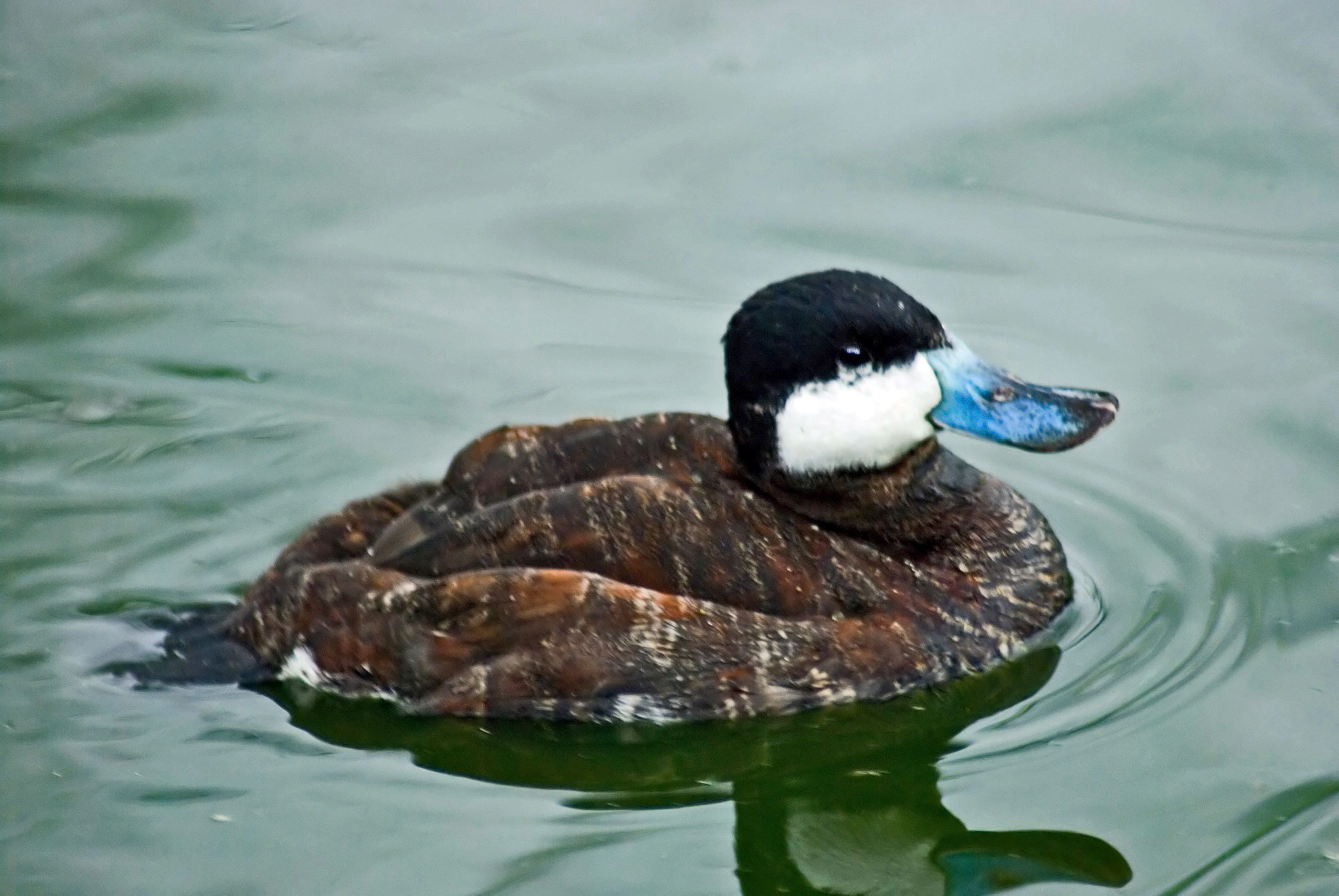
Ruddy duck numbers in the UK cut to 120 by cull

Photo: Wikipedia
1 March 2011

A cull of ruddy ducks in the UK has cut their numbers to just 120.

The government says about 4,400 of the birds were shot dead over the past five years.

Supporters of the cull, including the RSPB, say it is needed to protect other species from extinction. Opponents argue it is expensive and unnecessary.

The ruddy duck is originally from the United States, and came to the UK in the 1940s.

Experts say it has threatened the existence of the white-headed duck in Spain by interbreeding with it.
'Very effective'

Figures released by the Department for Environment, Food and Rural Affairs (Defra) show that 1,365 of the birds were killed in 2008, with the number falling to 717 in 2009, and 386 last year.

Duck shooters from the Food and Environment Research Agency killed the birds under licences issued by government officials.

Junior environment minister, Richard Benyon, said: "Defra considers the programme to date has been very effective. We remain committed to continuing the eradication programme through to completion."

The nationwide cull of ruddy ducks was ordered by the British government in 2003 after a request from Spanish authorities.

The bird was often found in the West Midlands, northern England, Anglesey and southern Scotland.

'Sad'

In 2007, bird lovers in Greater Manchester tried to get the cull stopped. They argued the white-headed duck population in Spain had recovered substantially.

Some critics argued the British cull was pointless unless other European countries also took action.

But the RSPB continues to back the actions of the UK government.

David Hoccom, head of the charity's species policy unit, said: "It is very sad that such measures are necessary, but we expect the white-headed duck's future to be more secure as a result."

"The white-headed duck has undergone a rapid worldwide decline over the last decade, making extinction a real possibility."

http://www.bbc.co.uk/news/uk-12603625
(Submitted by Dawn Holloway)

Sunday, 26 December 2010

Hong Kong duck returns from epic Arctic trip

The return of duck to Hong Kong after a year-long 6,000km (3,700-mile) journey to the Arctic has yielded new information about bird migration.


The female, fitted with a tracking device, was one of about 20 monitored by the WWF conservation group.

Using Google Earth, the WWF identified the duck's feeding areas and route back to Hong Kong's Mai Po Nature Reserve.

Another duck flew at the record-breaking speed of 114km/h (70mph), the data revealed.

The Mai Po Nature Reserve's manager, Bena Smith, said the duck that returned often travelled at 50km/h (31mph).

One of the birds was shot dead over Russia, where its transmitter was tracked to what was probably the hunter's home.

WWF and its partners, including the US Geological Survey, are studying not only migration but also avian diseases.

http://www.bbc.co.uk/news/world-asia-pacific-12074558

Monday, 22 November 2010

Smoked duck

Cannabis fed to ducks by French farmer for 'deworming'
A French farmer has been given a one-month suspended jail sentence and fined 500 euros (£428) for feeding his ducks marijuana to rid them of worms.

Police arrested Michel Rouyer after they discovered 12 cannabis plants and about 5kg (11lb) of the drug during a visit to his home after a theft.

Mr Rouyer said there was "no better worming substance" for ducks and that his flock was in excellent health.

A police spokesman said it was the first time they had heard such a claim.

Mr Rouyer, who lives in the village of Gripperie-Saint-Symphorien on France's Atlantic coast, did also admit to smoking some of the marijuana.

http://www.bbc.co.uk/news/world-europe-11799303

Friday, 19 November 2010

Duck has three legs - and four feet

A farmer in China has spoken of his surprise after one of his ducks turned out to have three legs and four feet.


Yang Fuyong, of Linchuan County, Guilin, southern China's Guangxi Province, said the duck was one of a batch of 600 he had bought as ducklings.

While vaccinating them, he noticed one of them had one too many legs - and two too many feet.

He has since sold the ducks but kept the unusual one for a pet.

"I have been raising ducks for more than 10 years but I have never seen anything like this before," he said.

"It has an extra leg behind the other two and that leg has two feet. I'm going to carry on raising it to see how it does."

An official at the local livestock husbandry station said the duck was almost certainly the result of a genetic mutation.
http://web.orange.co.uk/article/quirkies/Duck_has_three_legs_and_four_feet

Thursday, 21 October 2010

Mum told off for feeding ducks white bread

A mum who took her children to feed the ducks was ticked off by a council warden - for not giving them wholemeal bread.

The warden told Lisa Taplin, 34, that her white bread slices were "unhealthy" for the birds, reports The Sun.

Mrs Taplin had taken sons Luke, four, and Dylan, two, to a local pond near her home in Hailsham, East Sussex.

But she was shocked when the official said giving ducks white bread was "like feeding kids chips every day".

"I was a bit stunned. There were loads of ducks around us and they looked quite hungry," she said.

"He said it would be better to bring wholemeal, granary or bird seed. He walked off, leaving me feeling guilty."

Naturalist Chris Packham, who presents BBC's Autumn Watch, said bread was "not the best thing" to feed the ducks.

But he added: "I wouldn't stop anyone from feeding birds. We send out the message that wildlife needs our help all the time so it seems a bit churlish to tell people what food to use."

Nickey Caria, Hailsham's deputy town clerk, said: "We have been advised by an animal rescue centre that the public should be urged not to feed white bread to wild birds as it is bad for them."

http://web.orange.co.uk/article/quirkies/Mum_told_off_for_feeding_ducks_white_bread

Tuesday, 31 August 2010

Halifax center displays 180 species of waterfowl

BY RICHARD STRADLING - Staff Writer

SCOTLAND NECK -- The black-headed duck of South America is a lousy parent.

Rather than build its own nest, it simply lays its eggs in ones built by other birds, regardless of species, and never looks back. Left to fend for themselves, the ducklings somehow know to hatch at the same time as their stepbrothers and sisters.

"How it knows to do that, I don't know," said Mike Lubbock, founder of the Sylvan Heights Waterfowl Center on the edge of this small town 85 miles northeast of Raleigh.

This 18-acre zoo for birds - primarily ducks, geese, cranes and other water birds - has about 180 species on display. Each, like the parasitic black-headed duck, has a story.

The waterfowl center opened in late 2006 as an outgrowth of Lubbock's breeding center next door, where he produces birds, some extremely rare, for zoos and collectors. Lubbock has done 18 "first breedings," meaning he was the first to coax 18 species of birds to reproduce in captivity.

With his wide-brimmed hats, the accent of his native England and 45 years of work with water birds, Lubbock is the image of the globe-trotting naturalist. But the center is his home base, the place where he has chosen to share his love and knowledge of birds with the public and to encourage people to protect the habitats that sustain them.

Sylvan Heights takes its name from the town in the mountains of North Carolina where Mike Lubbock's breeding business got its start in the 1980s. After his partner in that business died, friends who lived in Scotland Neck suggested he move it east.

Lubbock says that besides having a milder climate, the area had what a waterfowl breeder needed, including hardware stores and a good supply of well water.

"It's a farming community," he said. "And I was farming birds, if you look at it that way."

The center may not yet be the tourist draw that some in Scotland Neck have wanted. On Sunday, there were few enough visitors that one could be alone with the birds at times, surrounded by their various honks, laughs and quacks and the sounds of flapping wings on water.

The birds are grouped by continents into five walk-through aviaries, each enclosed in netting held up without internal poles to make it easier for birds to fly around and for people to see and photograph them.

Surprisingly large

Melissa Phillips of Greenville liked the openness. "The birds seem happier," she said. "It's a more natural setting."

Phillips and her husband, Scott, had heard the center was a good place to bring a picnic and walk around, and they were pleasantly surprised. "We didn't expect it to be this big and have so many birds," Scott said.

Lubbock says the best time to visit Sylvan Heights is from October to April, when most of the waterfowl have finished molting and their drab new feathers become more showy.

"If you came back here in two months' time, you'd think these were different birds, because of the bright colors," he said.

Though the center specializes in waterfowl, there are other birds on display, including laughing kookaburras, parrots, an emu, a toucan, turkeys and a family of eagle owls, the largest owl in the world. These are a concession of sorts to the tastes of visitors, particularly school groups.

"To a kid, one duck looks like another one after awhile," Lubbock says.

Seven-year-old Tabitha Suzanne Shrader of Pine Tops said her favorite birds are owls, blue jays and flamingos, as she and her grandmother looked out over an enclosure containing 86 flamingos Sunday. Most were various shades of white and pink, but a gray, fuzzy baby approached the fence where Tabitha stood.

"That is a real strange one," she said.

The center is a family affair; Mike's wife, Ali, is operations manager, and their son Brent handles memberships and marketing on behalf of the N.C. Zoological Society, a partner in the venture. Brent notes that more than half the income for the nonprofit center comes from memberships and donations.

The center gets about 30,000 visitors a year, Brent said. It hopes that grows to about 50,000 in coming years. As it is, though, the Lubbocks say the tranquility is one reason to visit.

"There are probably 30 to 40 people in the park at the moment," Mike Lubbock said Sunday. "And you don't really run into anyone."

http://www.newsobserver.com/2010/08/31/656004/honk-if-you-love-water-birds.html#ixzz0yCLFMWrK

Tuesday, 3 August 2010

Pair to swim 500km with pet ducks

3 August 2010

Two Germans have set out on an unusual summer holiday, beginning a 500-kilometre swim down a river from central Germany to the North Sea with seven pet ducks.

Starting in the town of Kassel, 33-year-old Pia Marie Witt, 58-year-old Wilfried Arnold and their companions will swim down the Fulda and Weser rivers, hoping to reach the North Sea port of Bremerhaven by mid-September.

The pair say the journey is about self-fulfilment.

"It's our version of the pilgrimage to Santiago," Mr Arnold told German radio network Hessische Rundfunk.

Ms Witt and Mr Arnold aim to swim 10-15 kilometres per day - an order too tall for the seven runner ducks, which will swim for about 20 minutes a day, following by car or boat when exhaustion kicks in.

http://www.abc.net.au/news/stories/2010/08/03/2972488.htm

Tuesday, 13 July 2010

Marching ducks join Houston Police Academy


Published: 6:43PM BST 12 Jul 2010

Cadets starting their day with roll call and drills have been joined by three web-footed friends.

http://www.telegraph.co.uk/news/newsvideo/weirdnewsvideo/7885947/Marching-ducks-join-Houston-Police-Academy.html

Monday, 21 June 2010

Whistling ducks appear to be nesting in Augusta

RIGHT: Black-bellied whistling ducks, native to Central and South America, are turning up in several new locations, including Florida, coastal South Carolina and Phinizy Swamp Nature Park in Augusta. (Gene Howard/Special)
By Rob Pavey
Columnist
Saturday, June 19, 2010

Lots of people who visit Augusta end up living here.

The same is true for a new species of waterfowl that began stopping by Phinizy Swamp Nature Park a few years back.

The black-bellied whistling duck is normally found from southern Mexico to Central and South America, said Ruth Mead, senior education specialist at the 1,100-acre park.

"We first started noticing them here in the summertime four summers ago," she said.

Occasional sightings had also been reported in the Florida peninsula, and later in Georgia's Altamaha River Basin and coastal South Carolina near Charleston.

The supposition was that an occasional whistling duck was passing through the Augusta area, but there was no indication of a breeding population.

This summer, however, larger groups of the ducks have been observed -- and at least one pair appears to be nesting.

"This year, the population is fairly large and we see them every night. There is one flock that flies in regularly into the boardwalk area," Mead said.

The handsome ducks, named for their high-pitched, soft, wheezy whistle, have become a tourist attraction of sorts, especially from ardent birders.

"It's one of the tree nesting ducks," she said. "They are also brood dumpers -- females will sometimes dump a pile of eggs in someone else's nest."

Since the Nature Park near Augusta Regional Airport was established 10 years ago as part of a project to transform sewage-impacted wetlands into a restored riverine environment, more and more bird species have been confirmed there.

"I think we're at 236 species now, which is an incredible list for a Piedmont and Coastal Plain area," Mead said. "We just added a new bird to the park list this weekend: a white breasted nuthatch."

By comparison, a yearlong study conducted in 1998 that included the entire Phinizy Swamp corridor, including the Merry Brickyard pond system, identified 157 species.

The park, off Lock and Dam Road, is open from dawn to dusk daily -- and entry is free.

http://chronicle.augusta.com/sports/outdoors/rob-pavey/2010-06-19/whistling-ducks-appear-be-nesting-augusta?v=1276980745
(Submitted by Chad Arment)

Saturday, 15 May 2010

Owl adopts ducklings born in 30ft-high nest

Friday, 14 May 2010

A tawny owl is acting as surrogate mother to two ducklings born 30ft (9.1m) up a tree after their natural mother laid her eggs in the wrong nest.

Mary Hartley was expecting to see owlets after four eggs appeared in her nest box in Marple Bridge, Stockport.

But when she checked a nest box camera she was surprised to find two Mandarin ducklings jumping around inside.

Despite the perilous height of the box, Mrs Hartley said they would eventually climb out and "float down".

The bird enthusiast has had owls nesting in her garden for the past 25 years.

'Very caring'

Two owlets, also born in the nest, are being cared for by the mother alongside the two-day-old ducklings.

Speaking to the BBC, Mrs Hartley said: "We think that the mandarin duck must have gone into the box - because we have two pairs of mandarins - and laid her eggs and suddenly realised it was the owl box.

"Because when the owl came back she then laid her own eggs in the box - confusion all round."

But even though the ducklings' surrogate mother is a predator, she has shown no sign of aggression towards them.

"She's been very good," Mrs Hartley said.

"She's been very caring, although it does confuse her a little when she tries to feed them with meat - because of course they don't like it."

Another mandarin duck has already successfully raised 13 ducklings born in another - albeit empty - owl box in the garden, leading Mrs Hartley to believe the current pair will survive.

"They all managed to jump out of the box on their own as mother calls them," Mrs Hartley added.

"And because the box is 30ft up the tree it's quite exciting as she waits at the bottom to see if they can float down and she can take them to the stream."

See video at: http://news.bbc.co.uk/1/hi/england/manchester/8682411.stm

Sunday, 25 April 2010

Wis. woman braves traffic, saves 14 ducklings

WEST ALLIS, Wis. – A mother duck didn't survive her walk across a busy Wisconsin roadway, but a motorist made sure the 14 ducklings stayed safe — even one that wiggled under her dashboard.

Angela Speed of the Wisconsin Humane Society says the good Samaritan was driving in West Allis, a Milwaukee suburb, on Friday when she saw the newly hatched mallards trying to cross a busy road.

The woman told Speed that a vehicle in front of her appeared to intentionally hit the mother duck, leaving her ducklings confused in the middle of the road.

The woman gathered each into her car and took them to the Humane Society.

But an hour later, she heard a peep. A mechanic took apart her dashboard and found the 14th duckling. Speed says the brood is healthy and expected to survive.

http://news.yahoo.com/s/ap/20100425/ap_on_re_us/us_rescued_ducklings

Tuesday, 20 April 2010

Horse adopts family of ducklings

19th April, 2010

This galloping guardian is the mane man in a family of ducklings, who he has been taking care of.

And his neigh-bourhood watch service has proved a real life-saver for the new brood.

Champion horse Topper took the ducklings under his wing – well, hoof – after allowing their mother, Lola, to lay a dozen eggs in his stable.

He kept watch over them for a month before they hatched and then scared away foxes and dogs that got too close.

‘Far from being upset, Topper really likes his little duck family,’ said Kim Stevens, yard manager at the stables in Milland, West Sussex.

‘He was in and out of the stable all the time but every time he came back in, the first thing he did was look around to make sure they were still there.’

It is thought Lola moved in with Topper after her last lot of eggs were eaten by a fox. Before the new batch hatched, staff moved them to a safe corner of the straw so Topper, who was recently ridden to victory at the British Open Indoor Cross Country, did not accidentally squash them.

Now the wonder horse is facing up to empty-nest syndrome. Lola recently moved to a nearby pond, with the lucky ducklings trailing behind her.

http://www.metro.co.uk/weird/822386-horse-adopts-family-of-ducklings
Related Posts with Thumbnails

ShareThis