Showing posts with label federal protection. Show all posts

Wednesday, 13 August 2014

Endangered Florida butterflies to get federal protection

By Barbara Liston

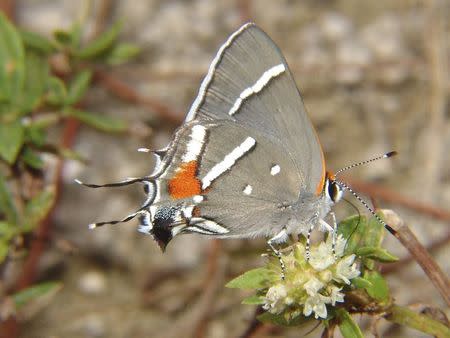
Handout of a butterfly species known as Bartram's scrub-hairstreak
Bartram's scrub-hairstreak
ORLANDO (Reuters) - Two species of butterflies that live in South Florida will be listed as endangered under federal law, the U.S. Fish and Wildlife Service announced Monday.
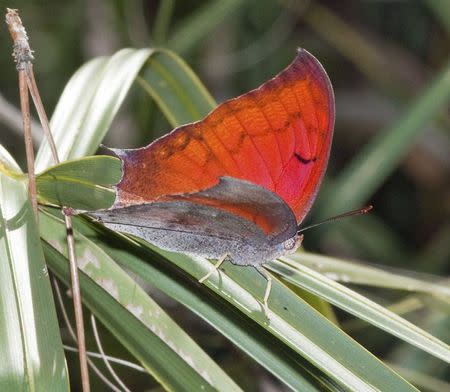
The official listing of the Bartram's scrub-hairstreak and Florida leafwing butterflies under the Endangered Species Act, expected on Tuesday, will make it illegal to capture or harm the butterflies, and their larvae.
Handout of a butterfly species known as Florida Leafwing
Florida leafwing

Both species were common around Miami and the Florida Keys until development wiped out much of their natural habitat, according to agency spokesman Ken Warren.
"We do believe their numbers are extremely low," Warren said.

Monday, 23 June 2014

Teams trapping grizzlies as feds eye delisting

By KEITH RIDLER

BOISE, Idaho (AP) — Sixteen grizzlies have been captured so far this year by teams gathering information that will be used this fall to decide whether to propose lifting federal protections of the bears in the Greater Yellowstone Ecosystem.

The Interagency Grizzly Bear Study Team captured the grizzlies in Montana and Wyoming, while efforts in eastern Idaho have just started. The team usually captures about 60 bears a year.

"We're evaluating whether the bear population is capable of being recovered at this time," said Chris Servheen, grizzly bear recovery coordinator with the U.S. Fish and Wildlife Service. "It will be ready this fall. If the answer is 'yes,' there will be a proposal to delist."

An estimated 740 grizzly bears roam the 19,000-square-mile Yellowstone ecosystem that includes portions of the three states plus Grand Teton National Park and Yellowstone National Park.

Sunday, 16 September 2012

Hundreds of Scientists Support Endangered Species Act - via Herp Digest


Petition for Rarest U.S. Frogs, Turtles, Toads, Snakes, Lizards and Salamanders
Press Release -Washington D.C. 9/6/12— More than 200 scientists sent a letter to the U.S. Fish and Wildlife Service today expressing support for an Endangered Species Act petition filed this summer by the Center for Biological Diversity and several renowned scientists and herpetologists, including E.O. Wilson, Thomas Lovejoy and Michael Lannoo. The petition, the largest ever filed targeting amphibians and reptiles, seeks federal protection for 53 species of turtles, snakes, toads, frogs, lizards and salamanders found across 45 states.
Wood turtle photo by Diane Baedeker Petit, USDA. Photos are available for media use.
“There’s broad scientific consensus that amphibians and reptiles face a profound, human-driven extinction crisis,” said Collette Adkins Giese, a Center biologist and lawyer focused on protecting herpetofauna. “The surest way to ensure our country’s rarest turtles, frogs and salamanders have a future is to give them Endangered Species Act protection.”
The signatories to the letter — which states that the petitioned animals deserve a Fish and Wildlife Service status review because they face threats like habitat loss, pollution, introduced predators and climate change — are herpetologists, biologists, ecologists and other scientists with collective expertise on amphibians and reptiles.
The 450-page listing petition, filed July 11, asked the Service to provide Endangered Species Act protection for six turtles, seven snakes, two toads, four frogs, 10 lizards and 24 salamanders. It detailed their status and the threats to their survival.
“We will get serious — scientists and general public alike — about preserving the diversity of life on Earth only when we have precise knowledge of individual species like those in this petition,” said Edward O. Wilson, a distinguished Harvard biologist and Pulitzer Prize-winning author. “Future generations will think badly of us if, through ignorance and inaction, we let die this part of their natural heritage.”
Although amphibians and reptiles have been around for hundreds of millions of years and survived every major extinction period, now, due largely to human impacts, they’re dying off at up to 10,000 times the historic extinction rate. This loss is alarming because they play important roles as predators and prey in their ecosystems and are valuable indicators of environmental health.
Among the species in the petition are the alligator snapping turtle in the Southeast, the wood turtle in the Northeast, Florida’s Key ringneck snake, the Illinois chorus frog, the Pacific Northwest’s Cascade torrent salamander and California’s western spadefoot toad. View an interactive state-by-state map showing where the petitioned species live and download photos for media use.
The Fish and Wildlife Service must determine within 90 days whether the petition has merit and make a decision about protection within a year.  
Contact:  Collette Adkins Giese, (651) 955-3821

Wednesday, 13 June 2012

Ruling on dunes sagebrush lizard likely on Thursday


SANTA FE — A day of decision is finally near for the West's most-publicized reptile.
The Obama administration probably will announce Thursday if the dunes sagebrush lizard will be listed as an endangered species, said Tom Buckley, a spokesman for the U.S. Fish and Wildlife Service in Albuquerque.
An occupant of wind-swept dunes in oil country, the lizard exists only in four counties of southeastern New Mexico and four others in West Texas.
Buckley said today the announcement on the lizard's status probably would be made in Washington. He expects either Interior Secretary Ken Salazar or Daniel Ashe, director of the Fish and Wildlife Service, to make the finding public.
Debate over whether the lizard should receive federal protection has raged for 18 months. Ashe in December postponed his scheduled ruling on lizard, saying he wanted another six months to consider scientific data.
Numerous Republicans in Congress, especially Rep. Steve Pearce of New Mexico, have argued against endangered status for the lizard. Pearce said thousands of jobs in the oil and gas industry would be in jeopardy if the lizard were listed.
The Center for Biological Diversity and other environmental groups then accused Pearce of spreading misinformation to scare the public.
Ecologists with the center said the lizard occupies only about 1 percent of public lands in New Mexico where oil drilling was proposed in the last two years.
Related Posts with Thumbnails

ShareThis