Showing posts with label idaho. Show all posts

Tuesday, 16 February 2016

Three T. Rex relatives uncovered in Idaho by Montana State University team


FEBRUARY 14, 2016

by Susanna Pilny

Idaho isn’t known for turning up many dinosaur fossils—which makes the recent discovery of three brand new T. rex cousins uncovered there all the more rare.

The dinos were found by researchers from Montana State University in the Wayan Foundation of Caribou-Targhee National Forest. According to the study, which is published in Historical Biology: An International Journal of Paleobiology, the team primarily found at least three new kinds of theropods—carnivorous dinosaurs that ran about on their hind legs and had grasping hands, like Tyrannosaurus rex.

While the family of one of the theropods is as of yet indeterminate, two of these three new dinos date back to around 95 million years ago, and fall into the small- to mid-sized range of their specific family—Tyrannosauroidea. Based on their fragmentary fossil evidence (mostly teeth), they were able to estimate that the larger tyrannosauroid they discovered was the size of a horse, while the smaller was similar in size to a Labrador retriever.

Limited evidence means tough work
Of course, such conclusions weren’t the easiest to reach, given the limited evidence.

“The challenge is identifying the animals based on the fragmentary specimens we find,” said MSU doctoral student L.J. Krumenacker, who has been searching Idaho for dinosaur fossils for 10 years, in an MSU statement.

“I put my best effort into it. It’s possible I could discover some identifications are wrong if we find more complete remains later. But I’d be thrilled because then we’d have an even better understanding. I’d really like to find more.”

Sunday, 10 January 2016

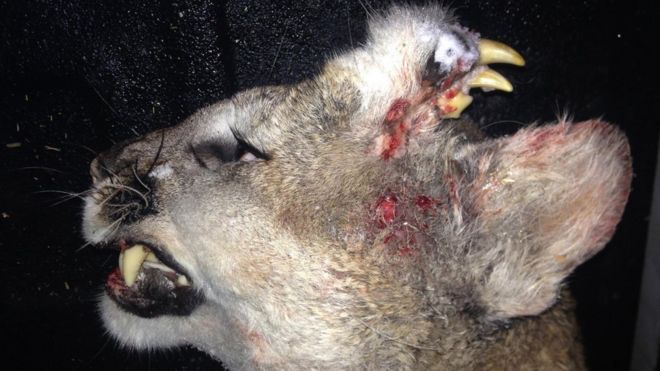
Idaho mountain lion had teeth growing from forehead

2 hours ago 
From the sectionUS & Canada
A mountain lion killed in the US state of Idaho had a set of fully formed teeth growing out of its forehead, wildlife officials say.

The lion was legally shot dead by a hunter on 30 December.

Image copyrightAP

The Idaho Department of Fish and Game says the teeth could be the remnants of a conjoined twin which died in the womb, or possibly a kind of tumour.

Biologists in the region have never seen anything like this particular deformity before, it says.

The lion was hunted after it attacked a dog near the town of Weston, Idaho. The dog survived, but a hunter set off in pursuit and killed the big cat a few hours later.

A conservation officer checked the lion's body, as required by law, and found the set of teeth, as well as what appeared to be a set of whiskers on the left side of the animal's forehead.

Monday, 9 November 2015

Mammoth tusk unearthed in Idaho sparking hunt for full skeleton

12-foot Columbian mammoth tusk found in Idaho
By AP
9:55PM GMT 06 Nov 2015

A 12-foot Columbian mammoth tusk has been unearthed in Idaho and scientists say more of the fossil skeleton might still be buried at the site.

Researchers say the large herbivore lived 72,000 to 200,000 years ago and was about 16 to 19 when it died. Its left tusk was found earlier this year at American Falls Reservoir.

"That's a really good find out there," said Mary Thompson, collections manager at the Idaho Museum of Natural History at Idaho State University. "We know we have Columbian mammoth (in the region). We're constantly finding bits and pieces."

Researchers with the university unearthed about 60 percent of the skull last year and about 8 feet of the right tusk after a volunteer with the US Bureau of Reclamation spotted the fossil.

Rising water at the reservoir forced a stop to the excavation, but researchers returned this year when the water dropped and removed the tusk last week.

Thompson said the tusk will likely go on display next year.

She said the recently found mammoth specimen is likely better preserved than others in the area because it spent thousands of years under the sediment of the ancient American Falls Lake that formed when a lava flow dammed what is now the Snake River.


Wednesday, 26 November 2014

Endangered species success: Idaho salmon regaining fitness advantage

Date:
November 25, 2014

Source:
NOAA Fisheries West Coast Region

Summary:
Once on the brink of extinction with only a few fish remaining, Snake River sockeye salmon are regaining the fitness they need to rebuild wild populations. A new analysis shows that naturally spawned offspring of fish saved by a hatchery program are now surviving to return at increasing rate -- high enough to not only sustain the population but also to rebuild it.


Wednesday, 29 October 2014

70,000-Year-Old Mammoth Skeleton Uncovered in Idaho

by Megan Gannon, News Editor | October 28, 2014 02:58pm ET

The skeleton of a mammoth was discovered this month on the banks of a reservoir in Idaho. Paleontologists have rescued part of its skull and a tusk, but there could be a lot more buried below the surface.

"We may even have a complete mammoth," said Mary Thompson, a vertebrate paleontologist and senior collections manager at the Idaho Museum of Natural History. "This is very unique for us."

Every year, when water levels drop in Idaho's American Falls Reservoir, teams of paleontologists and volunteers with the Bureau of Reclamation walk the beaches in search of fossils. The ancient bones of camels, bison latifrons, giant ground sloths, saber-toothed cats and other extinct Ice Age beasts sometimes poke out of the freshly eroded reservoir banks. 

Wednesday, 26 March 2014

Idaho approves year-round wolf hunting on private land

LEWISTON, Idaho — Wolf-hunting season will be open 365 days a year on private property in northern Idaho's Clearwater Region. The Fish and Game Commission made the rule change in the last week as part of the Idaho Department of Fish and Game's 2014 Big Game Hunting Rules Package.

The commission also moved up the opening of wolf-trapping season in the Lolo and Selway zones.

The commission in 2012 approved year-round wolf hunting on private land in the Panhandle Region. Adding the Clearwater Region means wolf hunting on most private land from the Canadian border to the Salmon River is legal in Idaho.

Dave Cadwallader, supervisor of the department's Clearwater Region at Lewiston, said the change likely won't greatly increase the number of wolves killed in the region. He said it's mainly to give private landowners the ability to kill wolves to protect property.

Wednesday, 1 January 2014

Controversial Idaho hunting contest ends with no wolves killed

By Laura Zuckerman

SALMON, Idaho (Reuters) - A controversial hunting contest in Idaho targeting wolves and coyotes has ended with nearly two dozen coyotes killed but no wolves shot, though rancor over the event remains undiminished.

The coyote and wolf derby was promoted by ranchers and hunting enthusiasts as a form of family recreation aimed at reducing the number of predators threatening livestock and big-game animals like elk prized by hunters. It was condemned by conservationists as cruel and unsportsmanlike.

Thursday, 10 October 2013

Ancient microscopic animals thrive in Idaho lakes

Diane Lawrence couldn't identify the gelatinous masses attached to the community dock in her Hayden Lake subdivision.

They were translucent with a jellyfish-like texture, and they kind of gave her the creeps.

"Sometimes, you see them free-floating in the lake," Lawrence said. "They look like alien life forms."

"Alien-looking" is a common description for bryozoans, freshwater colonies of microscopic animals that group together like coral. The colonies are thriving in local lakes this year, prompting calls from people who spend time on the water.

"I get a lot of calls from landowners like these folks in Hayden, wondering, `What is this thing?'?" said Thomas Woolf, a program manager for the Idaho Department of Agriculture.

Bryozoans are an unusual but benign presence in local lakes, he said. They're part of the varied life forms that teem below the water's surface.

"I think they're really cool, especially to show to kids," Woolf said. "They're neat, gooey, booger-like creatures that you don't expect to see in the water."

Because of their gelatinous nature, people often mistake the colonies for masses of frog or fish eggs, or even freshwater jellyfish, which also are found in some local lakes.

Tuesday, 27 August 2013

U.S. authorities probe killing of grizzly bear near Yellowstone

SALMON, Idaho (Reuters) - The U.S. Fish and Wildlife Service is investigating the killing of a grizzly bear near Yellowstone National Park in eastern Idaho, not far from where a grizzly attacked two biologists this month, state wildlife officials said on Saturday.

It is generally illegal to kill grizzlies in the 48 contiguous states, where the bears are listed as threatened under the U.S. Endangered Species Act. But the law does allow the animals to be killed if they are threatening humans.

The caretaker of a residence near the park shot the grizzly on Friday night, said Gregg Losinski, regional conservation educator with the Idaho Department of Fish and Game.

The caretaker was armed with a high-powered rifle while at the home because a grizzly had previously torn down a bird feeder on the property and eaten the seeds, Losinski said.

State wildlife biologists have collected tissue samples from the bear for DNA testing to compare with fur taken from a site nearby where a grizzly startled from sleep charged and bit two biologists on August 15.

Also on that day, a mother grizzly attacked and wounded two hikers who unexpectedly encountered the bear's cub, park officials said.

Grizzly and human conflicts happen mostly in the autumn when the bears are driven to seek food in order to bulk up before hibernation, said Losinski.

About 600 bears roam Yellowstone and its border states of Idaho, Montana and Wyoming.

Sunday, 18 November 2012

Idaho scientist seeks to launch aerial Bigfoot search with blimp

SALMON, Idaho, Nov. 4, 2012 (Reuters) — An Idaho scientist shrugging off skeptical fellow scholars in his quest for evidence of Bigfoot has turned his sights skyward, with plans to float a blimp over the U.S. mountain West in search of the mythic, ape-like creature.
Idaho State University has approved the unusual proposal of faculty member Jeffrey Meldrum, an anatomy and anthropology professor ridiculed by some peers for past research of a being whose existence is widely disputed by mainstream science.

Now Meldrum is seeking to raise $300,000-plus in private donations to build the remote-controlled dirigible, equip it with a thermal-imaging camera and send it aloft in hopes of catching an aerial glimpse of Bigfoot, also known as sasquatch.

Meldrum, author of "Sasquatch: Legend Meets Science," said the undertaking represents a giant leap in the quest for an animal he believes may have descended from a giant ape that once inhabited Asia and crossed the Bering land bridge to North America.

"The challenge with any animal that is rare, solitary, nocturnal and far-ranging in habitat is to find them and observe them in the wild; this technology provides for that," he said.

Decades of alleged sightings, elaborate hoaxes and the discovery of huge footprints in the forests of the Pacific Northwest and elsewhere have led to beliefs that Bigfoot is a man-like ape, an ape-like man or a figment of the popular imagination.

Most scholars discount Bigfoot as a phenomenon borne of myth and perpetuated by a mix of fakery and misidentification of real animals. They contend that science demands a high standard of evidence that has not been achieved in the case of sasquatch.

Continued: http://www.newsdaily.com/stories/bre8a402g-us-usa-bigfoot-blimp/

Thursday, 4 October 2012

FISH FINGER: Man's lost digit turns up in trout


YOU know when you go wakeboarding and you have an accident and your fingers fall off?

Turns out fish like to eat them.

A fisherman in the US state of Idaho recovered a bizarre find when he reeled in a trout from Priest Lake, CBS reports.

The fingers within were identified as belonging to Washington wakeboarder Haans Galassi after a simple fingerprint test.

Mr Galassi lost four fingers during a wakeboarding accident at the lake two months prior to the trout being caught.

There’s a pun to be made about Haans missing his fingers, but we’re not going there.

Sunday, 24 June 2012

Tracks leave bigfoot imprint


SANDPOINT — Bonnie Thompson never set out to look for bigfoot, but can’t help but can’t help but wonder if she stumbled onto a sign of the elusive bipedal humanoid.
Thompson was fishing with friends in the Trestle Creek drainage 30 years ago this month when she glanced down at the game trail she was walking on and saw a large footprint.
“As soon as I saw it, I knew it was something unusual,” said Thompson.
Looking behind her 6 or 7 feet away, she noticed another footprint of equal size and took off running to find her fishing companions while repeatedly shouting “bigfoot!”
Thompson said her companions were dubious of her assessment, but the laughing stopped once they saw the tracks. Other similar tracks were found on the forest floor, but due to the ground cover they weren’t as discernible as the other two.
Thompson later went to Merwin’s, purchased plaster of Paris and returned to the creek, where she made impressions of the footprints.
“They appear to be the same left foot,” said Thompson, who suspects whatever was making the tracks was walking with one foot on the game trail and one foot off.
Thompson does not believe the tracks were made by a bear because there were no claw marks extending from the top of the prints. Moreover, the casts of the tracks fit neatly together when one is laid atop the other.
One of the casts has three prominent, bulbous protrusions that resemble toes and another which appears to be the ball of a foot. Thompson believes the creature was striding on the balls of its feet.
The casts were stowed for a time in a paper grocery sack and later in a cardboard box. Sometimes she would show them to guests if the topic of bigfoot came up.
“For the most part, people are perplexed and amazed,” said Thompson.
Several years later, the Spokane Chronicle published a story featuring Grover Krantz, a Washington State University professor who was regarded as a leading authority on bigfoot. Krantz is pictured in the story holding up plaster casts of purported bigfoot tracks found in the Umatilla National Forest.
Thompson was struck by the similarity of the casts, leading her to believe the same type of creature left them. She said she was compelled to reach out to Krantz, but procrastinated until 2002.
But when Thompson phoned the university, she was advised that Krantz had passed away only hours before she called.
“That was a big lesson in procrastination,” she said.
Thompson turned to Jeffrey Meldrum, an associate professor of anatomy and anthropology at Idaho State University who is also considered an expert on bigfoot.
But she said Meldrum dismissed them as overlapping elk tracks after he reviewed photos of Thompson’s casts. Thompson counters that the elk would have to do some fancy footwork to leave such tracks.
Meldrum did not respond to emails requesting further comment on the Thompson casts.
Thompson, however, is undeterred and is hoping some publicity might inspire others in Bonner County who may have had their own bigfoot-related encounters or finds.
“It’s been 30 years. I shouldn’t go another 30 years with them sitting in a closet,” she said.

Monday, 2 April 2012

Dead wolf photos stir tensions in West


SALMON, Idaho (Reuters) - Photos of dead and maimed wolves have pervaded the Internet in recent weeks, raising tensions in the Northern Rocky Mountains over renewed hunting and trapping of the once federally protected animals.
Escalating rancor between hunters and animal rights activists on social media and websites centers on pictures of wolves killed or about to be killed. Many have text celebrating the fact that Western states are allowing more killing of the predators.
Commenting on a Facebook-posted image of two wolves strangled to death by cable snares, an individual who identified himself as Shane Miller wrote last month, "Very nice!! Don't stop now, you're just getting started!"
A person going by the name Matthew Brown posted the message, "Nice, one down and a BUNCH to go!" in response to a Facebook image of a single wolf choked to death in a snare.
Such pictures and commentary have intensified online arguments over the ethics of hunting and trapping wolves. The debate took a threatening turn this week with an anonymous email warning thatanimal rights advocates will "be the target next."
In Idaho and Montana, hundreds of the animals have been killed -- mostly through hunting -- less than a year after being removed from the U.S. endangered species list.
Stripping the wolves of federal protection last spring opened the animals to state wildlife management, including newly licensed hunting and trapping designed to reduce their numbers from levels the states deemed too high.
Since the de-listing last May, Idaho has cut its wolf population by about 40 percent, from roughly 1,000 to about 600 or fewer. Some 260 wolves have been killed in Montana, more than a third of its population, leaving an estimated 650 remaining.
The U.S. Fish and Wildlife Service has also proposed lifting the protected status for another 350 wolves in Wyoming.
The threatening note received by an anti-trapping group based in Missoula, Montana, this week has drawn scrutiny from federal and local law enforcement.
The group says it was likely singled out because it had criticized and widely circulated a snapshot of a smiling trapper posed with a dying wolf whose leg was caught in the metal jaws of a foothold trap on a patch of blood-stained snow.

Wednesday, 29 February 2012

Two-Headed Trout Causes Controversy In Idaho (PHOTO)

Does the existence of two-headed trout mean things are just fine in Southern Idaho's waterways?
According to The New York Times, that's more or less the conclusion drawn by the J. R. Simplot mining company, which commissioned a study including photos of two-headed trout spawned from fish caught in Southern Idaho creeks.
What's more, the report concludes that levels of the metal selenium should be allowed to reach higher levels than what laws currently permit.
Things got even stranger when, in an initial review, the Environmental Protection Agency seemed to agree with the report's findings, according to the Times.
But, in its own review, the Fish and Wildlife Service had some extremely unkind words for Simplot's report and now the company and EPA are on the defensive.
Less than a week before the controversial findings were released, Simplot's spokesman David Cuoio said his company didn’t know about the pictures of two-headed trout, the Jackson Hole News reports.
Even after the report was released, Cuoio didn't retract his statement, telling the Jackson Hole News the company was taking an "open, transparent and scientifically based approach to protect the environment.”

Tuesday, 28 February 2012

318 wolves killed in Idaho – Because they eat deer - Its Elkonomics

Elkonomics in Idaho
February 2012. The poor hunters of Idaho couldn't find enough deer to kill, so to make life easier for them the Idaho Fish and Game Department (At least, unlike many states, they don't pretend to be a wildlife department) has killed more than 300 wolves to allow humans to buy licenses to kill the deer instead. Last year humans shot more than 16,000 elk alone, but that wasn't enough, and, apparently it is because wolves kill so many elk that they don't leave enough for humans to kill. So the obvious answer, according to Idaho, is to kill the wolves, so then the hunters can kill even more elk.

Deputy Director Jim Unsworth said. "We'd like to see one of Idaho's premier elk populations recover as much as possible." Perhaps they could just stop people shooting them instead.
42 wolves killed recently
In cooperation with Idaho Fish and Game, the USDA Wildlife Services has completed a ‘wolf control action' in northern Idaho's Lolo zone. Over three days in early February, Wildlife Services agents killed 14 wolves from a helicopter. In the Lolo zone, hunters have taken 11 wolves, trappers have taken 11, control efforts earlier in spring 2011 took six, and the most recent control effort took 14 for a total of 42 wolves. The cost of the action is estimated at $22,500 in license funds. As of February 22, hunters and trappers have taken a total of 318 wolves across the state.
In recent years wolves have been identified as the primary cause of death in female elk and calves over six months old. But the habitat in the area is capable of supporting an increased population, Deputy Director Jim Unsworth said.
"We'd like to see one of Idaho's premier elk populations recover as much as possible," he said.
Idaho Elk
In 2011 the Idaho elf population was estimated at 103,000, (See here) and hunter hunter success was 19 percent
According to the Rocky Mountain Elk Foundation : "The statewide population actually broke a long plummet and rebounded 2,000 animals from last year. That growth likely came, at least in part, from fewer hunters. Tag sales went from 92,565 in 2008 to 84,765 in 2010-a decline of about 8 percent.

So 84,765 tags were sold, with a 19% success rate, so that equates to 16,105 successful elk kills.
Elkonomics
In Idaho, a resident must pay $30.75 for a license to kill an elk, and a non resident some $416.75. They also have to purchase a hunting license as well. So (If I understand correctly) if 90% of the 84,765 tags sold were to residents, the income from elk shooting was some $4-5 million. No wonder Idaho Game and fish want more people to kill elk and other wildlife.

Thursday, 18 August 2011

McCall, Idaho: the Monster of Payette Lake (via Chad Arment)

An afternoon spent at Payette Lake can be relaxing and refreshing – as long as you refrain from dwelling on what lies beneath.
The 5,330-acre lake, around which the resort town of McCall, Idaho, was built, is 392 feet at its deepest recorded depth. And within those murky depths lives a beast called Sharlie. Or so some say.
The first documented sighting of Payette Lake’s serpentine monster took place in 1920, and in the 1940s several groups of people also claimed to have seen a serpent 30 to 40 feet long with humps and scaly skin. As word spread, tourists headed for McCall hoping to sight the mysterious creature. In 1954 the local newspaper, the Star News, held a contest to name the lake monster. A Virginian won the contest with the name “Sharlie.”

Some believe the monster is fictitious; others think it’s a giant sturgeon or some other unusually large fish. Whether Sharlie is real or not, the town of McCall claims him proudly.
South of the lake is a street called Sharlie Lane. A small public garden on the lake’s west side has been named Sharlie’s Garden. Gift shops sell Sharlie t-shirts and stuffed Sharlie dolls. And every year during the town’s winter carnival, at least one sculptor carves a giant Sharlie in ice.
Sharlie stories and occasional sightings (the latest documented in 2002) don’t keep locals or tourists out of the lake. Water skiers, wakeboarders and jet skiers take advantage of the wide expanse of crisp glacial water all summer.
For those afraid of mystery serpents, however, this writer recommends sticking to the lake’s shallow edges.

http://www.sandiegoreader.com/news/2011/aug/13/travel-monster-payette-lake-mccall-idaho/
Related Posts with Thumbnails

ShareThis