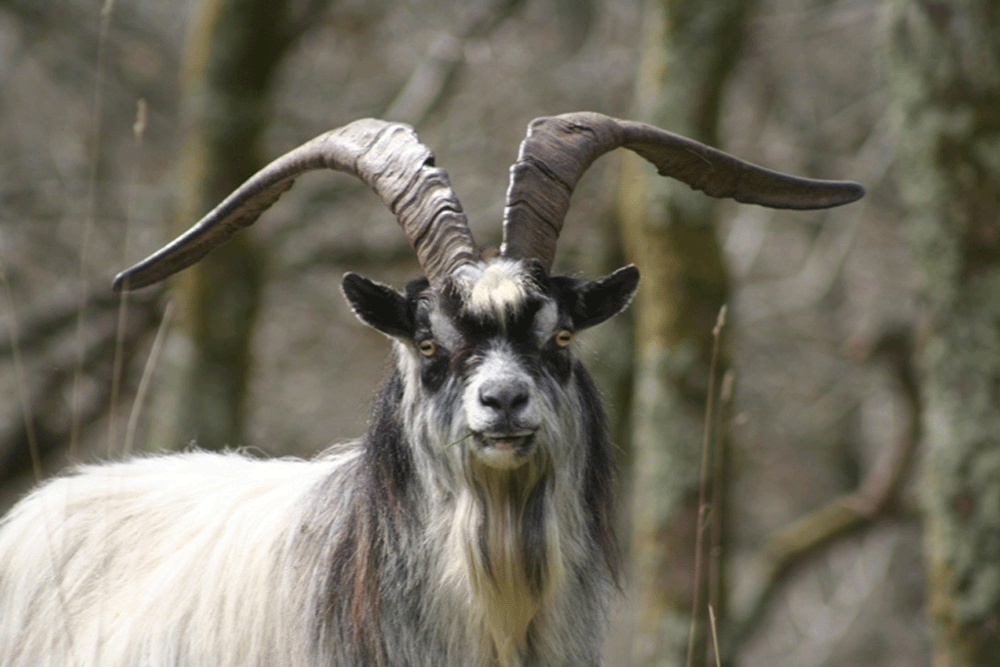
Showing posts with label goats. Show all posts

Sunday, 28 July 2019

Goats can distinguish emotions from the calls of other goats


JULY 9, 2019

Goats can probably distinguish subtle emotional changes in the calls of other goats, according to a new study led by Queen Mary University of London.
The researchers measured behavioural and physiological changes in goats to determine if they can differentiate between calls linked to positive and negative emotions.
They found that when the emotion of a call changed, the likeliness of the goats to look towards the source of the sound also changed suggesting that they can distinguish the emotional content of calls of another goat.
The study, published in the journal Frontiers in Zoology, also shows that the goats' heart-rate variability—the variation in time between each heartbeat—was greater when positive calls were played compared to when negative calls were played.
Together, these results provide the first strong evidence that goats are not only able to distinguish call variants based on the emotion that they convey, but also that their own emotions are potentially affected.
The study was carried out in collaboration with the University of Roehampton, ETH Zurich and University of Turin.
Luigi Baciadonna, lead author of the study from Queen Mary University of London, said: "Despite its evolutionary importance, social communication of emotions in non-human animals is still not well understood. Our results suggest that non-human animals are not only attentive, but might also be sensitive to the emotional states of other individuals."

Thursday, 8 November 2018

Oldest evidence of dairying on the East Asian Steppe


Dairying of cattle, sheep, and goats was established in northern Mongolia by 1300 BC

Date:  November 5, 2018
Source:  Max Planck Institute for the Science of Human History

Although dairy pastoralism once made Mongolian steppe herders successful enough to conquer most of Asia and Europe, the origins of this way of life on the East Asian steppe are still unclear. Now an international team of researchers led by the Max Planck Institute for the Science of Human History has uncovered evidence that dairying arrived in Mongolia as early as 1300 BC through a process of cultural transmission rather than population replacement or migration.

Two thousand years before the armies of Ghengis Khan, populations in Mongolia were already living a pastoralist, dairying lifestyle -- similar to that which would enable future populations to conquer most of Asia and Europe. Although pastoralism has long been the primary means of subsistence on the East Asian steppe, the origins of this tradition have been unclear. Now, an international team of researchers has uncovered the earliest direct evidence to date of dairying in Mongolia -- around 1300 BC -- by tracking milk proteins preserved in tooth tartar. The livestock that were milked -- cattle, sheep and goats -- are not native to the region and were likely introduced by Western Steppe herders. However, ancient DNA evidence from Bronze Age Mongolians indicates minimal genetic contributions from Western Steppe herders, suggesting that the livestock and dairying technologies were transferred by cultural processes rather than a major population migration, in contrast to the pattern seen in Europe. The findings are published in PNAS.


Thursday, 6 September 2018

Goats prefer happy people


Date:  August 28, 2018
Source: Queen Mary University of London
Summary:
Goats can differentiate between human facial expressions and prefer to interact with happy people, according to a new study led by scientists at Queen Mary University of London.
The study, which provides the first evidence of how goats read human emotional expressions, implies that the ability of animals to perceive human facial cues is not limited to those with a long history of domestication as companions, such as dogs and horses.
Writing in the journal Royal Society Open Science, the team describe how 20 goats interacted with images of positive (happy) and negative (angry) human facial expressions and found that they preferred to look and interact with the happy faces.
Dr Alan McElligott who led the study at Queen Mary University of London and is now based at the University of Roehampton, said: "The study has important implications for how we interact with livestock and other species, because the abilities of animals to perceive human emotions might be widespread and not just limited to pets."
The study, which was carried out at Buttercups Sanctuary for Goats in Kent, involved the researchers showing goats pairs of unfamiliar grey-scale static human faces of the same individual showing happy and angry facial expressions.
The team found that images of happy faces elicited greater interaction in the goats who looked at the images, approached them and explored them with their snouts. This was particularly the case when the happy faces were positioned on the right of the test arena suggesting that goats use the left hemisphere of their brains to process positive emotion.

Thursday, 11 August 2016

Army vets shoot horny goats with contraceptive pill to save protected woodland


By Joe Stenson -

August 9, 2016

ARMY veterans are shooting horny goats with the contraceptive pill in a bid to curb their destruction of a protected woodland.

The forest is unique - with a huge array of trees and lichen - but the goats are an ongoing threatThe 222 acre Pollochro Wood – on the shore of Loch Lomond – is a protected area, home to an incredible mixture of flora and fauna. 

But the woods are under threat from feral goats which destructively graze on plant life.

Now a team of ex-army sharpshooters have been called in to administer the goats with the contraceptive pill, in a bid to keep their numbers under control.

50 goats have been given the chemical cocktail through a dart in an operation launched by the landowner, the RSPB.

The forest is unique – with a huge array of trees and lichen – but the goats are an ongoing threat

The drug will curb the mating drive of the goats for three years in an attempt to keep their numbers under control, and keep the woodland intact.

RSPB warden Fraser Lamont oversees the woods – and regularly sees the feral goats eating young trees.

He said: “There are open areas where older trees are dying off and nothing is coming through to take their place.

“The goats will walk up trees to eat the mosses and lichens some of which have taken hundreds of years to develop.”

It is the first time the technique has been deployed in Scotland – and it is being touted as a more human alternative to a culling.

Dave Beaumont is the RSPB’s south Scotland reserves manager.

He said: “The last thing we really want to be doing as a conservation organisation is shooting things, and trying to find a non-lethal method here has been particularly challenging.


Wednesday, 6 July 2016

Could goats become man's best friend?

July 5, 2016

Goats have the capacity to communicate with people like other domesticated animals, such as dogs and horses, according to scientists from Queen Mary University of London (QMUL).

In a new paper in the journal Biology Letters, researchers from QMUL's School of Biological and Chemical Sciences found that goats respond to people by gazing at them when facing a problem they cannot solve alone, and their responses change depending on the person's behaviour.

To investigate, the team trained goats to remove a lid from a box to receive a reward. In the final test, they made the reward inaccessible and recorded their reaction towards the experimenters, who were either facing the goats or had their backs to them.

Goats redirected their gaze frequently between the inaccessible reward and human experimenters. They also gazed towards a forward facing person earlier, more often and for longer compared to when the person was facing away.

First author Dr Christian Nawroth, said: "Goats gaze at humans in the same way as dogs do when asking for a treat that is out of reach, for example. Our results provide strong evidence for complex communication directed at humans in a species that was domesticated primarily for agricultural production, and show similarities with animals bred to become pets or working animals, such as dogs and horses."


Saturday, 5 March 2016

Thousands of goats and rabbits vanish from major biotech lab

Santa Cruz Biotechnology is one of the world’s largest antibody providers — and the subject of a US government animal-welfare investigation.

19 February 2016 Clarified: 

Santa Cruz Biotechnology has used goats to make antibodies for research.

In July 2015, the major antibody provider Santa Cruz Biotechnology owned 2,471 rabbits and 3,202 goats. Now the animals have vanished, according to the US Department of Agriculture (USDA).

The company, which is headquartered in Dallas, Texas, is one of the world’s largest providers of antibodies — extracting them from animals such as goats and rabbits by injecting the animals with proteins to stimulate antibody production. Biomedical researchers can then use these antibodies to detect and label the same protein in cell or tissue samples.
But Santa Cruz Biotech is also the subject of three animal-welfare complaints filed by the USDA after its inspectors found evidence that the firm mistreated goats at its facility in California.

Santa Cruz Biotech has contested the complaints, prompting a hearing in August before a USDA administrative law judge in Washington DC. Four days into the hearing, both parties asked to suspend the proceedings in order to negotiate a settlement. But those negotiations fell through in September.
The USDA hearing is set to resume on 5 April. If Santa Cruz Biotech is found to have violated the US Animal Welfare Act, it could be fined or lose its licence to keep animals for commercial use. The USDA says that the company could face a maximum fine of US$10,000 per violation for each day that a given violation persists. The agency has reported 31 alleged violations by the company.

Disappearing act
In the meantime, the company seems to have done away with its entire animal inventory. When the USDA inspected the firm's California facility on 12 January, it found no animal-welfare violations, and listed “no animals present or none inspected”. USDA spokesman Ed Curlett says that no animals were present during the inspection.

The fate of the goats and rabbits is unclear. The company did not respond to questions about the matter, and David Schaefer, director of public relations for the law firm Covington & Burling in Washington DC, which is representing Santa Cruz Biotechnology, declined to comment on the animals’ fate.

As research animals, the goats and rabbits could not be sold for meat, although they could be sold to another business or research entity. Cathy Liss, president of the Animal Welfare Institute, an advocacy group in Washington DC, suspects that the animals were killed. She says that it is unlikely that such a large number of animals bred for such a specific purpose would find a buyer.


Monday, 2 February 2015

Goats offered as alternative for clearing area of plutonium

BOULDER, Colo. (AP) — A goat herder who has a college degree in weed sciences told federal wildlife officials that she could eliminate the need for a possible 700-acre controlled burn at the Rocky Flats National Wildlife Refuge by turning her goats loose there and eliminate concerns over spreading radioactive plutonium.

Lani Malmberg said it's unwise to burn land that has been exposed to the toxic metal, and she said her goats won't suffer any ill consequences.

The refuge was created in 2006 in the wake of the nuclear weapons site's closure, and a $7 billion cleanup was finished in 2005. Concerns that a controlled burn there could put plutonium into the air prompted Boulder's Rocky Mountain Peace and Justice Center and surrounding communities to take a stance against that happening.

Tuesday, 30 December 2014

Farmers say Christmas trees make great goat snacks

GRAND JUNCTION, Colo. (AP) — Western Colorado goat farmers say Christmas trees make great snacks for their herds, and they're offering to collect them from homes in the Grand Valley.

Nevelle Hopper of the Lil Moo Ranch said Friday the the trees are a natural de-wormer for goats, and pine needles have vitamin C.

She says the goats enjoy eating them, too.

Hopper's Lil Moo Ranch, the Top of the Hill Ranch and 5-R Ranch want undecorated trees that haven't been sprayed with any chemical.


Nevada goats help eat, recycle Christmas trees

RENO, Nev. (AP) — Goats are known to eat just about anything, but it didn't dawn on Vince Thomas until recently that the menu might include Christmas trees.

"They'll eat the pine needles and leave the skeleton of the tree," said Thomas, a longtime volunteer firefighter who has come up with a new use for his family-owned goat herding business, "Goat Grazers."

"It basically looks like Charlie Brown's Christmas with a scrawny tree that has nothing but the branches," he told the Reno Gazette-Journal (http://tinyurl.com/kctx67s).

Thomas is launching a new program with the Truckee Meadows Fire Protection District on Friday to use his 40 goats to help recycle Christmas trees.

Saturday, 7 June 2014

Gene study shows how sheep first separated from goats

Date:
June 5, 2014

Source:
University of Edinburgh

Summary:
Scientists have cracked the genetic code of sheep to reveal how they became a distinct species from goats around four million years ago. The study is the first to pinpoint the genetic differences that make sheep different from other animals.


Continued

Friday, 9 May 2014

Croatian goat born with eight legs Wednesday 7 May 2014 3:52 pm

A Croatian farmer has spoken of his pride after one of his goats gave birth to a kid with eight legs.
Croatian goat born with eight legsZoran Paparic thought he was seeing double when his goat Sarka gave birth on his farm in Kutjevo, Croatia.

The ‘octogoat’ also has both male and female reproductive organs, leading local vets to believe that the goat’s condition is the result of an under-developed twin sibling.

Sunday, 4 May 2014

Goats Attack Car In Maine

The Huffington Post | by Ed Mazza
Posted: 04/30/2014 3:09 am EDT Updated: 04/30/2014 4:59 am EDTPrint Article

Call it "Goatz n the Hood." Or in this case, "Goatz on the Hood," as two of the animals recently got loose in Richmond, Maine and did what goats do.

They climbed.

The victim during this particular goat-break was a Ford Focus. The goats enjoyed climbing it so much that they refused to back down, and the car's owner had to call the cops.

A police photo shared on Twitter by the Kennebec Journal shows one of the animals conquering the car:

Apparently the goats got loose from the neighbors’ and were climbing all over his car,” Richmond Police Chief Scott MacMaster told Craig Crosby of the Kennebec Journal.

Friday, 18 April 2014

Clever Goats Can Learn Quickly

By Agata Blaszczak-Boxe, Staff Writer | April 16, 2014 03:43pm ET

Goats might be smarter than once thought — it turns out, they can quickly learn and remember how to perform certain tasks, according to a new study. The findings may help explain goats' ability to adapt to a variety of environments.

In the study, the researchers trained a group of goats to retrieve food from a box by pulling a lever, and then lifting it. It took the goats 12 tries on average to perform the trick.

"I wasn't surprised that they managed to do the work. I was surprised that they got it so quickly," said study author Alan McElligott, of Queen Mary University of London.

Thursday, 27 March 2014

Goats are far more clever than previously thought, and have an excellent memory

Date:
March 26, 2014

Source:
Queen Mary, University of London

Summary:
Goats learn how to solve complicated tasks quickly and can recall how to perform them for at least 10 months, which might explain their remarkable ability to adapt to harsh environments, say researchers. The goats' ability to remember the task was tested after one month and again at 10 months. They learned the task within 12 trials and took less than two minutes to remember the challenge.


Thursday, 25 July 2013

Cashmere trade threat to snow leopards

The global demand for cashmere is threatening endangered snow leopards, according to a new report.
Domestic cashmere goats in parts of Central Asia have almost tripled in the last 20 years to fuel cashmere demand.
The goats are encroaching on the natural habitats of the snow leopard and their natural prey.
The authors of the paper, published in Conservation Biology, say that other endangered animals are also at risk.
These include herbivores which compete for the same resources as the goats, such as the antelope Saiga tatarica, the Tibetan chiru (Pantholops hodgsonii) and the Himalayan bharal (Pseudois nayaur) also known as the blue sheep.

Thursday, 6 June 2013

Goats arrested for vandalising police car

· By Rory Reid
· on Monday, 03rd June 2013

Police have detained a herd of goats in the Indian city of Chennai after the force's brand new Toyota Innova police car was damaged by up to 12 errant beasts. Policeman Ganesh Babu, who was in charge of the car, is said to have caught the animals as they grazed near the city police station. The animals were allegedly standing on top of the vehicle, causing dents, scratching the paintwork and damaging the windscreen and wipers.

The officer was able to apprehend three of the suspects, who have now been remanded in custody at a nearby Society for the Protection of Animals centre. Police claimed the goats had a record of damaging vehicles belonging to local residents and shopkeepers, and had 'crossed the line' by damaging the brand new police car.

The arresting officer has filed a complaint against the goats' reported keeper, 37-year-old local woman Mary Arogynathian.

Ms Arogynathian will have to claim ownership of the animals before police are able to turn the complaint into a 'first information report' or to charge her with negligent conduct with respect to animals.

In an unusual twist, animal activists claim it is the police that should be charged for violating the City Police Act and Municipal Corporation Act of 1919, which bands cattle from the city limits. Dawn Williams of the Blue Cross of India said: “When police saw the goats, they should have handed them over to NGOs like the civic body does.”

The nine other suspects are still at large. 

Tuesday, 21 May 2013

Backlash over plans to shoot goats of Inversnaid

The goats of Inversnaid on the banks of the beauty spot's shores are said to have helped shelter Robert the Bruce as he fled his enemies – and to hold a valuable genetic record of an ancient breed.

But now the area's conservationist landowner, the Royal Society for the Protection of Birds (RSPB) has caused controversy by demanding they be shot.

The proposal has sparked a backlash from local people, tourist operators and goat experts.

Most of the herd on the charity's 2000-acre Inversnaid nature reserve on the east shore of Loch Lomond, through which runs the West Highland Way, is to be shot to protect woodland.

The RSPB says it has no choice after Scottish Natural Heritage (SNH) told it a woodland SSSI – a site of special scientific interest – in the reserve was in decline, and goat browsing was blamed.

Opponents say the cull, taking the herd of more than 60 down to just 30, is too severe and could damage tourism. The British Feral Goat Research Group fears the herd could die out as a result.

The local Strathard Community Council believes the RSPB has not adequately recognised the goats' importance.

It told the society: "The historic Inversnaid goats need protection too, in order to ensure that the herd continues to be viable."


Saturday, 4 May 2013

Monitor Lizards out of reach, goats may salvage Goa's ghumat - via Herp Digest

IANS Apr 8, 2013,Times of India 

Stringent wildlife laws are hammering long, legal nails into the coffin of one of Goa's very few indigenous musical instruments, the ghumat. 

Could goats be an alternative to the monitor lizard, whose tough treated skin is stretched taut across the mouth of the ghumat, which is actually a uniquely designed clay-pot? 

While monitor lizards, once hunted frequently across the state's forested hillsides, are now protected under Schedule 1 of the Wildlife Protection Act and their hides are rare and very expensive contraband, taking the ghumat - Goa's answer to the dholak and the tabla - to the brink of extinction. 

But help could be at hand. 

"There is no point ruing about anything. We switched to goat skin after monitor lizard skins became rare," said Vinayak Akhadkar, 62, a leading ghumat player in Goa who has a troupe that plays at several competitions as well as Ganesh Chaturthi ceremonies, during which a 'ghumat arti' has a special significance. 

According to Rohan Khaunte, an independent member of the Goa assembly, "we should accord it official recognition as a traditional state instrument and then find ways to salvage it or we will lose it forever". 

Khuante had moved a private member's bill during the budget session of the Goa assembly last month to safeguard the fading thump of the ghumat. 

What Goa's lawmakers agreed during the discussions to salvage the ghumat was that the instrument perhaps needed to adapt to survive in a world which was keen to value its wildlife, at least when it comes to public commitments. 

Chief minister Manohar Parrikar summed it up in one line. 

"You have to change with the times. We have to find out substitutes for monitor skin," he said. 

Apart from goats, there could be other alternatives. 

Vishnu Wagh, a versatile artiste and also a Bharatiya Janata Party (BJP) legislator claims that synthetic material could also be developed to ensure that the legacy of the ghumat survives. "It's a matter of getting the sound right. The pores and scales on the monitor lizard creates that special ghumat sound. Synthetic material could be developed to calibrate the same sound effect," he said.

Tuesday, 16 April 2013

Goat's head at Wrigley 'speaks for itself'


Chicago Tribune | 11 April 2013

Mayor: Goat's head at Wrigley 'speaks for itself'

By John Byrne and Fred Mitchell

Mayor Rahm Emanuel said today that a goat's head dropped off at Wrigley Field is no laughing matter, but tell that to Cubs players.

"Come up with something original," scoffed Cubs pitcher Jeff Samardzija, noting that the billy goat curse against the team "has only been around for 60 or 70 years. You would think they would come up with something new."

"I don't have many thoughts on that," said Cubs manager Dale Sveum. "It's just some unfortunate fan doing something crazy. I spent two years in Boston, so I have a pretty good idea of the passion of the fans and the willingness to want to win."

Cubs first baseman Anthony Rizzo added, "In my opinion, it's just dumb. But it is what it is."

A man drove up to the ballpark around 2 p.m. Wednesday and handed a package to a security guard at Gate K, according to police and Cubs spokesman Julian Green.

The man asked the guard to deliver the package to Ricketts, then got back into his truck and drove away, police said. Security officials found the goat's head inside. The head was all black and had a U.S. Department of Agriculture tag on its ear, police said.

The package did not contain a note and was never delivered to Ricketts, police said. The head was taken to the city's Animal Control department, police said.

At an unrelated news conference today, Mayor Rahm Emanuel said he talked to Ricketts Wednesday night and promised that police will take action.

"There's nothing else to say, it speaks for itself, it's wrong to do," Emanuel told reporters. "I did call Tom last night, and said obviously that the police need to do something, we'll be on it."

No arrests have been reported but police are investigating the "intimidating package," Police News Affairs Officer Veejay Zala said.

The Cubs are in the middle of highly publicized negotiations with city officials and neighborhood interests regarding proposed changes at the ballpark, including whether the team should be able to install a Jumbotron-like scoreboard and increase the number of night games from 30 to about 40.

Goats are part of Cubs lore, dating back to a supposed curse placed on the team by the late Billy Goat Tavern owner William Sianis during the 1945 World Series after Sianis' goat was denied entrance into the park.

Columnists including Mike Royko and David Condon helped popularize the legend, and Cubs officials over the years have repeatedly denied the existence -- or at least the relevance -- of the curse.

Thursday, 31 January 2013

Global Gene Pool of Goat Is Seriously Under Threat


Jan. 23, 2013 — Amongst the range of domestic livestock species, the goat is not just the 'black sheep' but a resource of survival in impoverished countries, and many breeds are at great risk of disappearing. This is the case according to researchers of the Regional Service of Agro-Food Research and Development in their first monographic study tackling the global impact of this species. 

A study from the Regional Service of Agro-Food Research and Development (SERIDA) has analysed the situation of the global goat population.

The study took into account the state of different breeds, the multiple implications of their conservation, the interaction with other animal species (wild and domestic) and the consequences of goat grazing from an environmental point of view.

"The risk of the gene pool of the goat disappearing has increased due to intensive animal husbandry systems that use a very limited number of breeds. Strangely enough, the biggest loss in the genetic resources of indigenous animals has been observed in Europe, although the situation is unknown in many areas," as explained to SINC by Rocío Rosa García, researcher at SERIDA and coauthor of the study.

The bad reputation given to goats stems from one of its main virtues: it has an extraordinary capacity to adapt to the most difficult of environmental conditions in places where other domestic livestock species would not survive.

"It is a reality that the grazing of these animals can cause damaging effects on the environment but ecosystems become overloaded because of inadequate practices of handling," ensures the scientist. 

Saturday, 29 December 2012

First Goat Genome Sets a Good Example for Facilitating De Novo Assembly of Large Genomes


Dec. 23, 2012 — In a collaborative study published online today in Nature Biotechnology, researchers from Kunming Institute of Zoology, Chinese Academy of Sciences, BGI, and other institutes, have completed the first genome sequence of domestic goat by a robust approach integrated with next-generation sequencing (NGS) and whole-genome mapping (WGM) technologies. The goat genome is the first reference genome for small ruminant animals and may help to advance the understanding of distinct ruminants' genomic features from non-ruminant species. This work also yields a valuable experience for facilitating the de novo assemblies of large, complex genomes in the future.

Goats are recognized as an important member of the world livestock industry, and with many unique biological features. They are an important economic resource in many developing countries around the world, especially in China and India. However, despite their agricultural and biological importance, breeding and genetic studies of goats have been hampered by the lack of a high quality reference genome sequence. The goat genome sequence will be useful for facilitating the identification of SNP markers for marker-assisted breeding, and improving the utility of the goat as a biomedical model and bioreactor.


Related Posts with Thumbnails

ShareThis