Showing posts with label increase in population. Show all posts

Sunday, 17 November 2019

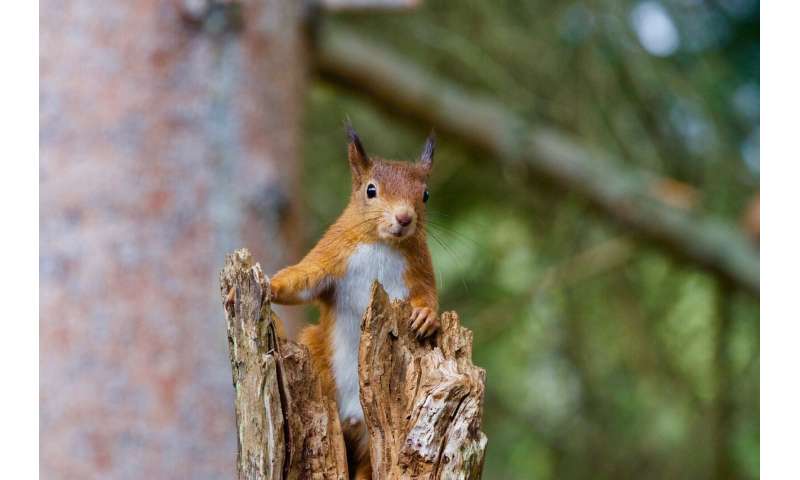
Survey finds gain in endangered red squirrel population

NOVEMBER 16, 2019

Credit: CC0 Public Domain

Wildlife officials say an endangered squirrel subspecies in southeastern Arizona is fighting its way back after much of its mountain habitat was burned by a 2017 wildfire.

The Arizona Game and Fish Department says the Mount Graham red squirrel's population is stabilizing, with a 4% increase recorded in September during an annual survey that produced an estimate of 78 squirrels, up from 75 in 2018.

According to the department, the population peaked at about 550 in the late 1990s. Before the 2017 wildfire, the population ranged between 200 and 300.

Terrestrial wildlife specialist Tim Snow says the results are encouraging though much work remains to help protect the squirrel population.

The squirrel is found only in upper elevation conifer forests of the Pinaleño Mountains.

Monday, 20 May 2019

Sea turtle survey shows the endangered animals are making a comeback – via Herp Digest


Hunting bans and other conservation efforts may be paying off — though warming oceans remain a serious threat.Sea turtle survey shows the endangered animals are making a comeback.


May 1, 2019, by Jaclyn Jeffrey- Wilensky, NBCNews.com

A new survey of sea life in the Pacific Ocean suggests that some endangered sea turtles are making a comeback. The survey showed that populations of green sea turtles along dozens of coral reefs in waters around Hawaii and other nearby regions either remained stable or increased from 2002 to 2015.

The scientists behind the survey, which was described April 24 in the journal Plos One, called the finding compelling evidence that conservation efforts like hunting bans are working.

“You often hear such bad and challenging news about the threats that our ocean faces,” said Kyle Van Houtan, chief scientist at the Monterey Bay Aquarium in Monterey, California, and leader of the team of researchers that conducted the survey. “There are places where there are a lot of sea turtles very close to shore. And that’s good news.”

Once hunted for their meat, green sea turtles were designated an endangered species in 1978. They're now protected under U.S. law and international treaties.

The same survey suggested that populations of hawksbill turtles, another protected species that is even more endangered, remain perilously low.

The survey effort began almost by accident, according to Van Houtan. On a research expedition to count fish living on reefs, divers with the National Oceanic and Atmospheric Administration found themselves counting turtles, too.

As it turns out, counting turtles in the water is more reliable than counting them on land, where only egg-laying females and their hatchlings are visible. “Really understanding the dynamics of turtle populations requires more attention to different age classes, and that means getting out on the water,” David Godfrey, executive director of the Sea Turtle Conservancy in Gainesville, Florida, told NBC News MACH in an email.

So Van Houtan and his colleagues decided to formalize the count. Over 13 years, divers trained to count green sea turtles and hawksbills visited 53 reefs across the Pacific, including spots in Hawaii, the Marshall Islands and American Samoa. Towed along by a slow-moving boat for a total of more than 4,500 miles, the researchers tallied more than 3,400 turtles.

The research represented a “Herculean effort,” Van Houtan said, adding, “This is the kind of data and the kind of study we’ve wanted for so long.”

Analysis showed that what the scientists call "turtle density" — the estimated number of animals per kilometer based on the survey counts — had increased by as much as 8 percent each year in some areas.

Turtle density increased the most in areas that tended to have few turtles at the start of the census period, including the Hawaiian Islands. The greatest turtle density was seen In the Pacific Remote Island Areas, uninhabited islands west of Hawaii, with an average of 3.62 green turtles per kilometer.

Hawksbill turtles, meanwhile, were outnumbered by green turtles by 11 to 1. “Their numbers have not really come back,” Van Houtan said of the hawksbills.

The highest turtle densities were seen in regions with plenty of seagrass and algae for the turtles to eat; minimal human presence; and, most important, water temperatures at 80 to 82 degrees Fahrenheit. Sea turtles flourish in that "Goldilocks" environment, which is neither too hot nor too cold.

But as the world's climate continues to warm, turtles and other marine species may be forced to relocate. “As the ocean warms with climate change, that ideal temperature is going to move toward the poles and away from the equator,” Van Houtan said. “As the temperatures change, those distributions are going to change.”

While Van Houten is wary of the effects this move will have on the greater coral reef ecosystem, he’s optimistic about the turtles’ odds for survival.

“They’re very resilient animals, and they’ve lived for millions of years,” he said. “The turtles aren’t going to roll over and die.”

Wednesday, 3 April 2019

The return of JellyWatch


March 20, 2019 by Kim Fulton-Bennett, Monterey Bay Aquarium Research Institute
Are jellyfish populations increasing around the world? Like the weather, jellyfish blooms are something that many people talk about, but few people do anything about. One exception would be MBARI's Steve Haddock, a marine biologist who has been studying jellies for more than two decades. Haddock recently rolled out a new and improved web site (jellywatch.org) that allows citizen scientists around the world to report jellyfish blooms.
Haddock first set up the JellyWatch site about 10 years ago, in an attempt to use citizen science to find out about jelly blooms worldwide. Designed by Haddock and two summer interns, the original JellyWatch site was a joint effort by MBARI and the Monterey Bay Aquarium.
As Haddock explained at the time, "People have been talking about jelly blooms increasing around the world, but we don't really have a lot of data on this. So it's hard to know how localized these events are. That's why we created this website. The idea is that everyday people can get involved in a real ocean research project. Their eyes are important instruments in this study."
The jellywatch.org site was quite popular; by March 2010 it already had observations from every continent except Antarctica. For years it allowed people from all over the world to report and share jellyfish sightings, as well as photos and observations of other transient ocean events.
Unfortunately, due to difficulties with funding and website hosting, the JellyWatch site went dormant in 2018. But just this month, Haddock rolled out a new and improved JellyWatch site, funded in part through a grant from the National Science Foundation.

Friday, 8 February 2019

Monarch butterfly population wintering in Mexico increases 144%

Monarch production will not be replicated next year, experts warn, as above average temperatures will cause problems
Associated Press in Mexico City
Wed 30 Jan 2019 21.28 GMTLast modified on Thu 31 Jan 2019 18.10 GMT
The population of monarch butterflies wintering in central Mexico is up 144% over last year, according to new research.
The data was cheered but scientists quickly warned that it does not mean the butterflies that migrate from Canada and the United States are out of danger.
This winter, researchers found the butterflies occupying 14.95 acres (6.05 hectares) of pine and fir forests in the mountains of Michoacán and Mexico states – an increase from 6.12 acres a year ago.
This year’s is the biggest measurement since the 2006-2007 period, said Andrew Rhodes, Mexico’s national commissioner for protected natural areas. A historic low of just 1.66 acres (0.67 hectares) was recorded in 2013-2014.
Jorge Rickards, director of World Wildlife Fund in Mexico which participates in the monitoring, cautioned that the butterflies, like other insects, see their annual populations rise and fall and the monarchs have had a declining trend. This year’s number was positive, but there is no guarantee it will continue.

Read on

Friday, 9 March 2018

India's endangered lion population increases to 600


March 6, 2018

The Asiatic lion population has come under threat due to hunting and human encroachment on its habitat

The endangered Asiatic lion, which only lives in one forest in India, has fought back from the verge of extinction, with its population increasing to more than 600, a minister said Tuesday hailing a major conservation campaign.

The lion, which once roamed across southwest Asia but is now restricted to the 1,400 square kilometre (545 square mile) Gir sanctuary in Gujarat state, was listed as critically endangered in 2000, with its population under threat due to hunting and human encroachment on its habitat.
A recent unofficial count found more than 600 lions in the area, up from 523 in a 2015 census, Gujarat's chief minister Vijay Rupani said.

"Our efforts for lion conservation with support of local people have yielded good results. The number of lions now in Gujarat has reached the 600 mark," Rupani said.

In the late 1960s only about 180 Asiatic lions were thought to survive but an improvement in numbers prompted conservationists to raise their assessment to endangered in 2008.

The population is currently growing at about two percent a year, according to A.P. Singh, a state forest and wildlife conservationist.

The cats are cousins of the African lion—they are believed to have split away 100,000 years ago—but are slightly smaller and have a distinctive fold of skin along their bellies.

Monday, 29 January 2018

Tasmania: new find of extremely rare red handfish doubles population to 80


Team of divers spent two days searching a reef, and hope more red handfish will be found

Wed 24 Jan 2018 06.27 GMTLast modified on Wed 24 Jan 2018 06.29 GMT

Divers in Tasmania have discovered a new population of red handfish, doubling the known population of the elusive and extremely rare fish and raising hopes that more may be found.

Until last week the remaining population of red handfish, Thymichthys politus, was believed to be confined to one 50m long reef in Frederick Henry Bay near Hobart in south-east Tasmania.

A recent survey at that site found eight individual fish at that site, prompting scientists to estimate the reef housed 20 to 40 handfish.

The second site, discovered on a similarly-sized bit of reef a short distance away, is estimated to house the same number of fish.

It was discovered after a member of the public reported seeing a red handfish in the area and a team of seven divers spent two days searching the reef.

“We were diving for approximately three and a half hours and at about the two-hour mark we were all looking at each other thinking this is not looking promising,” diver Antonia Cooper said.


Friday, 4 November 2016

Flying squirrel numbers soar in Helsinki


27 October 2016

Helsinki has seen a boom in the population of Siberian flying squirrels in the past two years, according to researchers.

The city's Environment Centre says that the number of flying squirrel habitats - where evidence of their activity has been spotted - has more than tripled in Helsinki's northwest, from a dozen during the last count, to 39 this year. The biggest increase has been in city's wooded Central Park, where there are now 25 habitats, compared to just six in 2014, the Yle public broadcaster reports. The squirrels are protected by law nationwide in Finland, where the main threat comes from habitat destruction.

"It's clear that after many decades of absence the flying squirrel has returned in droves to the capital," says Esa Nikunen, the centre's director. The animals are notoriously hard to spot, and researchers track them by looking for their droppings. The squirrels need mixed forests to thrive, and Mr Nikunen tells Yle that they've benefited from the careful management of Helsinki's woods.

Sunday, 6 March 2016

Orangutan population up but threats remain

By Helen BriggsBBC News

4 March 2016 

There are more Sumatran orangutans in the wild than previously thought, according to a new survey.

The latest estimate puts the population at about 14,600 - more than twice the previous figure, based on a survey of nests where the apes sleep.

Ecologists say the rise is not due to population growth but because some apes were missed in past surveys.

The species remains at serious threat from poaching and loss of forests, they report in Science Advances.

Orangutans are the world's largest tree-climbing mammal - and Asia's only great ape.

They were once found across South East Asia, but today are confined to two islands, Borneo and Sumatra.

Their forest habitat is rapidly disappearing, putting their future in jeopardy.

Higher estimate
Until now, the total Sumatran orangutan population was put at 6,600 individuals, based on data from 2004.

In the new survey in 2015, orangutans were found in unexpected places, including at higher altitudes in the mountains, forests recovering from logging and areas west of the Toba Lake that had not been previously examined.

An international team of scientists says that while there are evidently more Sumatran orangutans remaining in the wild than once thought, the species remains under serious threat.

It is very important that these findings are not interpreted as suggesting that numbers have increased, nor that their range has expanded, the group reports.

"The known current range is now 17,797 sq km (6,871 sq miles), roughly 2.56 times larger," said a team led by Serge Wich, professor of primate biology at Liverpool John Moores University.

"Since 2004, Sumatran orangutan numbers have undoubtedly declined, and they continue to do so at an alarming rate because of ongoing deforestation and poaching/persecution," they wrote in Science Advances.

Monday, 2 November 2015

Population of UK’s largest spider is increasing says charity


October 30, 2015

Population of UK’s largest spider, the fen raft spider, is increasing steadily thanks to a highly successful translocation project, the Royal Society for the Protection of Birds (RSPB) has revealed.
The increase in numbers of these spiders has been pegged as a success by Strumpshaw Fen nature reserve – a feat that was achieved in just three years after the spiders were first released in the reserve in 2012. According to officials at the reserve, they have already spotted over 480 nursery webs this season (July-October), compared with 184 in 2014.

Efforts of RSPB and Strumpshaw Fen nature reserve officials have helped spiders achieve a more secure position as a UK species and this is due to the excellent condition of the habitat and management of the grazing marshes at the nature reserve says Tim Strudwick, RSPB Site Manager at Strumpshaw Fen nature reserve.

The fen raft spider is a striking creature with a dark body and cream stripes down the side; they are very large and females can sometimes reach up to the size of the palm of a hand and prefer ditches and pools in chalky wetlands.


Sunday, 10 May 2015

Nepal rhino population increases by more than 100

Nepal’s rhino population in the Terai Arc Landscape has increased 21 per cent over the last fours according to figures released by the Nepali Government

There are now 645 rhinos there, compared to the 2011 estimate of 534, and numbers are the highest they’ve been since the early 1950s.

The increase in rhino numbers also comes just days after Nepal marked yet another 365-day period without a single rhino being poached – the third time in five years they’ve achieved this zero-poaching feat.

The rhino count was conducted from 11 April–2 May inChitwan National Park, Parsa Wildlife Reserve, Bardia National Park, Shuklaphanta Wildlife Reserve and their buffer zones in the Terai Arc Landscape. 

It was led by the government’s Department of National Parks and Wildlife Conservation and Department of Forests, in collaboration with WWF Nepal and National Trust for Nature Conservation.

Thursday, 19 February 2015

Mexican Wolf Population Now Tops 100 in US

by Megan Gannon, News Editor | February 17, 2015 04:43pm ET

Once driven to the brink extinction in the United States, the population of Mexican wolves has doubled in the past five years.

There were at least 109 wild Mexican wolves, or lobos, in the Southwest in 2014, up from 83 in 2013, U.S. Fish and Wildlife Service (FWS) announced Friday (Feb. 13). It's the fifth year in a row the small population has grown. In 2010, there were just 50 Mexican wolves in the wild.

According to the latest wolf census — conducted through radio tracking, aerial surveys and sightings in the field — there are now 19 packs, with at least 53 wolves in New Mexico and 56 wolves in Arizona. The 2014 total also included 38 wild-born pups that survived through the end of the year, FWS officialssaid in a statement

Tuesday, 20 January 2015

India's tiger population sees 30% increase

20 January 2015 Last updated at 11:16

India said it was willing to donate tiger cubs to the international community to help conservation efforts

India says it now has almost a third more tigers than it did four years ago.

Presenting the findings of the latest tiger census, Environment Minister Prakash Javadekar said the tiger population had risen from 1,706 in 2011 to 2,226 in 2014.

He said a number of government initiatives to streamline tiger conservation were behind the increase.

India is estimated to be home to around 70% of the world's tigers.

Mr Javadekar described the results of the census as a "huge success story".

'Great news'

"Never before has such an exercise been taken on such a massive scale where we have unique photographs of 80% of India's tigers," he told journalists in New Delhi.

"While the tiger population is falling in the world, it is rising in India. This is great news," he added.

Tuesday, 2 December 2014

Population of potoroo once thought extinct passes 100

Numbers of Gilbert’s potoroo – the world’s rarest marsupial – triple in the 20 years since species was rediscovered in Western Australia

Tuesday 2 December 2014 02.29 GMT

The population of the world’s rarest marsupial has grown to more than 100 in the 20 years since the Gilbert’s potoroo species was rediscovered in Western Australia’s Great Southern region.

The state’s environment minister, Albert Jacob, said there had been intensive conservation efforts made since the discovery of 30 animals at Two Peoples Bay nature reserve near Albany in 1994 and there were now more than 100 across three colonies.

“Prior to its rediscovery, the species was thought to have been extinct for more than a century, with the last recorded specimens collected in the late 1870s,” he said.

Recovery efforts included moving 10 potoroos to the predator-free Bald Island between 2005 and 2007. In 2010, nine potoroos were released into a predator-free 380-hectare enclosure in Waychinicup national park, 25km east of Albany, with more animals introduced into the park over the past four years.

Tuesday, 3 June 2014

Indian rhino populations up over 25% in last 7 years

Posted by: Leya Musa / 19 hours ago

After a surge in rhino poaching this year at Kaziranga National Park the forestry department has released a paper to allay fears for the species. The paper shows that despite an increase in poaching of the one-horned rhino the population in Assam is up by 27% since 2006 and the state is on target to meet the Indian rhino vision target of 3000.

The ‘White Paper on Wildlife Conservation in Assam’ was released today by the Environment and Forest Minister Rockybul Hussain. It shows that the current population of one-horned rhinos is 2544. This is up from the last census of 2006 when the state of Assam had 2006, giving a population growth rate of 4.6% a year. This is above the target of the Indian Rhino Vision of 3.25%.

The Kaziranga National Park, the stronghold of the species, now has 2329 with the remaining 215 rhino living in other parts of the state.

Related Posts with Thumbnails

ShareThis