Showing posts with label gene pool. Show all posts

Monday, 14 November 2016

Two-headed sharks are becoming more common and no one knows why

A large reduction of the gene pool caused by overfishing is blamed for the deformity 
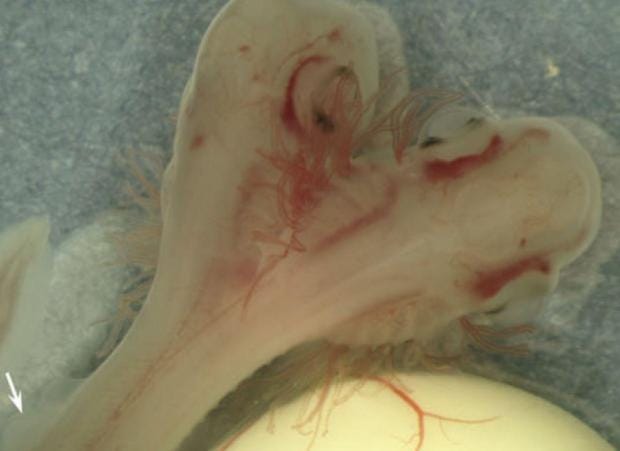
A two-headed catfish shark embryo discovered in a Spanish laboratory
 
Matt Payton
Thursday 3 November 2016


An increasing number of two-headed sharks are being reported in the wild, leaving scientists unable to explain why.

Over the last few years, a growing number of these genetic aberrations have been discovered and examined by scientists.

Professor Valentín Sans Coma, from the University of Malaga, studied the embryo of a two-headed catfish shark in a laboratory condition alongside 800 other shark embryos.

He has claimed a genetic disorder is the most reasonable explanation for the mutation as the unborn fish were not exposed to any infection, chemicals or radiation, reports the National Geographic.

Regarding wild sharks, scientists have blamed the mutation on a cocktail of factors including viral infections, metabolic disorders and pollution.

After studying a two headed smalleye smooth-hound shark and a two-headed blue shark, marine scientist Nicolas Ehemann claimed overfishing was probably to blame.
 

Sunday, 20 April 2014

Diverse gene pool critical for tigers' survival, say experts

Date:
April 16, 2014

Source:
Stanford University

Summary:
Increasing tigers' genetic diversity -- via interbreeding and other methods -- and not just their population numbers may be the best solution to saving this endangered species, according to research. Iconic symbols of power and beauty, wild tigers may roam only in stories someday soon. Their historical range has been reduced by more than 90 percent. But conservation plans that focus only on increasing numbers and preserving distinct subspecies ignore genetic diversity, according to the study. In fact, under that approach, the tiger could vanish entirely.


Thursday, 31 January 2013

Global Gene Pool of Goat Is Seriously Under Threat


Jan. 23, 2013 — Amongst the range of domestic livestock species, the goat is not just the 'black sheep' but a resource of survival in impoverished countries, and many breeds are at great risk of disappearing. This is the case according to researchers of the Regional Service of Agro-Food Research and Development in their first monographic study tackling the global impact of this species. 

A study from the Regional Service of Agro-Food Research and Development (SERIDA) has analysed the situation of the global goat population.

The study took into account the state of different breeds, the multiple implications of their conservation, the interaction with other animal species (wild and domestic) and the consequences of goat grazing from an environmental point of view.

"The risk of the gene pool of the goat disappearing has increased due to intensive animal husbandry systems that use a very limited number of breeds. Strangely enough, the biggest loss in the genetic resources of indigenous animals has been observed in Europe, although the situation is unknown in many areas," as explained to SINC by Rocío Rosa García, researcher at SERIDA and coauthor of the study.

The bad reputation given to goats stems from one of its main virtues: it has an extraordinary capacity to adapt to the most difficult of environmental conditions in places where other domestic livestock species would not survive.

"It is a reality that the grazing of these animals can cause damaging effects on the environment but ecosystems become overloaded because of inadequate practices of handling," ensures the scientist. 

Related Posts with Thumbnails

ShareThis