Showing posts with label Lancashire. Show all posts

Wednesday, 24 April 2019

Feeding red squirrels peanuts may make natural diet a tough nut to crack


APRIL 1, 2019
by Shelley Hughes, University of York
New research suggests a population of red squirrels on the Lancashire coast may have developed weaker bites after snacking on peanuts.
The researchers suggest that the changes in bite strength of the squirrels in Formby could have been brought about by their softer diets, reducing their ability to gnaw through the tough-to-crack nuts they eat naturally – such as pine cone seeds, hazelnuts and beech nuts.
The findings have important implications for conservation efforts for red squirrels, which were once widespread across mainland Britain. They have suffered severe population decline from the 1920s onwards due to a loss of woodland as well as viruses and competition from grey squirrels.
Bite force
The researchers, from the University of York and National Museums Scotland, compared the lower jaws of red squirrels from surviving population pockets in the UK (which are mainly in northern areas and on offshore islands) as well as a sample from central Europe.
Their analysis has indicated that Formby squirrels, which are managed by the National Trust and the Lancashire Wildlife Trust, appear to have a less efficient temporalis muscle than all the other red squirrel populations. In rodents this muscle is used for rapid closing of the jaws to generate a powerful bite force.
Dr. Philip Cox from the Department of Archaeology and the Hull York Medical School at the University of York, said: "We found that the shape and function of the lower jaws of the Formby squirrels were different from all of the other red squirrel populations we looked at.
"They are the only group of red squirrels in the study that were given supplementary food and it is possible that the changes to their jaws have been brought about by diet.
"Many mammals- and especially rodents- have the capacity to evolve at very fast rates under changing environmental conditions. The changes to the gnawing ability of Formby squirrels could be an evolutionary response which has occurred over a few generations of squirrels or it could be an adaptive response which occurs over the lifetime of individual squirrels exposed to supplementary feeding."

Sunday, 24 July 2016

Rare bog butterfly flutters back from brink

By Jonathan Webb Science reporter, BBC News

23 July 2016 


A small bog in Lancashire is once again home to a rare species of butterfly, for the first time in 100 years.

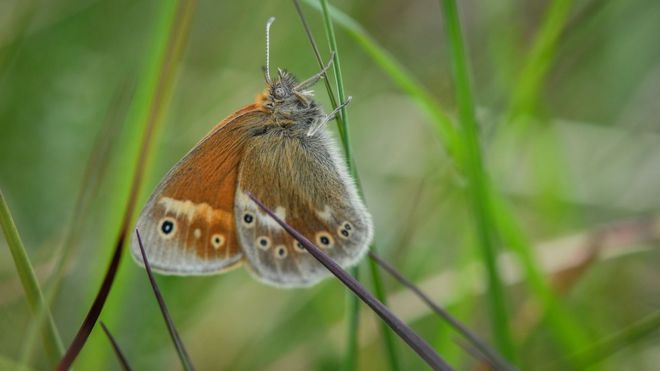
The large heath butterfly has been disappearing from northern England, where it was once common.

But after three years of careful captive breeding, scientists from Chester Zoo say they have established a stable wild colony at Heysham Moss.

Only two other locations in Lancashire play host to this fluffy brown species, which thrives in low, damp boglands.

Chester Zoo
"They've not been at Heysham for at least 100 years," said Heather Prince, an invertebrate keeper at the zoo.

"They've found museum specimens that date back to the 19th Century, labelled Heysham, so we know they were there historically."

But in Lancashire and elsewhere, disruption of their peatland habitats saw numbers plummet, Ms Prince explained. Drainage is good for farming and housing, but bad for bog-based bugs like the large heath butterfly.

"They used to be so common that one of its names was the Manchester argus. But obviously now in Manchester, you'd probably never ever see it."

Sunday, 17 April 2016

UK couple discovers $70,000 chunk of whale vomit

APRIL 14, 2016

by Chuck Bednar

Typically, when a husband and wife encounter vomit, they’re far from excited – but when said vomit comes from a whale, making it worth up to $70,000 (£50,000) due to its rarity and desirability as an ingredient in perfumes (that’s a different story entirely).

According to The Guardian and the International Business Times, Lancashire natives Gary and Angela Williams were walking along Middleton Sands beach when they picked up the pungent scent of rotting fish. Rather than turning around and heading for more pleasant-smelling pastures, they chose to follow the odor and found a grey-colored lump about the size of a rugby ball.

They had read about whale vomit, also known as ambergris, in their local newspaper and decided to wrap the object up in a scarf and take it home. Perfume makers use ambergris in their products to try to make scents last longer, but the substance is very rare, and thus can be quite valuable. In this case, the 1.57 kg lump found by the couple could net them well over $70,000.

“It was a bit of a shock,” Gary Williams told the Daily Mirror. “It was down a section of the beach where no one really walks. It smells bad though. It’s a very distinctive smell, like a cross between squid and farmyard manure. It feels like a rock hard rubber ball. Its texture is like wax, like a candle. When you touch it you get wax sticking to your fingers.”

Sunday, 13 July 2014

Three men from Colne jailed for badger and cat cruelty

12 July 2014 Last updated at 12:13

Three men who set dogs on a badger and a cat have been jailed after video of the cruelty was discovered on one of their mobile phones.

Footage showed a badger being attacked and a cat being shaken from a tree, while barking dogs waited below.

Joshua Varey, Shaun Mullens and Paul Ashworth, all from Colne, near Burnley, were jailed at Burnley Magistrates' Court on Friday.

The RSPCA said it was unclear if the badger or cat survived the attacks.

Inspector Carroll Lamport said: "These men were responsible for a vicious, deliberate and vindictive level of animal cruelty.

"We'll never know whether the cat or badger in these clips survived, or whether they were torn to shreds by the dogs set upon them."

'Untold suffering'

Varey, 24, of Duke Street, was sentenced to 126 days in prison while 22-year-old Mullens, of Leach Street, was jailed for 114 days.

Both admitted fighting a dog with a badger, and were banned from keeping animals for 10 years.

Sunday, 17 November 2013

Three not so little pig ‘fugitives’ caught after spending month away fattening up

Three little pigs from Lancashire returned from a jaunt away all fattened up after managing to avoid being eaten by a big bad wolf.

The runaways had absconded from Bowland forest, near Clitheroe, almost a month ago, with the worst feared for the saddlebacks.

But the six-month-old sows were spotted recently looking quite different from when they had left, having gained a lot of weight.

The animals were either trying to change their appearance so they wouldn’t be recognised, or more likely had been gorging themselves on acorns because they were greedy.

‘We found them on moorland belonging to another farmer and that farmer, the pigs’ owner and myself were able to capture the three after a bit of pig wrestling,’ said Lancashire Wildlife Trust’s Phil Dykes.

‘They are now safely back in the woodland, but they seem to have almost doubled in size since they went missing, probably because of the large amounts of acorns around at the moment.’

The pigs were being used as part of a grazing trial at the woodland.

Monday, 8 July 2013

Bolton man fined for destroying a bat roost

Fined for destroying a bat roost
July 2013. A Chorley Magistrates Court heard a case against Mr David Dalton, 33, of Bolton, who had been charged with destroying a bat roost. Following a guilty plea Mr Dalton was fined £540 with £100 costs and a £54 surcharge (Maximum penalties for destroying a bat roost are six months imprisonment and or a £5000 fine).

Offences against bats are one of the UK's wildlife crime priorities of identical standing to the illegal trade in endangered species and the persecution of birds of prey.
Brown long-eared bats are particularly loyal to their roost sites and will return
 to the same site each year for many years so retaining and protecting
 bat roost sites is essential for the survival of the species.
 The Bat Conservation Trust is the only national organisation solely
 devoted to the conservation of bats and their habitats in the UK.
 It runs a national helpline to provide advice and information on bats.
 The Bat Helpline receives more than 9,000 calls a year.
Tel: 0845 1300 228 or visit www.bats.org.uk .

Demolished building he knew contained bats
Mr Dalton is the owner of property in Rivington Lane that he wished to develop. He engaged the services of an ecological consultant who surveyed the buildings and found a roost of brown-long eared bats. To allow the building to be developed a licence would have been required outlining how the needs of bats were being considered. Mr Dalton demolished the building without a licence and destroyed the bat roost.

‘Ignored the law'
Wildlife Crime Officer for Lancashire Police Mark Thomas said: Lancashire Police take every report of wildlife crime very seriously. "We have worked hard to bring this case to court, people can't just start carrying out building renovation work and think they don't have to have the correct surveys and licences to cover the work they intend to do. The reason they have to do this is to protect certain species in this case bats and their roosts. Working together with the Bat Conservation Trust, we put together a package for criminal proceedings against a local land and property owner Mr Dalton from the Rivington area who chose to ignore the law and the codes of practice. It is the responsibility of property owners and developers to ensure all building work has had appropriate ecological surveys undertaken."

Pete Charleston Investigations Officer for the Bat Conservation Trust explains: "Bat roosts are very important sites for conservation. The loss of bat roosts is thought to be one reason why bat populations declined dramatically in the 20th Century. By following conditions set out in a license the impact of building, development and demolition on bats can be minimized. If you plan works and follow the mitigation measures as outlined in the license, projects can run smoothly; if you don't it is a serious offence that puts bat populations at risk." The Bat Conservation Trust have provided support to Lancashire Police during this investigation and are very grateful both to the Police and the Crown Prosecution Service for their efforts in bringing this case to court.

Thursday, 2 May 2013

Lancashire kangaroo or wallaby sighting investigated

Police in Lancashire have been looking for a mystery marsupial after people reported seeing one near Garstang. 

Officers heard about a kangaroo crossing a carriageway in Winmarleigh while they were running a rural crime operation in the area at the weekend. 

Lancashire Police's Dave Kerfoot said he had been sceptical but added that seeing a photo of the animal showed he may have been "overly suspicious". 

He said police were investigating where the animal was from and who owned it. 

Kangaroo or wallaby? 

· Kangaroos and wallabies are marsupials and are closely related, though adult kangaroos are larger than wallabies 
· They can be identified via their teeth, which are different as kangaroos mainly eat grass while wallabies mostly eat leaves 
· They are native to Australia and have been introduced in the UK in parks, zoos and farms 

Source: Australia Zoo 

He added that he had "suspected that it was residents wanting a Winmarleigh Wallaby to rival the Pilling Panther". 

The Pilling Panther refers to rumoured sightings of a wildcat which is said to stalk the area around near the village of Pilling, which lies to the west of Winmarleigh. 

A police spokesman said there were suggestions that the animal was not a kangaroo, but a wallaby, which may have escaped from a nearby farm. 

He added that the weekend operation had seen officers stop and check 130 vehicles and arrest one driver on suspicion of drinking and driving.

Tuesday, 12 June 2012

Peacocks invade Lancashire village


Forget divebombing seagulls, there is a new menace stalking the streets – peacocks.
An ostentation of more than a dozen peacocks and peahens has invaded Banks, near Southport, devouring fruit and vegetables in people's gardens, devastating flower beds and leaving droppings on cars and driveways.
Villagers are at a loss to explain where the colourful birds have come from and their mysterious arrival follows a recent plague of feral chickens which were driven out after months of running wild on the estate.
The sight of sparring peacocks in the middle of a road has even forced traffic to a halt on numerous occasions since they took up residence in the well-to-do community.
Jean O’Hanlon, 71, told the Daily Mail: "They’re absolutely beautiful but they’re a damn nuisance. They make the most horrendous noise, all through the night."
She said that she often tries to chase the birds with a feather duster or her husband's walking stick, but they "don't seem frightened at all".
On one occasion she heard "an almighty crash" and rushed outside to find that a large peacock had leapt onto a neighbour’s greenhouse and fallen through the glass.
"They’re everywhere,"she said. "Some of us have got water pistols. We thought it would be a way of frightening them without hurting them, but that doesn’t work either.
"In the road, they sit down and won’t budge. Cars have to stop until they decide to move."
One woman complained that a peacock pecked a dent in her car when it caught sight of its reflection in the paintwork and began to spar with it.
Neighbour Cathy Bell, 62, said: "They are marauding daily through our tidy gardens, trampling on our bedding plants and pooing on the lawns."
Despite the complaints, some residents have welcomed the birds and have even been spotted feeding them.
There are various theories about their origin with some claiming they have come from a nearby farm, which was also blamed for the feral chicken plague.
Another explanation is that they are the descendants of a pair believed to have been kept in the grounds of a nearby mock-Tudor manor house, demolished in 2009.
Related Posts with Thumbnails

ShareThis