Showing posts with label wallaby. Show all posts

Wednesday, 7 October 2015

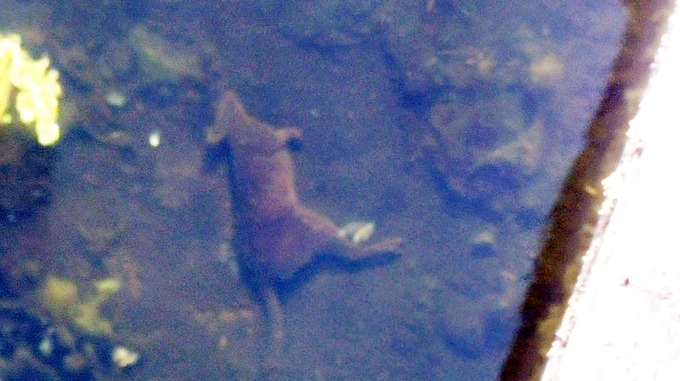
Fishermen find dead wallaby in River Exe


6 October 2015 at 2:55pm

A pair of fishermen have found a dead wallaby in the River Exe in Devon.

The wallaby was found in the River Exe in Devon
 Credit: SWNS
Matt Welham and Richard Williams caught the animal while trying to catch pike.

The animal is believed to have been in the water for several days. It's thought to have escaped from a nearby farm.

Matt said: "As it was pike we were bottom fishing and I got a what seemed like a bite. I hauled it in and it looked at first as if there was a dead cat on the line. When it got closer and out of the water it looked like a kangaroo. I guessed it was stuffed but when we saw it close up we realised it was real and a wallaby. It must have weighed about 25lb and we reckoned it had been in the water for about two days tops."

The pair, who are both from Exeter, were fishing close to the Mill on the Exe pub in the city at the time.

Wallabies, which are known as reasonable swimmers, are usually found in Australia or New Guinea.

Monday, 28 September 2015

Wallaby loose in English outback after giving police the hop

Public warned not to approach “strong and powerful” animal last seen heading for woodland
Sunday 27 September 2015 12:48 BST
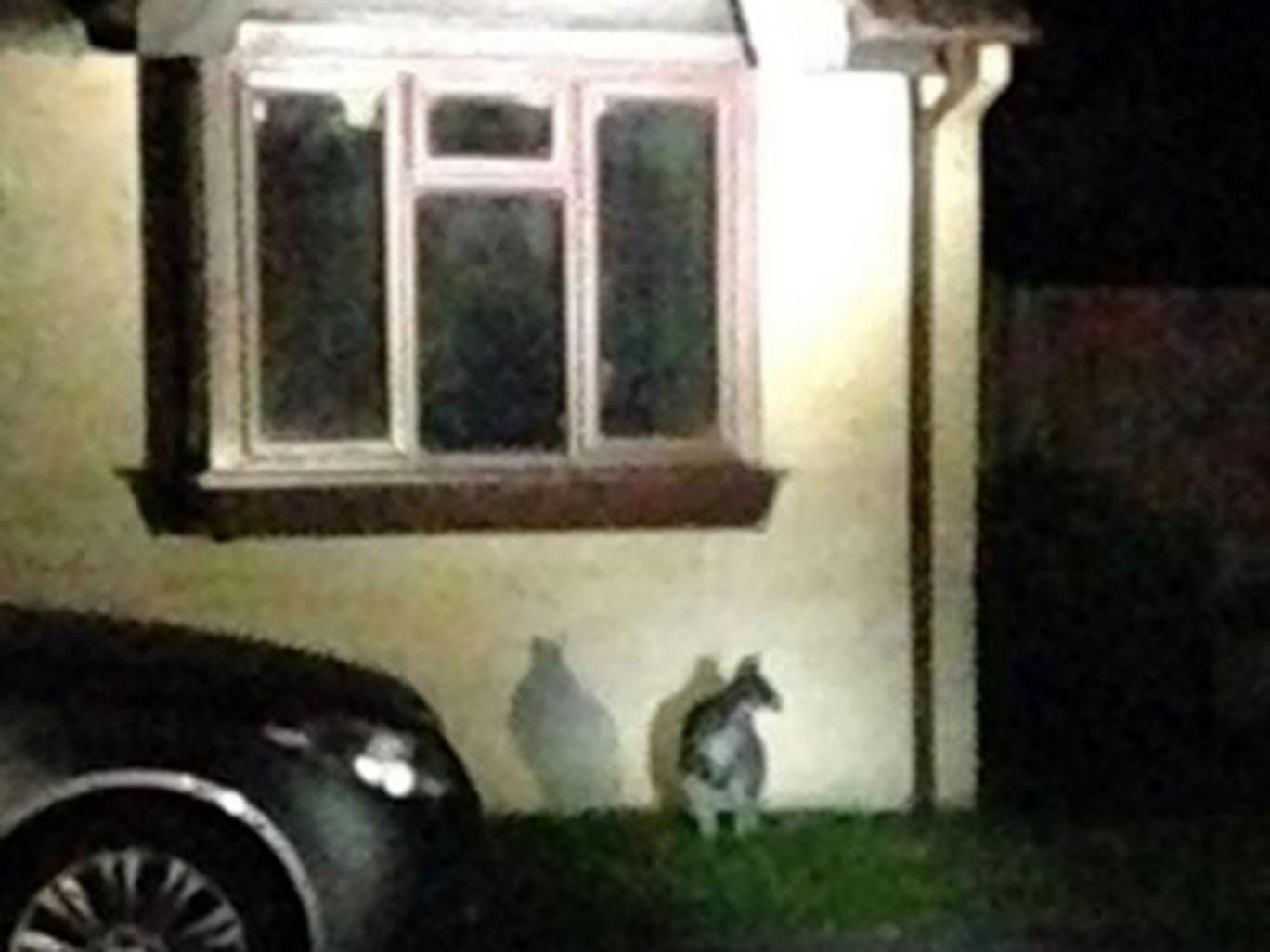
A picture of the wanted wallaby on the loose in Dursley,
Gloucestershire, released by police PA
A wily wallaby is loose in the English outback after giving police the hop. 

Officers cornered the Australian marsupial after it was spotted in the small town of Dursley, Gloucestershire, on Saturday night.

But the crafty creature – at first mistaken for a kangaroo - somehow evaded capture and bounced off towards woodland around the nearby village of Woodmancote.

Police, who covered the bizarre chase in a series of tongue-in-cheek Facebook postings, have warned the public not to approach the ‘strong and powerful’ animal.

Tuesday, 30 June 2015

Orphaned tree kangaroo raised by surrogate wallaby mother in Adelaide zoo

World-first surrogacy between a wallaby and a kangaroo occurred after the tree kangaroo’s mother was killed by a falling branch

Australian Associated Press

Tuesday 30 June 2015 02.35 BST

An orphaned tree kangaroo has been raised by a surrogate wallaby mother at Adelaide zoo, in what vets say is a world first.

The orphaned tree kangaroo was named
 Makaia and lived with its surrogate
 mother for about three months. 
Photograph: Adelaide Zoo
The cross–species surrogacy between a wallaby and a kangaroo has never been attempted before but was forced on the zoo when the the tree kangaroo’s mother was killed by a falling branch.

“We had no idea if the yellow-footed rock-wallaby would accept the tree kangaroo joey, but if we wanted to save the joey we had to try our luck,” veterinarian David McLelland said.

The tree kangaroo was orphaned in November and was too young to be reared by hand.

The zoo had previously reared wallabies using surrogate mothers from other wallaby species, but had never used the technique to have a wallaby mother raise a joey tree kangaroo.

The cross-foster procedure, to get the tree kangaroo joey to latch on to the new teat, ran smoothly and tiny ripples of movement over the next few days confirmed the joey was alive and thriving.

Friday, 8 August 2014

Wallaby spotted in Kingsclere gardens

5 August 2014 Last updated at 13:36

An animal normally associated with Australian forests has been spotted in Hampshire gardens.

Police received calls from Kingsclere about a wallaby on the loose.

There have been five reported sightings so far.

Police were investigating but the RSPCA said there were established groups of wallabies in the wild so unless the animal was in distress there was no cause for concern.

Calie Rydings, of the RSPCA, said: "What people might not be aware of is that wallabies are established in the wild in Britain. There have been established populations in this country since the 1940s. There is no need to be alarmed."

An alpaca was on the loose in the same area earlier, but police said they believed they had found its owner.

Saturday, 1 February 2014

Wallaby's perception of color is more similar to a dog than a quokka

Date: January 30, 2014

Source: Curtin University

Summary: Biologists have recently discovered that a wallaby's perception of color is more similar to a dog than a quokka, sparking questions as to why marsupial color vision has evolved so selectively. By developing a pokies-like game for the wallabies, the research was able to determine exactly what the animals saw and how their color perception differed from other species.


Thursday, 14 November 2013

Yet another wallaby loose in London: Second animal spotted in same cemetery as first that died after being rescued by RSPCA

  • A second wallaby has been captured in Highgate Cemetery in north London
  • It was treated for a sore foot and has now been rehomed
  • First was caught a fortnight ago by RSPCA, but later died during surgery
A second wild wallaby has been found and captured after being spotted hopping around Highgate Cemetery.

The first was caught two weeks ago by the RSPCA. It had suffered a broken foot, and died during surgery last Thursday.

A second wallaby was found in the cemetery - the final resting place of Karl Marx - on Friday and was treated for a sore foot and has now been rehomed.


Monday, 28 October 2013

Wallaby spotted in Highgate Cemetery


Footage taken at Highgate Cemetery on Monday shows what appears to be a wallaby skulking in the bushes and around gravestones.

Visitor and volunteer coordinator Melanie Winyard said someone first spied the marsupial, which belongs to the same family as the kangaroo, on Sunday.

“It’s quite extraordinary and so unexpected,” she said. “The West Cemetery is quite secure so it’s a mystery how he got in there but now he’s in, it’s quite a good place to be as he won’t be crossing the roads.”

“To spot a wallaby in London is quite strange.”

Saturday, 24 August 2013

Wallaby spotted bouncing down country lanes near Slaithwaite

A bouncing wallaby has been making motorists jump, bounding along the leafy lanes of Last of the Summer Wine Country.

The latest sighting of the Australian exile was on Marsden Lane, outside the village of Slaithwaite, near Holmfirth.

One driver who managed to snap a picture of the marsupial said: “I got the shock of my life. It was just there in the road.

“I kept sounding my horn but it wouldn’t move. Eventually it just skipped off.”

Locals have been left wondering whether the wayward animal is Billy, a wallaby who went missing from his home at a nearby farm in 2010.

Then, Billy went on the run for a week before he was tracked down and reunited with is female companion, R Betty. In that incident, he escaped despite his compound being surrounded by a 2m fence.

West Yorkshire Police said they have had no reports of wallaby-related road incidents in that area.

Sunday, 16 June 2013

How Colin, the escaped white wallaby gave six startled policemen the slip in midnight chase before hopping back home


Colin the wallaby escaped from his pen in Solihull last night 
His dash for freedom sparked a police hunt involving six officers 
He was eventually found back home five hours later 


PUBLISHED: 16:40, 14 June 2013 | UPDATED: 18:14, 14 June 2013

A runaway wallaby sparked a police hunt involving six officers after he was spotted making a dash for freedom near Birmingham

Three-year-old Colin jumped a 6ft fence to escape from his pen in Solihull, West Midlands, before hopping back home five hours later, his owners revealed today.
The meandering marsupial escaped last night and sightings were reported over four miles away from the half-acre field he shares with seven other wallabies.

Police were called when a shocked motorist spotted the unusual sight and filmed the fugitive on his mobile at around 11.45pm.

Despite six officers turning up to try and catch Colin he disappeared into the night and it was down to owners Jon Cloke, 46, and wife Angela, 46, to track him down.

He was eventually found cowering in a field just yards from where he had originally escaped after his countryside walkabout. 

Mr Cloke drove around for 90 minutes in the dark and cornered Colin before returning at sunrise to capture him.

Today he said: 'The police rang us about 12.30am. There’s no-one around here who owns wallabies so I knew it was ours.

Mr Cloke, who breeds the animals at his farm, said he had never known one to escape before.

He said: 'They didn’t tell me how far it had got but it was spotted near a lane by Balsall Common so it was a few miles away. He must have been missing for about five hours.

'When I found it, it was nearly back and was in the field near where they are all kept – so he’s pretty much much made his own way home. They are quite shy so it’s odd that somebody got a picture of him.'


Thursday, 2 May 2013

Lancashire kangaroo or wallaby sighting investigated

Police in Lancashire have been looking for a mystery marsupial after people reported seeing one near Garstang. 

Officers heard about a kangaroo crossing a carriageway in Winmarleigh while they were running a rural crime operation in the area at the weekend. 

Lancashire Police's Dave Kerfoot said he had been sceptical but added that seeing a photo of the animal showed he may have been "overly suspicious". 

He said police were investigating where the animal was from and who owned it. 

Kangaroo or wallaby? 

· Kangaroos and wallabies are marsupials and are closely related, though adult kangaroos are larger than wallabies 
· They can be identified via their teeth, which are different as kangaroos mainly eat grass while wallabies mostly eat leaves 
· They are native to Australia and have been introduced in the UK in parks, zoos and farms 

Source: Australia Zoo 

He added that he had "suspected that it was residents wanting a Winmarleigh Wallaby to rival the Pilling Panther". 

The Pilling Panther refers to rumoured sightings of a wildcat which is said to stalk the area around near the village of Pilling, which lies to the west of Winmarleigh. 

A police spokesman said there were suggestions that the animal was not a kangaroo, but a wallaby, which may have escaped from a nearby farm. 

He added that the weekend operation had seen officers stop and check 130 vehicles and arrest one driver on suspicion of drinking and driving.

Thursday, 28 February 2013

Wallaby rescued from car park rooftop

A wallaby is recovering after he was rescued from a precarious perch on the rooftop of a multi-storey car park in Australia.

Six wildlife workers set up nets to prevent the marsupial jumping off the car park after he hopped onto a ledge next to a 50 metre drop.

Fortunately, the wallaby jumped the other way - to safety - and was tranquilised and then taken to a wildlife shelter, following the rescue in suburban Melbourne.

The wallaby will be monitored for a few days to make sure he has got over the stress of his adventure before being released back into the wild.

Wildlife Victoria worker Manfred Zabinskas, who darted the wallaby, said he had some paw injuries from hopping on concrete but his prospects for recovery were good.

"He could have jumped either way when he was on the ledge," Mr Zabinskas said.


Wednesday, 3 October 2012

Odessa Zoo adopts wallaby found wandering city streets


Ukraine is down south, hardly Down Under… but that didn’t stop a wallaby turning up in Odessa!

The small kangaroo was found by the tourists, who took the fury stranger to the city zoo.

The young male was distressed, but otherwise healthy. 

Zoo keepers say he's in high spirits again now. 

It's thought the animal was abandoned after being bought on the black market.

The zoo has decided to adopt the wallaby…

The only problem now is to decide on a name!

Monday, 14 May 2012

Dog walker bumps into wallaby


A dog walker was stunned to come across a wallaby in the wild in Kent - and managed to film the encounter.
Alex Pooley, 29, and her dog Shackleton bumped into the creature on a farm track in Pluckley, reports Kent Online.
She said: "We were in a field near the train station and I saw what I thought was a giant hare, but then it moved and started hopping.
"I was a bit surprised to say the least and the dog was off the lead at the time and he went off to investigate. They ran around for a couple of minutes and then he came back and I put him on the lead.
"Then I saw it hopping down the path towards us. It seemed pretty friendly and quite intrigued because it came right up to us."
Grabbing her mobile phone, Ms Pooley managed to film the animal before it once again hopped off.

Wednesday, 29 September 2010

This seal was declared extinct in 1892. So what is it doing alive and well today?

Good news for Guadelupe fur seal, Bahian tree rat and bridled nailtail wallaby – but survey warns rate of extinctions still accelerating

Ian Sample, science correspondent
The Guardian, Wednesday 29 September 2010

The Guadalupe fur seal was feared extinct, gone the way of the dodo after being slaughtered by Russian and American hunters for their skins. None could be found at breeding grounds and as sightings elsewhere tailed off the species was consigned to history.

So why are there thousands of Guadalupe fur seals swimming off the coast of Mexico now? As naturalists gladly admit, reports of the species' demise at the end of the 19th century were premature. Small numbers of the animals clung on in island caves and were rediscovered only decades later. The population is now thriving, with the latest estimate putting their number at 15,000 or more.

But the case of the Guadalupe fur seal is far from unique – and more animals feared extinct could be waiting to be rediscovered. A survey of the world's mammals published today reveals that more than a third of species once feared extinct have since been spotted in the wild, in one case 180 years after the last confirmed sighting. Rare mammals that were considered dead but later rediscovered were typically missing for 52 years.

The Guadalupe seal was hunted to apparent extinction in 1892, but a tiny colony was spotted on the island by two fishermen in 1926. After a failed attempt to sell two of the animals to San Diego zoo, one of the fishermen went back to slaughter the colony out of spite. He later turned up in Panama to sell the skins, but was killed in a bar brawl. The seals were only rediscovered and protected when a zoologist tracked down the second fisherman, who revealed their location on his deathbed in 1950.

One rodent, the Bahian tree rat, which lives in forests on the Brazilian coast, went missing in 1824. Despite efforts by conservationists, the animal was not rediscovered until 2004. The bridled nailtail wallaby was once common in eastern Australia but seemed to die out in the 1930s. It was spotted in 1973 by a contractor who was preparing to clear an area of land. After he raised the alarm, the habitat was bought by the local parks service to save the animal. Another creature, a small marsupial called Gilbert's potoroo, was missing for 115 years before it was rediscovered in the south of Western Australia in 1994.

Diana Fisher, who led the survey at the University of Queensland, said the number of mammals going extinct was still accelerating despite large numbers of lost animals being found.

Conservation experts have already warned that the world is in the grip of the "sixth great extinction", as imported species and diseases, hunting and the destruction of natural habitats deal a fatal blow to plants and animals.

Writing in the journal Proceedings of the Royal Society B, Fisher lists 180 mammals reported as extinct, feared extinct, or missing since the year 1500. Of these, 67 were later found to be alive and well. Animals that were picked off by new predators were rarely rediscovered, while those threatened by a loss of habitat or hunting by humans were more likely to be holding on in small colonies, she found.

The survey highlights the uncertainties in lists of extinct species, but Fisher said it should help conservationists target their searches for missing species by focusing on those most likely to be alive.

More than 25 large-scale searches have failed to find thylacines, the carnivorous, dog-like marsupials that have not been seen in Australia for nearly 80 years.

Fisher said her analysis puts the chance of the species surviving at "virtually zero". Mammals that were hunted to extinction before the 20th century, such as Steller's sea cow, the Falkland Islands wolf, sea mink and the large Palau flying fox are also unlikely to be found now, Fisher said.

"Conservation resources are wasted searching for species that have no chance of rediscovery, while most missing species receive no attention," Fisher told the Guardian. "Rather than searching ever more for charismatic missing species, such as thylacines in Australia, it would be a better use of resources to look for species that are most likely to be alive, find out where they are, and protect their habitats," she added.

According to Fisher's survey, the most likely missing mammals to be found alive are the Montane monkey-faced bat in the Solomon Islands, Alcorn's pocket gopher, which was last seen in the high forests of Mexico, and the lesser stick-nest rat, a large, soft-furred desert animal from Australia.

Four other 'extinct' species

Bahian tree rat


A small rodent that lives in the coastal forests of Brazil. Was missing and presumed extinct for 180 years from 1824. A year-long search of the area in 2004 found only one of the animals living in the region. The species is critically endangered and is considered at threat from ongoing deforestation.

Bridled nailtail wallaby

Once common in eastern Australia, this nocturnal species was thought to have died out in 1930. The animal was rediscovered in Queensland after a contractor recognised it from a picture of extinct creatures published in a women's magazine. It gets its name from the horny, pointed tip on its tail. It was hunted for its fur, but more recent threats include foxes and habitat loss. It remains endangered.

Gilbert's potoroo

A small, silky-coated marsupial that was missing in Australia from 1879 to 1994, when conservationists found a tiny population of the animals in the Two People's Bay park area in the west of the country. The animal is likely to have survived because the reserve was already protected to save the habitat of a rare bird. The potoroo suffered from predation by cats and foxes that were introduced to the area. Those that remain are genetically very similar, leaving them vulnerable to diseases. It is one of Australia's rarest animals.

Leadbeater's possum

A grey marsupial with black markings. Leadbeater's possum was known from only four specimens collected around 1900. It was considered extinct in 1920 when its habitat was destroyed, but was rediscovered in 1961 during a survey of a mountain forest in Victoria. The population stands at around 2,000 adults, a number that is expected to fall by 90% in 30 years as den trees and nesting habitat are lost.

http://www.guardian.co.uk/environment/2010/sep/29/third-of-extinct-species-alive

Sunday, 4 July 2010

The real zoo escapees that mimic the cartoon characters in Madagascar

RIGHT: A Bactrian camel wandering through traffic. Dozens of animals at English zoos have managed to give their keepers the slip. Photo: ALAMY
A survey has revealed some of the unusual ways in which animals have succeeded in escaping from zoos across the country.

By Jasper Copping
Published: 8:45AM BST 04 Jul 2010

In the film Madagascar a group of cartoon animals breaks out of New York's Central Park zoo in an attempt to escape into the wild.

Alex the Lion is helped over the perimeter wall by his friend Melman the giraffe, while Gloria the hippopotamus smashes her way straight through, followed by Melman and some monkeys.

The scenario might sound fanciful, but real zoo animals appear to be just as determined and resourceful as their cartoon cousins in liberating themselves from captivity.

The Sunday Telegraph has uncovered details of exactly how dozens of animals at English zoos have managed to give their keepers the slip.

The methods of escape range from gnawing a hole in their cages, to scaling fences and crossing moats. In other cases, the creatures have simply capitalised on human error and got out through doors in their cages that were left open.

The real life escapees include:
  • Akea, cheetah, who climbed over an 8ft high solar powered electric fence after it developed a fault. Fortunately, he was swiftly recaptured after he was spotted by a nine-year-old boy playing in his garden and returned to nearby Hamerton Zoo, near Huntingdon;

  • A pack of dholes, or Asiatic wild dogs, which chewed through the fence of their pen at Howletts Wild Animal Park, near Canterbury. While some were quickly returned to the enclosure, others spread out in the surrounding countryside, leading police to warn the public not to approach the animals. The last one was not located for three days;

  • A wolf which gnawed a hole in the wire mesh around its enclosure at Combe Martin Wildlife Park, Devon, and then crawled under the zoo's gate. The animal headed out onto a road near the adjacent village and was seen by a passing motorist, who raised the alarm;

  • A wallaby at the same zoo which got out after the door to its enclosure was left open. The wallaby remained at large for several days in the surrounding countryside;

  • A forest buffalo, an African creature which normally weighs up to 565kg, which managed to push the wire of its fence high enough to squeeze underneath it, although it did not succeed in getting out of the grounds of Marwell Zoo, near Winchester;

  • A sulewesi crested macaque which got off its island compound at the same attraction. The animal was found to be wet when it was recovered elsewhere in the zoo, leading keepers to think it had been in the moat around the island;

  • A flamingo, which flew out of the same attraction because staff did not realise it had not had its wings pinioned. It was spotted in a field by a member of the public and eventually recaptured.
Chris Newman, an exotic species expert and adviser to Defra, said: "Animals will be animals. Many of them are very inquisitive and this just shows how opportunistic they are."

One of the most endangered escapees was a red panda called Peter, which got out of his enclosure at London Zoo in the middle of the night and ran into Regent's Park where he climbed a tree.

Security staff alerted keepers who stayed under the tree monitoring him throughout the night. Attempts to coax Peter down with food failed and he had to be shot with a dart.

The information was disclosed in a series of Freedom of Information Act requests to councils, which must be informed of escapes, under the conditions of the licences they grant to zoos.

Each attraction must also hold four "practice escapes" over the course of a year in which a member of staff will play the part of an animal which has got loose.

Miranda Stevenson, director of the British and Irish Association of Zoos and Aquariums, said: "We have to accept that things go wrong and to be prepared for these eventualities which we hope are very few and far between.

"Most escapes are not of dangerous animals."

http://www.telegraph.co.uk/news/newstopics/howaboutthat/7870260/The-real-zoo-escapees-that-mimic-the-cartoon-characters-in-Madagascar.html

Tuesday, 27 April 2010

WHERE'S WALLABY? (via Paul Cropper)

WHERE'S WALLABY?
Sam Dimmer
14 April 2010
Coventry Evening Telegraph

Trucker is caught on the hop by sighting
STREWTH! Has a wallaby been spotted in Warwickshire? A lorry driver passing through Long Itchington on Sunday night certainly reckons he saw one nibbling on grass on the outskirts of the village. The sighting comes after a spate of sightings a few miles away in Northamptonshire leading experts to believe that a colony could be thriving in the area.

Alan Guscott, who spotted the mild-mannered marsupial, said: "It was a little after midnight while driving through Long Itchington, I spotted what I first thought was a kangaroo. "I slowed for a look and realised that at about 3ft 6ins it was too small. It didn't run off even after I almost stopped. It was raining hard and it's brown coat was soaking wet. It was nibbling grass on the verge and looked at me, then carried on nibbling. It was on it's own as far as I could tell."

"My mates didn't believe me and thought I had been drinking, even though I'm teetotal. It's the first time I have ever seen one in this country."

It's not the first time a wallaby - normally found in the Australian outback - has been spotted hopping around the UK in the wild. In the 1930s five were released from a private collection and found conditions in the Derbyshire Peak District suited them. They began breeding and by the 60s a small colony had developed drawing tourists from far and wide but after a series of savage winters it was feared that the wallabies had died out.

Now several fresh sightings have been made across the UK, leading experts to suggest that wallabies may be here to stay. Kiri Charlton, education officer at Drayton Manor Park's zoo, said that their wallabies thrive in the UK climate. "We have four," she said. "And the only shelter they have is a hut with a bit of straw in it.
"There's not really any predators for them, so I suppose they could survive. It depends really on how well they were treated in the first place. If they are used to being fed then they would struggle to fend for themselves."
Christopher Lee, landlord of the Cuttle Inn, on Southam Road in Long Itchington suspected another foreign imposter might be to blame for the wallaby sighting.

"I would guess the driver saw a Muntjac deer," he said. "They do hop about a bit like a wallaby."

HAVE YOU SEEN THE MYSTERY MARSUPIAL? OR HAVE YOU SPOTTED ANY OTHER STRANGE ANIMALS IN OUR AREA? EMAIL: sam.dimmer@coventrytelegraph.net
CALL: 024 76 500 222
Related Posts with Thumbnails

ShareThis