Showing posts with label fire ants. Show all posts

Friday, 28 December 2018

Lizards adapt to invasive fire ants, reversing geographical patterns of lizard traits


Date:  November 29, 2018
Source:  Penn State
Some lizards in the eastern U.S. have adapted to invasive fire ants -- which can bite, sting, and kill lizards -- reversing geographical trends in behavioral and physical traits used to avoid predators. A new study describing this reversal appears online on November 29, 2018, in the journal Global Change Biology and reveals that new environmental challenges can override the historical influences that originally determined geographical trends in traits.
"Rapid environmental change, be it from changing climate or the introduction of invasive species, is putting a lot of pressure on native species," said Christopher Thawley, graduate student at Penn State at the time of the study and first author of the paper. "Usually when researchers look at how native species might respond to these kinds of threats, they might measure one characteristic of the animal and at one or a few sites. In this study, we looked at three separate characteristics of eastern fence lizards from thirteen sites spanning a thousand miles and found that these lizards are capable of adapting in a concerted way to meet the threat of invasive fire ants, and in a relatively short time frame."
Some behavioral and physical characteristics within a species change gradually across geographical space, for example animals at one end of the range may have relatively short limbs that, as you move across the range, are longer. These geographical "clines" may be related to changes in temperature, precipitation, or other environmental factors that also change across the geographical range, often with latitude.


Sunday, 1 April 2018

Are fire ants worse this spring because of Hurricane Harvey?


Ecologists are checking to see if floods gave advantage to invasive ants

Date:  March 26, 2018
Source:  Rice University

Summary:
Ecologists are checking to see if Hurricane Harvey's unprecedented floods gave a competitive boost to fire ants and crazy ants, two of southeast Texas' least favorite uninvited guests.

Thursday, 31 August 2017

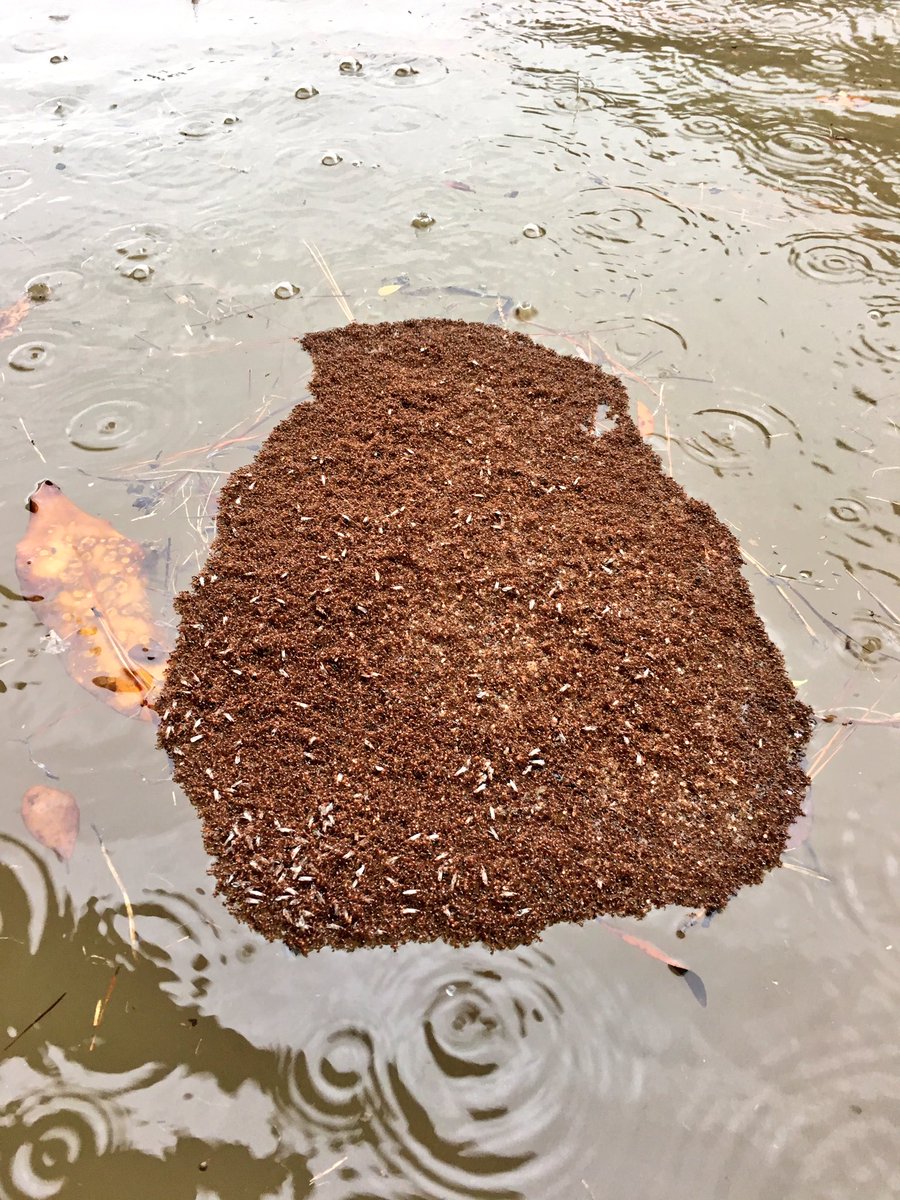
Fire Ants Make Themselves into Rafts to Float to Safety in Houston

By Sarah B. Puschmann, Staff Writer | August 29, 2017 05:53pm ET

As floodwaters rise in Houston and its surrounding area, fire ants are staging their own type of evacuation, by floating to safety on rafts made out of their own bodies.

On Sunday (Aug. 27), CBS News correspondent Omar Villafranca tweeted a photo of a huge raft of fire ants seen in Houston — yet another danger inhabitants of southeastern Texas have had to contend with since Tropical Storm Harvey made landfall as a hurricane on Friday night (Aug. 25).


In the United States, fire ants (Solenopsis invicta) primarily inhabit the Southeast. When faced with a flood, they emerge from the soil, and form a floating raft by linking their bodies together. Rafts made up of as many as 8,000 ants have been observed, according to a 2011 study performed by researchers at the Georgia Institute of Technology in Atlanta. The ants' ability to trap air pockets makes them buoyant and, for the submerged ants at the bottom of the raft, provides a source of oxygen, according to the study. 


Monday, 17 July 2017

Fire Ants Build Sinking 'Eiffel Towers' from Their Own Bodies


By Charles Q. Choi, Live Science Contributor | July 12, 2017 06:08am ET

Fire ants can build miniature look-alikes of the Eiffel Tower from their own bodies, and the insects perpetually rebuild the structures to save them from collapsing, a new study finds.

The insects crawl up and down these structures in a phenomenon that resembles a slow-motion water fountain in reverse, the researchers said.

The new study's finding could help lead to swarms of robots that can use their own bodies to form complex 3D structures, the scientists added.

Building rafts
Fire ants (Solenopsis invicta) evolved in the Pantanal wetlands of Brazil. In 2011, Craig Tovey, a biologist at the Georgia Institute of Technology in Atlanta, and his colleagues discovered the way in which colonies of these insects can shape themselves into raftsthat can stay afloat for months.

Fire ants can use sticky pads at the ends of their feet to link to each other and form a pancake-shaped raft. The 2011 study found that each ant's exoskeleton can trap air bubbles and become slightly water-repellent. Weaving a colony together leads to a more powerful waterproofing effect that keeps the raft dry while afloat in the water.


Sunday, 11 October 2015

What’s the deal with fire ants building rafts?

OCTOBER 9, 2015 

by Chuck Bednar 

ant raftOdds are if you’ve watched the news at all over the past week, you’ve seen that video of fire ants forming giant rafts in order to survive the flooding going on in South Carolina. (If you have yet to see the footage, check out this video captured by WSAV's Chris Murray). 


 According to Mashable, fire ants can assemble these rafts in ridiculously short periods of time–even in as little as 100 seconds–and a 2011 study published by the journal Proceedings of the National Academy of Sciences (PNAS) indicates that this can keep thousands of them from drowning for several days, possibly for even up to a week or longer! The authors of that study explained that they used time-lapse photography to track a group of fire ants (Solenopsis invicta) to study how the creatures were able to link their bodies together so that they could form a waterproof raft. They discovered that the ants could significantly enhance their ability to repel water by linking their bodies together for an unusual survival mechanism. 

 Read more at 

Thursday, 7 May 2015

Invasive ants are extreme excavators

By Victoria GillScience reporter, BBC News

7 May 2015 

Invasive fire ants have dug in soils across different continents to establish their colonies

Researchers in the US have revealed a secret of the success of invasive fire ants - they can excavate any type of soil.

Three-dimensional scanning revealed that the insects were able to build their complex nests regardless of the size of grains they needed to move.

The ants also changed their excavation techniques depending on the type of soil in which they were digging.


They invaded [the US] 80 years ago and they have dug nests from Georgia to LA - they can dig in anythingProf Dan Goldman, Georgia Institute of Technology

Lead researcher Prof Dan Goldman, from the Georgia Institute of Technology, told BBC News that while we "shove this kind of material around using bulldozers", fire ants create complex underground structures using discreet little appendages.

"They're really grasping and holding," he said.

"They're more sophisticated manipulators of [sand and soil] than anything humans have ever engineered."

Thursday, 19 March 2015

Native toads avoid aggressive ants


Presented by
Michelle Douglass

Southern toads recognise and avoid an aggressive invasive ant species in the US.

“Our study is the first to reveal that an amphibian, the southern toad, views fire ants as a predator,” said the study’s lead researcher Andrea Long from the University of Florida, Gainesville, US.

Details of the findings are published in the journal Biological Invasions.

Red imported fire ants (Solenopsis invicta) – also known as RIFA – predate young amphibians, and their venom is thought to cause death or injury to adult southern toads (Anaxyrus terrestris) that try to eat them.

The invasive ants are similarly venomous to some native fire ants, but they are more aggressive.

RIFAs, which are native to South America, were introduced to the southeastern United States in the 1900s, and have been linked with the decline of amphibians such as the endangered Houston toad (Bufo houstonensis) and the marbled salamander (Ambystoma opacum).

Wednesday, 18 February 2015

Tropical fire ants traveled the world on 16th century ships

Date:
February 18, 2015

Source:
University of Illinois at Urbana-Champaign

Summary:
Thanks to a bit of genetic sleuthing, researchers now know the invasion history of the tropical fire ant (Solenopsis geminata), the first ant species known to travel the globe by sea.


Thursday, 7 August 2014

Ten Things To Know About March Of Invasive Fire Ants

August 4, 2014

By Cheryl Dybas, National Science Foundation

Heading for a summer picnic or hike, or just out to mow your lawn? In the US Southeast and beyond, you might want to watch where you walk.

Fire ants. Crossing the border from South America, they’re on the march northward. How does habitat–in particular, corridors that connect one place with another–help the ants spread?

To find out, the National Science Foundation (NSF) talked with ecologist and program director Doug Levey of its Division of Environmental Biology, and researcher Julian Resasco, now of the University of Colorado, Boulder (formerly at the University of Florida, Gainesville).

This week Resasco, Levey and colleagues published a paper in the journal Ecology reporting new findings on habitat corridors and fire ants. They conducted their NSF-funded study in an experimental forest in South Carolina, at the USDA Forest Service – Savannah River site.

1. Where did fire ants come from, and where are they found now?

(Resasco) Fire ants are native to South America, where they’re found from Western Amazonia to northeastern Argentina. Fire ants were accidentally introduced by humans to the southeastern US almost a century ago. Now they’re established in parts of the Caribbean, China, Southeast Asia, Australia, and New Zealand.

2. Why are fire ants a problem?

(Resasco) Fire ants are very aggressive, have painful stings, and can occur at high densities. They can displace native ants and other kinds of small animals, including reptiles, birds, and mammals. Because they have a broad diet that includes plants, they’re a major economic problem in agriculture. The USDA estimates that fire ant control, property damage from the ants, and medical treatment from stings cost several billion dollars each year.


Friday, 14 February 2014

Crazy Ants! Secret Weapon Lets Invaders Take Over US South

by Tanya Lewis, LiveScience Staff Writer | February 13, 2014 02:00pm ET

All over the southern United States, miniature foes are engaging in fierce battle. Invasive "crazy ants" have been displacing fire ants, and a curious defensive strategy may be behind the crazy ants' bold takeover.


Fire ants pack potent venom that kills most ants that come into contact with it. But when crazy ants get stung, they secrete a substance and rub it all over themselves to neutralize the venom, new research finds.

This detoxifying behavior — the first example of an insect capable of detoxifying another's venom — may be the reason crazy ants have been able to compete with the venomous fire ants, according to the study detailed online today (Feb. 13) in the journal Science.


Wednesday, 22 May 2013

Ant studies to aid design of search and rescue robots


A study showing how ants tunnel their way through confined spaces could aid the design of search-and-rescue robots, according to US scientists.
A team from the Georgia Institute of Technology found fire ants can use their antennae as "extra limbs" to catch themselves when they fall, and can build stable tunnels in loose sand.
Researchers used high speed cameras to record in detail this behaviour.
The findings are published in the journal PNAS.

Start Quote

We could watch these glass tunnels and really see what all the body parts were doing when the ants were climbing and slipping and falling”
Nick GravishGeorgia Institute of Technology
PhD student Nick Gravish, who led the research, designed "scientific grade ant farms" - allowing the ants to dig through sand trapped between two plates of glass, so every tunnel and every movement could be viewed and filmed.
"These ants would move at very high speeds," he explained, "and if you slowed down the motion, (you could see) it wasn't graceful movement - they have many slips and falls."

Tuesday, 21 May 2013

Invasive 'Crazy Ants' Are Displacing Fire Ants in Areas Throughout Southeastern U.S.

May 16, 2013 — Invasive "crazy ants" are displacing fire ants in areas across the southeastern United States, according to researchers at The University of Texas at Austin. It's the latest in a history of ant invasions from the southern hemisphere and may prove to have dramatic effects on the ecosystem of the region. 

The "ecologically dominant" crazy ants are reducing diversity and abundance across a range of ant and arthropod species -- but their spread can be limited if people are careful not to transport them inadvertently, according to Ed LeBrun, a research associate with the Texas invasive species research program at the Brackenridge Field Laboratory in the College of Natural Sciences 

The study by LeBrun and his colleagues was published in Biological Invasions

"When you talk to folks who live in the invaded areas, they tell you they want their fire ants back," said LeBrun. "Fire ants are in many ways very polite. They live in your yard. They form mounds and stay there, and they only interact with you if you step on their mound." 

LeBrun said that crazy ants, by contrast, "go everywhere." They invade people's homes, nest in crawl spaces and walls, become incredibly abundant and damage electrical equipment. 

The crazy ants were first discovered in the U.S. in 2002 by a pest control operator in a suburb of Houston, and have since established populations in 21 counties in Texas, 20 counties in Florida, and a few sites in southern Mississippi and southern Louisiana. 

In 2012 the species was formally identified as Nylanderia fulva, which is native to northern Argentina and southern Brazil. Frequently referred to as Rasberry crazy ants, these ants recently have been given the official common name "Tawny crazy ants."

Wednesday, 24 April 2013

Ants 'Use Math' to Find Fastest Route


Tanya Lewis, LiveScience Staff Writer
Date: 17 April 2013 Time: 01:54 PM ET

Just as light does, ants traveling through different materials follow the fastest path, not the shortest one.

A recent study found that when fire ants (Wasmannia auropunctata) crossed different surfaces, the insects chose the route that would minimize their total walking time, rather than the distance traveled. The ants' behavior offers a window into how groups of social insects self-organize, the scientists say.


In optics, a ray of light traveling between two points takes the path that requires the least amount of time, even if it's not the shortest distance — which is known as "Fermat's principle of least time." For example, imagine a lifeguard rushing to save someone in the ocean some distance down the beach. The quickest way for her to get to the victim would be to run along the beach first, in order to minimize the time she would have to spend swimming, which usually takes longer than running.

In the study, researchers collected colonies of the little fire ant — one of the world's 100 most invasive species — at sites in Israel. Each colony contained a few thousand worker ants and several queens. The ants were placed in a corner of an enclosure, and cockroaches were provided as a food source in the opposite corner. To get to the cockroaches, the ants had to cross a foraging area covered with different materials: smooth felt, rough felt or a glassy surface. The scientists tested the ants on surfaces composed of pairs of these materials next to each other (glass and rough felt, glass and smooth felt, smooth felt and rough felt).


Related Posts with Thumbnails

ShareThis