Showing posts with label beaching. Show all posts

Wednesday, 3 October 2018

This Beached Shark Tore a Beached Whale to Shreds (And It's All on Video)


By Brandon Specktor, Senior Writer | October 2, 2018 12:32pm ET
When a beached whale arrives on your local shore, it's sad, but not too surprising. When a live, thrashing tiger shark arrives right next to it, it's a good time to dust off your favorite expletives.
That's what some Ponta, Mozambique residents did when they saw a massive, 13-foot-long (4 meters) tiger shark (Galeocerdo cuvier) seemingly beach itself in order to chow down on the 30-ton humpback whale carcass bedecking the local shore.
According to Lorrayne Gaymer, a Mozambique dive instructor who filmed the incident (and the community's shocked response), the 66,000-lb. (30,000 kilograms) whale washed up on Ponta beach in early September. [13 Bizarre Things That Washed Up On Beaches]
"Initially, a rescue attempt was made for the whale, but after the locals of Ponta contacted a whale expert it became clear that the whale was very sick and shouldn't be moved," Gaymer told The Daily Mail. "It had passed away, and as the tide went out, hundreds of locals of Ponta all came down to take their share."
Then, Gaymer said, the sharks descended. According to Caters New Agency, an estimated 60 sharks of different species — including tigerbulland dusky sharks — took turns ripping hunks of meat and blubber out of the whale's side. By the time Gaymer arrived on the scene and started filming, one giant tiger shark had swum so close to shore that it temporarily beached itself on the sand near the whale.
As you can intuit from the sundry shrieks and bleeped-out expletives that begin Gaymer's video, the sight of a tiger shark so close to shore was both exciting and terrifying for many spectators.

Monday, 26 March 2018

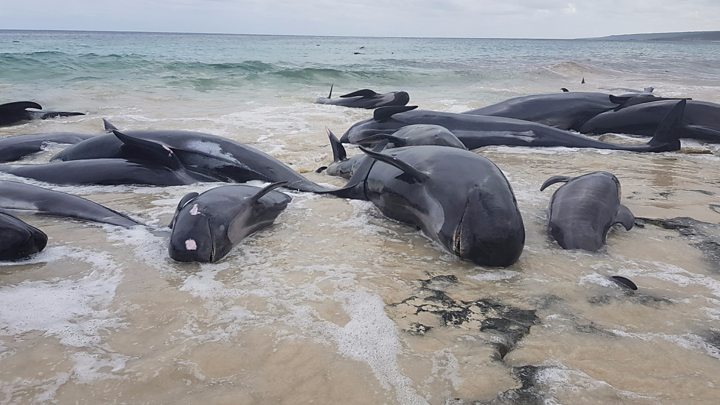
Hamelin Bay: Nearly 150 beached whales die in Australia


23 March 2018


Over 100 whales die in mass stranding in Australia

Only six whales have survived a mass stranding of pilot whales on the coast of Western Australia.

About 150 of the animals were found beached at Hamelin Bay, about 300km (180 miles) south of Perth.

Their discovery by a local fisherman on Friday prompted a major rescue effort to return them to deeper waters.

However, by nightfall, more than 140 of the whales had died, with deteriorating weather conditions and the threat of frenzied sharks impeding efforts.

More than 100 volunteers, wildlife personnel and others came to the aid of the beached pilot whales, a species known to strand en masse.

Monday, 28 December 2015

Dead whale closes popular South African beach amid shark concerns

Strand Beach near Cape Town has been shut as experts fear the corpse of the 14 metre whale may attract sharks

Thursday 24 December 2015 05.33 GMTLast modified on Thursday 24 December 201509.13 GMT

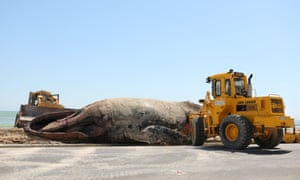
A South African beach popular with Christmas holidaymakers has been closed until the carcass of a beached whale is removed amid concerns its blood may attract sharks, the City of Cape Town said.

Photograph: Reuters
Local media described it as a humpback whale measuring over 14 metres (46 feet) in length and said two sharks had been spotted in the area.

“The immediate area around the whale carcass has been cordoned off and this area is closed to members of the public ... The blood and debris from the carcass can attract sharks to the area,” the city said in a statement.

Workers remove the carcass of a whale on Strand Beach, near Cape Town. The South African beach, popular with Christmas holidaymakers, has been closed until the carcass is removed amid concerns its blood may attract sharks. 

The affected area was the Strand Beach, a stretch of sand east of Cape Town.

Great whites, the largest predatory species of shark, are common in the cool Atlantic waters off Cape Town and sometimes attack surfers or swimmers. They would not be expected to attack a whale and it was not immediately clear how the humpback had died.

Thursday, 13 September 2012

Four Baby Whales Rescued in Florida


Four rescued baby pilot whales have been taken to SeaWorld Orlando after washing up on a Florida beach. The whales, one male and three females, are the only survivors of a mass stranding that left 18 other whales dead. On Saturday (Sept. 1), a pod of 22 short-finned pilot whales turned up at Avalon State Park Beach near St. Lucie on Florida's east coast. 


Volunteers and environmental officials responded to the scene to try to keep the whales — the largest of which was more than 25 feet (7.6 meters) long — hydrated and shaded. But 17 died or had to be euthanized. The remaining five, all young whales, were brought to a rehab center at Florida Atlantic University's (FAU) Harbor Branch Oceanographic Institute. There, they were treated for malnutrition, dehydration, stress and infection, FAU officials said.


Continued:
 http://www.livescience.com/22968-four-baby-whales-rescued-in-florida.html

Saturday, 18 August 2012

WHALE GETS STUCK AGAINST CORK PIER WALL

A 40ft fin whale has tried to beach and is stuck against a pier wall in west Cork.

The creature came in to the harbour in Baltimore on a low tide and initially moved 328-437 yards (300m-400m) off shore before coming back to the small port.

The Irish Whale and Dolphin Group (IWDG) said from the description it is a young fin whale and maybe sick or starving.

Brendan Cottrell, assistant coxswain on the Baltimore lifeboat and owner of the Cape Clear ferry, said they were doing their best not to panic the creature further.

"We've been told to keep all the boats back and try not to stress the animal," he said.

"It looks as though he's stuck by the pier wall and there's a crowd of about 200 or 300 looking on. We've had dead whales on the beaches before but never a live one in this spot."

Fin whales are the second-largest species of whale and can grow up to 85ft.


Continued:  http://www.eveningecho.ie/2012/08/14/whale-gets-stuck-against-cork-pier-wall/

Friday, 3 August 2012

Dead humpback whale found in Sydney swimming pool


Australian authorities find a dead 39 feet 30-tonne humpback whale washed up in a Sydney seaside swimming pool.


Beached whales are common in Australia, but authorities said rough seas and a high tide washed the whale over a chain safety fence and into a public salt water swimming pool area at Sydney's northern Newport beach.


Shona Lorigan of the Organisation for the Rescue and Research of Cetaceans in Australia (ORRCA) warned onlookers to stay away from the whale which appears to have died within the last 48 hours.


"It's very, very dangerous for everyone in the water... because we don't know how it's died, we don't know what kind of fluids, what kind of disease might be floating around with the animal," she said.


The beach, at Newport in the north of Sydney, is closed for fear that the carcass will attract sharks.


National Parks authorities said they hoped the whale carcass might float out of the pool area on the next high tide, or workers would have to use heavy equipment to remove the whale and carve it up.

Friday, 20 July 2012

Rare whale stranding a first for Victoria

Shepherds beaked whale found on Australian beach
July 2012. After a public report of an unidentified dead whale at Marlo in Victoria, Australia, an exciting addition has been made to the knowledge of Victoria's marine wildlife, which will improve our understanding of the species' biology and evolution.

The whale has been identified as a Shepherd's Beaked Whale and it is the first stranding record of the species in Victoria, with fewer than five individuals stranded in all of Australia.
The Victorian Department of Sustainability and Environment's Biodiversity Officer Tony Mitchell visited the site and realised immediately that he had never seen a whale like this on the Gippsland coast.
Mr Mitchell said "Given there has only been a handful of confirmed sightings of live animals anywhere in the world, it's quite incredible to have found this species washed up on Gippsland's shores. The 6.6 metre whale has a long, dolphin-like beak and is dark brown with pale sides and belly. It is distinguishable from other species by teeth in both its upper and lower jaws."

Tuesday, 3 April 2012

Minke whale washes ashore at Spurn Point

Yorkshire Wildlife Trust is again saddened to announce that yet another of nature's giants has washed up dead on a popular local nature reserve.

April 2012. The Minke whale, which was initially reported on the Humber side of Spurn Point, appears to have suffered serious trauma to its side and head. Biopsies will confirm the cause of death at a later date. Minke whales are encountered throughout the year in the North Sea, both from land and on ships.
This stranding continues to mark a trial of sad endings for the North Sea's marine mammals, following on from the stranded Sperm whale found at Skegness last month and the Sei and Fin whales found in the Humber last Autumn.
Kirsten Smith, The Living Seas Manager for the North Sea Wildlife Trusts comments: ‘We are deeply saddened to again hear another of our mammals has met such a shocking end. We hope through a new partnership with the charity MARINElife, to help a greater understanding of the marine mammals found within the North Sea and the risks they face.
Recording marine mammals on east coast
This partnership will see The Wildlife Trusts along the length of the East Coast work with MARINElife and volunteers to record sightings of marine mammals both from the land and at sea. We hope by building a better picture of how and where these creatures occur we can help to understand how best to protect them in the future'
The Wildlife Trusts' vision for Living Seas is one that holds Marine Protected Areas at its heart. We aim to see wildlife protected throughout our seas giving it the opportunity to thrive and recover from past decline. We need your help to do this, show your support for your local marine wildlife by adding your name to our petition fish campaign www.wildlifetrusts.org/petitionfish today and saying yes to Marine Protected Areas.

Tuesday, 27 March 2012

Sea Monster Washes Ashore in SC

According to live5news.com, a veterinarian from the South Carolina Aquarium identified the body as that of a sturgeon.
There are several sturgeon species in North America, and all get large.  The Atlantic sturgeon is the species that is found in South Carolina waters, and they can grow to be 15 feet long and weigh 800 pounds (although more commonly they are less than ten feet long and weigh around 300 pounds).  Sturgeons have been around for over 100 million years, and individual fish can live to be over 60 years old. 


Their bodies are covered in bony plates called scutes rather then scales, and they have tiny eyes and barbels on their face that help them locate prey in the muddy bottom of murky water, all of which gives them their bizarre appearance. 
Sadly, sturgeon are on the decline. National Wildlife Federation reports:

Sunday, 19 February 2012

Why Are So Many Dolphins Beaching Themselves?

From New England to Peru, an unprecedented number of dolphins have been beaching themselves in recent weeks, and experts are grappling as to why.

On Cape Cod alone, 177 short-beaked common dolphins have stranded and 124 have died, according to an Associated Press report. The report goes on to say that the total is nearly five times the average of 37 common dolphins that have stranded annually there during the last 12 years.

More than 200 dolphins have washed up dead on the beaches of Chiclayo, Peru, according to The Blaze. In that case, dead anchovies were also found. Since these small fish are prey, the dolphins may have become ill as a result of eating them, but the deaths remain a mystery.

Monday, 25 July 2011

Pilot whales die after Highland beaching (via Dawn Holloway)

Fifteen whales have died and many others have become stranded at Kyle of Durness, on the north Highland coast.


The Maritime and Coastguard Agency (MCA) said the whales were believed to be from a pod of as many as 60.

The long-finned pilot whales may have been hunting prey or had sought a place to rest.

Rescuers trying to save the pod said the whales had perished when they stranded at low tide. About 35 beached as the water in the sea loch receded.

Some 20 of them were refloated to deeper water using inflatable pontoons as the water returned, but the remainder had died, the British Divers Marine Life Rescue (BDMLR) charity said.

'Narrow channel'
It said many of the whales had stranded on their sides, on top of each other and upside down and were breathing in sand.

A further 20 are thought to be in deeper water and not in imminent danger.

On Friday three pilot whales, including a calf, beached on the shore of the loch.

A Royal Navy bomb disposal team training in the area offered its help in any rescue effort.

Scottish SPCA inspectors also headed for the scene.

Highland Council countryside ranger Donald Mitchell and nine coastguard volunteers monitored the situation.

Mr Mitchell said that at low tide only a narrow channel of sea remained.

Kyle of Durness opens out into Balnakeil Bay.

On Friday, Charlie Phillips, a Whale and Dolphin Conservation Society (WDCS) field officer, said: "It is going to be tricky.

"It is a remote and difficult place to get to."

Mr Phillips added: "The whales may have come in from the Pentland Firth, following prey or trying to find somewhere to rest."

Marine strandings
He said a young female pilot whale was found at Scourie, in Sutherland, a few weeks ago.

SAC vet Dr Andrew Brownlow of the Scottish Agricultural College (SAC), who leads the Scottish Marine Animal Strandings Scheme, drove to the scene.


The college said: "Should any of the whales fail to make it back out to sea and do not survive, Dr Brownlow will lead post mortem examinations with the aim of identifying what has caused them to come ashore.

"This enables the Strandings Scheme to monitor trends in causes of marine strandings which in turn allows identification of any new or developing hazards to marine mammals in Scottish waters."

In May, two pilot whales were found dead in a Hebridean loch after experts feared more than 60 of the animals had been at risk of becoming beached.

The pod had got into difficulty in Loch Carnan in South Uist.
http://www.bbc.co.uk/news/uk-scotland-highlands-islands-14258149
Related Posts with Thumbnails

ShareThis