Showing posts with label Drusillas Park. Show all posts

Saturday, 19 July 2014

Birth of twin red pandas gives hope for future of one of the rarest - and cutest - mammals

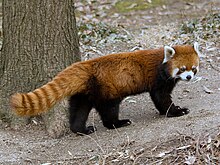
A red panda standing on the groundIt was a regular Monday morning at Drusillas Park in East Sussex when head keeper Mark Kenward went in to check on the centre's red pandas as part of his daily rounds. The creatures were in the enclosure that has been their home since they were brought to Alfriston last year, having been paired as part of the European breeding programme from their respective homes in Asson Zoo, France, and Paignton Zoo, in Devon.

On this particular visit last month, Kenward was met by Tibao, the male. This in itself was a little odd – it was usually Mulan, the female, the more outgoing of the pair, who was first to say hello. Mulan, though, was nowhere to be seen so Kenward called out to her.

Moments later, the day took a heart-melting turn when she emerged from a nest box. She was gently carrying in her mouth one of two new babies, which have added precious numbers to some 10,000 adult red pandas remaining in the wild. "She brought the cub over, as if to show me, before returning to the box," Kenward says. "I can't explain how happy I was."

Wednesday, 11 December 2013

Zookeepers mistakenly attempt to mate two male sloths, unsurprisingly don’t get results

Saturday 7 Dec 2013 10:52 am

It’s normally sloths that are slow but experts at a Sussex zoo took a while to realise they were trying to breed two males.

Staff at Drusillas Park were perplexed as to why their treasured animals Sofia and Tupee had been unable to produce offspring since 2011.

Eventually they decided to get some help and that’s when they found out they had been trying to breed two males.

‘We are going to have to find a more suitable name for Sofia,’ said head zoo keeper Mark Kenward.

He blamed medical records that had categorised Sofia as a female and said it was difficult to tell what sex sloths were.

‘We had never looked after sloths before and were relying on the information provided,’ he added.

Mr Kenward said it was unlikely the two males would be kept together at the Alfriston zoo – although we’re not sure they would still want to.


Monday, 13 August 2012

Rare flamingo born after keepers play Barry White love songs to birds


Keepers in Sussex have gone to great lengths to encourage breeding amongst flamingos this year, including playing the birds classic love songs in an effort to set the mood.
Finally, their efforts have been rewarded with the welcome arrival of a healthy chick.
The rare Chilean flamingo is finding its oversized feet in the flock. It is the first successful hatching at the Drusillas Zoo in East Sussex in three years and keepers are tickled pink.
Classified as a threatened species, Chilean flamingos are native to western South America.
Sadly populations have declined in the wild mainly due to interference in their wetland habitats and human activity near breeding sites so birds abandon their nests.
The flamingos arrived at Drusillas in 1982 but there has not been a successful hatching since 2009.
This year the zoo was determined to break the cycle and over the last few months they have tried all manner of ways to encourage the birds’ natural courtship behaviours.
To get the feathered favourites in the mood the zoo team began by playing them love songs including the classics of love lyricists Barry White and Marvin Gaye.
These were played alongside pre-recorded mating vocalisations of Chilean flamingos attained from Zoo Atlanta, in Georgia.
The keepers also placed mirrors in the enclosure, to create the illusion of a fuller flock and egg on the romance; flamingos are very sensitive to their surroundings and feel safer in a larger group.
They even started building the nests and placed a fake egg on top.
At last their efforts finally paid off and the tiny chick is now making egg-cellent progress under the guidance of proud parents, Maurice and Gabriella.
The couple have been together at the Park since 2002 and the new addition is their third chick at Drusillas.
Feathers crossed these will hatch over the next two to three weeks, after an incubation period of 27 - 31 days.

http://www.itv.com/news/meridian/update/2012-08-10/rare-flamingo-born-after-keepers-play-barry-white-love-songs-to-birds/

Monday, 23 July 2012

Zoo welcomes rare black lemur baby


A rare black lemur has been born at a zoo and is thriving under the watchful guidance of its parents.
The baby lemur is settling in at Drusillas Park, in Alfriston, East Sussex, and is thought to be female due to the species' strong sexual dimorphism - males are all black with orange eyes, while females are brown with a pale belly and white ear tufts.
A spokeswoman for the zoo said the baby will be carried around by her mother for up to six months and will be nursed for about 135 days.
Her parents, Clementine and Lotfi, were introduced in 2010 as part of the European Endangered Species Programme, arriving from zoos in Portugal and Tunisia respectively, the spokeswoman said.
The latest addition is the couple's second baby, following the birth of Tsito at Drusillas in April 2011.
Zoo manager Sue Woodgate said: "We are delighted with the new arrival. She is very special indeed, particularly when you consider that there were only 18 black lemurs born and survived in Europe last year."
A new survey carried out by the Primate Specialist Group of the International Union for Conservation of Nature concluded that lemurs are far more threatened than previously thought.
In the wild, black lemurs are only found in the forest areas of northern Madagascar where they are considered vulnerable mainly due to hunting and the destruction of the habitat in which they live.
The zoo population of this species is managed by a specialist co-ordinator on behalf of the European Association of Zoos and Aquaria.
The co-ordinator is responsible for the movement of animals between zoos for the purpose of breeding.
Related Posts with Thumbnails

ShareThis