Showing posts with label donkeys. Show all posts

Thursday, 28 November 2019

China 'medicine' demand threatens world donkey population: report

NOVEMBER 21, 2019 

Researchers say China's demand for donkey skins threatens the world's donkey population 

China's demand for donkey skins to make a traditional medicine could wipe out more than half the world's donkey population in the next five years, researchers said Thursday. 

Nearly five million skins are used every year to make ejiao, a gel believed in China to be a remedy for troubles ranging from colds to ageing, putting enormous strain on donkey populations around the world, Britain-based animal welfare group Donkey Sanctuary said in a report. 

Ejiao was once the preserve of emperors but is now highly sought after by a burgeoning middle class, with production growing 20 percent each year between 2013 and 2016, Donkey Sanctuary said. 

China's domestic donkey population has collapsed by 76 percent since 1992, and the country imports most of the donkey skins it uses, mainly from traders in South America, Africa and Asia. 

There are currently around 45.8 million donkeys in the world, Donkey Sanctuary said. 

The donkey skin trade has resulted in "suffering on an enormous and unacceptable scale", the group's chief executive Mike Baker said in a statement. 

Researchers documented instances of unhygienic and inhumane processing conditions, including donkeys being crudely bludgeoned on the head at one slaughterhouse in Tanzania while still conscious and restrained. 

At a holding facility in Brazil, malnourished animals were being kept in the same pens as "hundreds of donkey carcasses" that had contaminated the only available water source, "putting remaining donkeys at risk of either infectious disease or severe dehydration". 


Wednesday, 11 April 2018

Genome assembly of donkey reveals clues on how it may have branched from horse


April 9, 2018 by Bob Yirka, Phys.org report

A team of researchers from Denmark, Malaysia, France and the U.K. has conducted a genome assembly of the donkey to learn more about its evolutionary history. In their paper published on the open access site Science Advances, the group describes their study and what they found.

While the horse is well recognized by most people, the same cannot be said for the lowly donkey. This is likely due to some confusion regarding how it fits in with other horse-like animals. Scientifically speaking, the donkey is one of many of the asses. Mating a donkey with a horse can result in the birth of a mule (from a male donkey and a female horse) or a hinny (a female donkey and a male horse). As the researchers with this new effort note, a lot of genetic research has been done on the horse, but very little on the donkey. They have sought to rectify that situation by conducting a high-quality genome assembly of the donkey genome.

As part of their effort, the researchers created scaffolds, which are spans of genetic details, that are a factor of four higher than any other previous effort with donkeys. The amount of data was massive, filling 10 megabytes. But it also revealed a lot about donkeys, such as their history, including their split from the group that now includes the modern horse, going back approximately 4 million years. They also observed chromosomal rearrangements such as translocations and inversions, which will reveal more about how the donkey species diverged and separated from others.

Both horses and donkeys belong to the equid family, which prior research has shown have been around for approximately 55 million years. But today, the researchers note, just one member of the family remains, Equus. It includes both horses and donkeys, and also three kinds of zebras and other ass species. Asses, notably, split off from others in the family nearly two million years ago—the new sequencing results push the accepted date back approximately 200,000 years. Donkeys, the researchers note, were domesticated approximately 5,000 years ago.

Monday, 6 November 2017

The Chinese 'miracle' elixir that threatens donkeys around the world


Chinese demand for donkey gelatine is hammering the Chinese and African donkey populations, putting the price of donkeys out of reach for subsistence farmers

Kimon de Greef
Tuesday 31 October 2017 11.00 GMTLast modified on Tuesday 31 October 2017 13.54 GMT

It was a bout of period pain that led to Liu Yanan’s first taste of donkey gelatine. The 13-year-old was visiting family in Beijing when her cramps started for the first time. Her aunt took out an ornate box filled with smooth chocolate-brown slabs, broke off a small piece, and stirred it into a pot of sweetened rice porridge.

The medicine was ejiao, a Chinese medicine made from donkey skins and used for over 2,500 years. Yanan hesitated before eating the mixture, but she trusted her aunt and wanted relief from the pain. “I felt comfortable afterwards. My body was warm,” she says. “I took it for a month and the trouble went away.”

That was back in 2004, and since then China’s ejiao industry has turned into a global megabusiness. What was once a humble blood tonic for conditions like anemia – a claim supported by no clinical evidence – has been rebranded as a wellness product for China’s ascendant middle class, and now features in face creams, sweets and liqueurs, as well as a wide variety of medicinal preparations. There are claims it will help with anemia and acneboost your energy, improve your sleep, nourish your yinprevent cancer, make you look better and even improve your libido. It is billed, in short, as a miracle elixir.


Tuesday, 8 April 2014

Kick-ass! How donkeys are used by farmers to scare off wild dogs

ANTHONY GOUGH
THE COURIER-MAIL
MARCH 23, 2014 3:17PM

WILD dogs beware — you are in for an ass-whipping.

Donkeys are increasingly being used by farmers to keep wild dogs at bay, and while canines may be man’s best friend, they’re not winning any popularity competitions with these beasts of burden.

“A donkey loves to be with a lot of mates. There’s only one animal he really doesn’t like at all, and that’s canines,” said Heike Mack-Behle, from Destiny Boonah Eco Cottages and Donkey Farm.

Ms Mack-Behle said she started rehoming donkeys 10 years ago, and in that time she had helped find new homes for around 600 donkeys on farms protecting everything including sheep, goats, calves and even ostriches from wild dogs.

“It’s an instinct. Some donkeys love dogs, but it’s really only 15 per cent,” she said.

Monday, 26 August 2013

Kenya: 3,000 donkeys take 'annual leave' from owners

At least that's according to a report in Kenya's Star newspaper, which describes the animals as going on "annual leave" between July and December. It quotes local official William Moile as saying donkeys in about eight localities "just refuse to listen to their masters and go to the plains to eat and make merry" before returning during the dry spell. "I grew up here and for the last 40 years nobody has questioned their habits. To us it is normal for the beasts of burden to rest," he adds.

Other elders reportedly say their donkeys are only used for fetching water from boreholes and rivers and when not "engaged in such services" they disappear. "They know their calendar and that is why nobody bothers to look for them," Moile is quoted as saying.


Saturday, 25 May 2013

Killer Donkeys Maul Pensioner To Death

Two donkeys are to be put down after they dragged a pensioner from his mobility scooter and mauled him to death.

Sandor Horvath, 65, was chased and pulled from the scooter at a farm in Hungary, where he was visiting his farmer friend.

He was bitten and trampled on, and when his mutilated remains were found it was believed he had been attacked by wolves.

However, a post-mortem examination revealed the bites and markings had come from the donkeys.

A vet told local media: "Donkeys aren't usually aggressive towards humans.

"They probably reacted like this as they thought the victim was intruding upon their territory."

A police spokesman said: "If these were dogs then they would also be put to sleep.

"We can’t allow animals to go around killing people. Putting them to sleep is the best thing for everyone."

The farmer's daughter, Csikos Darda, said: "I had noticed that the donkeys were becoming increasingly aggressive and I'd asked my father to do something about it, but he'd said they were fine."

Tuesday, 15 May 2012

The age-old question is finally answered: Donkeys aren't stubborn


Now a university has hitched its wagon to the debate in a two-day conference taking apart centuries of asinine conjecture about ‘donkey, mule and hinny cultures worldwide’. 


Ben Hart of the Donkey Sanctuary posited the theory that ‘evolutionary histories of donkeys and mules’ had led to behaviour that has been misunderstood and contributed to the reputation for being stubborn. 

‘The donkey’s behaviour is commonly misunderstood principally because their behaviour is compared to that of the horse, rather than viewed as a separate species,’ he said in Stubborn Donkey Or Smart Ass? at the School of Oriental and African Studies at the University of London. 

‘By looking at the domesticated donkeys’ evolutionary niche and the behaviour of both free-living donkeys and domesticated donkeys, it is possible to explain the different behaviours of donkeys and to lay to rest their reputation for stubbornness and their misrepresentation as small horses with big ears.’ 

Donkeys have been associated with stubbornness since before Christ.  Ancient Greek epic poet Homer and fabulist Aesop labelled the creatures as ‘stupid, servile and stubborn’.


Read more: http://www.metro.co.uk/weird/898973-the-age-old-question-is-finally-answered-donkeys-arent-stubborn#ixzz1uqjOlXAD

Wednesday, 28 September 2011

Political party enters a donkey to run for mayor in Bulgarian elections

A donkey has been submitted as a candidate for the upcoming elections for a new mayor of Bulgarian town Varna.
Marko the donkey has been chosen by the Society for New Bulgaria political party to represent them for the elections on October 23.

It was reported that the party see Marko as the ideal alternative to the current mayor Kiril Yordanov, who they feel is not doing a good enough job for the town.
Angel Dyankov, head of the campaign headquarters of the Society for New Bulgaria party, said: 'Unlike the other mayor candidates and politicians, the Donkey has a strong character, doesn’t steal, doesn’t lie, and gets work done.'
Fellow Society for New Bulgaria member Doychin Dimitrovmade made his point clear about his dissatisfaction with the current mayor of Varna.
'Marko’s life is difficult because the green areas in the Bulgarian sea capital are disappearing.
'Let the residents of Varna draw the line and decide who has more positive qualities – the donkey or the incumbent Mayor.' 

http://www.metro.co.uk/weird/876750-political-party-enters-a-donkey-to-run-for-mayor-in-bulgarian-elections#ixzz1ZFFh5kE0

Thursday, 3 March 2011

Cornwall man shoots sister's donkey after row

2 March 2011 Last updated at 21:31

A Cornishman has admitted shooting dead his sister's donkey after an argument.

Bodmin magistrates heard that Darrell Duffill shot donkey Claude in the temple with an air rifle, followed by two more shots as it lay on the ground.

Duffill, 54, who lives in a cabin on land owned by his sister near Looe, had drunk half a bottle of rum before the attack on Monday, the court heard.

Duffill admitted criminal damage and was remanded in custody to 23 March for probation reports to be prepared.

The court heard that Duffill's sister, Carolyn Jones, found the 10-year-old donkey in a pool of blood in his stable.

Despite the crime, defence solicitor Ramin Shamsolahi claimed in court that Duffill was an "animal lover".

http://www.bbc.co.uk/news/uk-england-devon-12627887
(Submitted by Tim Chapman)

Wednesday, 28 July 2010

Uncommon hybrid of zebra and donkey born at north Georgia wildlife preserve (Via D R Shoop)


http://www.startribune.com/nation/99337569.html?elr=KArks8c7PaP3E77K_3c::D3aDhUMEaPc:E7_ec7PaP3iUiacyKU7DYaGEP7vDEh7P:DiUX

DAHLONEGA, Ga. - A zedonk, an unusual cross between a donkey and a zebra, is attracting attention at the Chestatee Wildlife Preserve in Dahlonega after being born there about a week ago. The animal, which has a zebra father and donkey mother, has black stripes prominently displayed on her legs and face.

C.W. Wathen, the preserve's founder and general manager, said the foal has a zebra's instincts. Wathen said she sits up instead of lying on her side, as if she's staying alert for predators.

Donkeys and zebras don't usually mate, but zedonks turn up occasionally.

Wathen said that in about two weeks, the zedonk will begin roaming the property with the rest of the animals.

___

Information from: The Times, http://www.gainesvilletimes.com/

Tuesday, 13 April 2010

"The defendant does not have a stable address..."

Man admits sex with donkey and horse
Monday, 12 April 2010

A 66-year-old man has pleaded guilty at Leicester Crown Court to having sex with a donkey and a horse. Joseph Squires was charged with buggery of a donkey between February 2 and February 5, 1999, and buggery of a horse between March 15 and 18, 2004.

He also faced charges of damaging property - relating to the two animals on the same dates. Squires, whose address was previously given as Overpark Avenue, Leicester, was due to stand trial but pleaded guilty to all four counts at Leicester Crown Court today. Defence counsel Amar Mehta told the court Squires had no previous
convictions and was of previous good character.

Requesting he be released on bail, he said: "The defendant does not have a stable address although he says his daughter can provide an address." Judge Michael Pert QC refused the application and remanded Squires into custody for a pre-sentence report to be prepared. He will be sentenced on May 24.

Sunday, 11 October 2009

Zookeepers paint donkeys like zebras

11 October 2009
By sss

Gaza City zoo has found a creative way of drawing crowds to its dilapidated attraction by painting their donkeys as zebras.

The Marah Land Zoo's only two zebras died of hunger earlier this year when they were neglected during the Israel-Hamas war.

They were too expensive to replace, so the keepers decided to design a pair of donkeys with black and white patterns instead.

A professional painter used French-manufactured hair colouring to make the donkeys look like zebras.

http://www.lep.co.uk/weirdnews/Zookeepers-paint-donkeys-like-zebras.5722809.jp

See also:

Wednesday, 5 August 2009

The silly season: Benson the carp and other fishy tales

The Times's front-page story is part of a tradition including great white sharks in Cornwall, killer chipmunks and runaway pigs

In pictures: classic silly season stories

There's a carp story on the front of today's Times.

No, that's not a misprint – there really is a great big fish pictured across the top of the paper, beneath the solemn headline, "Benson, Britain's best-loved carp, 1984-2009".

And lo, just a few days into August, the silly season has arrived.

It has to be said that Valentine Low's story about Benson – a female carp, named after a hole in her dorsal fin that resembled a cigarette burn, who was caught at least 60 times – is an extremely enjoyable read.

The quote from Tony Bridgefoot of the Bluebell Lakes complex is a classic. "We are all rocked by Benson's death. She was an iconic carp. We are all still trying to come to terms with her death. Money could not have bought Benson. She had that celebrity status. I can't stress how famous she was in the angling world."

And then turn to today's Daily Telegraph, which has a delightful story about dolphin sign language. A flop on to its side means "Let's go", a roll on to its back with tail fin waving means "Let's eat", and a rapid movement of its fins means "Let's bash out 300 words on this - there's nothing else going on".

The Sun tends to keep the silly season going all year round, but it has enjoyed a good run of "killer chipmunk" stories.

Here's a recent example – make sure you click on the graphic of the chipmunk launching itself at the lady.

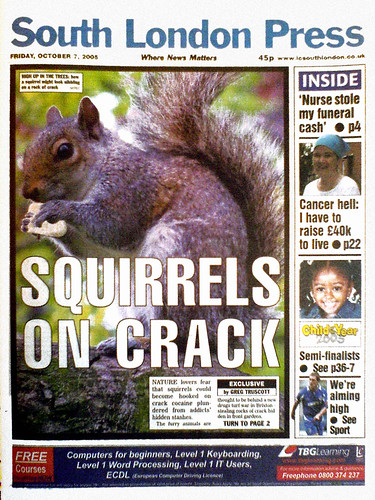
The story is reminiscent of a classic tale from October 2005 – it was an Indian summer that year, clearly – when the South London Press reported that squirrels were digging up crack cocaine hidden by drug dealers.

Here's the front page that Chris Morris would be proud of.

Some silly season stories are so good they have to be repeated year after year.

Back in August 2003, there were reports that a great white shark had been seen off the coast of Devon.

The story resurfaced in July 2007, this time in Cornwall – only to be rubbished by a Falmouth coastguard:

"There has never been a confirmed sighting of a great white off the Cornish
coast. It's utter rubbish. We have never had a shark attack down here and we
would urge people to take this with a pinch of salt. They are not the man-eating
Jaws."
Clearly, animals are the essential ingredients of classic silly season tales.

Back in 1987 there was Blackie the Donkey, saved from being crushed at a Spanish fiesta and then brought to England by the Daily Star.

Then there were the Tamworth Two, a pair of piglets who broke out of a Wiltshire abattoir and spent a week on the run in January 1998 (OK, that wasn't really the summer).

The Daily Mail bought the pigs, named them Butch and Sundance and paid for them to live at the South of England Rare Breeds Centre near Ashford, Kent.

But sometimes it's possible to contrive a magnum opus of daftness that doesn't involve beasts.

Take the Sun's classic tale from August 2005 that Victor Meldrew had been found in space, the apotheosis of the I-saw-Jesus-in-my-toast story genre.

Here's a collection of holy relics, Daily Mail-style.

But this is far from an exhaustive list – have you noticed any corkers this year, or do you have any favourites from silly seasons past?

http://www.guardian.co.uk/media/organgrinder/2009/aug/04/newspapers-silly-season-stories

Wednesday, 29 July 2009

3,000 donkeys drafted in for Afghan polls: UN

Agence France-Presse 07/29/2009 1:52 PM

KABUL – More than 3,000 donkeys will be drafted in to help deliver millions of ballot papers to remote regions of Afghanistan for presidential elections on August 20, a UN official said Tuesday.
Swathes of Afghanistan are inaccessible by road, forcing election authorities to come up with innovative solutions to get voting materials to the masses in time for election day.

Kai Eide, the top UN representative in Afghanistan, toured a hanger at the Independent Election Commission (IEC) headquarters in Kabul where he watched the papers being stuffed into bright blue boxes and loaded onto trucks.

"There will be 3,500 trucks involved altogether in getting the material to the polling centres. And 3,000 donkeys will get the ballot papers to the most remote areas," said Eide, head of the UN Assistance Mission in Afghanistan.

He said the pack animals would be loaded up with the papers and dispatched to polling stations mostly in the north, where the mountains of the Hindu Kush cut off many residents from the outside world.

Eide called the operation "one of the most demanding electoral exercises I have seen" and praised Afghanistan for holding elections in the middle of a war, with Western and local forces battling Taliban insurgents.

"What makes it challenging is the infrastructure... and also the fact that the country is a country in conflict," the Norwegian diplomat told reporters.

Ahmad Bilal, IEC head of logistics, said helicopters would also be mobilised to reach the more remote areas and hoped to get all materials to polling centres by August 10.

Afghanistan is one of the poorest countries in the world and 80 percent of the people live in rural areas, largely without electricity.

Election officials also have to contend with fragile security in the south, Bilal said, where thousands of newly deployed US troops are trying to wrest back Taliban strongholds in harsh and baking desert.

The election will cost about 220 million dollars and is being bankrolled by Afghanistan's international partners.

More than 35 million presidential and provincial ballot papers are being distributed to 28,500 polling stations across Afghanistan.

http://www.abs-cbnnews.com/classified-odd/07/29/09/3000-donkeys-drafted-afghan-polls-un

Wednesday, 18 March 2009

Woman to sue over donkey attack

A woman is planning to sue a philanthropist after she says was attacked by donkeys while out horse riding.

55-year-old Florida resident Patty Curtice says she was riding the horse last June on her first date with her boyfriend, Angel Velez, when they were attacked by two donkeys that had escaped from a nearby ranch.

'That's the only thing I remember is the teeth coming at me. I never got bit by the donkey, I got trampled by him, but the teeth, I remember the teeth,' she said.

She now plans to file a lawsuit against local car dealer and philanthropist Frank Morsani, who owns the ranch, over the injuries and medical bills resulting from the donkey attack.

Curtice told 10 Connect News: 'I don't blame anybody, but if the man had fixed the fence, I wouldn't be in this mess.'

Morsani says that the donkeys escaped when someone cut his fence.

http://www.metro.co.uk/weird/article.html?Woman_to_sue_over_donkey_attack&in_article_id=586681&in_page_id=2
Related Posts with Thumbnails

ShareThis