
SCOTSMAN REPORTER
Published: 15:35 Monday 22 July 2019
A wasp which has never been seen in Scotland before has made its home in Loch Lomond.
The brightly-coloured Ichneumonid wasp has never been recorded in the country before, but zoology graduate Sam Buckton, who volunteers with the RSPB, made the remarkable discovery in West Dunbartonshire.
Sam, who studied at the University of Cambridge, discovered 315 species considered to be new to the Loch Lomond nature reserve and the area.
He hopes to find more, to bring the total to 500.
Sam said: "RSPB Scotland's Loch Lomond reserve was acquired relatively recently in 2012, so we still have much to learn about the species that call it home.
"Although the birds and plants on site are well-studied, other groups - particularly invertebrates - are relatively unknown.
"As a large site with a wide array of habitats, Loch Lomond is likely to harbour a huge diversity of species, and the truth is, I've just been scratching the surface with my surveys.
Source
Showing posts with label loch lomond. Show all posts
Showing posts with label loch lomond. Show all posts
Thursday, 8 August 2019


Thursday, 11 August 2016
Army vets shoot horny goats with contraceptive pill to save protected woodland
August 9, 2016
ARMY veterans are shooting horny
goats with the contraceptive pill in a bid to curb their destruction of a
protected woodland.
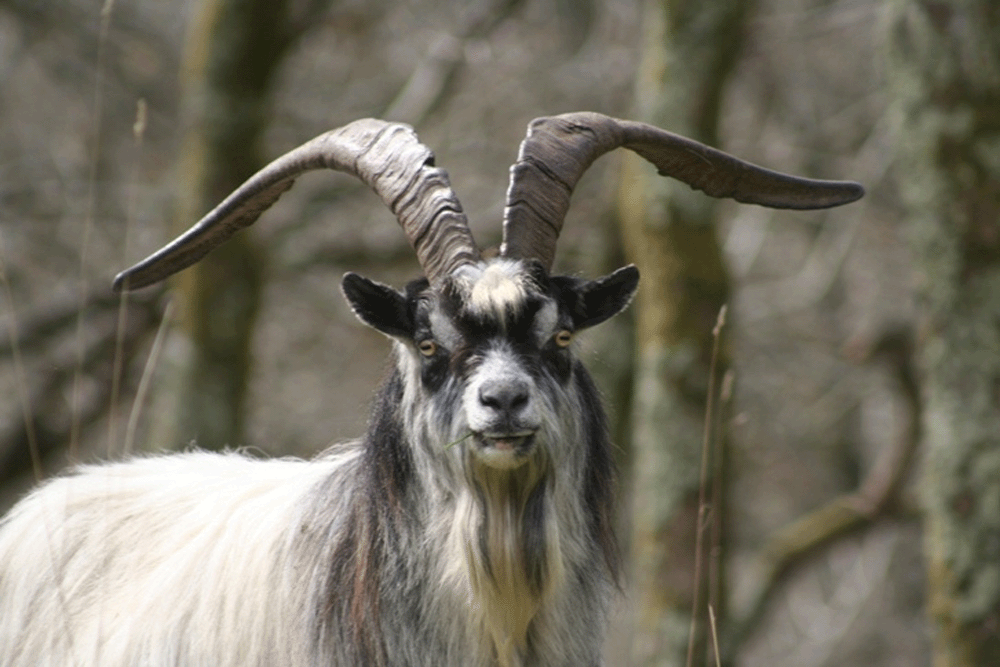 The 222 acre Pollochro Wood – on
the shore of Loch Lomond – is a protected area, home to an incredible mixture
of flora and fauna.
The 222 acre Pollochro Wood – on
the shore of Loch Lomond – is a protected area, home to an incredible mixture
of flora and fauna.
But the woods are under threat
from feral goats which destructively graze on plant life.
Now a team of ex-army
sharpshooters have been called in to administer the goats with the
contraceptive pill, in a bid to keep their numbers under control.
50 goats have been given the
chemical cocktail through a dart in an operation launched by the landowner, the
RSPB.
The drug will curb the mating
drive of the goats for three years in an attempt to keep their numbers under
control, and keep the woodland intact.
RSPB warden Fraser Lamont
oversees the woods – and regularly sees the feral goats eating young trees.
He said: “There are open areas
where older trees are dying off and nothing is coming through to take their
place.
“The goats will walk up trees to
eat the mosses and lichens some of which have taken hundreds of years to
develop.”
It is the first time the
technique has been deployed in Scotland – and it is being touted as a more
human alternative to a culling.
Dave Beaumont is the RSPB’s south
Scotland reserves manager.
He said: “The last thing we
really want to be doing as a conservation organisation is shooting things, and
trying to find a non-lethal method here has been particularly challenging.
Saturday, 30 November 2013
Loch Lomond goat cull: Sanctuary offers to re-house animals and update
An animal sanctuary has offered to re-home feral goats from the eastern shore of Loch Lomond to prevent them being culled.
Hillside Animal Sanctuary urged RSPB Scotland to halt the cull, which is being carried out to protect Pollochro Woods.
The area is viewed as a site of special scientific importance.
RSPB Scotland said it would consider alternatives solutions in March, but that the cull will continue until then.
SCOTTISH NATURE NOTES
Challenges of habitat management update
29 Nov 2013 12:47 PM
Recently there has been some coverage about goats at our Inversnaid Reserve. Our previous blog explained the specialness of the reserve and the reasons that we need to control the goats at the site.
In the past 2 days we have been alerted to the suggestion that we have rejected an offer from an animal sanctuary in Norfolk to provide a home for the goats of Inversnaid. This is not the case. In the past 24 hours we have been in contact with Scotland for Animals, who have identified themselves as the organisation that set up the offer from the Norfolk animal sanctuary and we will be meeting with them shortly to discuss options.
Tuesday, 12 November 2013
Concern as Inversnaid feral goat cull resumes
RSPB Scotland has resumed a controversial cull of feral goats on the eastern shore of Loch Lomond.
The environmental organisation is facing criticism from local people, who fear the cull could wipe out the entire population of goats around Inversnaid.
 The animals are popular with tourists and walkers on the West Highland Way.
But their voracious appetites cause problems for conservationists and RSPB Scotland says it needs to protect the rich woodland habitat.
It wants to reduce goat numbers in the Inversnaid area from about 69 to 30 in the coming years.
Reserves manager Robert Coleman said: "This is Scotland's rainforest. We've got a huge range of moss and lichen here. In fact, 5% of all of the world's moss species are represented in Scotland and this habitat is an excellent example of that diversity.
"By managing the herbivores, deer and goats, we can ensure the longevity of this habitat and make sure there are trees, mosses and lichens in the future while ensuring we maintain the populations of herbivores within the area as well."
Saturday, 15 June 2013
AD 1658: The Floating Island of Loch Ness
Sunday, 9 June 2013
AD 1658: The Floating Island of Loch Ness
Take a look at some ancient maps of Scotland and you may notice a strange phrase inscribed beside Loch Lomond which goes something like this:
“Loch Lomond famous for its floating island its fish without fins and being frequently tempestuous in a calm.”
Thus did cartographer Hermann Moll annotate his 1712 map of the Scottish county of Dunbartonshire (below). Cryptozoologists have speculated on whether these phrases refer to a strange creature residing in Loch Lomond or have a more mundane explanation.
Tuesday, 22 May 2012
RSPB purchase of “already-protected” land criticised
BIRD protection charity RSPB Scotland is facing criticism it wasted more than £300,000 of public money creating a nature preserve on as site which is already protected.
The charity bought land on the Wards Estate on the banks of Loch Lomond at a total cost of £1.1 million.
It plans to increase the populations of endangered birds such as snipe, curlews, redshanks and lapwigs.
The land is heavily protected under European laws, and falls within the Loch Lomond National Nature Reserve.
The Scottish Gamekeepers Association (SGA) also says snares will have to be used to prevent foxes preying on the rare birds.
One rural property agent, who wished to remain anonymous, said questions had been asked about the decision to use public money to
help buy the land.
help buy the land.
The property agent said: “This land is fully designated and has full legal protection. It is a criminal offence to damage it.”
Read on: http://www.deadlinenews.co.uk/2012/05/20/rspb-purchase-of-already-protected-land-criticised/
Saturday, 28 April 2012
RSPB acquires 563 acres of important habitat on shore of Loch Lomond
Partnership helps safeguard top nature site on Loch Lomond's bonnie banks
April 2012. RSPB Scotland is hoping to secure the future of one of the most important conservation sites in Central Scotland, after successfully purchasing land at the Wards Estate.
Situated close to Gartocharn at the south east shore of Loch Lomond, the estate is home to a rich variety of wildlife that inhabit the woodlands, mires, fens, grasslands and floodplain of the River Endrick, making this one of the most important wildlife sites in the UK.
New nature reserve
The conservation charity has unveiled plans for a 563 acre nature reserve that it will manage in a pioneering partnership with Scottish Natural Heritage (SNH) and Loch Lomond & The Trossachs National Park Authority(LLTNPA). This major purchase, of which RSPB Scotland will contribute a majority share of the total cost, will be made possible thanks to the partnering organisations plus a grant of £172,000 from the National Heritage Memorial Fund (NHMF). An appeal for donations from RSPB members and the public has also been launched. It comes exactly 50 years after this part of Loch Lomond was first declared a National Nature Reserve.
The conservation charity has unveiled plans for a 563 acre nature reserve that it will manage in a pioneering partnership with Scottish Natural Heritage (SNH) and Loch Lomond & The Trossachs National Park Authority(LLTNPA). This major purchase, of which RSPB Scotland will contribute a majority share of the total cost, will be made possible thanks to the partnering organisations plus a grant of £172,000 from the National Heritage Memorial Fund (NHMF). An appeal for donations from RSPB members and the public has also been launched. It comes exactly 50 years after this part of Loch Lomond was first declared a National Nature Reserve.
The partnership will ensure that the site will be managed as a hot spot for wildlife on Loch Lomond supporting breeding and wintering waders and waterfowl, and nationally rare plants such as the endemic Scottish or Loch Lomond dock.
Subscribe to:
Posts (Atom)


 Posts
Posts


