Showing posts with label Scotland. Show all posts

Monday, 10 February 2020

Scottish animal welfare baffled by python mutilation in Aberdeen

Two dead 5ft snakes were discovered at a nature reserve within a month of each other

A python has been found dead, slit open along the length of its body, while another was found in pieces, prompting an investigation at a nature reserve in Scotland.

The 1.5-metre (5ft) snakes were discovered within a month of each other at Den of Maidencraig in Skene Road, Aberdeen. A member of the public found the slit-open snake on 7 January, while the second was found on 31 January.

It is not known whether the first one was cut open while it was still alive. Both reptiles are thought to have been pets at some point.

The Scottish Society for Prevention of Cruelty to Animals (SSPCA) is appealing for information as it tries to track down whoever is responsible.

The SSPCA inspector Fiona McKenzie said: “They were both adult pythons and approximately 5ft in length. The first snake discovered had been slit up the stomach, the full length of its body.

“We’re unsure whether this happened when the snake was still alive. The second was found in pieces. This could have been due to the level of decomposition.”

She added: “We believe that both of these reptiles were pets at some point.They were found near the pond at Den of Maidencraig. They could have been left at the same time, it’s difficult to know at this stage.

“We want to find the person responsible for dumping these snakes in the condition they were found in.”

Thursday, 8 August 2019

Wasp species never seen before in Scotland discovered for the first time

SCOTSMAN REPORTER

Published: 15:35 Monday 22 July 2019

A wasp which has never been seen in Scotland before has made its home in Loch Lomond.

The brightly-coloured Ichneumonid wasp has never been recorded in the country before, but zoology graduate Sam Buckton, who volunteers with the RSPB, made the remarkable discovery in West Dunbartonshire.

Sam, who studied at the University of Cambridge, discovered 315 species considered to be new to the Loch Lomond nature reserve and the area.

He hopes to find more, to bring the total to 500.

Sam said: "RSPB Scotland's Loch Lomond reserve was acquired relatively recently in 2012, so we still have much to learn about the species that call it home.

"Although the birds and plants on site are well-studied, other groups - particularly invertebrates - are relatively unknown.

"As a large site with a wide array of habitats, Loch Lomond is likely to harbour a huge diversity of species, and the truth is, I've just been scratching the surface with my surveys.

Source

Friday, 21 June 2019

Scotland to allow supersized salmon-farms if they pass pollution tests


New policy expected to see larger farms created in deeper water further off Scottish coast
Severin CarrellScotland editor
Wed 5 Jun 2019 16.52 BSTLast modified on Wed 5 Jun 2019 17.08 BST
Scottish salmon farmers will be allowed to create supersized farms in return for accepting much stricter controls on parasites and marine pollution.
The Scottish Environment Protection Agency (Sepa) has said it will no longer restrict the size of salmon farms as long as they meet tougher standards limiting chemical, faecal and organic waste pollution in surrounding seas.
Scottish ministers have also unveiled much stricter legal limits on the level of sea lice allowed on farmed fish, amid mounting anger about plagues of sea lice, a parasite that eats fish alive, killing wild Atlantic salmon.
The new measures are expected to see much larger farms placed in deeper water further off the Scottish coast, in part to replace smaller inshore fish farms that may be forced to move because of the tougher pollution tests.
At present fish farms have a ceiling of 2,500 tonnes of fish per site. That will no longer apply, but larger firms will only be authorised in areas that are more “exposed, more remote, deep-water locations with strong tides”, said Sepa.
Deeper open seas should lead to their waste – medicines and chemicals used to control disease and lice, fish faeces, and uneaten food – being much more quickly dispersed and less likely to pollute the seabed. However, deep sea sites are at much greater risk of storm damage and of bad weather preventing visits by fish farm workers.

Monday, 6 May 2019

'Historic day for Scotland' as beavers get protected status


New legislation makes it illegal to kill beavers or destroy dams and lodges without a licence
Libby BrooksScotland correspondent
Wed 1 May 2019 10.50 BSTLast modified on Wed 1 May 2019 11.04 BST
Wildlife campaigners have hailed a “historic day for Scotland” as beavers are granted protected status nearly a decade after their successful reintroduction in Argyll.
It is now illegal to kill the animals, or destroy established dams and lodges, without a licence.
While wildlife groups emphasise the widespread ecological benefits of the beavers’ reintroduction, including increasing biodiversity and reducing flood risk, farming representatives continue to raise concerns about damage to agricultural land and waterways.
Welcoming the European Protected Status, which comes into force on Wednesday, Barbara Smith, the chief executive of the Royal Zoological Society of Scotland, said: “This is an historic day for Scotland and a milestone for the many of us who have worked together for years on the return of this species.
“[It] is a vital step in welcoming beavers back as a natural part of our ecosystem and a most welcome success as part of wider and continued efforts to protect and enhance our natural heritage.”
Announcing the legislation earlier this year, the Scottish government’s environment secretary, Roseanna Cunningham, described the beaver as being of “huge importance” to Scotland’s biodiversity, while acknowledging that their impact on farming meant it was necessary to include a licensing system for culling “when there is no other alternative”.
The vice-president of NFU Scotland, Martin Kennedy, warned on BBC Radio Scotland of a “ticking timebomb” as the beaver population grew. He told Wednesday’s Good Morning Scotland programme: “Beavers create problems with drainage systems in low-lying areas, the undermining of flood-banks, and these can run into thousands of pounds.”

Friday, 3 May 2019

Mountain hare 'saved by grouse moor'


11th April
UPDATED
Hare today, not gone tomorrow.
THEIR numbers were throught to be dwindling, victims of a changing landscape and the heavy hand of man.
But now fresh analyses has suggested that Scotland's mountain hares are thriving  - especially wild areas where human activity is at its most intensive.
A study undertaken by the Game & Wildlife Conservation Trust (GWCT) has found that grouse moor, and the efforts taken by shooting estates to preserve their land, are a "net benefit" to hare populations.
The mountain hare is the UK’s only native hare and was listed as Near Threatened in a recent review by the Mammal Society indicating that the species is of conservation concern in the UK.
The report examined mountain hare counts during a 16-year period from 2001 to 2017, during the spring across Highland, Grampian and Tayside. 
It found that populations of the elusive mammals was "significantly higher" on driven grouse moors than on unmanaged areas or moors managed for "walked-up" shooting.
However, the GWCT data flies in the face of research released last year by the Dr Adam Watson, of the Centre for Ecology & Hydrology and RSPB Scotland which said that between 1999 and 2017 hare numbers dropped by more than 30 per cent each year - with some counts finding fewer than one per cent of the original levels spotted in 1954.


Monday, 29 April 2019

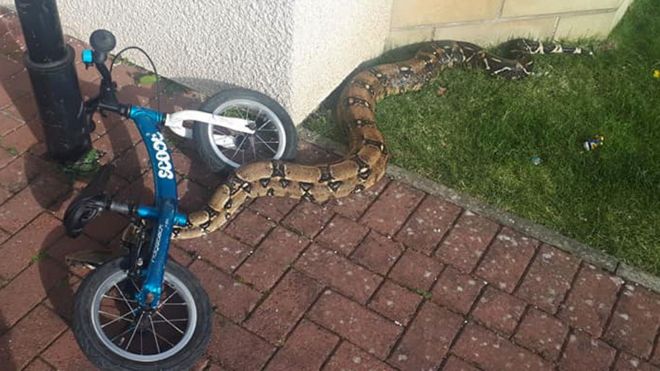
Dad's shock after children find boa constrictor in garden - via Richard Muirhead


23 April 2019


Image copyrightBRUCE BAKER

A father has spoken of his shock after his children found a seven-foot boa constrictor in their garden.

Bruce Baker thought the youngsters were playing a prank when they told him to come and see the 2.1m-long snake.

He and a neighbour had to coax the boa constrictor into a plastic box until the Scottish SPCA arrived at his home in the Scottish Borders.

Efforts are continuing to try and trace the owner of the stray snake, which was captured in Innerleithen on Sunday.

The boa constrictor, which is thought to be an escaped pet, has been taken to the Scottish SPCA rehoming centre in Edinburgh.

Sunday, 13 January 2019

No sign of 'distressed sperm whale' in loch


4 January 2019
A search of a Highlands loch has found no sign of a sperm whale believed to be in difficulty earlier this week.
The animal, which has been estimated to be up to 9m (30ft) long, was reported to have been tangled in rope in Loch Eriboll, near Durness, Sutherland.
Coastguard and British Divers Marine Life Rescue (BDMLR) volunteers and Scottish SPCA officers have been monitoring the whale.
The whale was reported to the coastguard on Wednesday.
BDMLR said it had been unable to confirm if the animal was caught in rope, adding that the it might have been ill or injured.
'Lost its course'
A team from the organisation had hoped to get to Loch Eriboll on Thursday with specialist equipment, but it was delayed.
A search of the loch for the whale began at first light on Friday and continued until late afternoon. The BDMLR team will remain on standby over the weekend.


Monday, 31 December 2018

Scottish ministers urged to honour pledge to protect beavers


Wildlife groups say delay has allowed some farmers to systematically cull the animals
Severin Carrel lScotland editor
Fri 21 Dec 2018 06.01 GMTLast modified on Fri 21 Dec 2018 06.03 GMT
Wildlife experts have said wild beavers in Scotland are being trapped and shot because ministers have broken promises to make them a protected species.
A group of 17 prominent ecologists and conservation bodies have signed a letter to the Guardian urging the Scottish government to honour its pledge two years ago to legislate to protect more than 400 wild beavers in the southern Highlands and Tayside.
“Without this protection, beavers are subject to unregulated culling, which can take place any time, anywhere,” says the letter, signed by groups including the Scottish Wildlife Trust, the Royal Society for the Protection of Birds and the Royal Zoological Society of Scotland. “This causes concern for the individual welfare of animals and the ability of the species to naturally spread through Scotland’s lochs and rivers. Lethal control must be a last resort rather than the go-to solution.”
A year ago the Scottish environment secretary, Roseanna Cunningham, told MSPs new regulations under the EU habitats directive would be in force in the first half of 2018 to prevent any unlicensed killing, dam destruction or relocation.


Friday, 21 September 2018

Whale stranding death toll rises to 58 in Scotland and Ireland


By Steven McKenzieBBC Scotland Highlands and Islands reporter
7 September 2018
More whales have been found dead on the coasts of Scotland and Ireland following several strandings of the animals at the end of last month.
Eleven whales were found dead over the course of one week in August.
Whale and Dolphin Conservation said the toll had now risen to at least 58.
In Scotland, 20 whales were found beached in the Western Isles, 16 in Argyll and Bute and two in the Highlands. Twenty have stranded in Ireland.
One of the whales was found dead in Northern Ireland, and the rest in the Republic of Ireland.
Many of the animals that died were Cuvier's and True's beaked whales, which are a deep-diving species.
Some have been found dead along the shores of North Uist and Harris in the Western Isles.
Last month, Whale and Dolphin Conservation asked the UK's Department for Environment, Food and Rural Affairs and the Scottish government to investigate the strandings.
The Cetacean Strandings Investigation Programme and Inverness-based Scottish Marine Animal Strandings Scheme are investigating,


Friday, 7 September 2018

Tropical sunfish spotted in Highland waters


2 September 2018
A fish normally found in tropical waters has twice been spotted off the west coast of Scotland last week.
It is the fourth time this year that the sunfish has been recorded by the Hebridean Whale and Dolphin Trust.
The ocean sunfish is the heaviest bony fish in the world, with an average weight of 2,200lbs (998kg).
The species was recorded on Friday by the crew of a fishing boat off the north coast of Skye. A sunfish was also seen off Ardnamurchan on Wednesday.
Sunfish, which drift with ocean currents, were once rarely seen in Scotland, but boat operators have reported more sightings in recent years, with August being the peak month.
They live on a diet of mostly jellyfish and swim at depths of up to nearly 2,000ft (610m).

Sunday, 24 June 2018

Can Scotland save its wildcats from extinction?


The secretive mammals are fast disappearing from the Highlands but last-ditch efforts to save them are fraught with challenges

Fri 15 Jun 2018 16.52 BSTLast modified on Fri 15 Jun 2018 22.00 BST

Set deep in mixed woodland of Scots pine and birch, near the banks of the river Beauly in Inverness-shire, several huge, concealed pens contain two breeding pairs of Scottish wildcat.

Wildcats mate from January to March, and their high, anguished breeding calls through the dark winter nights are thought to have inspired tales of the Cat Sith, a spectral feline of Celtic legend that was believed to haunt the Highlands.

“It is a cry that carries over quite a distance and it is spine-chilling if you hear it in the middle of the night,” says Sir John Lister-Kaye, renowned nature writer and director of the Aigas Field Centre. The former Victorian sporting estate, which now offers conservation holidays and environmental education, is one of 20 sites currently participating in a conservation breeding programme led by the Royal Zoological Society of Scotland (RZSS).

“I’m sure that if there were other wildcats nearby they would have been attracted to the calls. But since we started in 2011 we’ve had foxes, pine martins, badgers, one or two domestic cats come and have a look – but not a single wildcat anywhere near.”

The Scottish wildcat is now one of the most critically endangered wild mammals native to the UK, according to a comprehensive analysis by the Mammal Society released earlier this week, which estimated the population at 200 but accepts that the figure may be significantly lower.


Friday, 22 June 2018

Large fenced reserves an effective way to bring wolves back to Scotland


Date:  June 13, 2018
Source:  University of Sussex

Research, led by the University of Sussex and the University of Kent, indicates that for wolves to be effective at directly reducing red deer numbers and allowing nature to recover in the Scottish Highlands they may need to be reintroduced to very large fenced reserve.

A fenced area, which would also help limit encounters with residents, farmers and workers in the Scottish Highlands, would give the reintroduced grey wolf the opportunity to achieve the high population densities (e.g. 80 wolves per 1000 km2) required to directly reduce the very high red deer numbers that are currently create an over-grazing problem in the Highlands.

The current high red deer densities (up to 40 deer/km2) are preventing tree regeneration and ecosystem restoration in parts of Scotland with more than one third of all native woodlands in an unfavourable condition because of herbivore impacts.

Dr Christopher Sandom, lecturer in biology at the University of Sussex with a particular interest in rewilding, said: "Reintroducing the wolf has long been suggested as part of the solution to large red deer populations but there will always be concerns about how wolves interact with people in any rewilding project like this. This research shows that they could actually have an extremely beneficial impact in terms of making the rewilding process more effective."


Friday, 4 May 2018

Specieswatch: conservation effort is under way to save our mountain hares


Spring is risky for mountain hares; to avoid predators, they have to time their change from white to brown carefully

Tue 24 Apr 2018 21.30 BST Last modified on Tue 24 Apr 2018 22.00 BST

Britain’s mountain hare Lepus timidus should presently be turning from white to grey-brown with a blue tinge as the breeding season starts. Spring is a dangerous time; the snow disappears and adults need to blend in to avoid hungry eagles or a fox.

Unlike brown hares and rabbits the mountain hare is a true native species, but is increasingly threatened by climate change as it has to climb higher to find a suitable habitat. There are mountain hares as far south as Derbyshire and on the Pennine Hills, where they have been introduced, but their true home is in alpine Scotland.

Not all mountain hares turn white – the temperature seems to be the trigger. In Ireland, where it snows less and is warmer, there is a sub-species that stays mostly brown – a better survival strategy.

Numbers in Scotland vary enormously, with peak populations on a 10-year cycle, the cause of which remains unexplained. When they are not shot by gamekeepers they gain from grouse-moor management burning because it provides suitable heather habitat for them, too. There are fears for the future because in some areas hares have almost disappeared. A count is under way as the first stage of a conservation effort.


Wednesday, 2 May 2018

'Very angry badger' causes part of Scottish castle to be closed


Repairs to masonry damaged by intruder put Craignethan’s cellar tunnel out of bounds to public

Martin Belam and agencies
Thu 19 Apr 2018 11.25 BSTLast modified on Thu 19 Apr 2018 15.19 BST

Parts of a Scottish castle remain closed to the public after a “very angry badger” took up residence. The cellar tunnel at Craignethan Castle, in South Lanarkshire, was initially closed last week after the animal arrived, and remains closed while the damage it caused is repaired.
It is thought the animal had become lost, and staff tried to lure it out with cat food and honey. 
Staff first noticed some dug-out earth last Wednesday evening, and later saw the culprit. The badger is said to have caused some mess, digging through loose soil into stonework, and staff have been clearing away the rubble.

On social media, people tried to give the castle better tips on shifting the animal – including luring it out with peanuts.


Monday, 30 April 2018

Killer whales seen in river Clyde


Pod of orcas spotted between Dunoon and Gourock, thought to be hunting seals or porpoises

Sun 22 Apr 2018 14.32 BSTLast modified on Mon 23 Apr 2018 00.55 BST

A pod of killer whales has been spotted in the river Clyde apparently hunting seals or porpoises.
Images and videos have been posted on social media over the weekend of about half a dozen killer whales, or orcas, between Dunoon and Gourock.

Lindsay Moss was on a Western Ferries service on Saturday when they made an appearance. Her footage shows three orcas, including what appears to be a youngster, rising to the surface before disappearing again.

Orcas are sociable animals that travel in groups of up to 50. Although they are frequently seen near Arran in the Firth of Clyde, they have not been regular visitors to the upper Clyde for many years, experts say.

It is thought they were attracted to the area due to its abundance of food – porpoises and seals.
In the UK, killer whales are seen most regularly around the Shetland and Orkney islands.

Source  

Wednesday, 11 April 2018

One man’s plan to let wolves roam free in the Highlands


The ‘custodian’ of the Alladale estate wants to turn it into a fenced-off wildlife reserve

Sun 8 Apr 2018 06.00 BST

The echoes of Scotland’s predator prince faded into silence three centuries ago. The wolf was once lord of these Sutherland slopes and the forest floors beneath and now a voice in the wilderness is calling him home.

Paul Lister acquired the Alladale estate, 50 miles north of Inverness, in 2003 and immediately set about creating a wilderness reserve according to his perception of what these wild and beautiful places ought to look like. He can’t imagine them without the packs of wolves that once roamed free here.

But his views are considered eccentric by ramblers and conservationists, who view them as a rich man’s caprice, centring their objections on his plans to fence off the vast reserve.

Lister’s plans for the controlled release of a pack of Swedish wolves have been known for years but last week he seemed to issue an ultimatum to the Highland and Islands council, using a local newspaper interview to tell them: “I want to do this, but we would really need to have the details nailed down by the end of 2018.” Yet, when you speak to this man, driven as he is by a vision of how these places should be managed, you form an unshakeable impression that he will strive to fulfil it for as long as it takes.


Monday, 9 April 2018

Rare Scottish dinosaur prints give key insight into era lost in time


April 2, 2018, University of Edinburgh

Dozens of giant footprints discovered on a Scottish island are helping shed light on an important period in dinosaur evolution.

The tracks were made some 170 million years ago, in a muddy, shallow lagoon in what is now the north-east coast of the Isle of Skye.

Most of the prints were made by long-necked sauropods - which stood up to two metres tall - and by similarly sized theropods, which were the older cousins of Tyrannosaurus rex.

The find is globally important as it is rare evidence of the Middle Jurassic period, from which few fossil sites have been found around the world.

Researchers measured, photographed and analysed about 50 footprints in a tidal area at Brothers' Point - Rubha nam Brathairean - a dramatic headland on Skye's Trotternish peninsula.
The footprints were difficult to study owing to tidal conditions, the impact of weathering and changes to the landscape. In spite of this, scientists identified two trackways in addition to many isolated foot prints.

Researchers used drone photographs to make a map of the site. Additional images were collected using a paired set of cameras and tailored software to help model the prints.

Analysis of the clearest prints - including the overall shape of the track outline, the shape and orientation of the toes, and the presence of claws - enabled scientists to ascribe them to sauropods and theropods.


Wednesday, 28 February 2018

Rare butterfly found breeding in Scotland for first time in 130 years


Eggs laid by white-letter hairstreak found on elm trees in Berwickshire


Thu 15 Feb 2018 07.01 GMTLast modified on Thu 15 Feb 2018 07.03 GMT

The microscopic eggs of an endangered butterfly have been found in Scotland, suggesting the insect has returned to breed in the country for the first time in more than 130 years.

Lepidopterists discovered white-letter hairstreak eggs on wych elm trees at Lennel, Berwickshire, this month after an adult butterfly was spotted last summer 10 miles away – the first sighting in Scotland since 1884.

“Last year was an impossible find, but this year’s egg discovery is beyond anything we thought possible,” said Iain Cowe, butterfly recorder for the Borders, who found the adult butterfly last summer.

While most butterflies hibernate as caterpillars, the white-letter hairstreak spends nine months of the year as an egg, which is smaller than a grain of salt and stuck to slender branches of elm.

The eggs were detected by Jill Mills and Ken Haydock, volunteers for Butterfly Conservation who travelled from Bolton to scour trees in the Borders.

“We were searching the elm trees by the River Tweed at Lennel when Jill called me over,” said Haydock. “I could see by the look on her face that she had found something.


Wednesday, 14 February 2018

Scotland's red squirrel numbers stabilise


Red squirrels have seen a surge in numbers in Scotland's north east and have stabilised nationwide, according to conservation researchers.

Results from Scotland's Red Squirrels 2017 survey show that their population has stopped shrinking across the country.

The most positive results reveal that there has been a "significant" boost in numbers around Aberdeen.

Red squirrels are also starting to appear in previously abandoned areas.

Conservation officer Mary-Anne Collis said: "In the central lowlands, red squirrels are holding their ground and as a result we've started to see them in areas where they haven't been seen for a long time.

"This is particularly noticeable to the south and east of Loch Lomond and the Trossachs National Park, which is now predominantly a red-only zone.

"If it wasn't for our fantastic volunteers that brave the unpredictable spring weather to help us with these surveys then we wouldn't be able to see the positive impact that our conservation work is having."


Monday, 15 January 2018

First polar bear cub born in the UK for 25 years at Scottish park


Staff at Highland Wildlife Park in Scotland confirm the birth to mother Victoria but say the first three months of life for the new-born cub are perilous


Wed 3 Jan ‘18 10.31 GMTLast modified on Wed 3 Jan ‘18 22.00 GMT


The first polar bear cub to be born in Britain for 25 years is being cared for in a private den by its mother, Victoria, at the Highland Wildlife Park in Scotland.

Staff at the Royal Zoological Society of Scotland (RZSS) park confirmed the birth after hearing distinct high-pitched sounds from Victoria’s maternity unit, which remains closed to visitors to ensure privacy.

The news of the birth comes 24 hours after a polar bear cub at a Berlin zoo died aged 26 days, and the RZSS admitted that the first three months would be perilous for the newborn polar bear.

Una Richardson, the park’s head keeper responsible for carnivores, said: “While we are absolutely thrilled, we are not celebrating prematurely as polar bear cubs have a high mortality rate in the first weeks of life due to their undeveloped immune system and the mother’s exaggerated need for privacy, with any disturbance risking the cub being killed or abandoned.”


Related Posts with Thumbnails

ShareThis