Showing posts with label Merseyside. Show all posts

Monday, 26 February 2018

'It's given the children a love of wildlife': the schools letting nature in

In school fields and communities, pupils are learning about the fragility of nature – and restoring depleted environments

Sat 17 Feb 2018 09.00 GMTLast modified on Sat 17 Feb 2018 12.13 GMT

After the long slog of winter, pupils at Evelyn Community primary school in Merseyside are getting outside with a mission in mind: to count and record the number of different bird species in the school grounds. The challenge is part of the Big School’s Bird Watch, an event which last year involved 73,000 school children and their teachers.

But the children have been taking an active interest in the wildlife at their school for a while. Since creating a garden in an unused corner of their field more than two years ago, the pupils have attracted a variety of birds. They’ve planted wildflower seeds, created a vegetable plot, made bird nests, and learned about biodiversity. The school has a wicker bird hide and has bought binoculars to encourage bird spotting all year round.

The school’s headteacher, Carole Arnold, says the impact of the children’s work on biodiversity in the garden has been significant. A group of 12 children spend time in the garden each week, for a full term, before giving a new group their turn. “Our school field had absolutely no birds at all [before]. It’s really given the children a love of wildlife,” she says. “We use it with some vulnerable children as well who sometimes need help to be calm.”


Monday, 6 March 2017

Red squirrels: 5,000 volunteers sought to save species – and help kill invasive greys


Wildlife Trusts’ biggest-ever recruitment drive will see volunteers monitor populations, educate children – and bludgeon grey squirrels to death

Patrick Barkham
Friday 24 February 2017 06.01 GMT 

An army of 5,000 volunteers is being sought to save the red squirrel from extinction by monitoring populations, educating children – and bludgeoning grey squirrels to death.

The Wildlife Trusts’ biggest-ever recruitment drive is focused on areas of northern England, north Wales and Northern Ireland where invasive grey squirrels first introduced by the Victorians are driving the retreating red squirrel population to extinction.

More than 2.5 million grey squirrels are continuing to spread north through England and into Scotland, out-competing the 140,000 remaining red squirrels and spreading the squirrelpox virus, which does not affect greys but rapidly kills reds. 

“In most of the UK there are only a handful of refuges left for red squirrels,” said Dr Cathleen Thomas, programme manager of Red Squirrel United, a conservation partnership started in 2015. “Without help, experts predict this beautiful and treasured creature could be extinct within as little as 35 years.”

Volunteers for Red Squirrel United will be asked to monitor red squirrel strongholds in Northumberland, Merseyside, Wales and Northern Ireland, and report any grey squirrels entering these areas. Volunteers will set up camera traps to film squirrel behaviour and teach the public and school children about the way in which greys have rapidly driven the reds to extinction across southern Britain since 1945.

Tuesday, 30 December 2014

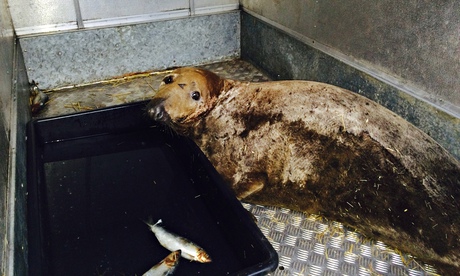
Seal found in field is recovering from pneumonia

Dumbledore the seal receiving treatment at RSPCA facility in East Winch after being found 20 miles from the sea last week

Press Association

The Guardian, Monday 29 December 2014 13.56 GMT

Photograph: RSPCA/PA
A seal discovered in a field on Merseyside has been diagnosed with pneumonia but is on the road to recovery.

The adult grey seal, who has been named Dumbledore, was found stranded in a field in Newton-le-Willows, at least 20 miles from the sea, on 22 December.

He was taken to the RSPCA’s specialist seal facility in East Winch, Norfolk, the following day, where he was examined by a vet and underwent tests.

Wednesday, 24 December 2014

Two rare sea turtles found washed up on Britain's shores


Critically-endangered Kemp’s ridley turtles were found in Cumbria and Merseyside, 5,000 miles from their home


One of two Kemp’s ridley turtles found in Cumbria and Merseyside, 5,000 miles from their home in the Gulf of Mexico. Photo: Wildlife Trust

By Telegraph reporter

12:37AM GMT 24 Dec 2014

Two rare sea turtles have washed ashore on beaches in the North West, some 5,000 miles from their home in the Gulf of Mexico.

The critically-endangered Kemp’s ridley turtles were found in Cumbria and Merseyside, and it is feared that more could yet appear.

Rod Penrose, a Marine mammal expert, said that they could have been “cold-stunned” by a drop in ocean temperatures in the US, which would leave them unable to feed or swim against strong currents.

Rob Archer, who was walking with his girlfriend on Saturday when he found one of the turtles on Sefton Beach, near Formby, told the Liverpool Echo: “At first I thought it was a crab.

“It seemed in a stupor as if there wasn’t much life left in it.

“My first thought was to put it back in the sea so I walked out into some deeper water and it swam away.”

Monday, 22 December 2014

'Lost' grey seal rescued from field in St Helens

22 December 2014 Last updated at 15:47

A seal found in a field in Merseyside has been taken to a wildlife hospital "exhausted" after being rescued.

The "distressed" sea mammal was found near Newton Brook in Newton-le-Willows at about 09:45 GMT, police said.

Police, animal rescue officers and a farmer herded it with brooms and metal fences into a RSPCA trailer.

The grey seal, found about 17 miles (27km) from the nearest coastline, is thought to have travelled up the River Mersey, before getting "lost".

Saturday, 21 June 2014

Rare Merseyside lizards get a helping hand with egg laying

North Merseyside Amphibian and Reptile Group (NMARG) is celebrating the successful creation of egg-laying sites especially for the Merseyside sand lizard, a unique form of this rare and strictly protected species which has very specific egg-laying requirements.

Volunteers from the Amphibian and Reptile Group network have been spearheading emergency habitat restoration for the sand lizard on the Sefton Coast over the winter months.

They have created over 150 sand patches among the dunes of the Sefton Coast for the animals.

Now they can report that initial indications are that the sand lizards have adopted these egg-laying sites.

Tuesday, 26 November 2013

Merseyside red squirrels show signs of pox resistance

Red squirrels at a National Trust reserve in Merseyside have shown signs of resistance to the pox virus that has blighted the species, say researchers.


They found that 10% of its squirrels had pox antibodies in their blood.

Tuesday, 7 May 2013

Meet the tiny Chihuahua who has become best friends with a PYTHON

Fifi the dog and Bashar the snake have become unlikely pals - and even sleep together according to their owner. 

A Chihuahua and a Python have formed an unlikely friendship - after their belly dancing owner brought them together for a show.

Paula Staunton, 48, adopted Bashar, along with another python called Xena, to use in her performances.

And for Fifi the dog, who is a regular sight at the unique spectacle, it was love at first sight.

They often sniff each other out for a cuddle and fall asleep together on their own throne-shaped chair.

Paula, from Wallasey, Merseyside, believes their relationship is just like a human love affair. 

Monday, 29 August 2011

Rare sand lizards released back to the wild on Merseyside

Species has been lost from local heathland August 2011: The UK's rarest lizard has been given a helping hand, with 80 captive-bred sand lizards released on the Sefton Coast as part of a long-term conservation project to restore the species' status and historic range.

The release at The Lancashire Wildlife Trust's Freshfield Dune Heath is one of 19 projects within the Sefton Coast Landscape Partnership Scheme.
CAPTIVE BRED: Young sand lizards.
Picture: Phil Smith

In the UK, sand lizards only live on two rare habitats - sand-dunes and lowland dry heath. A healthy population still survives on the sand dunes of the Sefton Coast but they have been lost from the heathland.

Lizards are extending their rangeLast September, 34 juvenile sand lizards were released at Freshfield and a number have been found and photographed since, moving further away from the release site than had been anticipated.

Merseyside sand lizards have a unique genetic make-up and the juveniles due for release have been captive bred from local stock. The animals are being released later this month to allow them to get used to the reintroduction site before hibernation in October.

Fiona Whitfield of the Lancashire Wildlife Trust said: ‘We are excited at the arrival of a new species for the reserve and to be a part of these important local and national projects. There is a large population of common lizards on Freshfield Dune Heath so we are confident that the sand lizards will thrive here.'

The lizard release is part of a three-year Heritage Lottery Funded Project being delivered by the Sefton Coast Partnership. It is also supported by the North Merseyside Amphibian and Reptile Group, Amphibian and Reptile Conservation and Natural England.
http://www.wildlifeextra.com/go/news/lizard-merseyside.html
Related Posts with Thumbnails

ShareThis