Showing posts with label pilot whales. Show all posts

Thursday, 3 January 2019

Groups of pilot whales have their own dialects


Date:  December 19, 2018
Source:  Woods Hole Oceanographic Institution
The groups of pilot whales all use the same habitat, but have different vocal repertoires. This means that they're purposely not associating with each other, says WHOI researcher Amy Van Cise.
Credit: Photo by Amy Van Cise, Woods Hole Oceanographic Institution
In humans, different social groups, cities, or regions often have distinct accents and dialects. Those vocal traits are not unique to us, however. A new study from the Woods Hole Oceanographic Institution (WHOI) has found that short-finned pilot whales living off the coast of Hawai'i have their own sorts of vocal dialects, a discovery that may help researchers understand the whales' complex social structure. The study was published on Dec. 14, 2018, in the journal Behavioral Ecology and Sociobiology.
"These groups of pilot whales all use the same habitat. The fact that they have different vocal repertoires means that they're purposely not associating with each other," says Amy Van Cise, a Postdoctoral Scholar at WHOI and lead author on the study. "It's sort of like if you've got hipsters and prep kids in the same high school -- each group has different slang. They identify themselves with certain speech to maintain that separation."

Monday, 3 December 2018

New Zealand whales: Why are so many getting stranded?

By Gareth EvansBBC News

30 November 2018


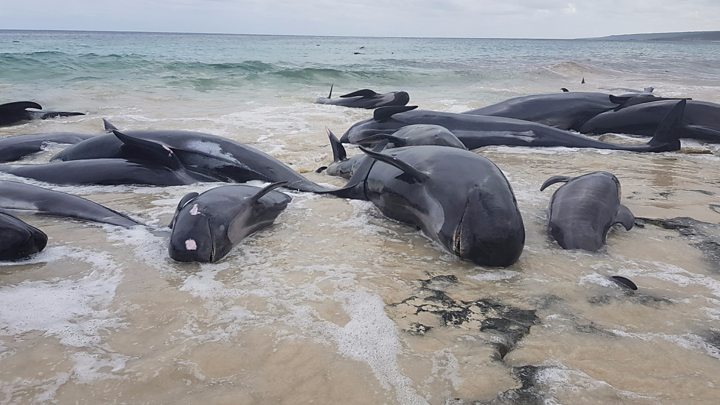
The pictures are striking: dozens of whales lie stranded on an idyllic beach in a remote part of New Zealand.

The group were found by a walker on Stewart Island earlier this week. And just a few days later, a further 51 pilot whales died after becoming stranded on a beach on the Chatham Islands.

While whale strandings are not uncommon, they usually involve just a single animal rather than a whole group. The recent flurry of mass strandings has brought a renewed focus on the mysterious, and rare, phenomenon.

So why does it happen? While the exact reasons remain unclear, experts say many different factors could play a part.
Sickness and injury

"Quite often animals that turn up on a beach are getting exhausted, they're malnourished, or they haven't eaten because they're ill," says Dr Simon Ingram, a Professor of Marine Conservation at the University of Plymouth.

"They can be in the final stages of being ill or die at sea and end up getting washed up on a beach," he adds.

But Dr Ingram says that sickness or injury mainly plays a part when a single animal is found stranded.

Monday, 26 March 2018

Hamelin Bay: Nearly 150 beached whales die in Australia


23 March 2018


Over 100 whales die in mass stranding in Australia

Only six whales have survived a mass stranding of pilot whales on the coast of Western Australia.

About 150 of the animals were found beached at Hamelin Bay, about 300km (180 miles) south of Perth.

Their discovery by a local fisherman on Friday prompted a major rescue effort to return them to deeper waters.

However, by nightfall, more than 140 of the whales had died, with deteriorating weather conditions and the threat of frenzied sharks impeding efforts.

More than 100 volunteers, wildlife personnel and others came to the aid of the beached pilot whales, a species known to strand en masse.

Friday, 17 February 2017

Mass Stranding: Hundreds of Pilot Whales Returned to the Water


By Jeanna Bryner, Live Science Managing Editor | February 12, 2017 09:02am ET
Update: Feb. 12, 9 a.m. ET: 

This morning (Feb. 12), most of the 240 or so whales that had re-stranded yesterday near the original stranding site made there way back out to the shallow water during the high tide, according to the New Zealand Department of Conservation. Then, this afternoon local time, the remaining 17 whales on the beach were refloated and sent back into the deeper waters in Golden Bay.

"The animals can only be moved while floating so work with animals is dependent on tides," the DOC's Herb Christophers told Live Science. "While the tide is out, the whales are kept cool and maintained as much as possible in an upright position. They have trouble bearing their own weight and suffocate sometimes because of the position they find themselves in when stranded."

"Two boats were used to guide the 17 whales out to rejoin the original diffuse pod, and it is hoped that they will find a way into deeper, safer waters," the DOC said in a statement


Monday, 20 June 2016

Eight pilot whales dead in mass stranding in Indonesia

Hundreds of fishermen and officials rescued 24 of the whales after their pod swam ashore in Probolinggo, East Java

Agence France-Presse
Thursday 16 June 201611.02 BST
  

Eight pilot whales have died after a mass stranding on the coast of Indonesia’s main island of Java that sparked a major rescue operation, an official said Thursday.

Thirty-two of the short-finned pilot whales came ashore during high tide early Wednesday in Probolinggo, East Java province.

“At first there were just one or two whales swimming near the shore, and the nature of whales is that if they are sick they will come near the shore,” Dedy Isfandi, the head of the local maritime and fisheries office, told AFP.

“But whales have such high social interaction – when one fell ill, they approached the sick one to swim back to sea ... when the tide fell all of them were trapped,” Isfandi added.

Hundreds of local fishermen and government officials tried to take them back out to sea overnight, but in the morning eight whales had returned to shore and died, Isfandi said.

About 23 others were already out at sea while one disoriented whale was accompanied by rescuers to make sure it did not return to shore.

Rescuers used tarps to wrap around the beached whales and pull them out to sea, while swimmers plunged into the water to drive others out of the area.

Vets and scientists conducted autopsies on the dead whales to find out why they were stranded. Fishery officials said it could be due to turbulent waters in the Indian Ocean or that they had eaten something poisonous.

Over the last decade or so, whale sharks and orcas have also been found stranded in the area, Isfandi said.


Monday, 15 February 2016

Toxic chemicals found in beached pilot whales in Scotland


Scientists find levels of mercury and cadmium in the whales’ brains increased with age
Thursday 11 February 2016 16.52 GMTLast modified on Thursday 11 February 201617.07 GMT
Scientists have found clear evidence that whales are absorbing high levels of toxic heavy metals, with cadmium found in the brains of pilot whales which washed up in Scotland
Chemists at the University of Aberdeen said they had found cadmium in all the organs of adult long-finned pilot whales which stranded in 2012, including their brain.
The research shows for the first time that cadmium – known to pass into the brains of infant and unborn whales - had also passed across the so-called blood-brain barrier in adult whales.

They said their findings also suggested that mercury concentrations could be increasing high enough in the seas “to lead to additional toxic stress in the long-lived marine mammals”, with higher concentrations increasing with age.

The team, lead by Dr Eva Krupp, an environmental analytical chemist, tested the remains of 21 long-finned pilot whales which died in a mass grounding between Anstruther and Pittenweem in Fife in September 2012.

There have been a series of recent whale strandings, with the most dramatic in the UK taking place in Norfolk in January and early February. Six sperm whales washed up over a series of days along beaches in East Anglia, in a stranding linked to other recent groundings by sperm whales in Germany and France. Cetacean experts are currently testing samples to investigate possible reasons why.
“We were able to gather an unprecedented number of tissue samples from all the major organs including the brain and as a result we can see for the first time the long term effects of mammalian exposure to the environmental pollutants,” Krupp said of the whales that stranded in 2012.
“This pod of whales provides unique new insights because we were able to look at the effects on a large number of whales from the same pod and how this varied according to age.” 

The university said that in three of the whales aged nine years or older, the mercury concentrations were higher than the toxic levels which would cause severe neurological damage in humans. 


Sunday, 6 December 2015

Sea runs RED with BLOOD: 11 pilot whales SLAUGHTERED after being 'harrassed for hours'


THE seas are running red on the “killing beaches” after the latest slaughter of whales on the Faroe Islands.

PUBLISHED: 11:28, Tue, Dec 1, 2015 | UPDATED: 12:06, Tue, Dec 1, 2015

A pod of 11 pilot whales has been slaughtered on in the sixth drive hunt – or grindadráp – of the season.

Conservationist said today that 501 pilot whales have so far been slaughtered this year in the northern archipelago.

While the Faorese authorities say the slaughter is quick, Sea Shepherd campaigners refute the claims and describe the whales’ deaths as “slow and torturous”.

Rosie Kunneke, Sea Shepherd land team leader during its latest pilot whale defence campaign, said: “For an hour and a half these pilot whales were harassed by small boats, driven into the killing beach, hooked by their blowholes, dragged onto the rocks and sand and then slaughtered in the presence of their family members.

“Video and photographs captured by Sea Shepherd earlier this year clearly show the truth of the grindadráp. It is a slow and torturous death. To claim otherwise is a totally outrageous sham.”

Throughout the summer, the Faroese whale drives shocked animal campaigners and led to award-winning actor Martin Sheen writing to the Danish prime minister to criticise its support for the “grinds” by sending in naval vessels against demonstrators.

Friday, 26 June 2015

Royal Navy bomb explosions caused mass whale deaths, report concludes

Noise from underwater bombs caused 19 pilot whales to beach and die off the coast of Scotland in 2011, say government scientists


Wednesday 24 June 2015 14.09 BSTLast modified on Wednesday 24 June 201514.12 BST

Four large bombs exploded underwater by the Royal Navy were to blame for a mass stranding which killed 19 pilot whales on the north coast of Scotland in 2011, government scientists have concluded.

A long-delayed report released on Wednesday by the Department for Environment Food and Rural Affairs says that the noise from the explosions could have damaged the hearing and navigational abilities of the whales, causing them to beach and die.

On 22 July 2011, 70 long-finned pilot whales swam into the Kyle of Durness, a shallow tidal inlet east of Cape Wrath, Europe’s largest live bombing range. Despite attempts to herd them back out to sea, 39 were left stranded by the tide.

Concerted efforts by expert teams and local people managed to refloat 20, but 19 ended up dead. It was one of the largest mass strandings in recent years, and it prompted a government-funded investigation by 12 scientists from laboratories across the UK.

Tuesday, 2 June 2015

Five whales die in Isle of Skye stranding

Rescuers refloat several pilot whales pod at Brogaig Bay on Staffin Island but 11 are still stranded and five others have died

Staff and agencies

Tuesday 2 June 2015 12.40 BSTLast modified on Tuesday 2 June 201513.00 BST

Five whales have died and 11 others are stranded off the Isle of Skye after becoming stuck on rocks on Staffin Island off the northern coast earlier on Tuesday.

A team from the British Divers Marine Life Rescue (BDMLR) is tending to the stranded mammals and giving first aid to them.

A spokesman said: “They are not in an easy position as they have stranded awkwardly on rocks, meaning it is difficult to relieve the pressure on their bodies.”

The BDMLR was alerted to a pod of 21 pilot whales that had become stranded at Brogaig Bay on Skye at about 4am.

Rescuers said 18 were refloated before 16 became stranded again on Staffin Island. Two whales died and a pregnant female who was not expected to survive was euthanised, the BDMLR said.

Monday, 16 February 2015

New Zealand rescuers refloat 60 stranded whales

Australian Associated Press

Saturday 14 February 2015 23.02 GMT

The 60 pilot whales stranded off New Zealand’s South Island have been refloated and “it’s looking quite good”, rescuers say.

About 200 whales stranded on Farewell Spit in Golden Bay on Friday and about 140 died and the rest had been refloated.

But 60 restranded and Department of Conservation (DOC) staff and 400 volunteers worked to keep them alive on Saturday until they could be refloated at high tide in the early evening.

Lead whales were taken out on pontoons and other whales were moved to follow them, says DOC conservation services manager for Golden Bay, Andrew Lamason.

“They’re all off and the lead whales are actually now swimming into deep water and are going in the right direction,” he said.

“Our guys are moving in behind them to keep an eye on them and it’s looking quite good.”

The whales were monitored overnight on Saturday.

Thursday, 20 November 2014

Rescuers try to guide pod of whales off Essex coast into deeper water


Pilot whales spotted a mile offshore in area where there are several mud and sand flats

A group of pilot whales spotted off the Essex coast are being herded out into deeper water to stop them from stranding.

The 40-strong pod have been spotted just a mile offshore and have been sheltering near the Blackwater Estuary.

Boats are being used by British Divers Marine Life Rescue and Essex police’s marine unit to try to herd the whales further out to sea as the estuary has a number of mud and sand flats.

This could lead to the pod, which was initially spotted off the Norfolk coast, becoming stranded when the tide goes out.

Members of the public have been asked to keep their distance to stop the animals from becoming upset.

Tuesday, 2 September 2014

Charlie Sheen says Danish authorities are complicit in pilot whale ‘slaughter’

Actor had donated boat used by activists who were arrested after trying to save pod of 33 pilot whales in Denmark’s Faroe Islands

theguardian.com, Monday 1 September 2014 03.58 BST

Hollywood star Charlie Sheen has criticised Danish authorities over the arrests of 14 anti-whaling activists in the North Atlantic.

Sheen donated one of three inflatable boats used by Sea Shepherd members to try to save a pod of 33 pilot whales being driven toward hunters on the Faroe island of Sandoy.

Eight activists on the water and six more on land were arrested and detained by Danish officials.

The boats were seized by the Danish navy.

Sheen accused the Danish authorities of being complicit in the “brutal slaughter”.

“I am proud that a vessel bearing my name was there and did all it could to try to stop this atrocity,” the Anger Management star said.

“The 40-foot Zodiac called the BS SHEEN that I donated to Mr [Sea Shepherd leader Paul] Watson’s tireless and heroic efforts, has been shamefully seized. This level of insidious and vicious corruption must be dealt with swiftly and harshly.”

Sea Shepherd claims one of the activists, Spaniard Sergio Toribio, was pulled from a car and assaulted while monitoring the hunt from land, suffering a broken finger.

Sunday, 31 August 2014

14 detained trying to prevent Faroe Island dolphin hunt

31st August 2014

Fourteen animal rights activists have been detained on the Faroe island of Sandoy in the North Atlantic while trying to stop a controversial dolphin hunt, their organisation said Sunday.

The activists were detained Saturday when attempting to save a pod of 33 pilot whales, members of the dolphin family, as the mammals were driven to shore to be killed by waiting hunting parties, according to environmental group Sea Shepherd.

"The 14 have been under arrest since Saturday, and three of our boats have also been seized," Lamya Essemlali, president of Sea Shepherd France, told AFP.

Large numbers of pilot whales are slaughtered each year on the Faroe Islands, an autonomous territory within the kingdom of Denmark.


Tuesday, 21 January 2014

Whales make wrong turn in Naples

A pod of 23 pilot whales that swam into Gordon Pass in Naples on Sunday was back in the Gulf of Mexico before sundown as marine biologists continued to monitor this latest stranding.

“There were three that had beached themselves and weren’t looking good,” said Denise Boyd, research associate with the Florida Fish and Wildlife Conservation Commission. “They were thin, but some looked really good. I’d say it was about 50-50.”

Someone spotted the whales and called the National Marine Fisheries around 11 a.m., Boyd said. She said FWC and other agencies marked 18 of the whales so they’ll know if that group strands again. A pod of 51 pilot whales beached in Everglades National Park on Dec. 3. Twenty-two of those whales are thought to have died or been euthanized, Boyd said.

Tuesday, 7 January 2014

Stranded whales on Farewell Spit unable to be saved

Thirty-nine pilot whales are unable to saved after stranding on Farewell Spit overnight.

Golden Bay Conservation Services Manager John Mason said 27 of the whales were still alive this morning but DOC staff had made the difficult decision to euthanise them when it became clear an attempt to refloat them would be unlikely to succeed.

‘We carefully weighed up the likelihood of being able to refloat them and get them safely back out to sea. But our staff, who have extensive experience in dealing with mass whale strandings in Golden Bay, determined that due to various factors it was unlikely they could be rescued.

Saturday, 14 December 2013

NOAA: 11 Dead Whales Suffered From Malnutrition

SNIPE POINT (CBSMiami/AP) — Eleven of the pilot whales found dead in the Florida Keys were found to be emaciated and suffering from malnutrition, according to federal officials Monday. 

National Oceanic and Atmospheric Administration stranding coordinator Blair Mase said the whales’ empty bellies could be a result of disease or of being out of the deep, cooler waters that form their natural habitat.

“Really we don’t know how long they’ve been in the area and we don’t have any clues of why they got here in the first place,” she said in a conference call with the media. It could be weeks to months before the results of the necropsies come in, she said, and “there is a possibility there could be more whales in the area.” 

Friday, 6 December 2013

Workers try again to save whales in Everglades

EVERGLADES NATIONAL PARK, Fla. (AP) - Wildlife workers are returning to Everglades National Park in Florida on Thursday to try leading 41 pilot whales out of dangerously shallow waters and back to the ocean where they belong.

"We're going to be cautiously optimistic on our way out," said Liz Stratton, assistant stranding coordinator for the National Oceanic and Atmospheric Administration. "We don't know what we're going to find."

For now, the death count stands at 10. Six whales were found dead in the remote area on the park's western edge, and four had to be euthanized. The whales were first spotted on Tuesday about 20 miles east of where they normally live. It takes more than an hour to reach the spot from the nearest boat ramp and there is no cellphone service, complicating rescue efforts.

Monday, 26 November 2012

Pilot Whales Use Synchronized Swimming When They Sense Danger

ScienceDaily (Nov. 23, 2012) — An international team of scientists have observed the behavior of various groups of cetaceans in the Strait of Gibraltar and Cape Breton in Canada belonging to the Globicephala melas species, which are also known as long-finned pilot whales. These results show that these whales use synchronized swimming when they identify the presence of an external threat.
There are 300 pilot whales inhabiting the Straight of Gibraltar. Here these cetaceans remain throughout the entire year in the water of the Mediterranean and the Atlantic. But, little is known about their social structure.

Headed by the University of Aberdeen (United Kingdom) in collaboration with the Doñana Biological Station (CSIC) and Conservation, Information and Study on Cetaceans (CIRCE) group, the study analyzed the patterns of association between individuals within this whale community. The aim was to provide a long-term vision of their social system.


Continued: http://www.sciencedaily.com/releases/2012/11/121123092740.htm

Thursday, 13 September 2012

Four Baby Whales Rescued in Florida


Four rescued baby pilot whales have been taken to SeaWorld Orlando after washing up on a Florida beach. The whales, one male and three females, are the only survivors of a mass stranding that left 18 other whales dead. On Saturday (Sept. 1), a pod of 22 short-finned pilot whales turned up at Avalon State Park Beach near St. Lucie on Florida's east coast. 


Volunteers and environmental officials responded to the scene to try to keep the whales — the largest of which was more than 25 feet (7.6 meters) long — hydrated and shaded. But 17 died or had to be euthanized. The remaining five, all young whales, were brought to a rehab center at Florida Atlantic University's (FAU) Harbor Branch Oceanographic Institute. There, they were treated for malnutrition, dehydration, stress and infection, FAU officials said.


Continued:
 http://www.livescience.com/22968-four-baby-whales-rescued-in-florida.html

Thursday, 23 August 2012

Do Animals Have Menopause?


The animal kingdom is full of strange reproductive strategies, but when it comes to menopause, humans are among the weirdest. In just three species on the planet — humans, killer whales and pilot whales — do females routinely stop breeding years before the end of their lives. Human women spend about a third of their life span after menopause.

Seems counterproductive to stop having children so early in life when evolution is supposed to favor those with the most offspring, right?

Many species become less fertile as they age. For instance, female chimpanzees experience declining fertility rates from their early 30s onward until their reproductive chances reach zero around age 45. What makes humans and some whales different is that they carry on living and surviving with good odds for so long after menopause, whereas chimpanzees and other animals rarely survive much beyond the point where their eggs run out, even in captivity, said Virpi Lummaa, an evolutionary biologist at the University of Sheffield in England.

Related Posts with Thumbnails

ShareThis