Showing posts with label sea shepherd. Show all posts

Friday, 4 August 2017

Sea Turtle Poachers Attack Sea Shepherd Volunteers, Police, on the French island of Mayotte in the Indian Ocean – via Herp Digest

By The Maritime Executive, 07-13, 2017

Sea Shepherd volunteers and local police have had rocks thrown at them during efforts to save turtles. Less than two weeks after publishing images of poached sea turtles on the French island of Mayotte in the Indian Ocean, Sea Shepherd volunteers interrupted a poaching operation on the night of July 7. 

The island in the Indian Ocean between Madagascar and Mozambique is home to a 68,381km² protected marine reserve, rich in ocean wildlife. Yet the sea turtles are often killed by poachers who sell the meat on the black market.

When the volunteers arrived at the beach known as Moya 1, one of the most popular tourist beaches on the Petit Terre island, they spotted a 4x4 vehicle, its lights switched off as it waited to pick up poached turtle meat. The guards, who should have been there to protect the turtles who come to lay their eggs, were nowhere to be seen.

Down on the beach, the volunteers found two turtles ripped open with their eggs scattered in the sand. Sea Shepherd alerted the local gendarmes. The poachers, who had run to hide on a hill overlooking the beach, began throwing rocks at the volunteers and police from above. No one was hurt, however the poachers also set the Sea Shepherd volunteers’ car on fire.

Despite the intervention of three police officers, who helped seize some of the turtle meat which was left behind by the fleeing poachers, no arrests could be made because the security on the beach that night was grossly insufficient compared to the scale of the threat, says Sea Shepherd.

“France seems to remain blind and deaf concerning the social and ecological crisis which is raging in Mayotte,” said President of Sea Shepherd France, Lamya Essemlali. “France is letting its overseas department perish, a place which is home to one of the world’s largest lagoons, rich in local biodiversity. The only law which seems to prevail on this island is the law of the jungle. This condition has caused social and environmental chaos which is hard to imagine in continental France.”

Sea Shepherd launched Operation Nyamba in June 2017 at the request of locals and work with them to fight the poaching with direct action. “Even though the circumstances on the ground turned out to be worse and more dramatic than we expected, the situation has only reinforced our determination,” says Essemlali. “We will not give up on Mayotte.”


Sea Shepherd has released video footage of the incident on YouTube at http://bit.ly/2v0kHAD

Sunday, 13 March 2016

Dame Vivienne Westwood Joins Sea Shepherd in the Fight to Save our Oceans

"I believe that Vivienne Westwood can help us to deliver an important message to millions of people," said Paul Watson.

Sea Shepherd Conservation Society is excited to welcome Dame Vivienne Westwood to the Sea Shepherd Conservation Society Advisory Board. Vivienne Westwood will help the organization strive to cultivate a diversity of ideas, skills, experience and imagination, to defend, conserve and protect our oceans.

Sea Shepherd founder Paul Watson said, "When I first met Vivienne last year in Paris, I was struck by her genuine passion to make this a better world, and her willingness to jump right into controversy to get involved. While speaking with her, I realized very quickly that this was an artist that we need to have onboard with us at Sea Shepherd."

Worldwide, Sea Shepherd has worked with many diverse groups to rally around a cause that impacts us all—the defense of biodiversity in the ocean. Sea Shepherd has been supported by communities like surfers, boaters, divers and marine biologists, but the fate of the ocean goes well beyond those who sail, surf, dive and study the sea.

Paul Watson added, "For no matter where you live or what you do, the ocean is the foundation for our collective survival because if the ocean dies, we all die. Vivienne Westwood understands this."


Tuesday, 8 March 2016

Video: Sea Shepherd Launches Viral Video of Whale Captured in Net

BAJA CALIFORNIA, Mexico – February 24, 2016: Sea Shepherd Conservation Society has launched a video of this weekend's rescue of a humpback whale, entangled in an illegal gillnet. The video received over 113,000 views on Facebook after its first day, almost 4,000 shares and hundreds of excited comments from fans. In total, over 543,000 people have been exposed to the video on Facebook. The Sea Shepherd video shows the humpback whale desperately trying to free itself from the net while Sea Shepherd urgently works to save the whale, with assistance from the Mexican Navy.

On Friday, February 19, 2016, the crew of Sea Shepherd's research vessel of R/V Martin Sheen spotted a humpback whale entangled in an illegal gillnet within the Vaquita Refuge in the Gulf of California, Baja California, Mexico. While Captain Oona Layolle, campaign leader and captain of the M/V Farley Mowat, notified the Mexican Navy and the Federal Attorney for Environmental Protection (PROFEPA), the crew began the rescue operation. The whale was estimated to be 35 feet long and crews from both vessels worked to free the whale by cutting the gillnet off the whale's head and torso.


Friday, 5 February 2016

Drone footage captures rare sight of endangered blue whale mother and calf

Drone footage of a blue whale mother and calf in the Antarctic Ocean has been released by Sea Shepherd, whose ship the Steve Irwin encountered the pair in late January.

"Filming this endangered blue whale and her calf with a drone was unbelievable," drone pilot Gavin Garrison said in a statement.

"Spotting a blue whale from the deck of the Steve Irwin is a thrill, but being able to film the biggest animals on the planet from the air is truly awe-inspiring."

Read on ...

Tuesday, 27 October 2015

Marine conservationists claim Japanese fishermen are dumping dolphin corpses at sea

Fishermen dumping small dolphins so they can fill quota with more profitable specimens as annual Taiji dolphin hunt begins, says Sea Shepherd

Justin McCurry in Tokyo

Thursday 22 October 2015 23.01 BSTLast modified on Thursday 22 October 201523.12 BST

Marine conservationists have claimed that fishermen in the Japanese town of Taiji are dumping the corpses of small dolphins out at sea so that they can fill their annual quota with larger, more profitable specimens.

The conservation organisation Sea Shepherd released images on Thursday of a juvenile Risso’s dolphin it claimed had washed ashore in Taiji after being thrown overboard by local fishermen, who began their annual dolphin hunt last month.

The group said it believed the dolphin had been among a pod of 18 to 20 Risso’s dolphins driven to the shore and killed earlier this week. It claimed the dolphin had been discarded so it would not be counted as part of the fishermen’s annual quota.

David Hance, a Sea Shepherd campaigner, claimed that fishermen have been loading dead juvenile dolphins on to boats and concealing them with tarpaulin, before taking them out to the open sea and dumping them.

“These dolphins were slaughtered, just like their families, and should be counted in this season’s death toll,” Hance said.

Last year, Taiji’s fishermen caught 937 dolphins – well short of their quota of 1,971; this season’s quota for all species of dolphin caught off the town’s coast has been set at 1,873.

Sea Shepherd’s founder, Paul Watson, blamed the deaths on the lucrative international trade in live dolphins; the most attractive and profitable specimens are selected from the total haul, with the remainder slaughtered and sold in Japanfor their meat.

“Until there is no longer a demand for captive dolphins and whales around the world or until the world steps up and demands an end to the brutal hunts from the government of Japan, cetaceans will continue to die in Taiji,” Watson said.

Friday, 26 December 2014

Judge rules against anti-whaling activists in campaign to stop Japan hunt

Environmentalists found in contempt of court as Japanese whalers demand $2m along with attorney fees and damage and cost to ships

Saturday 20 December 2014 14.31 GMT

Radical environmentalists who threw acid and smoke bombs at Japanese whalers were found in contempt of court for continuing their relentless campaign to disrupt the annual whale hunt off the waters of Antarctica.

The ninth US circuit court of appeals on Friday ordered a commissioner to determine how much Paul Watson and members of the Sea Shepherd Conservation Society he founded owe Japanese whalers for lawyer fees, damage to their ships and for violating the court order to stop their dangerous protests.

The Japanese whalers are demanding $2m in addition to their attorney fees and damage and cost to their ships for warding off the protests.

The environmentalists’ exploits have been documented on the long-running Animal Planet reality TV series Whale Wars.

Sea Shepherd said in a statement it is disappointed with the ruling and considering its legal options.

“We are considering our legal options at this time, including the possibility of an appeal,” it said.

In 2012, the court ordered Sea Shepherd to stay at least 500 feet from Japanese whalers and to halt dangerous activities like attempting to ram the whalers and throwing smoke bombs and bottles of acid at their ships. The crews of Sea Shepherd ships also drag metal-reinforced ropes in the water to damage propellers and rudders, launch flares with hooks, and point high-powered lasers at the whalers to annoy crew members.

Friday, 26 September 2014

Sea Shepherd to switch campaign from whales to toothfish

Sydney (AFP) - Conservation group Sea Shepherd Australia said Wednesday it will switch its Southern Ocean campaign from whales to toothfish -- a rare species famed as "white gold" -- if Japan cancels this year's hunt in Antarctica.

Sea Shepherd, which has spent a decade harassing the Japanese harpoon ships during the southern hemisphere summer, said it would still keep its eye on any whaling vessels.

But provided Tokyo abided by its promise not to kill whales, the group would instead target the illegal fishing of Patagonian and Antarctic toothfish.

"If the Japanese are indeed suspending the slaughter this year we will conduct a Southern Ocean patrol mission with a focus on the illegal poaching of toothfish," spokesman Adam Burling told AFP.

Tuesday, 2 September 2014

Charlie Sheen says Danish authorities are complicit in pilot whale ‘slaughter’

Actor had donated boat used by activists who were arrested after trying to save pod of 33 pilot whales in Denmark’s Faroe Islands

theguardian.com, Monday 1 September 2014 03.58 BST

Hollywood star Charlie Sheen has criticised Danish authorities over the arrests of 14 anti-whaling activists in the North Atlantic.

Sheen donated one of three inflatable boats used by Sea Shepherd members to try to save a pod of 33 pilot whales being driven toward hunters on the Faroe island of Sandoy.

Eight activists on the water and six more on land were arrested and detained by Danish officials.

The boats were seized by the Danish navy.

Sheen accused the Danish authorities of being complicit in the “brutal slaughter”.

“I am proud that a vessel bearing my name was there and did all it could to try to stop this atrocity,” the Anger Management star said.

“The 40-foot Zodiac called the BS SHEEN that I donated to Mr [Sea Shepherd leader Paul] Watson’s tireless and heroic efforts, has been shamefully seized. This level of insidious and vicious corruption must be dealt with swiftly and harshly.”

Sea Shepherd claims one of the activists, Spaniard Sergio Toribio, was pulled from a car and assaulted while monitoring the hunt from land, suffering a broken finger.

Thursday, 24 April 2014

Gardenstown seal cull abandoned amid protests


A major wild salmon producer has said it is giving up the culling of seals after protests at a harbour in the north east of Scotland.

The Montrose-based Scottish Wild Salmon Company claimed it had been confronted by activists at Gardenstown harbour.

The company said it was removing firearms from its operations, meaning only acoustic devices would be used to drive seals away from nets.

The protest group, Sea Shepherd, expressed "delight" at the news.

Police Scotland said it was monitoring the situation.

Wednesday, 5 March 2014

Sea Shepherd, Japanese Whalers Clash For Third Time This Season

March 3, 2014

Brett Smith for redOrbit.com – Your Universe Online

In what appears to be the result of escalating violence, the anti-whaling activist group Sea Shepherd has claimed that Japanese whalers attacked one of their vessels during a recent clash in the Southern Ocean.

According to the environmentalist group, the Japanese ships Yushin Maru and Yushin Maru 3 dragged steel cables across the bow of its vessel the Bob Barker 11 times on Sunday in an attempt to disable the craft. When the Bob Barker released two small boats to cut the steel cables, a bamboo spear was thrown at Sea Shepherd crew members, the anti-whaling group claimed.

The clash is the latest episode in the ongoing saga between the environmentalist group and Japanese ships. The Japanese claim they are simply pursuing the whales for scientific purposes, while the Sea Shepherd has asserted that the Japanese ships are simply exploiting a loophole in international treaties to conduct whaling operations.

Sunday’s clash was the third since the Japanese ships started operation earlier this year. No one was injured during the most recent incident.


Thursday, 12 December 2013

Japan's whaling fleet en route to Southern Ocean for 'scientific' hunts

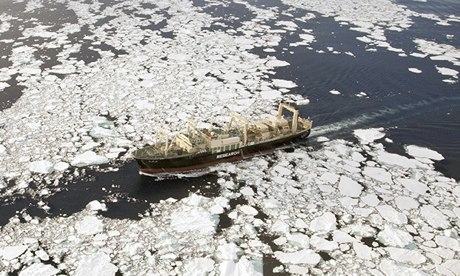
The Nisshin Maru, the factory ship of the Japanese whaling fleetSea Shepherd conservation group presses Australia's coalition government to honour pledge to monitor fleet's activities
Japan's whaling fleet is on its way to the Southern Ocean, where it hopes to kill almost 1,000 whales this winter as the world awaits a ruling on Australia's landmark legal attempt to ban the controversial hunts.

Two whaling vessels and a surveillance ship left the south-western port of Shimonoseki at the weekend and are expected to link up with the fleet's factory ship, the Nisshin Maru, Kyodo News reported.

As the fleet began its long journey to the Antarctic to slaughter up to 935 minke whales and 50 fin whales in waters that Australia considers a sanctuary for the mammals, campaigners called on Canberra to send a customs vessel to observe the whalers.

Sunday, 24 February 2013

Sea Shepherd ships collide with Japanese whaling ship


The Nisshin Maru apparently ramming the Bob Barker
 and the Sun Laurel 
photo: Sea Shepherd Australia/Glenn Lockitch

Several collisions as Sea Shepherd ships stop whaling ship refuelling
February 2013. The ships of the Sea Shepherd Society, currently in the southern ocean doing their best to disrupt and halt the Japanese whalers, have clashed with the Japanese whaling factory ship, the Nisshin Maru.

The Sea Shepherd Society's ships, the SSS Bob Barker and SSS Steve Irwin have, according to The sea Shepherd society, been rammed by the Japanese whaling fleet's massive factory vessel, the Nisshin Maru.

The following is a statement from Sea Shepherd:

On loudspeaker, the (Japanese whaling vessel) Shonan Maru No. 2 ordered Sea Shepherd's Australian flagged ship, the SSS Sam Simon, which was in the Australian Antarctic Territory, to leave the area on the orders of the Government of Japan. Concussion grenades were thrown at the Bob Barker and the Steve Irwin by the crew of the Nissin Maru.

Captain Peter Hammarstedt radioed the whaling fleet's factory vessel, the Nisshin Maru, and told them that the Bob Barker intended to maintain course and speed, that the moral and legal obligation to avoid the collision was on the Nisshin Maru.

The Nisshin Maru, turned and was approaching from starboard. It nearly collided with Bob Barker, before it turned into Steve Irwin, and rammed the Sea Shepherd ship's stern. The Nisshin Maru continued on its collision course, and rammed the portside of the Steve Irwin.

The Nisshin Maru then rammed the Bob Barker. The Steve Irwin increased its speed ahead to avoid the Nisshin Maru.

The Bob Barker took the Steve Irwin's position on the portside of the Sun Laurel.

The Steve Irwin circled back, and the Nisshin Maru pushed the Bob Barker into the Sun Laurel, sandwiching the Bob Barker between itself and the Sun Laurel. The Nisshin Maru then fell back behind the Bob Barker, and rammed full speed into the portside stern of the Sun Laurel, shattering their portside life-raft, and destroying the davit to launch the other life-raft. The Nisshin Maru then rammed the Bob Barker again from behind, destroying one of their radars, and all of their masts.

The Bob Barker completely lost power and issued a MayDay distress call. As this distress call was issued, theNisshin Maru turned away and began fleeing north.

Sea Shepherd Australia Co-Campaign leader, former Senator Bob Brown, has informed the Australian Government of the Japanese multiple breaches of international law and called for Tokyo to be required to remove its ships from this region north of Australia's Casey Base and to desist from its gross violation of Australian and international laws. He says that the Australian Navy should be dispatched to restore the law.

Currently the Sun Laurel is being escorted north by the Sea Shepherd fleet, since they have no emergency life-saving devices in the potentially treacherous waters of the Southern Ocean. Director of Sea Shepherd Australia, Jeff Hansen said, "The Nisshin Maru has committed the maritime equivalent of a hit and run accident. They have rammed the Sun Laurel, putting them in perilous danger, and simply abandoned them."

All vessels are heading north with the illegal whale poachers from Japan two miles ahead of Sea Shepherds' fleet.

All three Sea Shepherd ships were rammed, with the Bob Barker sustaining the heaviest damage. Power has been restored to the Bob Barker. Fortunately no crew member sustained injuries. The crews completed the mission to block the refuelling and will continue to protect the whales in the sanctuary.

'Institute of Cetacean Research'
Unsurprisingly, the so called ‘Institute of Cetacean Research', the cover name that is used by the Japanese whalers, have blamed Sea Shepherd for the collisions.

Some media reports have claimed that the Japanese whalers have abandoned their hunt for this season, though the Japanese fishing authorities deny this.


Friday, 21 December 2012

Sea Shepherd unveil ex Japanese research ship to join the fight against Japanese whaling


The SSS Sam Simon is the newest vessel to join Sea Shepherd's fleet

December 2012. With delicious irony, Sea Shepherd has revealed that their newest ship, SSS Sam Simon, was built in Japan for marine research. The vessel was retired from service by the Japanese Government in 2010, has since been laid up in Shimonoseki, Japan, alongside the very ships Sea Shepherd will confront this season.

Los Angeles-based philanthropist and co-creator of TV's "The Simpsons," Sam Simon, sad donated funds for the purchase of Sea Shepherd's new Antarctic patrol ship. Her 56-meter hull is painted bright white with a classic Sea Shepherd Conservation Society logo on her sides, and displaying a large "S" on her tall black smokestack, the Sam Simon has clearly received several months of careful preparation prior to Sea Shepherd's most ambitious Antarctic campaign yet.

Registered in Melbourne, Australia, the Sam Simon carries a crew of 24 international volunteers, ready to brave the Southern Ocean to seek out and shut down the illegal Japanese whaling fleet.

Built in 1993
Originally built as Seifu Maru in 1993 by IHI shipyard in Tokyo, to a high standard with no expense spared by the Japanese Government, the ice-strengthened steel vessel was operated by the Maizuru Meteorogical Observatory, a department of the Japan Meteorological Agency, out of Kyoto Prefecture.

While Sea Shepherd and most of the world agrees that the word "research" has no place in the Institute of Cetacean Research's (ICR's) whaling program, Seifu Maru was indeed responsible for a considerable amount of real ocean current data contributing to Japan's western North Pacific Whaling Program (JARPN).

Monday, 6 August 2012

Canadian whale activist Paul Watson on the run, vows to continue work


The Canadian founder of environmental group Sea Shepherd says he plans to continue disrupting Japan’s whaling fleets despite being on the run from authorities in at least three countries.
Paul Watson was arrested in Germany in May on a Costa Rican extradition request. He skipped bail earlier this month after learning that Japan, too, was seeking his extradition from Germany.
The 61-year-old has issued a statement saying he’s now in “a safe place far away from the scheming nations who have turned a blind eye to the exploitation of our oceans.”
Mr. Watson says he expects Japanese whalers to “continue to exploit all avenues” to find a way to stop him. He vows to set sail in December for the Southern Ocean Whale Sanctuary around Antarctica to intercept Japanese whaling ships.
He parted ways with Greenpeace in 1977 to set up Sea Shepherd. The group has waged aggressive campaigns to protect marine animals, prompting Japan to labels its members terrorists and to seek Mr. Watson’s arrest for allegedly masterminding violent protests.

Thursday, 2 August 2012

Anti whaling charities harpooning each other rather than fighting for conservation

Pete Bethune vs Sea Shepherd Conservation Society
July 2012. The case brought by marine activist, Pete Bethune, against the Sea Shepherd Conservation Society (SSCS) and its founder, Paul Watson, is underway in Annapolis, Maryland, USA.
Bethune has instigated the arbitration case in an attempt to force SSCS to pay up the $1/2 million it claims Sea Shepherd owes him for the purchase of his boat, the Ady Gil. The boat was rammed by a Japanese whaler while taking part in a Sea Shepherd campaign in the Southern Ocean Whale Sanctuary in 2010.
Sea Shepherd has left open the possibility that Paul Watson will be a witness in court despite him having just skipped bail from Germany where he was being held following an extradition order issued by the Costa Rican authorities.
"Extremely sad"
Prior to the start of the case, Bethune said: "I am extremely sad that I have been forced to bring this case to court against an organisation that I loved and a man that I had great respect for.
"I sacrificed a year of my life to Paul and the SSCS, including five months locked up in a maximum security prison in Japan resulting from actions I took under the captaincy of Paul. He then expelled me from SSCS (According to SSCS Bethune was expelled when a bow and arrows were found on board the Ady Gil) whilst I was in jail and their treatment of me publicly and privately since then has been a disgrace. The Japanese at least treated me with dignity and respect. Sea Shepherd in contrast has treated me like a used condom, throwing me away once I'd served its purpose."
Illegal fishing targetted
Bethune, who founded his own marine conservation organisation, Earthrace Conservation, after being released from prison in Japan, next plans to tackle illegal fishing off the coast of Africa. "Not only has the court case taken up a lot of my time, but the financial difficulties I have faced because of the money SSCS owes to me have also been a huge concern. Earthrace Conservation is being run on a shoe-string but still somehow managing to succeed in our campaigns thanks to our volunteers and my family and friends.
"At least in court, the case will be decided based on merit. I am looking forward to seeing an end to it all and being able to concentrate on the mountainous challenges to our marine environment rather than my mountainous debts."

Wednesday, 27 June 2012

Legal Victory for Sea Shepherd U.K. Today in the British Court - via Matthew Williams


FRIDAY HARBOR, Wash. – June 25, 2012– Sea Shepherd, Sea Shepherd U.K. and Captain Paul Watson have won the lawsuit filed by Maltese fish brokerage firm, Fish & Fish, that was filed in response to the release of 800 illegally caught Bluefin tuna in June 2010 off the coast of Libya.
Mr. Justice Hamblin of the Admiralty Court announced his decision this morning in a courtroom in London. His ruling was that the U.K. Court was not the proper place to file the suit against Sea Shepherd and ordered the case against the Sea Shepherd Conservation Society, Sea Shepherd U.K. and Captain Paul Watson dismissed. Fish and Fish requested an appeal, which the Judge refused. Fish and Fish may still appeal the ruling to a higher court.
Pending a possible appeal, Sea Shepherd will have the bond of 520,000 pounds (approximately $780,000.00 USD plus interest) returned. The judge ruled that Fish and Fish must pay a percentage of Sea Shepherd’s legal fees in the case, which could amount to more than 200,000 additional pounds.
This case saw the Steve Irwin arrested in Scotland in July of 2011 and released only after the bond was posted. The bond was raised in only 10 days from Sea Shepherd supporters worldwide.
“What we did in 2010 we have no apologies for,” said Captain Paul Watson. “We freed 800 large endangered Bluefin tuna illegally caught by poachers off the coast of Libya. We cut the nets and when the Maltese company that claimed ownership of these liberated fish sued us, we stood our ground in court and we won, the tuna won, and the poachers lost. Our British lawyers did an excellent job. I am confident that if an appeal is granted, we will see the appeal court upholding this ruling. Bottom line and most importantly, the fish were freed and the company failed to recover their requested losses for their illegal catch.”
Sea Shepherd Conservation Society will continue to aggressively oppose the illegal exploitation of Bluefin tuna in the Mediterranean. The society is seeking a vessel dedicated to the protection and conservation of biodiversity in the Mediterranean Sea.

Sunday, 27 May 2012

Anti-whaling leader says extraditing him won't halt campaign


Marine wildlife activist Paul Watson, currently on bail in Germany pending a decision on whether to extradite him to Costa Rica, vowed Tuesday that his campaign will go on even if he is tried and jailed.
"They hope that by getting me out of the way, they'll shut down our operations. They won't," Watson told AFP in a telephone interview.
"This is not about me. It is about our oceans and the ever-escalating threat of diminishment of the diversity of life in our seas. It is about the sharks, the whales, the seals, the sea turtles and the fish," the 61-year-old activist said.
Watson was arrested at Frankfurt airport on May 14 and detained for a week before being released on bail.
He told AFP he has been placed under "house arrest" and was obliged to report to the police twice daily.
"I want to make it very clear that whatever happens to me will not affect our campaigns," he said in a separate written statement emailed to AFP.
Watson is the leader of the Sea Shepherd Conservation Society, whose ships he said would continue to "defend sharks in the South Pacific, whales in the Southern Ocean Whale Sanctuary" and dolphins in Taiji, Japan.
"Fortunately, Sea Shepherd is now much bigger than myself... and if I am prevented from serving on the front lines upon the high seas I will serve as a symbol of resistance to the destruction of our oceans from inside a prison cell."
Watson said he planned to travel to Berlin on Wednesday to participate in a rally by his supporters on the occasion of a visit by Costa Rican President Laura Chinchilla to the German capital.
"But I have to be back in Frankfurt by 5:00 pm (1500 GMT) when I have to report to the police," he added.


Costa Rica assures fair trial for anti-whaling crusader

Costa Rican President Laura Chinchilla said Wednesday that anti-whaling activist Paul Watson would have a fair trial if extradited to the Central American country following his arrest in Germany.
"If Paul Watson is extradited to Costa Rica he will have legal proceedings that strictly keep to constitutional principles and the international standards which have to be applied in this type of case," she said.
Chinchilla, speaking at a press conference with German President Joachim Gauck during a visit to Berlin, stressed that her country had a "completely independent justice" system.
Watson, 61, the leader of the Sea Shepherd organisation noted for its muscular attacks on Japanese whalers, was arrested at Frankfurt airport in western Germany on May 14 and detained for a week before being released on bail.
German authorities are deciding whether he can be extradited to Costa Rica on charges stemming from a high-seas confrontation over shark finning in 2002. He is accused of "putting a ship's crew in danger".
He said in a telephone interview with AFP Tuesday that he had "no reason to believe that the Costa Rican legal system would not give me a fair trial".
"My concern is not for the judicial system, but for the reality that the shark fin mafia of Costa Rica has a price on my head and a Costa Rican prison would provide an excellent opportunity for someone to exercise this lethal contract against me," he said.
"We have cost the shark finners a great deal of money over the last two decades and they want their revenge. I would need absolute assurance that the Costa Rican authorities would not place me in a position to jeopardise my safety when I return to Costa Rica to prove my innocence in court."
Sea Shepherd claims it was escorting an illegal shark finning ship back to port when the crew falsely accused the organisation's members of trying to kill them.


Thursday, 17 May 2012

Anti-whaling group leader ordered held in Germany


A German court on Monday ordered Paul Watson, the founder of marine conservation group Sea Shepherd, to remain in custody a day after his arrest on a warrant from Costa Rica.
The veteran anti-whaling campaigner, a Canadian national, was detained in Frankfurt on Sunday on charges stemming from a high seas confrontation over shark finning in 2002.
He is accused of having "put a ship's crew in danger" in the incident, a Frankfurt prosecutor said.
Watson's lawyer Oliver Wallasch said that after Monday's court hearing that his client must remain in custody until the Costa Rican extradition request is considered, adding that he did not know how long the process would take.
"My client is shocked," Wallasch said.
A media report in Australia, citing Costa Rican reports, said Watson, 61, also faced an outstanding warrant for attempted murder during the same incident.
"The German police have said that the warrant for Captain Watson's arrest is in response to an alleged violation of ships traffic in Costa Rica, which occurred during the filming of 'Sharkwater' in 2002," Sea Shepherd said.
The specific "violation of ships traffic" incident took place in Guatemalan waters when Sea Shepherd encountered an illegal shark finning operation, run by a Costa Rican ship called theVaradero, it added in a statement.
"On order of the Guatemalan authorities, Sea Shepherd instructed the crew of the Varadero to cease their shark finning activities and head back to port to be prosecuted," the group said.

Monday, 23 April 2012

Anti-whaling activist set for new campaign

ANTI-whaling activists will soon have two ships berthed at Williamstown, taking the place of Victoria's tall ship Enterprize.


Fresh from 95 days in Antarctica, Sea Shepherd Conservation Society member, Williamstown North's Vincent Burke is back home aboard the Steve Irwin and anticipating the imminent arrival of the Bridget Bardot vessel.

Mr Burke was in charge of crew safety on the Bob Barker, which spent months pursuing Japanese whalers in the Southern Ocean.

"They managed to kill 266 minke whales and one fin whale," he said.

"They came down here to take 935 minke whales, 50 fin whales and 50 humpbacks, so we stopped about 768 kills, which is a huge success.

"We would have liked to have kept it lower than that, but it's still the second-best season we've ever had."

Mr Burke said Sea Shepherd spent up to $4million each year doing the job he believed the federal government should be doing.

The 35-metre (115-feet) Brigitte Bardot will arrive in Williamstown at the end of this month to begin a shark fin campaign.

"Once the time is right, it will be leaving with a full crew to go on a campaign in the South Pacific," Mr Burke said.

"It will be approaching shark-fin poachers, primarily ... there's up to 70million sharks taken every year, which are taken for fins.

"They catch sharks alive, cut their fins off when they're on the side of the vessel, then they push the bodies back in alive and they fall to the bottom and drown."


Read on:  http://www.maribyrnongweekly.com.au/news/local/news/general/antiwhaling-activist-set-for-new-campaign/2526190.aspx

Monday, 19 March 2012

Whale battle wins public

TWO in three Tasmanians support anti-whaling protesters, the Mercury Great Tassie Survey shows.
While 66 per cent backed whaling protesters, 83 per cent want the Federal Government to do more to stop whaling.
And while 89 per cent of respondents did not support whaling, just 52 per cent agreed with the Sea Shepherd Conservation Society's anti-whaling tactics.
A fourth saw Sea Shepherd as brave protesters saving whales, while another 48 per cent chose the response that they were a group that "uses some dodgy tactics but at least is doing something to save whales".
A fourth considered them an extremist group and 13 per cent as anti-whaling pirates.
Respondents were less supportive when it came to forking out to save protesters, with 61 per cent against Australian taxpayers having to foot the bill to rescue them.
The survey questioned 4400 Tasmanians on their views about the state.
Yesterday the anti-whaling ship Bob Barker docked in Hobart after another season hampering the Japanese whalers.
The crew is pushing for action after encountering a Japanese harpoon vessel four miles off Macquarie Island, which comes under Australian and Tasmanian governance.
"This is like a harpoon vessel coming up the River Derwent," captain Peter Hammarstedt said.
The Bob Barker was one of the Sea Shepherd fleet claiming victory after the Japanese whale tally was only 267, compared to its target of 1035.
Ship manager Andrea Gordon said a Japanese vessel tried to foul the Bob Barker's propeller within the Australian Exclusive Economic Zone, which extends 200 nautical miles from the coast.
Japan's Institute of Cetacean Research has accused the Bob Barker of attacking its vessels by firing flare signals and a high-powered laser beam.
"Japan's research whaling in the Antarctic is a perfectly legal activity carried out under the International Convention for the Regulation of Whaling," the institute said in a statement last week, adding it intended to continue whaling.
Capt Hammarstedt said Japan illegally entered Australia's territorial sea limits.
After concerns raised by Greens senator Bob Brown, Prime Minister Julia Gillard asked Japan to order its boats to leave territorial waters off Fremantle in January.
Sydney University international law expert Tim Stephens said ships minding their own business could come and go as they pleased.
Dr Stephens said enforcing a Federal Court decision that Australian law was broken was dangerous because it could jeopardise a deal that protected Antarctica from development.
painem@news.net.au
Related Posts with Thumbnails

ShareThis