Showing posts with label red squirrel. Show all posts

Friday, 13 December 2019

Northern Ireland's recovering pine marten population benefits red squirrels


DECEMBER 13, 2019


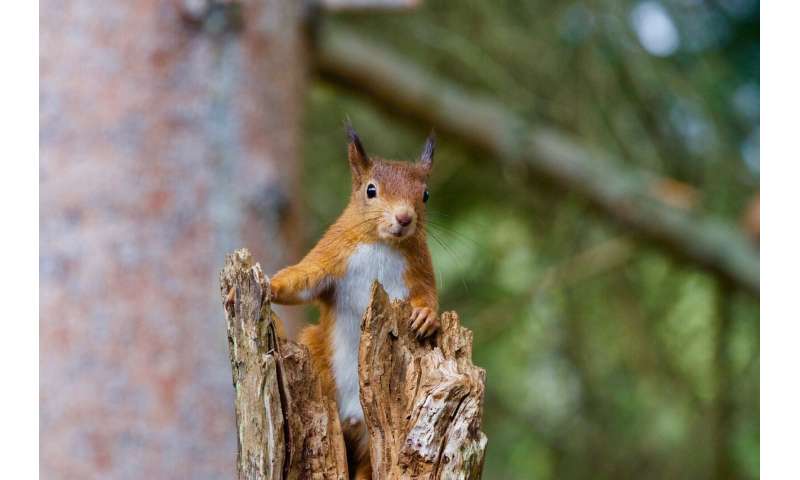
The recovery of pine marten in Ireland and Britain is reversing native red squirrel replacement by invasive grey squirrels, according to new research presented at the British Ecological Society's annual meeting in Belfast today.

Researchers at Queens University, Belfast and National Museums Northern Ireland have found red squirrels are responding positively to the increased presence of pine martens across Northern Ireland. So, where pine martens occur, it increases the chances of red squirrels occurring, simultaneously reducing the likelihood of grey squirrels being present.

Historically, persecution of pine marten and loss of their preferred habitat led to severe declines across Ireland and Britain. In Northern Ireland, small, remnant populations were all that remained, but today, the species is recovering, and this comeback may help ensure the long-term future of the red squirrel in Ireland.

Joshua Twining, who will be presenting the research at the conference, commented "the red squirrels 'positive response' is likely due to grey squirrel disappearance rather than red squirrels and pine martens working together." Pine martens eat both red and grey squirrels, though the key difference is that red squirrels have evolved alongside pine martens over millennia, making them able to coexist.

Twining said, "The ability of the pine marten to control the grey squirrel and help red squirrel recovery in Ireland and Britain is limited by three things; its ongoing recovery, the lack of forest cover on the island and the presence of urban areas. Twining and co-authors suggest that grey squirrels will persist in the latter as results show pine marten are forest specialists and avoid urban areas.

Although the red squirrel population is increasing in Northern Ireland, the researchers warn that "unless the issue of control within populated areas is addressed, we risk creating a situation where marten-savvy grey squirrels could recolonise the wider landscape in the future".

Sunday, 17 November 2019

Survey finds gain in endangered red squirrel population

NOVEMBER 16, 2019

Credit: CC0 Public Domain

Wildlife officials say an endangered squirrel subspecies in southeastern Arizona is fighting its way back after much of its mountain habitat was burned by a 2017 wildfire.

The Arizona Game and Fish Department says the Mount Graham red squirrel's population is stabilizing, with a 4% increase recorded in September during an annual survey that produced an estimate of 78 squirrels, up from 75 in 2018.

According to the department, the population peaked at about 550 in the late 1990s. Before the 2017 wildfire, the population ranged between 200 and 300.

Terrestrial wildlife specialist Tim Snow says the results are encouraging though much work remains to help protect the squirrel population.

The squirrel is found only in upper elevation conifer forests of the Pinaleño Mountains.

Wednesday, 10 January 2018

Dead red squirrel for sale on eBay ... for £275


The seller suggests the rodent could be used for 'taxidermy purposes', but warns potential buyers it will have to be picked up because they 'wouldn't know how to post it'

By
Luke Traynor
15:36, 8 JAN 2018
UPDATED15:46, 8 JAN 2018

A dead red squirrel has been put up for sale on eBay for £275.

Bargain-hunters were shocked to find a picture of the rodent's body on the online auction site.

And at least three people were 'watching' the item, possibly with a view to buying it.

An opening bid of £10 is required, and the seller suggests the corpse could be used 'for taxidermy purposes'.

But one woman who saw the listing while looking for an ornamental squirrel, said she was horrified by the listing.

The seller writes: "Found this beautiful creature this morning, must have died of natural causes as no damage.

“Shame to let it decay, it’s so beautiful, maybe someone would like to taxidermy!”

Read on  

Wednesday, 11 May 2016

Red squirrel leprosy study launched on Brownsea Island

Researchers to investigate how disease is passed between red squirrels, whose numbers have declined drastically


Monday 9 May 201606.01 BST

Wildlife experts have launched a research project on an island off the south coast of England to better understand how British red squirrels are affected by a form of leprosy.

The study on Brownsea Island will investigate how the disease is passed between red squirrels, whose numbers have declined drastically, and how conservationists can help control its spread.

Leprosy was first identified in red squirrels in Scotland in 2014, caused by the bacterium mycobacterium lepromatosis, although the disease is believed to have been present in the squirrel population for centuries.

Postmortem examinations have since revealed that the disease is also affecting the squirrels on Brownsea in Poole Harbour and the Isle of Wight.

Brownsea will be open as usual during the project and those leading the study say there is “negligible risk” to the public from the disease, but they advise visitors not to touch any wild animals and birds and exercise good hygiene practices such as hand washing.

The disease is believed to have been present on Brownsea, which is home to about 200 squirrels, for many years but researchers have only recently diagnosed it as leprosy.

Little is known about how the bacteria is spreading among red squirrels. The disease causes swelling and hair loss to the ears, muzzle and feet.
Researchers from the University of Edinburgh are working with the National Trust and Dorset Wildlife Trust on the project.

Vets will use humane traps to capture the squirrels and will take blood samples and other clinical samples for analysis before returning the animals to the wild.


Monday, 2 November 2015

The place that has wiped out grey squirrels


26 October 2015

The red squirrel has been in severe decline in the UK but one island has completely eliminated grey squirrels to promote a red resurgence. Could it lead to a wider programme of eradication, asks Rachel Argyle.

Once common, red squirrels have declined rapidly in the UK since the 1950s, falling in numbers from about 3.5 million, to a current estimated population of around 130,000.

Anglesey, an island off the north-west coast of Wales, declared itself a grey squirrel-free zone earlier this year after an 18-year cull.

Now, it's been announced that a share of £1.2m of Heritage Lottery Fund money will see the cull of grey squirrels extend to the neighbouring county of Gwynedd, where no native nutkins have been spotted for nearly 70 years.

Grey squirrels, said to have been brought to Britain from the US in the 19th Century, crossed the Menai Strait between Anglesey and mainland Wales in the mid-1960s. By 1998 the species had replaced the red squirrel almost completely, with only 40 red squirrels remaining.

It's long been believed that greys act as carriers of squirrel pox - which kills reds.


Tuesday, 26 May 2015

Charity joins the national fight to rescue red squirrel

MAY 26TH, 2015 - 12:01 AM JANICE BURNS

Three quarters of the UK’s remaining population of red squirrels is found in ScotlandRSPB Scotland has joined the fight to save the red squirrel from extinction by becoming part of a pioneering project.

The wildlife conservation charity has joined forces with five other charitable, government and landowning bodies in a bid to secure the future of the iconic woodland mammal.

The red squirrel is the UK’s only native squirrel and numbers have declined rapidly since the introduction of grey squirrels from North America in the 19th century.

Since 1952, 95 per cent of red squirrels in England and Wales have been wiped out, and today 75 per cent of the UK’s remaining population is found in Scotland.

However, greys still threaten the existence of the native reds because they compete for food and habitat, and transmit the deadly squirrelpox virus.

The Saving Scotland’s Red Squirrels project aims to continue to prevent the spread northwards of grey squirrels and squirrelpox through a programme of grey squirrel control in a zone running coast to coast along the Highland Boundary Fault.

Saturday, 14 February 2015

Baby red squirrel rescued after mother hit by car

The baby sqauirrel has been named Ewok

A baby red squirrel found clinging to its dead mother in Aberdeenshire is being cared for by the Scottish SPCA.

The kit - believed to be about two weeks old - was discovered at the side of a road in Drumoak.

The squirrel is now being looked after at the charity's National Wildlife Rescue Centre in Clackmannanshire, where staff have named her Ewok.

Centre manager Colin Seddon said: "Ewok is our first red squirrel orphan of the year. Her mum was hit by a car."

'Quite delicate'

He added: "It's incredible that she survived given she would have been attached to her mother at the time.

"Ewok is quite delicate but seems to be responding well to treatment.

"Sheelagh McAllister from our centre has been providing her with round the clock care, which includes taking her home in the evenings to syringe feed her through the night.

"Once Ewok is on solid food we'll move her to one of our outdoor enclosures where she'll have lots of space to run, jump and develop her fitness before her release back into the wild."

Tuesday, 1 July 2014

Spaniel enlisted in fight to save Scotland's red squirrels

By Giancarlo Rinaldi
South Scotland reporter, BBC Scotland news website

He might be the most unusual recruit to the fight to preserve the native red squirrels of southern Scotland.

Rory the springer spaniel has developed a skill which is helping in the struggle on the conservation frontline.

For he helps gamekeeper Richard Thomson identify whether a grey or red has been caught in a trap before they can even see it.

The gamekeeper then knows whether he needs to prepare to release the creature or destroy it humanely.

Friday, 25 April 2014

Norfolk red squirrel 'supermum' stuns Pensthorpe wardens

A red squirrel at a conservation centre in Norfolk has stunned wardens by producing her 48th kitten in six years, despite having lost her first partner.

The seven-year-old, part of the East Anglian Red Squirrel Group (EARSG) at Pensthorpe, has given birth to three kittens in her first litter of 2014.

Wardens feared the squirrel, know as Tortoiseshell, would never breed again when her partner died two years ago.

Chrissie Kelley from EARSG said she is a "wonder-mum" doing a "fantastic job".

Tortoiseshell and her former partner Tweedledum were considered one of the most successful breeding pairs in the Pensthorpe Conservation Trust's history.

When he died in 2012 there was concern she might never breed again.

Her latest litter, which is beginning to venture from the drey, has two males and one female.

Tuesday, 25 December 2012

Red squirrel sighted in Cheshire for the first time since 1980s


Has a Lancashire squirrel gone wandering?

December 2012. A red squirrel has been sighted in Cheshire for the first time since 1980s. Cheshire Wildlife Trust has described the sighting of a wild red squirrel in a Daresbury garden between Runcorn and Warrington as ‘extremely exciting'.
The rare mammal, which is mostly confined to Scotland and small populations scattered elsewhere across the UK, was last seen in the Cheshire region during the 1980s. The sighting was confirmed by members of the Warrington Conservation Forum and Cheshire Mammal Group (see the footage here), after a video was captured of the furry visitor making the most of local bird feeders.

A captive population of red squirrels is kept at Walton Gardens, but the nearest wild population is on the Sefton Coast, Lancashire. This group of red squirrels suffered a devastating recent drop in numbers after the squirrels succumbed to an infection of pox.

Adult squirrel
Expert Paul Hill of the local Mammal Group said that it was typical for young squirrels to explore beyond their usual territories during the autumn and winter, however the footage appeared to show an adult which was particularly interesting.

Special nut feeders
A team has now installed specialised nut feeders in the area which allow red squirrels to feed, but exclude the larger grey squirrel. Motion detection cameras will also be inspected over the coming weeks to see if the red squirrels return and to determine if there may be more than one.

Tom Marshall from Cheshire Wildlife Trust said: "This is a fantastic good news story and we really hope this visiting red squirrel is not alone. Our colleagues at Lancashire Wildlife Trust have worked hard on the recovery of red squirrels on the Sefton Coast, and to know that the squirrels are potentially exploring beyond this territory could be amazing for the Cheshire region."

Red squirrels are continuing to suffer from the intrusion of their larger, non-native American cousins into their historical haunts in northern Britain. Bolder and more aggressive, grey squirrels are also able to exploit many nuts earlier in the season, reducing supplies for red squirrels.

Recent conservation strategies have included culling the non-native greys across a ‘firewall' in parts of Scotland and northern England to try and minimise the northern spread in efforts to safeguard remaining populations of red squirrels.

Continued:  http://www.wildlifeextra.com/go/news/cheshire-red-squirrel.html

Friday, 14 December 2012

Jersey's squirrels are 'not severely inbred', a study finds


Jersey's red squirrel population is not severely inbred, according to a study.

The Jersey Society for the Prevention of Cruelty to Animals (JSPCA) has paid for a study into the origin of the island's red squirrels.

The study found those in the east of the island are of French descent, and those in the west have English origins, while those in the middle were mixed.

There have been red squirrels in Jersey since they were introduced in 1885, but there are no grey squirrels.

In the UK, red squirrels are endangered because of competition from grey squirrels.
The study was carried out by the Durrell Institute of Conservation and Ecology at the University of Kent.

'Dear creatures'
Major Steven Coleman, chief executive of the JSPCA, said the study aimed to find out if the squirrel population had started to inbreed.


Saturday, 24 March 2012

Red squirrels are Lottery winners

RED squirrels have been given a fighting chance to boost their population numbers thanks to a Heritage Lottery Fund grant.
The Westmorland Red Squirrel Society has been given £49,900 to pay for two part-time contractors in an exciting two-year project.
The group focuses on conserving and strengthening the remaining red squirrel population in the Grizedale Forest area so that the public and future generations can continue to enjoy them. Help is needed thr-oughout the area for sending sightings of red squirrels, monitoring, organisation and active grey control to the project network.
This will be the first time that a red squirrel project led by volunteers from the local community will include a working partnership between the Forestry Commission, the Lake District National Park Authority, Cumbria Wildlife Trust, National Trust, Red Squirrels Northern England, Red Squirrel Survival Trust, landowners and members of the general public. 

Friday, 24 February 2012

Study warns action needed to save Irish hare from extinction

The Irish hare is one of a number of native species facing extinction if action is not taken to control the invasion of foreign mammals in Ireland, according to new research.
The red squirrel and red deer are also in danger.
It follows research by academics from Queen's University in Belfast.
They carried out a two-year study on two introduced species now thriving in Ireland - the bank vole and the greater white toothed shrew.
Researchers found that the native pygmy shrew has completely vanished in the parts of the island where foreign species are found, while wood mouse numbers have dropped by 50% in places where the bank vole is fully established.
The study on so-called "invasional meltdown", published in the international scientific journal Biological Invasions, claimed that if the rate of invasion continued as at present, native small mammals in Ireland would die out in at least 80% of their available habitat.
Professor Ian Montgomery, lead researcher from the School of Biological Sciences at Queen's University, explained the importance of small mammals in the established food chain.
He said major changes in species composition have both top-down and bottom-up effects in the ecosystem, affecting bird and mammal predators as well as the invertebrates, seeds and seedling that small rodents feed on.
"The introduction of alien mammals to Ireland over the last 100 years has had major detrimental effects, threatening our indigenous habitats and species," Professor Montgomery said.

Monday, 2 January 2012

Grey squirrel culling starts in Gwynedd

A CULLING programme of grey squirrels has started in Gwynedd as the march of the reds goes on.
Twelve years ago the red squirrel faced decimation in its last bastion on Anglesey as numbers dwindled to 40 and the colonies left were inbred.
But action to remove the rival greys and the introduction of new bloodlines has seen numbers surge to 400 and the native reds take over the island.
The past 18 months has seen them venture over the Menai Strait bridges to establish small colonies around Bangor.
Now a squirrel charity has announced plans to support this incursion by removing greys, which have traditionally destroyed red colonies by spreading disease and dominating habitats.
Dr Craig Shuttleworth, from Friends of the Anglesey Red Squirrels, said: “We're now starting a new program of clearing grey squirrels from Bangor through to Felinheli, up into the Ogwen Valley, and Tregarth, Pentir areas.
“There is a triangle of forest area that is discreet and there are only certain pinch points for access. If we can control these by setting traps then we can create a protected area for reds to flourish.
“When we started out on Anglesey more than 10 years ago I never expected we would be at this stage where they had spread to the mainland.
“But since our first sighting near Bangor back in 2009 we have had numerous sightings from Bangor, Felinheli, and even up to Bethesda. Now is the time to support this.
“While the project is funded on Anglesey we are reliant on landowners and the public in Gwynedd to both report sightings and also assist with removing greys.
“For landowners though the damage that grey squirrels do to trees means that it is normally in their interest to take action.”
The group is also encouraging woodland owners to plant sweet chestnut, hazel nut and walnut trees to help red squirrel on Anglesey and in Gwynedd.
Report a red squirrel sighting on redsquirrels.info website or call 07966150847.

Sunday, 25 September 2011

Red squirrel and hedgehog under threat, study says

Red squirrel and hedgehog populations in the UK have continued to fall over the last decade, a report suggests. The 2011 State of Britain's Mammals study says the species are still under threat despite efforts to protect them.

But it says conservation schemes have benefited otters, polecats and water voles and half of the monitored species have stable or rising populations.

Read on...

Thursday, 8 September 2011

Baby red squirrels being cared for by Scottish charity

Squirrel siblings saved September 2011. Two baby squirrels have been rescued by the Scottish SPCA after being found huddled together on the ground at a Scottish Highlands holiday home. Acorn, male, and Hazel, female, were discovered in a carport by residents at a cottage in Nethy Bridge, Speyside, in August.


Scotland's Animal Welfare Charity was called to rescue the brother and sister who had become separated from their mother.

Senior Inspector Gill MacGregor said, "I advised the caller to leave the squirrels for an hour just to give mum a chance to find them. As they were found in a carport it's unlikely that mum dropped the pair whilst moving them so we can only imagine that they crawled in there themselves. Sadly we were unable to reunite them with their mother so I took them to our Wildlife Rescue Centre in Fife where they have been thriving ever since."

Wildlife Assistant Krystal Aitchison said, "Acorn and Hazel are doing really well and are becoming stronger and fitter every day as they enjoy exploring their outdoor aviary. We think this is the first time we have had squirrel siblings come into our care at the same time, normally we find one orphaned or abandoned, but this pair have decided to stick with each other.

"We will be aiming to release them back into the wild together once they are fully fit and able to fend for themselves."

Anyone wishing to report an injured or distressed animal should call the Scottish SPCA Animal Helpline on 03000 999 999.
http://www.wildlifeextra.com/go/news/baby-squirrels.html

Wednesday, 3 August 2011

New outbreak of deadly squirrel pox hits Lancashire

Red squirrels only just beginning to recover after last bout

August 2011: Lancashire Wildlife Trust is urging the public to be vigilant after the deadly squirrel pox virus returned to the red squirrel stronghold on the Sefton coast.

Red squirrel conservation experts have made the call after the body of a red squirrel was found on Mossgiel Avenue in Ainsdale, Merseyside. Expert analysis carried out at the University of Liverpool has confirmed that the animal died of squirrel pox virus.

The discovery is a blow to efforts to help the population of red squirrels in Ainsdale and Formby recover after it was ravaged by the pox virus three years ago.

The Wildlife Trust's Conservation Officer for North Merseyside, Fiona Whitfield said: ‘This is the first case in 18 months and we're particularly concerned because it is very close to where the first outbreak occurred.

This is a real setback
‘Our red squirrel population had started to recover from the two devastating outbreaks in 2006 and 2008 and we were feeling positive about their future, so this finding is a setback.

‘We have had two more reports of sick squirrels and we want people to report any more sightings to us so we can act quickly to contain this.

‘We urge the public to report any sightings of sick or dead red squirrels or any grey squirrel in that area to redsquirrel@lancswt.org.uk or text or ring 07590 745862.'

Grey squirrels, which are immune to the virus, pass on the pox to reds, with usually fatal consequences for the red squirrel; the symptoms include lethargy, poor condition and ulcers and lesions around the eyes, mouth and nose.

The last bout of squirrel pox decimated the population which has clung on in the woods and gardens behind the sand dunes in the area - numbers crashed by 90 per cent. But the squirrels have since staged a remarkable recovery. Densities of reds look set to approach their pre-epidemic values within the next year or so, and there have been reports of reds spreading into the surrounding woods and countryside.

http://www.wildlifeextra.com/go/news/squirrel-pox011.html#cr

Thursday, 23 September 2010

Warning issued after chipmunks sighted

RIGHT: A photograph of one of the chipmunks sighted in Waterford. The rodents are regarded as a threat to the survival of red squirrels.
The Irish Times - Thursday, September 23, 2010

WILDLIFE EXPERTS have issued an “invasive species alert” following sightings of Siberian chipmunks on the loose in Co Waterford. The striped rodents, native to northern Asia, are regarded as a “significant threat” to the survival of the Irish red squirrel, which is already imperilled by the grey squirrel.

Colette O’Flynn, manager of the National Invasive Species Database, explained that “Co Waterford remains a stronghold for red squirrels as the invasive grey squirrel has not as yet, penetrated into the heart of the county” but the chipmunk has “similar habitats and food requirements”.

She said the authorities were “alarmed” by sightings of chipmunks last month in Colligan Woods near Dungarvan. It is believed the creatures were bought as pets and escaped or were deliberately released into the wild. The first sighting occurred on August 10th when a member of the public spotted and photographed a chipmunk crossing a road.

The sighting sparked concern among officials at the National Biodiversity Data Centre and the National Parks and Wildlife Service. There was relief three days later when a dead chipmunk was found in the area. Officials hoped the sighting was “a one off”. However, a fresh sighting occurred on August 15th when a local resident, Dina Walshe saw and photographed another chipmunk whose behaviour suggested it might have been a former pet “as it did not shy away from close human contact”.

She submitted photographs to the National Biodiversity Data Centre, which then issued the invasive species alert. The Siberian chipmunk (Eutamias sibiricus) is normally found in woodlands in northern Russia, China, Korea and Japan and is distinguished by five longitudinal stripes along its back. The rodent can grow to a length of 25cm and lives on a diet of shrubs, mushrooms, berries, birds and other small animals.

Chipmunks can spread rabies and also carry the ticks which harbour Lyme disease. In Russia, they are regarded as pests which cause widespread destruction of nut and grain crops and can also threaten ground-nesting birds.

Ms O’Flynn confirmed it was “illegal to release any non-native species into the wild in Ireland without a licence” and that it was also “cruel to release a pet into the wild”. She pointed out that “Siberian chipmunks do not make ideal pets” as they “do not suit confinement and are difficult to contain”.

She also appealed to people who spot a chipmunk in the wild to take a photograph if possible and report the sighting. Ms O’Flynn added, “during 2009 and 2010, we have seen a number of species associated with the pet trade end up in the wild in Ireland”.

http://www.irishtimes.com/newspaper/ireland/2010/0923/1224279504217.html

Sunday, 15 August 2010

Wildlife campaigner drowns squirrel

A wildlife campaigner has drowned a grey squirrel to challenge the RSPCA to prosecute him.

Chairman of anti-grey activists Morpeth Red Squirrels Norris Atthey killed the animal in an attempt to confront the charity following its prosecution of Raymond Elliott last month.

Burton Magistrates granted Mr Elliott a conditional discharge but ordered he pay £1,547 costs to the RSPCA when the 58-year-old window cleaner admitted causing unnecessary suffering to an animal after drowning a grey squirrel in a water butt.

The landmark case set an important precedent for killing grey squirrels, which are classified as a non-native invasive species, and could pave the way for hundreds of other prosecutions across the country.

Mr Atthey, who thinks grey squirrels should be killed to protect England's native red species, said he was incensed by the prosecution.

The former military policeman, 66, said he set out to show that drowning was a humane method of culling.

Mr Atthey, a married grandfather-of-four from Ulgham, Northumberland, said: "I submerged this grey squirrel for a few seconds in the water and it was dead within 30 seconds. Of approximately 250 greys that I have killed it has been the quickest method. Normally it can take one to three minutes."

He said the charity had overstepped the mark.

He said: "I take issue with the RSPCA prosecution. My interpretation of the law is that drowning a grey squirrel is legal as long as it is done swiftly and as part of pest control."

An RSPCA spokesman said: "We won't be making any kind of comment on this matter as the case against Mr Elliott has gone to appeal and legal proceedings are ongoing."

http://news.uk.msn.com/environment/articles.aspx?cp-documentid=154380903&ocid=today

Saturday, 14 August 2010

Red squirrel does Saturday Nut Fever

Ted Thornhill - 13th August, 2010

This red squirrel could be reaching for his nuts, but we think he's showing off (Photo: Caters).

He was snapped by wildlife photographer Marek Paluch, who captured the fuzzy squirrel near Opole, Poland, demonstrating just what a mover and a shaker he is.

http://www.metro.co.uk/weird/837981-red-squirrel-does-saturday-nut-fever
Related Posts with Thumbnails

ShareThis