Showing posts with label nature reserve. Show all posts

Friday, 3 May 2019

Council accidentally bulldozes roadside nature reserve


13/04/2019
Kent County Council has unwittingly destroyed a nationally important roadside nature reserve (RNR), home to tens of thousands of orchids, as it carried out drainage ditch clearance works.
Verges at Blue Bell Hill RNR, just north of Maidstone, were churned up by heavy vehicles working on the site, in some places down to the chalk. 
Owned by Kent County Council, the verge has been managed by volunteers from Kent Wildlife Trust for 15 years. As well as 9,000 Pyramidal Orchids and nearly 8,000 Common Spotted Orchids, it was also home to Bee Orchids, the scarce Man Orchid and a wide range of other special chalk downland flowers. These attracted a host of pollinating bees, butterflies (20 species, including Chalkhill Blue) and other insects, which helped support a thriving population of small mammals as well as Common Lizards and Slow-worms.
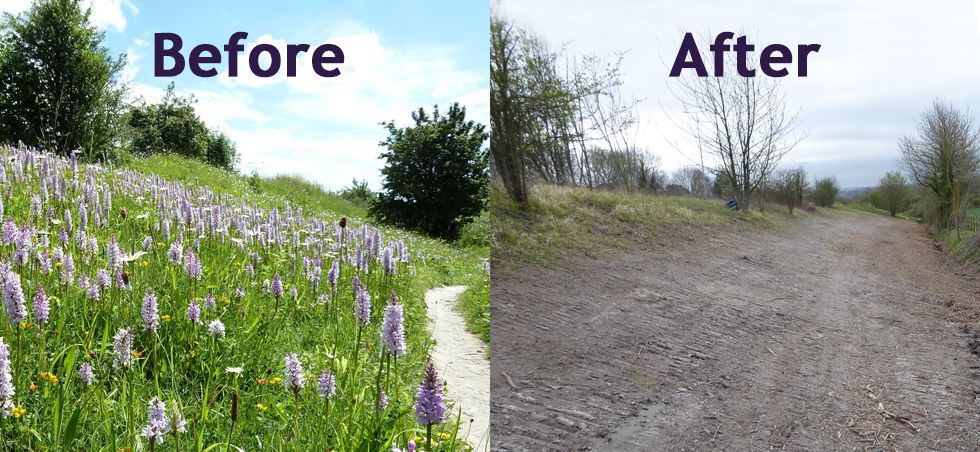
A stark contrast: Blue Bell Hill RNR in summer 2018 and spring 2019 (Plantlife).
After removing some trees from the ditch, the council scraped the bank smooth. Such intensive works will inevitably mean that much of this wildlife is lost for good from the site; other species will take years to recover. At this time of year, the Common Spotted Orchids will have been beginning to show above ground, ahead of flowering from late May onward.
Dr Trevor Dines of Plantlife said: "I worry that I've become immune to 'bad stuff' happening to wild flowers over the years. But the destruction a few days ago of 17,000 orchids on a road verge in Kent proved that I'm not.
"This mistake highlights just how vulnerable and threatened the fragments of our species-rich grassland have become – whether in a farmers' field or on a road verge – and the importance of raising our management across the entire network of road verges rather than just a few vulnerable 'jewels'."

Friday, 29 April 2016

Campaigners urge Elton John to boycott music festival in Portugal

In an open letter, environmentalists say locating Marés Vivas event near a nature reserve threatens nesting birds and wildlife

Elton John is due to play at the Marés Vivas festival alongside British singers James Bay and Tom Odell. Photograph: Daniel Leal-Olivas/PA


Friday 29 April 2016 17.24 BSTLast modified on Friday 29 April 201618.06 BST

Campaigners have sent an open letter to Elton John asking him to boycott a Portuguese music festival due to concerns it will be an environmental disaster to a nearby nature reserve.

Marés Vivas festival, which takes place every July in Gaia, Porto, has been moved for the first time to an area of land just 100m from the nature reserve of the Douro River Estuary.

The 150-acre reserve, which is protected under Portuguese law, is home to more than 220 species of birds, including eagles, kingfishers and cormorants, and is one of Europe’s most popular sites for birdwatching.

Local campaigners have written to John, who will headline Marés Vivas alongside other British singers James Bay and Tom Odell, asking him to take a stand against the “environmental damage”.

”More than your business and your art, please consider the environmental importance of the area. The reserve is very delicate, special and vulnerable... the area is very special to some species of birds for stopover and for nesting,” says the letter, which is signed by figures such as biologist Serafim Riem, Lucília Guedes, vice president of the Fund for the Protection of Wild Animals, and João Branco, director of Portuguese environmental group Quercus.

About 30,000 visitors a day are expected at the music festival, which was moved from its previous site after a dispute with the owners. Campaigners are concerned that crowds, noise and lights so close to the estuary will have a lasting impact on the nesting birds and wildlife.

The letter says “damaging” preparations for the festival had begun, including bulldozing and cutting down trees. It says the site of the show was home to the protected Iberian emerald lizard and that if the festival goes ahead “the whole area, including the nature park, is going to lose its state as a protected area”.


Saturday, 24 May 2014

Iconic Jamaican iguana under threat from $1.5bn Chinese port project


Development will destroy Jamaica's biggest nature reserve and fragile coastal areas, conservationists warn

Suzanne Goldenberg, US environment correspondent

theguardian.com, Friday 23 May 2014 07.00 BST

The Jamaican government is pursuing a $1.5bn Chinese port development inside the island's biggest nature reserve, threatening the famous Jamaican iguana (Cyclura collei) and putting fragile coastal areas at risk, environmental groups say.

Government officials have championed the project – which reportedly includes a port, industrial park and causeway – as a boon for the country's economy.

But the United Nations, the International Union for the Conservation of Nature and local environmental groups say the China Harbour Engineering Company development risks destroying mangroves and rare forests in the country's biggest nature reserve, the Portland Bight protected area.

The port would also doom a rare conservation success story, the Jamaican iguana, brought back from the point of extinction after a 20-year effort, environmental groups say.

Thursday, 12 December 2013

Endangered Florida Panther Found Shot Dead in Nature Reserve

An endangered Florida panther was found shot dead over the weekend, in the Big Cypress National Preserve, a (supposedly) protected area for wildlife. The death is significant as there are only 100 to 160 Florida panthers remaining, scientists estimate.

The National Park Service is asking anybody with information to come forward. It's a crime to kill a panther, with a maximum penalty of a year in prison and a $100,000 fine, according to the Tampa Bay Times.

Wednesday, 31 July 2013

Wildlife Trust appeal to buy Dambuster airfield

A Land Fit for Heroes - appeal to buy Woodhall Spa Airfield
July 2013. The Lincolnshire Wildlife Trust has launched an appeal to raise half a million pounds to buy Woodhall Spa Airfield. If successful, for the first time ever, the public will be able to walk along the runway that the Lancasters took off from.

The charity currently owns more than half of the airfield and an adjacent nature reserve, Kirkby Moor. By securing the rest of the site, the runway can be saved and a new nature reserve created. Kirby Moor has a wide range of plants and animals: 250 plant species have so far been recorded, together with 275 moths, 20 butterflies and 11 dragonflies. About 60 species of birds breed on the reserve in most years and over 100 species have so far been recorded. Adders occur on the reserve. 

Woodhall Spa Airfield will become a place where visitors can share in the unique atmosphere of spaciousness and serenity. The air will fill with the songs of skylarks. The open skies will see birds of prey soaring where aircraft once flew. It will be a fitting tribute to the many servicemen and women who gave their lives to preserve and protect our ‘green and pleasant land'.

Monday, 27 May 2013

British landfill transformed into nature reserve


· Published: 12 May 2013 at 10.49 

· Online news: World

A sprawling landfill site containing 50 years of rubbish from six London boroughs has been transformed into a 120-acre nature reserve for rare birds, bees and reptiles. 

The Thurrock Thameside Nature Park at Mucking, on the north bank of the Thames Estuary east of London, was officially opened on Saturday by veteran wildlife broadcaster Sir David Attenborough. 

Essex Wildlife Trust has restored the site to grasslands, woodland, ponds and reedbeds, attracting rare and threatened species including the skylark, adders, the shrill carder bee and water voles. 

The Wildlife Trusts -- an organisation representing 47 local wildlife groups across Britain -- said the reserve will eventually expand to cover 845 acres, around twice the size of London's Regent's Park. 

The wildlife haven sits on top of a 'pie-crust' up to 30 metres deep which covers the landfill site, The Wildlife Trusts said. 

A visitor centre has been built on top of the former landfill, with hydraulic jacks installed to cope with settlement of the rubbish below the building, and the park provides a network of paths, bridleways and cycle routes. 

"This is the beginning of a new chapter in the history of this part of the Thames Estuary," said Attenborough, President Emeritus of The Wildlife Trusts. 

"The area has had its ups and downs. This wonderful nature area and the extraordinary new centre stand where there were once 230 Saxon dwellings - but in-between times the waste of six London boroughs has been brought here. 

"We live in a crowded country and we need to respect its limits to sustain us. Positive change like this must become the norm – and The Wildlife Trusts across the UK are trying to make that happen." 

Peter Gerstrom, chief executive of Cory Environmental which owns the landfill site, said rubbish from London is still being transported from the capital by boat along the Thames but is now being processed in an energy-from-waste site which produces enough power for 100,000 homes.


Thursday, 21 February 2013

RSPB Ham Wall 'slime' baffles experts


Scientists at a nature reserve in Somerset have been baffled by a jelly-like slime which has appeared in a number of locations at the site.

Experts are divided over the origin of the jelly which has been found on grass banks away from the water's edge at the RSPB's Ham Wall base.

Spokesman Tony Whitehead said although unknown, similar substances have been noted in historical records.

Visitors are being asked to report findings but warned not to touch it.

'Regurgitated innards'
Scientific speculation as to the nature of the jelly is varied with one of the more favoured explanations that it is a form of cyanobacteria called Nostoc.

Others suggest that it is the remains of the regurgitated innards of amphibians such as frogs and toads and of their spawn.

"In records dating back to the 14th Century it's known variously as star jelly, astral jelly or astromyxin," Mr Whitehead said.

"In folklore it is said to be deposited in the wake of meteor showers."

Mr Whitehead added: "It's great that in this day and age that there are still mysteries out there.

"We've read a few articles now and much speculation.

"One suggested it was neither animal nor plant, and another that it didn't contain DNA, although it does give the appearance of something 'living'.

"Our reserve team will be looking out for the slime over the next few days, but if anyone can offer any explanations we'd be glad to hear."

Wednesday, 21 November 2012

Dorset's Upton Heath restored for rare reptiles and birds


Rare reptiles and birds are set to benefit from the clearance of invasive scrub at heathland in Dorset.

Upton Heath nature reserve, in Poole, is home to all six British species of reptiles, including rare sand lizards and smooth snakes.

The 506-acre (205-hectare) site's rare birds include Dartford warblers, stonechats and nightjars.

Dorset Wildlife Trust is clearing birch and pine tree saplings from the reserve in order to maintain the heathland.

Heathlands are supposed to have a "low density" of trees, according to the trust, which manages the site.

"We want to make it clear that established trees are not being cut down and the site will not look any different as a result of the clearance," said Nicky Hoar, communications officer for the trust.

"The trees also provide important habitats and nests of hobby falcons have been found in some of the mature trees."


Saturday, 25 August 2012

Can city cemeteries be nature reserves?


A sea of gravestones etched with the names of lost loved ones might not be what you would picture when you imagine a nature reserve.
But Manchester City Council plans to give Southern Cemetery in south Manchester, which is the largest cemetery in the UK, that official title.
According to Natural England, it will be one of just 10 graveyard nature reserves in England. And it is part of a bigger plan in Manchester to put cemeteries "on the map" for nature-loving urbanites.
So just how wild can a burial ground be?
David Barlow, who leads the environmental strategy team for the local authority, says cemeteries are "hidden gems".
"They're lovely places for wildlife," he told the BBC.
Mr Barlow and his council colleagues have the power to "officially designate" an area a nature reserve.
But to have the support of Natural England, the government body that sets the definition of a national nature reserve, they must demonstrate that the proposed site is "special" in terms of the flora and fauna it harbours, and that the council is working to protect it.

Friday, 3 August 2012

Sixty years since Britain’s first local nature reserve was declared – Gibraltar Point

Sixty years a Local Nature Reserve
August 2012. Sixty years ago today, on 1 August 1952, Gibraltar Point became the first Local Nature Reserve in England to be declared by a Local Authority under the 1949 National Parks and Access to the Countryside Act.
The designation recognised the special significance of Gibraltar Point as a new type of nature reserve and of the successful partnership between the former Lindsey County Council and the Lincolnshire Wildlife Trust.
Long recognised as an important wildlife site
Gibraltar Point on the Lincolnshire coast had long been recognised as an important place for wildlife. In 1915 it was included in the Society for the Promotion of Nature Reserves list of wildlife sites that were 'worthy of preservation' and in 1948, was first named a nature reserve in a landmark agreement between the Lincolnshire Wildlife Trust and County Council. But the statutory designation of 1952 gave it official national recognition.
Ted Smith, one of the founding members of the Lincolnshire Wildlife Trust said: "At that time the popular concept of the nature reserve was of a place with a fence round it to keep people out. Gibraltar Point was different. The first priority was to protect its nationally and internationally important wildlife and natural features, but it would also be open to the public for the quiet enjoyment of nature and used for education and research."
"By 1952 the Gibraltar Point reserve was flourishing and was widely regarded nationally as a model of its kind. Schools and universities were using it for teaching and research and the number of visitors was already in the tens of thousands. It was a fitting recognition of its success that in August 1952 it became the first Local Nature Reserve in England."
Today, Gibraltar Point remains a flagship nature reserve of the Lincolnshire Wildlife Trust. It is a fantastic place to visit at any time of year and the events programme helps visitors experience some of the wildlife highlights.

Saturday, 2 June 2012

Remarkable camera trap photos of jaguars & other cats taken on Colombia ranch

Jaguars, ocelot, jaguarundi & puma all spotted - Scroll down or click here to see the images


May 2012. Reserva Natural La Aurora is nature reserve is located in Colombia 400 kms to the east of Bogota, in the department of Casanare. The 9000 hectare reserve has a tropical climate with temperatures averaging 30 degrees Celsius. Annually there is a 6 month long dry season, and a 6 month wet.


ALL THE IMAGES ARE COURTESY OF JORGE ARMANDO BARRAGAN


Mixed use - Ranching and conservation
Wildlife conservation has been conducted hand in hand with ranching here for many years, maintaining a balance of livestock and wildlife. These ranching methods were inherited from the Jesuits of the seventeenth century.
Wide variety of birds & wildlife
A wide variety of native and migrant birds of the Orinoco basin can be found here, as well as mammals such as the capybara (the world's largest rodent), and cats such as puma, jaguar, ocelot and jaguarundi. Reptiles such as iguanas and huge anacondas (5 to 7 m in length) are abundant too.
Declared as a nature reserve
As an initiative of the owners, and with the approval of the ministry of environment and regional conservation bodies, the Hato La Aurora ranch has been declared as a ‘Civil Nature Reserve' (which means that this area is an important hotspot for conservation but the government does not own it, and it can only be protected if the owner voluntarily agree to turn this property into a nature reserve).
The cameratrap pictures have helped to identify the population of cats in the reserve. As part of the conservation initiative, an eco-tourism project is now running within the nature reserve, and a new eco-lodge providing accommodation and activities on the ranch is now up and running - See more at Juan Solito Eco-lodge.

Thursday, 26 April 2012

New wetland being created near Salisbury

Mass reed plantathon brings bird sanctuary closer to completion

April 2012. Staff at Wiltshire Wildlife Trust have turned out in force to breathe life into the new wetland being created at Langford Lakes nature reserve near Salisbury. They put their backs into planting 3,000 reed plugs into the banks of the newly dug water channels that are transforming a field into a rustling reed bed for birds and other wildlife.

Two complex trench systems, a large pool and numerous scrapes (areas of shallow water and marshland) have been dug into the 25-acre field to add a spectacular variety of habitats to what is already an important centre for resident and migratory birds.

30,000 reeds
While staff made great progress towards planting the 30,000 reeds that are needed to complete the project, there is still a long way to go and volunteer parties are turning out in all weathers to do their bit too. 

"You will be able to return in years to come and get great satisfaction from seeing the reeds swaying in the breeze, thronging with wetland bird species such as the reed warbler," says Chris.

"The reeds we are planting are common reed, which will develop over the years into an expansive reed bed."

Once grown as a resource for roof thatching, reed beds are dying out along with the industry that helped them flourish. As they disappear, so too does the wildlife that lives in them. Reed beds are now in included in the UK Biodiversity Action Plan (a blueprint for restoring wildlife) as a priority habitat, so it is vitally important to expand them wherever suitable.

Wetland will open in September
This is a good time to visit Langford Lakes nature reserve to see a variety of breeding waterfowl, as well as warblers in the surrounding trees and scrub. The wetland will open to the public on September 8th from 10am-4pm.


http://www.wildlifeextra.com/go/news/langford-wetlands.html

Thursday, 15 March 2012

Vandals attack Water's Edge nature reserve

A nature reserve in North Lincolnshire has been attacked by vandals.
Humberside Fire and Rescue Service was called to attend a fire at the Water's Edge Country Park on Saturday afternoon.
About two thirds of an island reed bed caught fire and plants and habitats, including some duck eggs and birds nests, were destroyed.
The Waters' Edge Country Park is a Site of Special Scientific Interest (SSSI) and home to rare birds and plants.
Councillor Liz Redfern, leader of North Lincolnshire Council, said: "I am shocked by this incident over the weekend at Waters' Edge.
"The fire has damaged the majority of the viewing area.
"These vandals should be warned, we will help the police with all their enquires to ensure these mindless vandals are brought to justice."

Sunday, 4 March 2012

Environment board to nurture nature reserve of rare birds and cattle near Mersey Gateway in Halton

A GROUP has been set up to protect wildlife on nature reserves along Halton’s river banks as part of a major £600m Mersey Gateway project.
The Mersey Gateway Environmental Trust completed its membership this week by recruiting two experts in flora and fauna.
Professor David Norman, Cheshire Wildlife Trust chairman, and Liz Newton, a Natural England programme director, will serve as trust directors.
The board’s aim is to protect, manage, conserve and improve the physical and natural environment across a 28.5ha saltmarsh nature reserve that runs along 200m of the River Mersey’s banks near to the proposed bridge site.
The trust is a charitable company limited by guarantee. Its other four directors are Halton’s Cllr Dave Thompson, Warrington’s Cllr Geoff Settle, Moore Parish Council’s Peter Edmonds and Walton Parish’s Council’s Yousuf Shaikh.
A project spokesman said the trust will create long-lasting environmental benefits.
The trust’s goals include restoring and creating saltmarsh, attracting important bird species, increasing the breeding bird population such as skylark and meadow pipit, introducing rare breeds of ‘conservation cattle’.
Prof Norman said: “We want to protect the habitats and wildlife around the bridge and invite residents and schools to experience the new and interesting wildlife and to find out more about our work.”
Liz Newton said: “I am delighted to be involved.
“This is the first time that a major bridge construction project in the UK has set up a trust of this type, and I hope it will be a model for future projects in this country and beyond.”

Sunday, 16 October 2011

Fire engulfs Bosnia's largest nature reserve

(Reuters) - Fire has engulfed much of Bosnia's Hutovo Blato nature reserve, killing many birds and animals, the park manager said Saturday.

The blaze broke out early Friday in an inaccessible section of the park and was fanned by strong winds across 80 percent of Bosnia's largest reserve before being extinguished on Saturday afternoon.

"The fire killed many birds, as well as mammals and reptiles. The vegetation was destroyed totally and the feeding chain is completely disturbed," said Nikola Zovko, manager of the park that attracts thousands of tourists every year.

"The damage is enormous," he said, adding the fire may have been started deliberately.

Hutovo Blato, on the list of Bird Life International's Important Bird Areas, is a unique natural reserve composed mainly of sub-Mediterranean marshland near the Adriatic coast created by an underground system of the Krupa river.

It is home to more than 240 types of migrating birds. In the migration season, tens of thousands of birds fill the lake and its surroundings.

(Reporting By Maja Zuvela)
http://uk.reuters.com/article/2011/10/15/us-bosnia-fire-park-idUKTRE79E1VZ20111015

Sunday, 4 September 2011

Wildlife 'does better on reserves'

Wildlife is better protected on reserves and parks than nature-friendly farms, according to a controversial new study.

The findings are at odds with current conservation policy in Europe, where farmers are encouraged to help wild birds and animals feel at home on their land.

They suggest that "land-sharing" measures such as maintaining hedgerows, ringing fields with wild flowers, creating "beetle banks" and setting aside sites for ground-nesting birds may not be the most effective way to preserve wildlife. Instead, separating land for crops and nature might be a better way to balance food production and conservation.

Scientists from Cambridge University and the Royal Society for the Protection of Birds (RSBP) collected data on more than 600 land species in south-west Ghana and northern India. Demand for agricultural land is placing ever more pressure on wild species in these regions.

The researchers measured crop production as well as the abundance of birds and trees in forests and various types of farmland. They discovered that, for most species, populations could be increased by restricting the size of farms while protecting as much natural forest as possible.

Farms that retained some natural vegetation to encourage wildlife had far lower yields per hectare than intensive "monocultures" of oil palm, rice or wheat. Yet in terms of wildlife conservation, they could not compete with natural forests.

"As well as requiring more land to produce the same amount of food, the 'wildlife-friendly' farmlands were not as wildlife-friendly as they first appeared," said Dr Ben Phalan, from Cambridge University, who led the research, published in the journal Science.

In the UK and the rest of the EU, farmers already receive Common Agricultural Policy (Cap) subsidies that encourage wildlife conservation. Currently these are given under voluntary schemes in addition to the basic direct Cap payments. But under new European Commission proposals, from 2013 all subsidies could be tied to some level of wildlife preservation.

Martin Harper, conservation director at the RSPB, said: "Land-sparing is a very different approach to the European model - underpinned by the Common Agricultural Policy - which sees conservation measures promoted across our farmed countryside.

"This paper in Science suggests that unless the proposed green measures really deliver significant and lasting environmental benefits it would be better to use this money directly on nature reserves and saving threatened species."

http://www.google.com/hostednews/ukpress/article/ALeqM5iSawI-1Uk2S1PwU0NQpdKpVXTkYQ?docId=N0141651314882867793A

Monday, 15 August 2011

First leopard spotted on newly created wildlife reserve in South Africa

UmPhafa records first leopard August 2011. As Colchester Zoo's charity, Action for the Wild, continues work to develop the UmPhafa Private Nature Reserve in South Africa, a leopard has finally been spotted on the reserve after many signs had been recorded indicating that they had been present in the area.

In December, staff at UmPhafa recorded conclusive evidence of a leopard whilst a security guard was out on patrol. Our project coordinator, Liam Westall headed out to investigate and confirmed that the tracks were undoubtedly those of a leopard, with a hair caught on the fence line caught by the leopard passing through a gap also confirming the sighting.

Camera trapsSince the signs have been recorded on the reserve the UmPhafa staff set camera traps on UmPhafa and the neighbouring farms hoping to catch a glimpse of the leopard, as tracks and signs became even more frequent. The staff sourced some bait to attract the leopard and left scent trails leading it through a path where the camera was set up. After lots of hard work trying to capture a photo of the elusive leopard on UmPhafa, staff managed to get a wonderful photo of a leopard on one of UmPhafa's farms; Geluk.

Leopards
Leopards can grow to between 1.6 and 2.1 metres long, with males growing considerably larger than females. This elegant and beautifully marked cat has a wide distribution in sub-Saharan Africa and has a wide habitat tolerance. As they are mainly active at night, it has taken the staff on UmPhafa a long time to record a photo. As they have huge home territories depending on food availability, it is likely that they cross out of the UmPhafa Reserve in order to search for prey. With the increase in natural prey numbers, it is hoped that the leopard will be encouraged to spend more time within the reserve.

In previous years the leopard has become increasingly rare, but with more lands set aside for wildlife, signs and sightings are now becoming more and more common. The hills and vales of UmPhafa provide an ideal habitat for this species and the appearance of the leopard is a clear indication of the extent of change the land has undergone. There is potential for UmPhafa staff to study this further, and create a clearer picture of the population density in the area, as well as an indication as to how well targets are being achieved regarding rehabilitating the habitat of UmPhafa.

For more information on the UmPhafa Reserve, please visit the website at www.umphafa.com.
http://www.wildlifeextra.com/go/news/Umphafa-leopard.html

Monday, 28 February 2011

Rare spider discovered in nature reserve in Poole

This incredibly rare arachnid, with a wacky human face
on its back, has been discovered on a nature reserve in
Poole, the first one found in 35 years
2:00pm Monday 28th February 2011

By Lara Tollast

YOU WOULD have thought that finding a tiny, rare, fury animal with the markings of a friendly face on its back would have brought families flocking to see it at the Arne nature reserve in Poole.

Tony Whitehead of the RSPB said: “If this were a bird, rather like the recent oriental turtle dove, the queues would be stretching around the car park.”

So why is this tiny critter so lonely?

Perhaps it’s the fact that it also has eight legs, eight eyes, and the ability to scare Miss Muffet right off her tuffet.

The eloquently named Philodromus Margaritatus spider was discovered by RSPB volunteer Chris Emblem-English on an electricity junction box at the reserve in Poole. What makes this eight-legged beauty so special is that it had not been seen in Dorset for more than 30 years.

“This spider is something of a rarity”, Whitehead adds.

For centuries spiders have been on the receiving end of bad press, when only a small handful are capable of harming a human.

Perhaps the fear of spiders comes not only from their appearance but their cunning predatory methods. The fact they construct a web – a trap invisible to its ill-fated prey, is vindictively morbid and easily creepier than the tactics of other larger predators. If spiders were the size of Alsatians we would have fair reason to live in fear of them, so let’s thank mother nature that she made them so small.

Laura Dunne, 22 from Bournemouth says: “I don’t like them because they are so small, and it’s knowing that they could be hiding under your bed and you wouldn’t even know.”

Strange, then, that this fearful disdain is coupled with the belief that some spiders bring you luck. Money spiders are traditionally thought to bring wealth to those who cross their eight-legged path, and circling the spider around your head three times before tucking it in your pocket may make for more financial sense than buying lottery tickets.

The association between spiders and money stems from the belief that spiders attract wealth to people in the same way those spiders attract their prey. This theory dates back to the Romans, who would carry a little gold or silver spider in their pockets for good luck in trade.

Perhaps the best thing about spiders is that their eating habits stop us from being overrun with other creepy crawlies, such as disease-spreading flies. In Papa New Guinea and South America, spiders themselves are included in some traditional foods.

Eat them, fear them or fling them around your head, remember that spiders are more sacred of you than you are of them. As the old saying goes, “If you want to live and thrive then let a spider run alive”.

http://www.bournemouthecho.co.uk/news/features/8879618.Rare_spider_discovered_in_nature_reserve_in_Poole/

Thursday, 17 February 2011

Wildwood gets wild horses ready for move to Scotland

The team at Wildwood have been busy moving some of the charity’s wild horses from their homes in Dover to the Wildwood Wildlife Park near Canterbury in readiness for them moving to a new home in Scotland. The horses are being transferred to the RSPB nature reserve at the Loch of Strathbeg where they will live wild to improve the wetland habitat through natural grazing.

In total 8 Konik foals have been transported from sites at Hospital Down and Western Heights near Dover. Visitors can see the foals at Wildwood for the next few weeks before they are moved to their new home in Scotland.

A team from Wildwood went to Dover to move the horses and to check the health of the rest of the wild herd. Head Keeper Paul Wirdnam said “Konik horses are much tougher than domestic horses and are perfectly suited to living wild. They require very little human intervention but this is the ideal opportunity for us to give the herd a general check-up and ensure that they are all happy and healthy.”

As a conservation charity, The Wildwood Trust is committed to improving conditions for wildlife throughout the UK. The Wildwood Trust's vision is to bring back our true 'wildwood' by restoring Britain's land to its natural state through conservation grazing by large wild herbivores that restore natural ecological processes to help Britain team with wildlife once more.

Konik horses are the closest living relative of the extinct Tarpan, the wild forest horse that roamed Britain in prehistoric times. They are hardy animals that live well on wetlands eating weeds, reeds and grass. They help to boost biodiversity through light grazing and natural fertilisation which keeps the land open and encourages a wider variety of plants, birds and invertebrates to settle in the area.

Wildwood’s Chief Executive Peter Smith said “We are delighted to be working with the RSPB to send these beautiful animals to the Loch of Strathbeg . They are the ideal conservation management tool and will boost the area’s biodiversity”

The Konik foals are currently at Wildwood and can be seen by visitors until they depart for Scotland. Wild horses are just one of the huge range of British animals that can be seen at the Wildwood Wildlife Park near Canterbury. For more information visit our website at www.wildwoodtrust.org or telephone 0871 7820081.

Further information on Konik Horses

Wildwood Trust & Kent Wildlife Trust pioneered the re-introduction of these amazing animals to the UK in 2002. The two Kent based nature conservation charities brought the first ever of their breed to arrive in southern England and these horses and their offspring have been helping to restore some of the most precious national nature reserves in the UK.

The Konik horse is the closest living relative of the extinct Tarpan, the wild forest horse that roamed Britain in prehistoric times. The horses are the last descendants of the true wild horse of Britain and Europe and have survived centuries of persecution and even squads of Nazis sent to kidnap them for genetic experiments.

Konik horses show numerous primitive features, associated with their ancestor, the Tarpan. They are resistant to harsh climates and severe weather conditions, hence their extensive range. They are very fertile and can produce numerous offspring in their lifetime. As they are adapted to foraging in the wild, they can live on a limited amount of food and have an extremely resilient immune system. They are very intelligent, allowing them to adapt their diet according to season and food availability. Konik horses do not require horseshoes as their hooves are naturally self-trimming, breaking off as they become too long.
,

Monday, 10 January 2011

Tiger & Terrain meet to save big cat

TNN, Jan 7, 2011, 05.41am IST

LUCKNOW: Immediately after the Billy Arjan Singh Memorial convention on 'Why we are not able to save the tiger and possible solutions' held recently, the Tiger and terrain trustees have decided to hold a meeting on Friday. The convention was able to attract some suggestions from participants which can form a concrete programme to fulfil the aim of the trust in saving the tigers of UP.

Organising secretary, Kaushlendra Singh said that minister for state (Independent charge) for corporate and minority affairs Salman Khurshid has consented to grace the occasion. "As he himself is eager to see the national animal survive and flourish, he will support us in raising important issues involving conservation of tiger," Singh said. tnn

Further to this meeting, a team will go to Dudhwa Tiger reserve and will make an attempt to meet field director and other officials concerned to get acquainted with their difficulties which they are facing in saving the tiger. Second in line in the same trip will be an attempt to meet the villagers along with gram pradhans of villages located on the fringe of Dudhwa Tiger Reserve and talk to them on same lines.

These two meetings will give us a clear picture as to where do we stand and where we can be of help, we are more than sure that some ticklish problems will come up but we will definitely try to do the best possible on our part.

http://timesofindia.indiatimes.com/city/lucknow/Tiger-Terrain-meet-to-save-big-cat/articleshow/7233468.cms
Related Posts with Thumbnails

ShareThis