The Sun's rays can "burn" whales' skin, just like they can damage human skin, according to a team of researchers.
The scientists studied more than 150 whales in the Gulf of California.
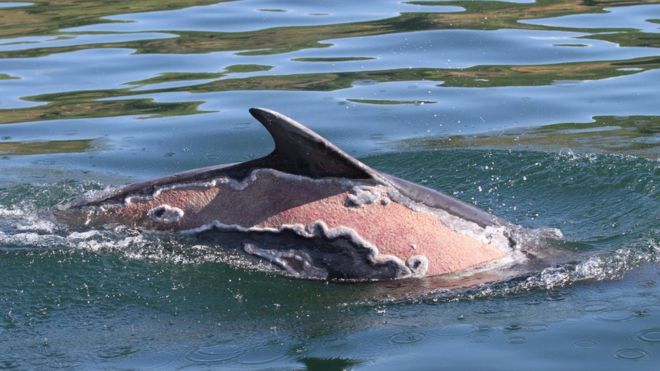
By taking photographs and skin samples, the US and Mexico-based team found the whales had blisters that were caused by sun damage.
The report in the Royal Society journal, Proceedings B, concluded that darker skinned whales showed fewer signs of sun damage.
The team was interested in the effects of increasing levels of ultraviolet (UV) radiation on wildlife.
Laura Martinez-Levasseur, from the Zoological Society of London (ZSL) and Queen Mary, University of London, led the study.
She explained that whales were a good model for this because "they need to come to the surface to breathe air, to socialise and to feed their young, meaning that they are frequently exposed to the full force of the sun".
Ms Martinez-Levasseur and her colleagues from the marine research centre CICMAR, in Mexico, studied blue whales, sperm whales and fin whales over a period of three years.
They examined high resolution photographs of the whales' skin and took skin samples from areas that appeared to be blistered.
Examining the samples under the microscope revealed that the blisters were caused by sunburn.
The scientists also found that signs of sun damage were more severe in the paler-skinned blue whales, compared with the darker-skinned fin whales.
Like in humans, darker skinned whales have more cells that produce of a dark brown pigment called melanin.
In humans, this is produced when DNA is damaged by UV radiation; a similar response appeared to be occurring in the whales.
'First evidence'
In blue whales the symptoms of sunburn seemed to be worsening during the period the study took place.
"This is the first evidence that the Sun's rays can cause skin lesions in whales," said Ms Martinez-Levasseur.
"The increase in skin damage seen in blue whales is a matter of concern, but at this stage it is not clear what is causing this increase. A likely candidate is rising ultraviolet radiation as a result of either ozone depletion, or a change in the level of cloud cover."
Professor Edel O'Toole, from Queen Mary, University of London, a skin specialist who took part in the study, said: "As we would expect to see in humans, the whale species that spent more time in the sun suffered greater sun damage.
"We predict that whales will experience more severe sun damage if ultraviolet radiation continues to increase."
This study showed no signs of skin cancer in the whales, but the team are going on to find out how the whales respond to sun damage at a genetic level.
This could provide clues about the longer term effects.
Ms Martinez-Levasseur said that other species were likely to be affected by UV damage, especially hairless creatures, including amphibians or sea mammals that live at the poles - where ozone decline is most pronounced.
She said: "I hope this will also open the door for other researchers to look into the effects of sun damage on wildlife."
By Victoria Gill
Science and nature reporter, BBC News
http://news.bbc.co.uk/earth/hi/earth_news/newsid_9173000/9173271.stm



 Posts
Posts


