Showing posts with label New Jersey. Show all posts

Tuesday, 10 September 2019

Rare, Two-Headed Rattlesnake Named 'Double Dave' Rescued from Certain Doom in New Jersey

Four eyes, two tongues, can't lose.

Two herpetologists in New Jersey — both named Dave — have discovered a rare, two-headed snake, which they've named Double-Dave. Members of the Nobel Prize committee: The ball is in your court.

Double-Dave is a baby rattlesnake, just a few weeks old and about 9 inches (23 centimeters) long, according to a recent segment on ABC News. Herpetologists Dave Schneider and Dave Burkett, who work with the Herpetological Associates in Pemberton, New Jersey, found the critter a few weeks ago while surveying the nearby Pine Barrens — a heavily forested area stretching across the southern tip of the state. 

Thursday, 29 November 2018

Sea Turtles Washing Up ‘Cold-Stunned’ At Jersey Shore As Wintry Weather Arrives - via Herp Digest


November 17, 2018

BRIGANTINE, N.J. (CBS) — Turtles are washing ashore along the East Coast according to officials at the Marine Mammal Stranding Center (MMSC) in Brigantine, New Jersey.

“Now that the colder weather is setting in, please remember that turtles will sometimes strand as a result of being cold-stunned,” officials explain.

Cold-stunning is a reaction that turtles have when exposed to cold temperatures for an extended period of time. Turtles can’t acclimate to temperatures below the mid-60s and must migrate towards warmer waters to stay safe.

“If turtles don’t make their way down south, they’ll be subject to cold stunning,” explains Bob Schoelkopf, the director of the Marine Mammal Stranding Center. “It happens every winter.”
Over 70 volunteers help the MMSC in their mission to respond efficiently to cases of stranded marine life.

 They work alongside experts to identify animals along 1,800 miles of the coastline in order to perform rescues. At times, they’re occupied with taking care of as many 25 cases at once.

“Volunteers are really invaluable to us to help us along with our work,” explains Schoelkopf, who adds that the volunteers are often their first responders considering the center has 3 stranding technicians on their staff.

Already, officials up north have responded to over 90 turtle rescues in New England and reports have begun to pick up further down along the East Coast according to Schoelkopf.

Turtle are washing in up and down the east coast. Please keep a sharp lookout when you walk the beach and immediately report any turtle, live or dead. 609-266-0538. We are here 24/7 to respond.

As the cold weather settles in for the tri-state area, Schoelkopf and his crew have already responded to several reports of various strandings.

On Saturday, a stranding technician from the team was responding to a call regarding a deceased dolphin as well as a stranded turtle on Long Beach Island.

It is especially important to note that while the turtles might appear lifeless, they are still alive.

Officials say you should not attempt to warm up a stranded turtle if you come across one. If mishandled, even by well-meaning citizens, a turtle could die and officials want the public to know to instead call them immediately.

With all the casinos and tourist attractions at the Jersey Shore, Schoelkopf reminds visitors that as winter arrives and marine life continues to migrate away from colder northern climates even seal sightings are likely to happen.

“They are wild animals, not pets,” says Schoelkopf, who wants the public to be mindful not to approach any wildlife found along the shore.

Officials also want the public to keep in mind that they should keep a safe distance from wildlife and always keep pets away from them as seal bites can be especially nasty.

Anyone that comes across a stranded turtle is urged to call the MMSC at 609-266-0538.


Wednesday, 10 October 2018

Rare, Blue Jellyfish-Like Creatures Wash Ashore in NJ, Puzzling Beachgoers


By Laura Geggel, Senior Writer | October 4, 2018 10:39am ET
Weird, brilliant blue creatures with feather-like tentacles are washing ashore on the beaches of New Jersey, surprising beachgoers who aren't used to seeing turquoise blobs dotting the shore, according to news reports.
These jellyfish-like critters are commonly known as blue buttons (Porpita porpita), but they aren't native to the Garden State. Instead, it appears that Hurricane Florence carried the tropical animals out of the Gulf Stream, a powerful current in the Atlantic Ocean, and pushed them northward up the East Coast.
"It's not something I've ever seen before, and I've been walking down that beach since I was 10 years old. I'm 55 now," Holly Horner, a professional wildlife photographer from Egg Harbor, New Jersey, told the Asbury Park Press, after spotting blue buttons on a beach in Brigantine last week. [In Photos: Spooky Deep-Sea Creatures]
Although they look like jellyfish, blue buttons are another type of creature (or rather, set of creatures) altogether. They fall into the scientific class Hydrozoa, whose members are each made up of colonies of hydroids — tiny predators that are related to jellyfish. The most famous hydrozoan is probably the Portuguese man o' War (Physalia physalis), which can deliver a venomous sting so powerful that it can kill fish and even injure humans, according to National Geographic.


Thursday, 22 June 2017

How many turtles have to die before we stand up to the balloon lobby? New Jersey (USA) - via Herp Digest

Editorial by STAR-LEDGER EDITORIAL BOARD , 6/19/17 

Let's hope our Legislature has the political chops and good sense to ban balloon releases statewide, so we don't find their tattered remains in our wildlife refuges and the mouths of dead sea creatures. 

You'd be surprised at what a challenge this is. After a similar ban died in the state Senate in 1989, thanks to the power of the almighty balloon lobby, a bill introduced last month would finally make the intentional release of helium balloons as part of an event illegal in New Jersey.

Violators could be fined up to $500. Because only do these hundreds of balloons become a source of litter, they can be a hazard if entangled in power lines, causing outages, or swallowed by sea turtles that mistake them for lunch.

Several towns along the Jersey Shore already ban releasing helium balloons. Lawmaker wants statewide ban.

Take a hard look at the grisly photos of dead birds and a turtle that encountered the remnants of party balloons in our state, posted online by the U.S. Fish & Wildlife Service. This is the terrible toll of your birthday.

Several towns have already banned balloon releases at events, but it's haphazard policy. The only reason we haven't banned them statewide is the political influence of the Trenton-based Balloon Council, which says this "creates a negative narrative about balloons."

Well, yes. It does. The council also argues it's a threat to mom and pop businesses. But why not just tie your balloons up during an event, and when it's over, pop them?

This group, which has spent more than $1 million in the past five years lobbying legislators against regulations, argues the threat to wildlife is exaggerated. Even though you find balloon bits in trees and on beaches, it says, it's not at the quantity of empty bottles and cans.

And so what? Who wants to see some poor seagull dangling from a wire a few days after the Fourth of July, wearing a stars-and-stripes balloon string as a necktie?

The lobbyists now plan to meet with the bill's sponsor, Sen. Jim Whelan, (D-Atlantic) to see if they can get him to drop this measure, the Bergen Record reports. Stay strong, senator. For the sake of our beaches and wildlife, stand up to the balloon bullies.

Thursday, 18 June 2015

Snakes alive! And well in New Jersey Pinelands - via Herp Digest


The female snake was named Hermione by two girls who found her tangled up in a ditch with a male they named Ron.
"They're the couple from the Harry Potter books," said their father, Emile DeVito.
Because DeVito is the manager of science and stewardship at the New Jersey Conservation Foundation, the girls knew what they were looking at: two northern pine snakes, which are on New Jersey's threatened species list, trying to propagate their numbers.
Since that moment two years, Hermione and Ron have done more to help their species survive rather than simply reproduce.
Hermione's name is the female derivative of Hermes, the Greek god known as the "earthly messenger," who moved freely between the mortal world and Olympus.

And this has been the snake couple's role since the day DeVito and his daughters found them copulating in the Franklin Parker Preserve in the Pinelands.
For 10 years, snakes such as Ron and Hermione have carried surgically implanted transmitters that allow scientists like DeVito to track their movement and study their behavior.
The research can aid developers and traffic engineers from encroaching on their territory around the Pinelands National Reserve, the only place where the snakes are found north of the Mason-Dixon Line.
"There is still a lot of development around the core of the Pinelands (reserve)," DeVito said. "We can give people information to make good choices about protecting wildlife."
The program began with timber rattlers, but in 2008, researchers from Drexel University expanded it to northern pines. Since then, about 30 snakes have led humans to the places where they feed, hibernate, mate and lay eggs in the underbrush of the pine forest. 
"The more we know about them, the more we protect them," DeVito said.
Transmission signals have revealed the snakes' hiding places in the dense understory of pitch pine and scrub oaks, as they dig and slither -- stealth-like -- through woody shrubs of lowbush blueberry and black huckleberry.
Without the signals, the snakes are almost impossible to find. In one of those amazing details of evolution, the northern pine snake has developed a camouflaged skin that mimics burned pine cones and pine needles.
"The pitch pine, scrub oak forest is a globally unique forest formed by fire," DeVito said.
"The snake has adapted to avoid predators. You can be right on top of them and not see them."
The signals have led researchers to rotten tree stumps in which the snakes burrow deep for earth's warmth -- well below the frost line – during the dark, cold months of winter.
Scientists also have been able to track them to the soft, sandy, windblown dunes where the snakes nest, and the shade of bracken ferns where they escape the unforgiving summer sun in a dwarf-pine forest that offers no shade canopy.
The snakes also reveal their proximity to their most feared predator: the car.
"They have a home range of about six square miles," DeVito said, "but we see they have dens and nesting sites sometimes within a quarter mile of a highway."
The snakes live in the 1.1 million acres of the Pinelands National Reserve. That sounds like a lot of room, but it is traversed by two state highways (Route 70 and 72), three inter-county roads (532, 539 and 563) and hundreds of local streets.
"The roads essentially create islands," DeVito said. "The roads don't allow the populations to connect."
Sticking with the island theme, the New Jersey branch of the northern pine snake is like a satellite outpost of their main habitat. Despite its name, the snake in most prevalent in South Carolina and extends into parts of five neighboring states. But from North Carolina to New Jersey, there are virtually none.
This is one reason they are on New Jersey's threatened species list.
A few weeks ago, Ron and Hermione were tracked down by their signals, which had grown weaker as the transmitter batteries began to wane. They were recaptured and brought to the office of a conservation consulting group called Herpetological Associates, Inc., in Pemberton.
Kevin Smith, one of the Drexel researchers, came from Philadelphia to remove the old transmitters and implant new ones. He did surgery on Ron two weeks ago and Hermione last week.
It's an elaborate procedure and Smith has done it about 15 times. With hands steady as, well, a surgeon, he gently anesthetized Hermione by placing her head in a tube of isoflurane vapors.
He then gingerly cut her open on an existing scar and pressed the old transmitter out toward the surface. Scar tissue was clipped away as minimally as possible, and a new
transmitter, dipped in paraffin and wax to dull the edges, was tucked under her ribs.
He ran an antennae through a catheter under her skin and five sutures later, she was removed from the vapor tube. She was measured and weighed before she woke up, then put in a bag for her trip back into the woods to continue her work as an earthbound messenger.

Monday, 1 December 2014

No croaking: New frog species groans, coughs

CHERRY HILL, N.J. (AP) — Scientists have discovered a new frog species in southern New Jersey that makes some un-froglike sounds.

The Atlantic Coast leopard frog groans and makes coughing noises rather than croaking sounds. The unfamiliar call attracted the notice of wildlife experts several years ago in Great Swamp National Wildlife Refuge in Morris County.

They photographed the frog and concluded it wasn't the northern leopard frog or southern leopard frog.

Friday, 14 November 2014

New Jersey's land-lovin' seal bound for Detroit

BRIGANTINE, N.J. (AP) — A seal with a fondness for New Jersey beaches — and the food-sharing fishermen and beachgoers that come with them — is headed for Detroit after becoming a little too friendly with the locals.

Since March, the 100-pound female gray seal had stopped on Long Island, New York, and New Jersey beaches at Sandy Hook, Island Beach State Park, Sea Isle City and Longport.

Each time, animal rescue groups shooed it back into the water or treated it for illness or injury. But the seal kept coming back.

When people started petting it on a beach in Longport on Sept. 5, the Marine Mammal Stranding Center removed it from the ocean permanently because it had become too acclimated to humans.

Tuesday, 29 July 2014

New Jersey snake hunt ends after officials find no evidence

Unconfirmed sightings this month of a snake, perhaps an anaconda as long as 16ft, raised concerns among visitors and swimmers

Associated Press in Jefferson, New Jersey

theguardian.com, Thursday 24 July 2014 19.08 BST

A 16ft exotic snake reportedly slithering around New Jersey's largest lake is apparently a suburban legend. Or the snake just isn't hungry.

The state has stopped looking for the reptile after scientists failed to find any evidence of it in Lake Hopatcong and traps baited with chicken were left untouched.

Three unconfirmed sightings this month of a snake, perhaps an anaconda as long as 16 feet, raised concerns among visitors and swimmers. The state investigated, erring on the side of public safety.

State wildlife experts found no scientific or biological evidence that an exotic snake is in the area, state Department of Environmental Protection spokesman Larry Ragonese said. "There were no signs of droppings or skin," he said.

Tuesday, 8 July 2014

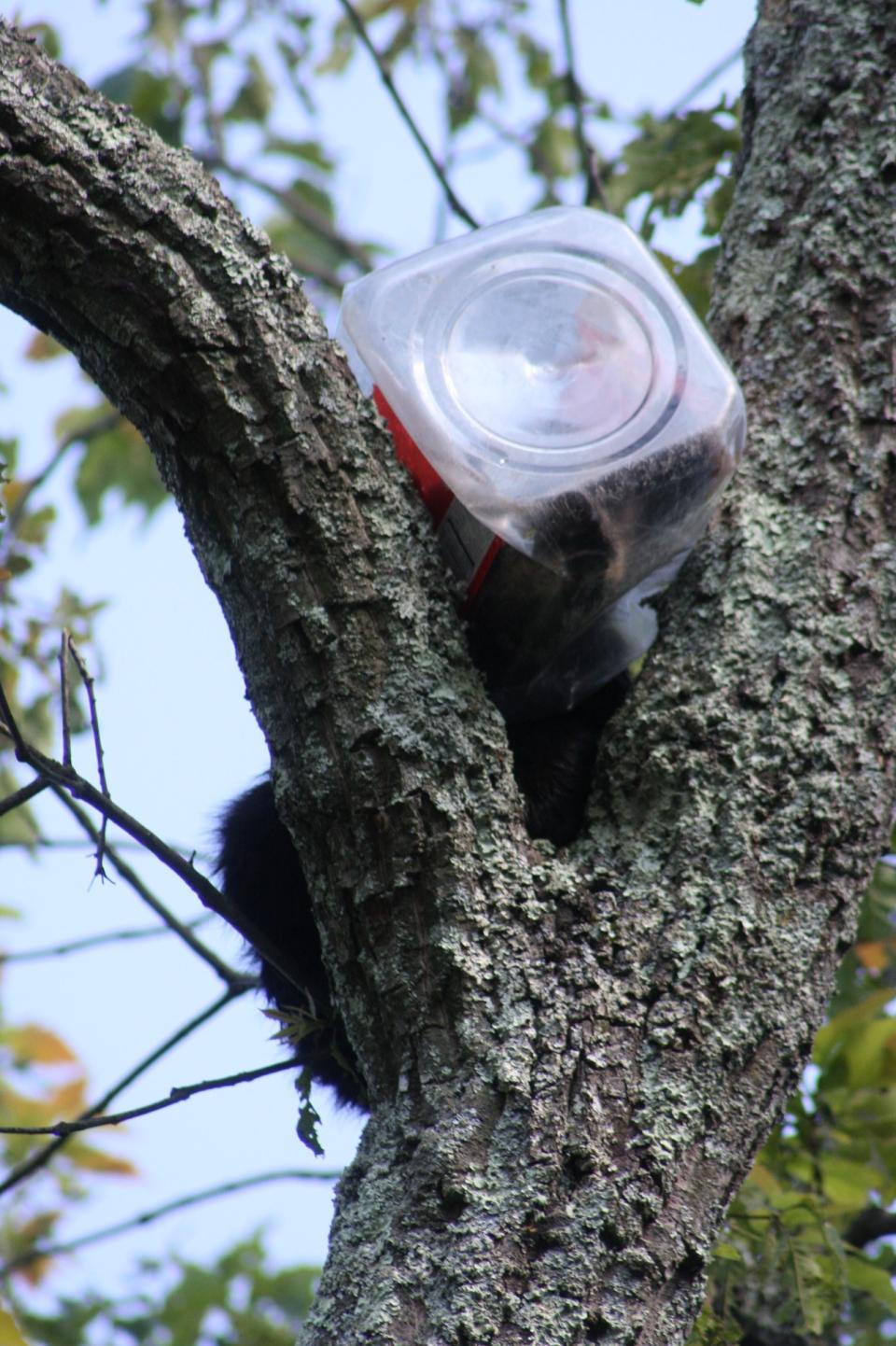
Bear rescued after head gets stuck in cookie jar

RINGWOOD, N.J. (AP) — A frightened bear cub got its head stuck in an oversized cookie jar while rummaging through some trash and had to be rescued from a tree in New Jersey.

Environmental Protection Department spokesman Larry Ragonese says the 6-month-old cub apparently found the animal crackers jar Friday night in Ringwood, near the New York border.

As the 28-pound animal tried to eat what remained in the jar, he apparently pulled it over his head and it got stuck.

The cub became spooked when approached and went up a tree, but got wedged about 40 feet up.

Saturday, 28 June 2014

Audobon Society asks N.J. to grow milkweed

By James M. O'Neill The Record (Hackensack, N.J.)


HACKENSACK, N.J. - Plant some milkweed in your yard this year - and you can help save the monarch butterfly.

Monarch butterflies, known for their migration from across the U.S. down to Mexico each fall, have been in decline for years, and are at the lowest numbers scientists have seen in the several decades they have been tracking them.

The easily identifiable orange-and-black monarchs have been hit hard by a number of factors, but perhaps most devastating is the loss of the one species of plant the monarch lays its eggs on - milkweed.

As a result, the Audubon Society is asking residents to plant milkweed in their gardens and for highway road crews and parks groundskeepers to avoid cutting milkweed that grows wild along roads and in open spaces. Bergen County Audubon Society also is donating milkweed plants to schools and community gardens.

"We're trying to do what we can to help," said Don Torino, Bergen Audubon's president. "Some environmental issues seem so big and overwhelming, and people feel powerless. But here's something simple they can do to help."

Monday, 5 May 2014

Whale washes up in New Jersey, gets graffiti tag

May 2, 2014 7:49 PM


ATLANTIC CITY, N.J. (AP) — A dead Minke whale that washed ashore in New Jersey suffered some further indignity: someone tagged it with graffiti.

The whale, which was roughly 12 to 15 feet long, was discovered Thursday morning below Atlantic City's Central Pier.

Police tell The Press of Atlantic City the purple markings are not gang-related and appear to be Greek letters.

The letters appeared to be Tau Epsilon Phi, a fraternity that has chapters at several area schools, followed by what looked like "94."

Monday, 28 April 2014

Honeybees battered by brutal winter

CINDY NEVITT, THE PRESS OF ATLANTIC CITYPOSTED: Sunday, April 27, 2014, 1:09 AM

DENNIS TOWNSHIP, N.J. - With wind gusts in excess of 30 m.p.h. buffeting him, Gary Schempp struggled to check the health of his honeybee hives. The insects, enduring another day imprisoned in their hives by the uncooperative weather, reacted to Schempp's intrusion with a few well-placed stings.

"We're having a hard time standing here," Schempp said of maintaining an upright position against the howling wind as he visited hives he has at Jalma Farms on Route 9 in Ocean View, Cape May County. "Imagine being a honeybee and trying to fly in this."

Such is the plight of the honeybee, an insect so lightweight, it takes 300 worker bees to equal an ounce.

With one-quarter of the state's honeybee colonies decimated by the brutal winter and starved by a cold spring, and almost half of the colonies killed by weather conditions coupled with a parasite infestation, the situation is getting desperate for the bees that have managed to survive.


Wednesday, 26 March 2014

Two Parts Of Same Sea Turtle Fossil Found 160 Years Apart

Brett Smith for redOrbit.com – Your Universe Online

Against insurmountable odds and after more than 160 years, an ancient sea turtle has finally been reunited – with itself.

Fossil evidence of the massive turtle Atlantochelys mortoni was first discovered in 1849 in the form of one-half of an upper arm bone – called the humerus. The other half of that bone would lie in a New Jersey streambed until it was stumbled upon by amateur paleontologist Gregory Harpel in 2012.

“I picked it up and thought it was a rock at first – it was heavy,” Harpel said.

The newer specimen was found in a fossil-hunting hotspot in Monmouth County, N.J., where Harpel often goes to look for fossilized shark teeth as a weekend hobby. After realizing that he had indeed found a fossil, Harpel brought the specimen to experts at the New Jersey State Museum, who joked that the amateur paleontologist had found the other half of a partial turtle limb being stored at the Academy of Natural Sciences of Drexel University in New Jersey.


Friday, 21 February 2014

Extreme Abuse of Calves Leads to Immediate Shuttering of N.J. Slaughterhouse (Op-Ed)


Wayne Pacelle, President and CEO, Humane Society of the United States | February 19, 2014 10:38pm ET

Wayne Pacelle is the president and chief executive officer of The Humane Society of the United States (HSUS). This Op-Ed is adapted from a post on the blogA Humane Nation, where the content ran before appearing in Live Science's Expert Voices: Op-Ed & Insights.

The U.S. Department of Agriculture (USDA) responded quickly to shut down a New Jersey slaughterhouse plant after The HSUS asked for enforcement action and provided the federal agency with footage of our latest undercover investigation into abuses and the continuing mistreatment of downer calves — in this case, at the Catelli Bros. slaughter plant in suburban Monmouth County, N.J., Following the USDA's action, The HSUS publicly released its materials.


Wednesday, 29 January 2014

Emotions Run High in NJ Pinelands Gas Pipeline Plan - via Herp Digest

by Wayne Parry, December 21, 2013, Pemberton Township, NJ (AP) — This is the other New Jersey. Far from the gas tanks, chemical plants and toll booths that have come to define the state in the minds of many, the Pinelands consist of more than a million acres of dense forest, wildlife and wetlands.

A flight over the region would reveal a canopy of lush green foliage as far as the eye can see, in a part of the state sometimes referred to as "the lungs of New Jersey." Endangered or threatened wildlife ranging from tree frogs and salamanders to bobcats, eagles and butterflies call its gnarly pine trees and sandy soil home.

But just outside the Pinelands sits the main power plant for southern New Jersey, one that has long created concern with the high levels of pollution its coal burners cause. The BL England plant recently agreed to switch from coal to natural gas to avoid being ordered to shut down by New Jersey environmental authorities.

And that is the center of one of the biggest jobs-vs.-environment clashes in recent New Jersey history.

A state agency tasked with protecting the Pinelands while managing development in responsible ways will try to balance those needs next month. On Jan. 10, the New Jersey Pinelands Commission will decide whether to approve a 22-mile natural gas pipeline through the woods to the power plant.

Six months of public hearings and contentious meetings have only raised the temperature, pitting conservation of the largest tract of wild space between Virginia and Boston against the desire for jobs and reliable energy for southern New Jersey, including teeming Atlantic City and its casinos. The commission's vote is the last obstacle to the plan by South Jersey Gas, which has already gotten other approvals it needs.

"The public has been talking to us since June, but the public has not heard how the commission feels," said Commissioner Paul Galletta, of Hammonton, who owns the largest cultivated blueberry company in the nation. "You can only beat this thing so much. It's time for us to hash this thing out."

Environmentalists say they fear the project will open the door to other types of private projects also forbidden in protected forestland. They say it will cause a loss of some habitat, as well as increase runoff and erosion in an area home to an aquifer estimated to hold 17 trillion gallons of some of the nation's purest water. By allowing a plant that now runs part time to run full time, they say, the pipeline will also increase environmental harm.

But supporters want the jobs. And the utility warns there is only one pipeline right now that takes gas to nearly 29,000 homes and businesses, which could be left out in the cold without a second means of getting gas to their homes if the existing pipeline fails.

South Jersey Gas would pay $8 million to a Pinelands land preservation fund to help clear the final hurdle. The deal would, in effect, exempt the pipeline from a ban on new transmission lines in the Pinelands. It needs commission approval because most of the people who would benefit from the project live outside the Pinelands region.

Many opponents say the plan would go beyond what the Pinelands Commission is supposed to do.

"It is not your mission to create jobs," Cape May County resident Martha Wright told the commission at a recent hearing.

"Protect the Pinelands," urged John Hiros. "That's your obligation — nothing else."

Robert Allen, a teacher at Cumberland County College, said the commission needs to consider the potential impact of a pipeline rupture and fire. He cited a report done for the gas company by a consulting firm showing that a person would need to be standing more than a football field away from the pipe to survive such a fire.

The report counted 158 homes and 32 businesses within 125 feet of the proposed pipeline, including 10 homes and two businesses within 25 feet of it.

The gas company says the pipeline would be rigorously inspected and would meet tough safety and reliability standards. It would go under or next to existing roads through the Pinelands, the company says, minimizing the impact on forest and wetlands.

Many union members strongly support the project as a source of work during trying economic times and say they have built safe, reliable pipes that are still in use decades later.

"What I'm hearing is a lot of fear," said Rick Baynton, who works at the power plant. "I fear losing my job. I fear not being able to live at the Jersey shore with my family any longer. Heat and electric are necessary."

Will Pauls, president of the South Jersey Building Construction and Trades Council, said the pipeline would provide 1,000 jobs to skilled union workers, whose industry he said is experiencing a 40 percent unemployment rate.

"Everybody should be happy with this: clean natural gas to stop pollution," said Mark Hutchinson of the Tea Party group Liberty and Prosperity. "I'm a human and I have a habitat as well. My habitat needs to be heated. I need electricity to cook food. I need cheap, abundant electricity, hot water, all those things. There is no reason to stay here if a habitat for us isn't maintained."

Sunday, 4 August 2013

Why Can't the Snakes Cross the Road, Secret Lives of Baby Snakes and Other Questions

Aug. 2, 2013 — Why can't the pine snakes cross the road? Hint: New Jersey traffic might have something to do with it.

Drexel students will bring to light these and other findings about the plight, perils and peculiarities of the Northern Pine Snake in several presentations and posters at the Ecological Society of America annual meeting next week (ESA 2013), based on their research with Dr. Walt Bien's Laboratory of Pinelands Research in the New Jersey Pinelands.

Northern pine snakes are charismatic ambassadors for the Pinelands National Reserve, an ecologically important region -designated as a U.S. Biosphere Reserve by UNESCO and as the first National Reserve in the United States. The pine snakes are large, nonvenomous, docile and beautiful (at least to the non-phobic).

The population in New Jersey is threatened, and the next-nearest population of northern pine snakes is in North Carolina. Protecting these snakes from the human-generated perils in the most densely populated U.S. state can go a long way toward protecting the entire ecosystem they are a part of.

Here is a closer look at some of the Drexel team's research:

Friday, 26 July 2013

Why Are Sea Stars Dying from New Jersey to Maine? Divers Asked to Report Large Groupings of Starfish

July 23, 2013 — When University of Rhode Island graduate student Caitlin DelSesto collected starfish in Narragansett Bay for an undergraduate research project in 2011, she was surprised to watch as the animals appeared to melt and die in her tank within a week. After bringing it to the attention of URI Professor Marta Gomez-Chiarri, she learned it was among the first observations of a new disease that is now affecting starfish -- also called sea stars -- from New Jersey to Maine.

Thanks to a grant from the Rhode Island Science and Technology Advisory Council, the URI researchers are collaborating with scientists at Brown University and Roger Williams University to try to identify the cause of the disease.

"There was a big increase in sea star numbers about three or four years ago," said Gomez-Chiarri, "and often when you have a population explosion of any species you end up with a disease outbreak. When there's not enough food for them all it causes stress, and the density of animals leads to increased disease transmission.

"Now that the disease is in the environment, it may be hard to get the population back to normal," she added. "Diseases don't just completely disappear after a massive die-off."

Saturday, 15 June 2013

Jersey Devil Sighted In NJ?

An unrecognizable animal was spotted walking on a wooden fence in New Jersey and the photo has made its way to Reddit.com where readers are speculating on exactly what the strange-looking animal could be.

The black-skinned animal with long toes, a long snout and extremely long tail is pictured on top of a fence, facing away from the camera. 

The image was posted on Reddit and has over 600 comments on it but the website, known recently for their detective skills, seem stumped by the picture and have been unable to identify just what it is yet. Being the fortean lover that I am, i hope it remains that way and we have a genuine mystery on our hands. SCOOBY-DOO! WHERE ARE YOU!? -Mort


Wednesday, 29 May 2013

Goat Snarls Traffic On New Jersey’s Pulaski Skyway

JERSEY CITY, N.J. (CBSNewYork/AP) – A renegade goat and an auto accident snarled traffic on the Pulaski Skyway in northern New Jersey during the morning rush Tuesday.
The small, chocolate brown female with curved horns eluded five Jersey City police officers for more than 90 minutes by jumping back and forth over a central divider along the Pulaski Skyway, alternately disrupting traffic along both east and west-bound lanes, according to city spokesman Stan Eason.
“The goat kept jumping over the divider and on top of cars,” Jersey City Police Capt. Edgar Martinez told 1010 WINS. “It was cornered and captured with a rope and we were able to walk it to the vehicle where it was taken out of the Skyway.”
Traffic was snarled from 7:10 a.m. until almost 9 a.m. along the elevated roadway, which traverses the Passaic and Hackensack Rivers between Newark and Jersey City and carries thousands of vehicles daily to the Holland Tunnel and into New York.
Four vehicles, whose drivers were attempting to avoid the zigzagging goat, were involved in a minor accident, police said. There were no injuries.
Officials are still trying to determine where the goat came from. One of the goat’s ears is tagged with a U.S. Department of Agriculture tag, indicating the animal likely escaped a truck headed to a slaughterhouse, Eason said. If no company claims the animal, it will be moved to a rural animal welfare facility that can accommodate livestock.
“If it can survive running around the Pulaski Skyway for two hours, and then winds up in a slaughterhouse, it’s kind of sad,” Eason said. “But if someone claims her, she is private property, so there’s not much we can do.”

Friday, 25 January 2013

Yoga Goes to the Dogs with 'Doga'


Marc Lallanilla, Life's Little Mysteries Assistant Editor

With people taking their dogs to restaurants, to dog-friendly resorts and to dog masseurs, it was probably only a matter of time before dog yoga, or "doga," classes came around the bend.

At Morris K9 Campus in Randolph, N.J., mellow sitar music fills the air as several dog owners stretch, flex and practice deep breathing with their pooches by their sides. But the dogs are not just passive observers, the New Jersey Star-Ledger reports: Yogis also encourage the animals to perform moves like back stretches and (of course) downward dog.

The pups in this yoga class are noticeably quiet and well behaved. "He shuts off in every doga class, and he's super high-energy" normally, Robin Lash, a trainer at Morris K9 Campus, told the Star-Ledger, referring to her border collie, Gabriel.

Related Posts with Thumbnails

ShareThis