Showing posts with label saltwater crocodiles. Show all posts

Thursday, 31 December 2015

Northern Territory removes 290 saltwater crocodiles from waterways in a year

Residents are warned to take more care as 2015’s figure is announced – it’s a high one, based on recent years, although not a record


Helen Davidson in Darwin

Friday 1 January 2016 07.29 GMTLast modified on Friday 1 January 201607.31 GMT

Wildlife rangers pulled almost 300 saltwater crocodiles from Northern Territory waterways in 2015, more than in either of the two previous years.

As part of its population management program, the Parks and Wildlife Commission NT (PWCNT) removed 290 crocodiles of various sizes from NT rivers, harbours and waterholes, the largest measuring 4.38m from the Daly River.

Two crocodiles which were smaller than two metres were pulled from Shoal Bay on Thursday.

The figure is slightly about 2014’s 287 and well beyond the previous year’s 226. The highest number of crocodiles removed by PWCNT staff was 318 in 2012.
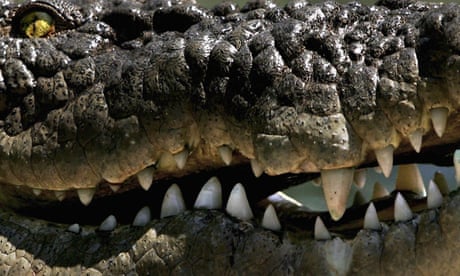
Rangers use a combination of baited traps and boats custom-fitted with harpoon racks, slides, a self draining deck and side rails to catch the “problem animals”.

All crocodiles are caught alive, and taken to the NT’s crocodile farms, which pay a “nominal fee” to the government based on size and weight, and “can do what they like with them,” PWCNT wildlife ranger Tom Nichols told Guardian Australia.

Tuesday, 14 May 2013

Croc trapping is false security: study in Australia – via Herp Digest


DARWIN, May 2 AAP - Trapping and removing large crocodiles from waterways around urban areas may give the public a false sense of security, a researcher says. 

A new study shows large crocodiles are far more mobile than previously thought, with some travelling over 1000km in a six-month period. 

Even crocodiles that were thought to have lived in a distinct location actually moved large distances, although they tended to move back and forth in the same area. 

One of the report's authors, Hamish Campbell from the University of Queensland, says the new study raises doubts about whether "zero-tolerance" zones, where crocodiles are trapped and removed, are effective. 

"Creating zero tolerance zones you are just going to get increasing numbers of animals," Dr Campbell said. 

"I wonder about how much of it is to appease the public rather than, as a biologist, it actually does anything," he said. 

Dr Campbell said crocodiles moved so far so quickly that trapping a large dominant male crocodile and taking it away could just leave a gap for a more troublesome crocodile to move into. 

"I think of the quote, it is better the devil you know," Dr Campbell said. 

He said removing crocodiles could be effective but evidence from the study showed management plans should take into account the implications of new crocodiles quickly moving into the same area. 

"We need to think about the implications of the management and if we are increasing the movements of the subordinates by removing crocodiles," Dr Campbell said. 

The study involved monitoring the movements of 12 large crocodiles. 

Last year 314 saltwater crocodiles were captured and moved as part of a NT Parks and Wildlife Commission management plan.

Wednesday, 1 May 2013

Fashion Houses Snapping up Croc Farms, - via Herp Digest

Brisbane Times (Australia) 4/23/13---International fashion houses are snapping up Australian crocodile farms to feed demand for accessories made from the reptiles' skins, a farmer says. 

Lillian Lever, who owns Koorana Crocodile Farm near Rockhampton, is approached at least once a month by international fashion houses wanting to buy her farm, which exports saltwater crocodile skins. 

She says five farms have been bought over the past year in Queensland and the Northern Territory. 

"What's going to happen is that they're going to be able to set the prices," she said. 

"It will turn into a monopoly." 

She said because croc farms are so expensive and take so long to establish there is only a small pool of companies that can afford to purchase them. 

The bulk of her croc skins are exported to Europe. 

There are 14 commercial croc farms in Australia, exporting about $20 million worth of crocodile skins each year. 

Ms Lever said Louis Vuitton has bought a farm in Innisfail in far north Queensland, while Hermes has brought one in Cairns and two others in the Northern Territory.

Wednesday, 2 January 2013

Number of crocodiles in Australian waters soars

A record haul of man-eating saltwater crocodiles was removed from waterways in the "Top End" of Australia last year, confirming that numbers of the feared reptiles are ballooning.
Wildlife rangers captured 314 of the estuarine crocodiles – or "salties" – in 2012, the equivalent of more than six a week in the northernmost section of the Northern Territory. Of those, 215 were fished out of Darwin Harbour, in the centre of a city that is home to nearly 130,000 people. The largest was a 16ft male, caught in a swamp in outer Darwin back in April.

The figures, which emerged yesterday, were released by the Northern Territory Parks and Wildlife Commission a month after a 12-year-old boy was killed by a crocodile near Port Bradshaw, 400 miles east of Darwin. Two weeks earlier, human remains were found in a crocodile's stomach after a seven-year-old girl was attacked while swimming in a waterhole.

Hunted almost to extinction last century, saltwater crocodiles have been a protected species since 1971 and since then their numbers have soared. There are now believed to be about 150,000 roaming the Top End. Despite their name, they are found in rivers and creeks miles from the sea.

Under a management programme, wildlife rangers trap creatures considered to pose a particular risk to humans, usually because they are close to populated areas. The two fatal attacks sparked renewed calls for the crocodiles to be selectively culled.

http://www.independent.co.uk/news/world/australasia/number-of-crocodiles-in-australian-waters-soars-8434295.html

Friday, 15 July 2011

Holidaymaker’s leaping crocodile photo wows Web

A giant three-legged crocodile has been wowing the Web after a tourist photograph capturing its freakishly large stature emerged online.


The striking creature named Brutus - which looks as though he is a special effect in a film - is said to be a starring attraction of a riverboat cruise in the Adelaide River, Australia.

Although some photos critics have questioned the legitimacy of the shot, the sightseer and the boat company have claimed that both the monster crocodile and this photo are indeed real.

At 80 years old, the 18ft-long saltwater croc can be seen leaping out of the waters of the Adelaide River to retrieve a slab of raw meat.


Bystanders in the photo look in awe as Brutus, who is believed to have lost his front right leg during an altercation with a shark, makes the awesome jump.

Katrina Bridgeford, who took the amazing snap, told the Northern Territory News: “When it came up out of the water there were a lot of Oos and Ahs. I wasn't expecting anything like this. I couldn't believe how close it got to us. If you had put your hand out you would have been able to touch it - if you'd dared.”

http://uk.news.yahoo.com/holidaymaker%E2%80%99s-leaping-crocodile-photo-wows-web.html
Related Posts with Thumbnails

ShareThis