
Showing posts with label sea lions. Show all posts
Showing posts with label sea lions. Show all posts
Sunday, 7 July 2019
Surge in sick, hungry sea lions off California coast puzzles marine biologists
JULY 5, 2019
by Don Sweeney, The Sacramento Bee
A rise in the number of ailing and malnourished sea lions along the California coastline has marine experts somewhat puzzled, KNTV reports.
About 130 sea lions and pups are now being treated at the Marine Mammal Center in Sausalito, Calif., KRON reported.
The center normally treats 50 to 70 young sea lions from April to June, said Greg Frankfurter, wildlife veterinarian at the facility, KNTV reported.
Some of the adult California sea lions may be suffering from domoic acid poisoning, related to toxic algae blooms in the ocean, according to the station. But experts aren't sure why they're also seeing more malnourished pups.
"Whether there is some underlying condition, we haven't been able to determine," Frankfurter said, KNTV reported. It may be related to the domoic acid poisoning cases in adults.
The upswing follows a similar surge in sea lion strandings in spring 2018 as well as a rise in California gray whale deaths in early 2019, KRON reported.
"We're seeing a lot of different animals being impacted from the gray whales that are coming in thin to the issues that we are seeing with Guadalupe animals and the sea lions up and down the coast," Frankfurter said, according to the station. "It's definitely a sign of the ocean overall. All of it might (connect) to climate change, relating to warming oceans."
Read on


Monday, 3 December 2018
Visually impaired sea lions join group at New Orleans zoo
December 1, 2018
A pair of visually impaired 2-year-old sea lions has joined the four sea lions already at the zoo in New Orleans.
Audubon Zoo officials say in a news release that Ayah and Jolee were both malnourished when rescued along different parts of the California coast in June 2017.
Jolee has cataracts in both eyes, and had an injury in her left eye when she was found on an El Segundo jetty. She gets around by following Ayah, who lost her left eye to a small-caliber bullet found in her brain after she came to Audubon.
Ayah was found off the Malibu coast.
Both youngsters were nursed back to health at the Marine Mammal Care Center Los Angeles. Its staff veterinarian, Lauren Palmer, says Audubon saved their lives by accepting them.
Sunday, 22 January 2017
Massive sea lion, fur seal hunting in the Patagonian coasts is altering Southern Atlantic Ocean ecosystems
Date: January 18, 2017
Source: Universidad de Barcelona
Sea lion hunting by the Europeans
at the Atlantic coasts of South America -it started in the 19th Century and
continued up to the second half of the 20th century in Argentina and Uruguay-
changed its nutrition guidelines of these pinnipeds as well as the structure of
the coastal trophic network, according to the studies by the team codirected by
Lluís Cardona, from the Department of Evolutionary Biology, Ecology and
Environmental Sciences and the Biodiversity Research Institute of the
University of Barcelona (IRBio), and Enrique Crespo, from the Patagonian
National Center and the National University of Patagonia (Argentina).
The results of this study are
shown in two articles, published in the scientific journals Oecologia and Paleobiology,
its co-authors being Fabiana Saporiti and Lisette Zenteno (UB-IRBio), and
Damian G. Vales (Patagonian National Center), among others.
This research is one of the
results of the project Efectes de l'explotació humana sobre depredadors apicals
i l'estructura de la xarxa tròfica del Mar Argentí durant els darrers 6000 anys
(Effects of human exploitation on apex predators and structure of the trophic
network in the Argentinian sea over the last 6000 years), financially supported
by BBVA Foundation and led by Professor Àlex Aguilar (UB-IRBio), head of the
Research Group on Large Marine Vertebrates of the University of Barcelona.
A megafauna exploited by humans
in all oceans
Hunting and fishing usually
create a reduction in the abundance of bigger species. Therefore, megafauna is
considered to be one of the most threatened compounds of biodiversity. Marine
mammals are an essential element of megafauna in all oceans and they have been
extremely exploited by humans. However, knowing about the effects of this
exploitation on the functioning of food networks in marine ecosystems -a high
complex structural framework- is still a hard challenge for the scientists due
to the difficulty to perform manipulative experiments.
Tuesday, 27 December 2016
Early action key to reducing sea lion impacts on salmon
Research uses epidemiological
models to track spread of behavior among marine mammals
Date: December 16, 2016
Source: NOAA Fisheries West Coast
Region
A new study used the same kind of
models that scientists use to track disease to instead examine how some California sea lions
have learned to prey on salmon gathering to ascend fish ladders at Bonneville
Dam.
Although sea lions commonly feast
on fish, their predation on salmon at Bonneville Dam on the Columbia
River poses wildlife management challenges. The sea lions that
gather on the Columbia
each spring are protected by the Marine Mammal Protection Act while the salmon
they are eating are protected by the Endangered Species Act.
In 2008 NOAA Fisheries authorized
Oregon, Washington and Idaho wildlife authorities to begin trapping and
removing sea lions shown to repeatedly prey on salmon at the dam. The removal
program was designed to reduce impacts on protected salmon.
NOAA Fisheries recently
authorized the states to continue the removals over the next five years.
The new study examined the
effectiveness of the removal program, employing epidemiological models to
assess how the behavior of eating salmon at the dam passes among sea lions. The
research concluded that the removal program has successfully slowed the
transmission of the behavior among sea lions, but would have been more
effective if it had started sooner.
The findings highlight the need
to act early "from both a conservation and management perspective to
prevent the spread of a detrimental behavior and to minimize the total number
of animals removed," the scientists wrote in the paper published in the
journal Proceedings of the Royal Society B.
Thursday, 18 August 2016
Island Sea Lions Offer Clues to Mysteriously Missing Mammals
The Falkland Islands population hasn’t bounced back despite an end to hunting over 50 years ago. Now scientists are closing in on the cause.
By Laura Parker
PUBLISHED AUGUST 11, 2016
Just off the southernmost tip of South America, a cluster of small islands presents a huge puzzle for marine mammal experts.
The Falkland Islands, isolated in the far reaches of the southwest Atlantic Ocean, once boasted one of the world’s largest populations of southern sea lions. Now, they have one of the smallest. Hunting is the main reason for historical declines of seals and sea lions worldwide, but the Falklands population never recovered even though commercial hunts ended more than half a century ago.
That’s especially odd, because elsewhere around the globe, other populations of sea lions and seals that were hunted to near extinction have bounced back. For example, the neighboring Antarctic fur seals, with pelts so prized that hunters had nearly wiped them out by the early 1900s, have rebounded to about three million individuals today.
For years, scientists blamed hunts off Argentina for the severe population decline in the Falklands. If the sea lions traveled from their island breeding grounds to the mainland while hunts were still happening, big commercial operations around the Argentine coast may have made too large a dent in their numbers.
But a new study based on sea lion genetics paints a much more complicated picture. For starters, it appears that the Falklands sea lions may not have been travelling to Argentina. Instead, a combination of changes to their habitat, including warmer waters due to climate change, has had a devastating impact that continues to ripple through the population.
“This realization is important, because it influences how we interpret threats to sea lion population persistence,” says Alastair Baylis, a marine ecologist with the Icelandic Seal Center and the South Atlantic Environmental Research Institute in the Falklands. “If we are correct, it suggests sea lions are more vulnerable than previously thought.”
Friday, 18 December 2015
First brain scans of sea lions give clues to strandings
Neuroscience links toxin to strandings
Date: December 14, 2015
Source: University of California - Davis
Brain scans and behavioral tests of California sea lions that stranded on shore show how an algal toxin disrupts brain networks, leading to deficits in spatial memory, according to a study to be published Dec. 18 in Science. The new findings by scientists at the University of California Santa Cruz, UC Davis and the Marine Mammal Center in Sausalito, Calif. suggest that chronic exposure to the toxin domoic acid, produced by naturally occurring marine algae, affects sea lions' ability to navigate in their ocean habitat and survive in the wild.
Blooms of the toxic algae typically occur in the spring and fall along the California coast, but have been increasing in frequency and severity. Hundreds of sea lions strand on California beaches every year with symptoms of domoic acid poisoning, including disorientation and seizures.
A team led by Peter Cook, then a graduate student at UC Santa Cruz and now at Emory University, studied 30 California sea lions undergoing veterinary care and rehabilitation at the Marine Mammal Center in Sausalito. Researchers administered behavioral tests to assess spatial memory and performed brain imaging (MRI) to see the extent of brain lesions in the affected animals.
Damage to the hippocampus, a part of the brain involved in memory, is often seen in sea lions with domoic acid poisoning, Cook said.
"In this study, we were able to correlate the extent of hippocampal damage to specific behavioral impairments relevant to the animals' survival in the wild," he said.
Monday, 8 June 2015
Fake orca used to scare sea lions out of Oregon port
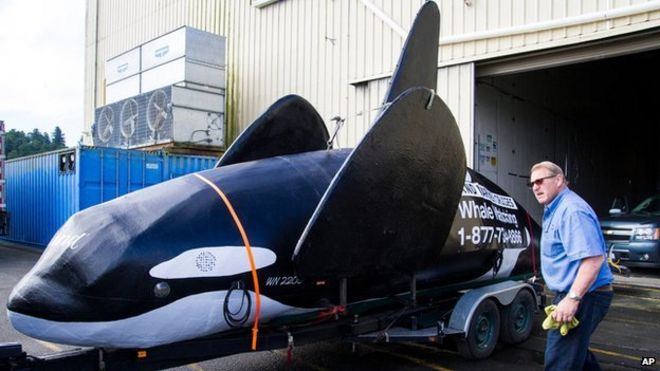 Port officials in an Oregon city have gone to creative lengths to see off hundreds of sea lions from their docks - by shipping in a fake orca whale.
The 32ft-long fibreglass whale was brought to rid Astoria's port of the sea lions after they failed to leave as expected once the weather got warmer.
Officials say the sea lions are putting thousands of jobs in the city at risk.
First attempts to use the fake orca ran into trouble on Thursday, after its motor became flooded.
Officials say they may try again on Friday.
"It really is a sign of how desperate the measures are that we're taking to try and solve this problem," Jim Knight, Port of Astoria Executive Director, said.
"We simply don't have the financial resources to build barriers. We have no choice but to look for very creative and low-cost solutions."
Thursday, 7 May 2015
Sea lion strandings: The view from the rookery
Date:
May 6, 2015
Source:
NOAA National Marine Fisheries Service
Summary:
Wildlife biologists are describing conditions at the sea lion rookeries on the Channel Islands, where pups are going hungry because unusually warm water along the Pacific coast has made it more difficult for their mothers to find food.
For a few months now, sea lion pups have been stranding on the coast of Southern California. So many have washed up, emaciated and exhausted, that marine mammal care centers can scarcely hold them all. But while most people first notice the pups on the beach, their desperate plight began on the Channel Islands, which are about 25 miles offshore of Santa Barbara. Those islands are home to the sea lion rookeries where the pups are born and where they spend the first year of life.
Many pups at the rookeries are going hungry, according to Sharon Melin, a wildlife biologist with the NOAA Fisheries National Marine Mammal Laboratory who recently returned from 3 weeks of fieldwork on the Channel Islands.
Friday, 30 January 2015
Record sea lion pup strandings reported in Southern California
By Marty Graham15 hours ago

SAN DIEGO (Reuters) - California sea lions – mainly pups – are turning up stranded and starved on Southern California beaches in record numbers this year, leaving experts worried that this winter may be the worst season ever documented for the marine mammals.
The precise cause is not clear, but scientists believe the sea lions are suffering from a scarcity of natural prey that forces nursing mothers to venture farther out to sea for food, leaving their young behind for longer periods of time.
Tuesday, 25 November 2014
Peru investigates deaths of 500 sea lions on north coast
24 November 2014 Last updated at 01:24
 But Peruvian environmental police are looking into other possible causes for the deaths, including disease and the accidental ingestion of plastic.
Peru is investigating the deaths of some 500 sea lions found on a beach on its northern coastline.
The local governor has accused fishermen of poisoning the mammals, which usually come close to the shore looking for food.
 But Peruvian environmental police are looking into other possible causes for the deaths, including disease and the accidental ingestion of plastic.
The rotting corpses were found on Anconcillo beach in the Ancash region.
Agents said the bodies were of young as well as old animals, the official Andina news agency reported.
They were considered a health hazard and quickly removed from the beach, which lies some 400km (250 miles) north of the capital, Lima.
Earlier this month, a similar incident happened further north, in the Piura region, where the bodies of nearly 200 sea lions, dolphins, turtles and pelicans washed ashore.
Officials are still investigating the causes of those deaths.
Subscribe to:
Posts (Atom)


 Posts
Posts


