Showing posts with label stone tools. Show all posts

Wednesday, 19 October 2016

Monkeys create stone tools forcing scientists to rethink human evolution


 Sarah Knapton, Science Editor
19 October 2016 • 6:00pm 

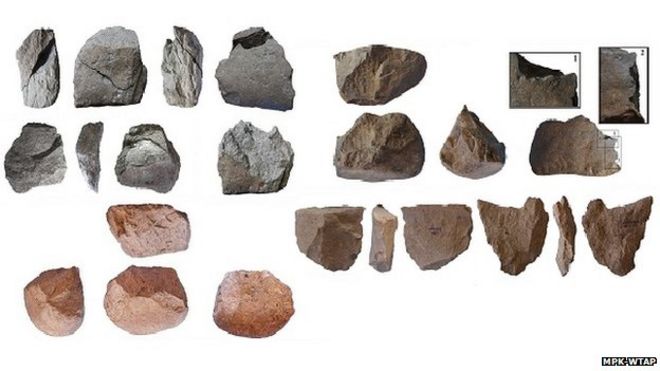
The path of human evolution may need to be rewritten after archaeologists discovered that monkeys also produce ‘tool-like flakes’ that were thought to be uniquely man-made.

In a discovery that calls into question decades of research, a band of wild bearded capuchin monkeys in Brazil were seen hammering rocks to extract minerals, causing large flakes to fly off.

Previously archaeologists believed the flakes were only made by humans through a process called ‘stone-knapping’ where a larger rock is hammered with another stone to produce sharp blade-like slivers which can be used for arrows, spears or knives.

It does throw a bit of a spanner in the works in our thinking on evolutionary behaviourDr Michael Haslam, University of Oxford

The flakes were thought to represent a turning point in human evolution because they demonstrated a level of planning, cognition and hand manipulation that could not be achieved by other animals.

But the new research suggests that flakes can be made without any such foresight. In fact they can simply be made by accident.

“The fact that we have discovered monkeys can produce the same result does throw a bit of a spanner in the works in our thinking on evolutionary behaviour and how we attribute such artefacts,” said Dr Michael Haslam, lead of the Primate Archaeology project at the University of Oxford.

“Our understanding of the new technologies adopted by our early ancestors helps shape our view of human evolution. The emergence of sharp-edged stone tools that were fashioned and hammered to create a cutting tool was a big part of that story.”


Tuesday, 12 July 2016

Monkeys in Brazil 'have used stone tools for hundreds of years at least'

Was early human behavior influenced by their observations of monkeys using stone tools?

Date: July 11, 2016
Source: University of Oxford

New archaeological evidence suggests that Brazilian capuchins have been using stone tools to crack open cashew nuts for at least 700 years. Researchers say, to date, they have found the earliest archaeological examples of monkey tool use outside of Africa. In their paper, published inCurrent Biology, they suggest it raises questions about the origins and spread of tool use in New World monkeys and, controversially perhaps, prompts us to look at whether early human behaviour was influenced by their observations of monkeys using stones as tools. The research was led by Dr Michael Haslam of the University of Oxford, who in previous papers presents archaeological evidence showing that wild macaques in coastal Thailand used stone tools for decades at least to open shellfish and nuts.

This latest paper involved a team from Oxford and the University of São Paulo in Brazil, who observed groups of modern capuchins at Serra da Capivara National Park in northeast Brazil, and combined this with archaeological data from the same site. Researchers watched wild capuchins use stones as hand-held hammers and anvils to pound open hard foods such as seeds and cashew nuts, with young monkeys learning from older ones how to do the same. The capuchins created what the researchers describe as 'recognisable cashew processing sites', leaving stone tools in piles at specific places like the base of cashew trees or on tree branches after use. They found that capuchins picked their favourite tools from stones lying around, selecting those most suitable for the task. Stones used as anvils were over four times heavier than hammer stones, and hammers four times heavier than average natural stones. The capuchins also chose particular materials, using smooth, hard quartzite stones as hammers, while flat sandstones became anvils.

Sunday, 24 May 2015

Oldest stone tools pre-date earliest humans


By Rebecca Morelle
Science Correspondent, BBC News

20 May 2015 
From the sectionScience & Environment

The tools includes sharp-edged flakes, hammers and anvils

The world's oldest stone tools have been discovered, scientists report.

They were unearthed from the shores of Lake Turkana in Kenya, and date to 3.3 million years ago.

They are 700,000 years older than any tools found before, even pre-dating the earliest humans in the Homo genus.

The find, reported in Nature, suggests that more ancient species, such asAustralopithecus afarensis or Kenyanthropus platyops, may have been more sophisticated than was thought.

"They are significantly earlier than anything that has been found previously," said Dr Nick Taylor, from the National Centre of Scientific Research (CNRS) in France and the University of Leiden in the Netherlands.

Saturday, 17 August 2013

Burmese Long-Tailed Macaques' Use of Stone Tools Is Being Threatened by Human Activity in Thailand

Aug. 14, 2013 — Human farming and the introduction of domestic dogs are posing a threat to the ability of Burmese long-tailed macaques to use stone tools. This was found in a study led by Nanyang Technological University (NTU) carried out at Thailand's Laem Son National Park. The research team has advised Thailand's authorities that in the management of their marine national parks they should pay closer attention to macaques' use of stones as tools.

Burmese long-tailed macaques (Macaca fascicularis aurea) are a rare variety of the common long-tailed macaques of Southeast Asia, found only in Myanmar and bordering areas of Thailand. In a few locations, these monkeys use stone tools along the coasts to crack hard-shelled invertebrate prey, such as rock oysters, sea snails, and crabs.

The research team, comprising Assistant Professor Michael D. Gumert from Nanyang Technological University's Division of Psychology, Professor Yuzuru Hamada of Kyoto University's Primate Research Institute, and Professor Suchinda Malaivijitnond of Chulalongkorn University' Primate Research Unit, discovered that human activities are showing signs that the persistence of the macaques' stone-use tradition may be in jeopardy at Laem Son National Park, a marine national park along the western coast of Thailand.

"Macaques easily change their feeding behaviour when influenced by humans, and we are concerned stone-using macaques will lose their traditional feeding behaviour if illegitimate development continues within the protected park," said Assistant Professor Gumert, who is based at the Nanyang Technological University in Singapore.

Thursday, 23 August 2012

Bonobo Stone Tools as Competent as Ancient Human?


(ISNS) -- The great apes known as bonobos can make stone tools far more varied in purpose than previously known, reaching a level of technological competence formerly assigned only to the human lineage, according to researchers.

These findings may shed light on the mental capabilities of the last common ancestor of humans and these apes, scientists added.

Bonobos are, with chimpanzees, humanity's closest living relatives. Together bonobos and chimps are part of the group Pan, just as modern humans and extinct species of humans make up the group Homo.

Related Posts with Thumbnails

ShareThis