Showing posts with label taxidermy. Show all posts

Monday, 6 March 2017

DNA from taxidermy specimens explains genetic structure of British and Irish goats


Date: February 28, 2017
Source: Trinity College Dublin

Intensive selective breeding over the past 200 years and high extinction rates among feral populations has greatly reduced the genetic diversity present in domestic goat breeds. The effect these pressures have had on Irish and British goat populations has been explored in a landmark DNA study that compared modern-day domestic and feral goats with museum specimens from years gone by.

A collaborative team led by geneticists from Trinity College Dublin compared the mitochondrial DNA (mtDNA) of 15 historical taxidermy specimens from Britain and Ireland and nine modern samples taken from Irish dairy and feral populations.

The team has just published their results in the Royal Society journal Biology Letters. Their work provides the first example in which DNA from taxidermy specimens is used to answer questions about livestock genetics.

Lara Cassidy, a researcher from Trinity's School of Genetics and Microbiology, is the first author of the journal article. She said: "There is an amazing wealth of genetic information locked away in taxidermic collections of animals that were -- and still are -- important for agricultural reasons. As such these collections are invaluable in helping us study the population history of these domesticated animals."

"Studying these specimens and comparing them with modern-day animals also helps to pinpoint existing populations that have retained some of the past genetic diversity, much of which has been lost to industrialized breeding. Retaining this diversity as an option for future breeding is very important, but some of these populations are being pushed to extinction."

The geneticists' study highlights an endangered feral herd living in Mulranny, Co. Mayo, as one such unique population in need of protection. Mulranny goats show a genetic similarity to extinct 'Old Goat' populations that lived on the Isle of Skye in the 1800s. They can therefore be considered among the last remaining 'Old Irish' goats.

Sunday, 29 January 2017

Restoration reveals human remains in famous Carnegie diorama

Donald Gilliland | Thursday, Jan. 26, 2017, 10:24 a.m.

“Arab Courier Attacked by Lions,” among the oldest and most storied pieces of taxidermy on Earth, will return to public display Saturday at the Carnegie Museum of Natural History with a new name, a new location and new secrets revealed — including the fact it contains human remains.

“It's an amazing piece,” said Gretchen Anderson, conservator for the museum.

For nine months, Anderson and her team have been restoring the dramatic diorama - one of the very few to feature a human figure, which is riding a dromedary camel being attacked by what are believed to be Barbary lions, a species now extinct.

“We've talked to hundreds of people. Everybody remembers it. Everybody talks about it. Kids love it,” Anderson said. “This is very iconic of this place.”

The diorama was first displayed 150 years ago at the Paris Exposition Universelle of 1867, where it created a sensation and won a gold medal. Two years later, it was sold to the American Museum of Natural History in New York, where it was equally popular. It traveled to Philadelphia to be a featured exhibit in the Centennial Exposition of 1876, but was subsequently boxed and put into storage in New York until Andrew Carnegie purchased it in 1899 for his new museum in Pittsburgh, where it has remained on display ever since.

“For the first 30 years of its life, it was not under glass,” Anderson noted, and although it has been under glass since it arrived in Pittsburgh, the glass was not air tight.

Anderson and her team carefully removed the accumulated grime from mid-19th Century Paris, New York - “not known to be the cleanest city on Earth” - and the notorious air pollution of industrial Pittsburgh.

Continued

Tuesday, 30 September 2014

Lonesome No More: George the Giant Tortoise on Public Display in NYC

By Elizabeth Palermo, Staff Writer | September 19, 2014 08:01am ET

NEW YORK — With head held high outside of his enormous shell, the giant tortoise proudly looks out from his rock-strewn box at the American Museum of Natural History (AMNH) in New York City. Just as in life, the painstakingly preserved reptile appears to extend his neck for a better view of his surroundings.

The creature on display is none other than Lonesome George, once known as one of the rarest creatures in the world. The last known giant tortoise from the island of Pinta in the Galápagos archipelago, George died of old age in June 2012 after what scientists say was about 100 years on Earth.

For the past two years, taxidermy experts have worked tirelessly with scientists at AMNH to preserve Lonesome George for future generations. And that team of professionals has done an impressive job.

Saturday, 13 September 2014

Heartbroken schoolboy has dead pet rat transformed into a flying rodent

A HEARTBROKEN schoolboy who was left distraught by the death of his pet rat has had the animal stuffed and turned into a flying rodent.

Pepeijn Bruins, 13, was devastated when Ratjetoe, which is Dutch for Rattatouille, had to be put down after suffering from cancer.

However, inventors Arjen Beltman and Bart Jansen have stuffed the rat and attached radio-controlled propellers to let it fly.

The result is the world's first airborne rat, which follows the bonkers Dutchmen's previous work - a flying cat.

Thursday, 11 September 2014

Dutch artist turns his dead cat into a radio controlled helicopter

Channel 4 show All Creatures Great and Stuffed is going to be seriously weird.

We’re not sure what gave us that impression. Maybe it’s the fact the show delves into the rise of taxidermy.

Or perhaps it’s because it will feature Dutch artist Bart, who turned the body of his dead cat Orville into the Orville-copter, a radio-controlled flying cat/horrifying hybrid.

Really.

The trailer features a great/nightmare-inducing clip of the aforementioned deceased moggy, all vacant eyes and frozen expression; taking off into the air.

Thursday, 12 December 2013

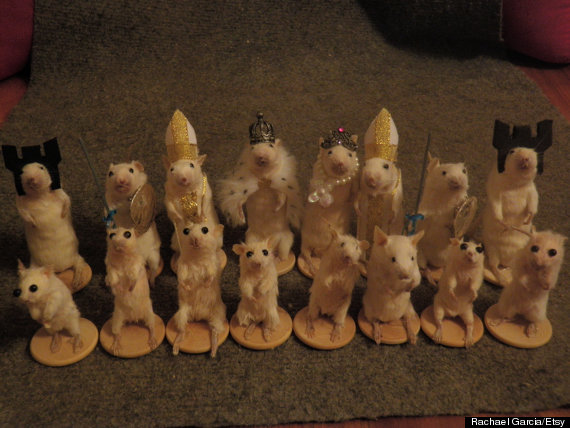
This Taxidermied Mice Chess Set Is The COOLEST. THING. EVER.

mouseketeersNow you can play out the battle for Redwall right in front of you -- with stuffed mice!

These black and white, custom taxidermy pieces, made by Etsy user TheCurious13, make up what might be the most creative chess set ever.
Rachael Garcia, 31, spoke to HuffPost Weird about her full set of real (dead) mice, adorned in armor and royal garb.

"I started to build a chess set once in high school out of clay, and told myself I was never going to learn how to play chess until I built a whole set," Garcia said.

Sunday, 7 July 2013

Preserving a Tortoise, and a Legacy-With Taxidermists’ Help, Lonesome George Will Remain in Public View - via Herp Digest

by Henry Fountain, New York Times, 7/1/13
WOODLAND PARK, N.J. — Lonesome George, the giant Galápagos tortoise whose death a year ago signified the extinction of his subspecies, is taking on a new life — as an in-the-flesh reminder of what has been lost in the natural world.
Castings of Lonesome George's head. The tortoise will be exhibited next winter at the American Museum of Natural History before being shipped back to the Galápagos Islands for permanent display.
George, who had been kept in the deep freeze since he died, was defrosted last week at a studio here where taxidermists began preparing him for posterity, dunking his bony head and leathery feet into tubs of gel to make molds for later reference.
He will be preserved in a typical pose chosen by those who knew him, and exhibited next winter at the American Museum of Natural History before being shipped back to the Galápagos Islands for permanent display at the research station where he had lived for four decades.
“What George is as a symbol shouldn’t be forgotten,” said Linda Cayot, the science adviser to the Galápagos Conservancy, who knew and worked with him for years. “And the best way of doing that is having him there in front of everyone.”
Johannah E. Barry, the conservancy’s founder and president, said, “George was a reminder of what we as a species are capable of doing out of ignorance.”
The unusual project, which Ms. Barry said cost “$30,000 and counting,” is a partnership involving the conservancy, the museum, the Galápagos National Park in Ecuador and the SUNY College of Environmental Science and Forestry in Syracuse. Edwin Naula, the director of the national park, said officials there had received many proposals for preserving Lonesome George, whose death, apparently from natural causes, hit Galápagos residents especially hard. “This was the best option, with the best technical and scientific people,” he said.
Wrapped to prevent freezer burn and further protected with pink fiberglass insulation, George arrived at the museum this spring in a gray shipping crate with the word “PERISHBLE” misspelled on the side. He was kept frozen and trucked to the studio, Wildlife Preservations, two weeks ago. After he was thawed — which took less than 24 hours because his internal organs had been removed during a necropsy, leaving a largely empty shell — the taxidermists took measurements using a cloth tape and calipers. (George’s neck is only a size 14 ½, though it is at least two feet long.)
“He’s a really great-looking tortoise,” said George Dante, the owner of the studio, gently patting George on the head. Mr. Dante will use the original shell — restoring it where the top and bottom had been cut apart with a chain saw for the necropsy — and will sculpture a mannequin for the limbs and neck, which he will sew the tanned skin around. The plan is to have George on his feet with his neck raised, as if on the lookout for his staple food, cactus.
Long before his death, Lonesome George had become an icon for conservation-minded adults and schoolchildren around the world as the last surviving member of the Pinta Island subspecies. For thousands of visitors, a glimpse of the tortoise — all five feet and 200 pounds of him — in his paddock on Santa Cruz Island was a highlight of their Galápagos trip.
Like other Galápagos tortoises, Pintas had been extensively collected for food by whalers and other seafarers in the 19th century, and the island’s vegetation had been ravaged by wild goats, which were introduced in the 1950s. Pintas had been thought to be extinct when George was discovered in 1971, and efforts to pass on some of his genes by breeding him were unsuccessful. (Last year, researchers who did DNA testing of tortoises on a remote part of another island found 17 that contained some Pinta genes, raising the possibility, yet unproved, that a full-blooded Pinta may still be alive there.)
James P. Gibbs, a professor at the SUNY environmental college, who accompanied the frozen body from Ecuador to New York, said that George was more fearful and shy than some tortoises. “I expect he was probably fairly solitary before he was found,” he said.
“He was a very complicated tortoise,” he added.
George’s death was unexpected, as he was not known to be in ill health and he was thought to be only about 100 (giant tortoises can live twice that long).
Dr. Gibbs, Dr. Cayot, Ms. Barry and Eleanor J. Sterling, director of the museum’s Center for Biodiversity and Conservation, all happened to be in the Galápagos when George died. To prepare him for freezing, they swaddled him in wet cloths and cotton, even going so far as to place bits of cloth between and underneath his stubby claws. “I felt like I was learning to be a manicurist,” Dr. Sterling said.
He was in good shape after being defrosted, with a few minor nicks on his skin and shell (more significant damage, the loss of a middle claw on one foot, occurred in life, and will be left as is). But there was something sad about him, knowing what he had been through in his life.
“Poor old chap,” Mr. Dante said. “You feel for him. You wouldn’t be human if you didn’t.”

Tuesday, 3 July 2012

Weird Taxidermied Animals 'Oddities San Francisco' Stuffs Creatures (PHOTOS)


Taxidermy has been around for more than 100 years, but, unlike the animals who are preserved, it shows no sign of dying.
Some people prefer to preserve animals looking as normal as possible, but Audra Kunkle, star of the Science Channel series"Oddities San Francisco" likes to put her own touch on each creature she stuffs.
That means making the critters wear human clothes or play banjos.
It's not easy, but the hardest part is finding military outfits that will fit a bird.
"Oddities San Francisco" airs Saturday nights. In the meantime, check out a gallery of Kunkle's more bizarre creations.

Tuesday, 5 June 2012

Cat Flap: Dead Pet Turned Into Helicopter


An artist has turned his cat into a flying helicopter after it was killed by a car.
Dutchman Bart Jansen stuffed Orville before teaming up with a radio control helicopter expert to attach propellers to each of its four paws.
The cat - named after pioneering aviator Orville Wright - is now a piece of artwork. The "Orvillecopter" is on show at the Kunstrai art festival in Amsterdam.
Jansen said his creation is "half cat, half machine", and part of a visual art project to pay tribute to his pet.
"After a period of mourning he received his propellers posthumously," he said.
The Orvillecopter currently struggles to fly steadily, a problem Jansen has promised to fix.
"He will receive more powerful engines and larger props for his birthday. So this hopping will soon change into steady flight."

Tuesday, 24 April 2012

Gaza zoo displays stuffed animals due to 'shortages of animals'

Using rudimentary taxidermy techniques learnt on the internet, the impoverished Khan Yunis zoo has stuffed the mangy cat, which died during an Israeli incursion, along with a monkey missing an eye and several limbs and a porcupine, which suffered a hole to its head during a botched mummification attempt.
The park's owner Mohamed Awaida, who has no veterinary training, has so far embalmed 10 animals that died as a result of disease, hunger and neglect with an improvised formula of sawdust and formaldehyde. The stuffed corpses now form a macabre display beside the 65 animals still living at the zoo, including an ostrich, a tiger and deer.
"We started using the stuffed animals because there were no animals left in Gaza after the war. We are stuffing them because it's hard to bring animals into Gaza. We are doing that for people to see and children to learn that it's stuffed and then they will know what taxidermy is," Mr Awaida said.
Both living and dead animals are kept in makeshift cages constructed from shippings crates and the remnants of Israeli settlements dismantled in 2005, littered with sweet rappers and fizzy drink cans.
This improvisation is the latest solution dreamt up by Gaza's five zoos to avoid the hefty costs of importing new animals. In 2009, another zoo in Gaza City resorted to painting a donkey with zebra stripes to replace two zebras killed during the Israeli offensive, which it could not afford to replace.

Monday, 19 March 2012

Frankenstein taxidermist sentenced to 20 months

Endangered animals used in weird ‘art'March 2012. Enrique Gomez De Molina used parts of endangered birds and other animals to create bizarre "Frankenstein" hybrids. Between late 2009 and February 2011, Enrique Gomez De Molina had attempted to import a range of wildlife species into the US without the required permits. He used the parts to create bizarre "Frankenstein" hybrids he sold as art. 
The wildlife included a wide range of species including skins of kingfishers, birds-of-paradise, skulls of babirusa and orangutans, a King Cobra, a pangolin and hornbills. After receipt, De Molina would incorporate the various wildlife parts into taxidermy pieces at a studio in downtown Miami. He offered these pieces through galleries and on the Internet for prices ranging up to USD $80,000.
Shipments from China & Far EastDe Molina's trafficking included numerous species and shipments, involving contacts in Bali, Indonesia, Thailand, the Philippines, Canada and China. The imports were in contravention of both CITES (the Convention on International Trade in Endangered Species of Wild Flora and Fauna) and federal laws. Despite the interception of two shipments in late 2009 that were ultimately forfeited by De Molina and abandoned, he continued to solicit protected wildlife from his suppliers via the Internet, and to select specific animals from photographs to be provided to him.
The parts or carcasses of the wildlife he selected would then be shipped to him without the permits or declarations required by law.
"Mr De Molina trafficked in highly endangered species in violation of the law, disguising commercial exploitation of endangered species as artwork," said Ignacia S. Moreno, Assistant Attorney General for the Environment and Natural Resources Division. "Today, Mr. De Molina has been held fully accountable for his illegal actions, which are prohibited by both U.S. and international law."
FineDe Molina was also sentenced to one year of supervised release to follow his prison term, a USD $6,000 fine and ordered to forfeit all of the smuggled wildlife in his possession.
"The Department of Justice and US Fish & Wildlife Service are both to be congratulated for bringing this criminal to justice and for the severity of his sentence, which will send out a strong signal to others that trafficking in endangered species will not be tolerated," said Crawford Allan, Director of TRAFFIC North America.
"Using endangered wildlife to create hideous art pieces was a crime in every sense of the word."

Saturday, 3 March 2012

Freeze-Dried Pets Comfort Grieving Owners

Stephanie Pappas, LiveScience Senior Writer

Mike McCullough never intended to start freeze-drying beloved pets for grieving owners. But more than a decade ago, a friend of a friend asked the Fort Loudon, Penn., taxidermist to save his beloved dog from the grave or cremation by preserving the animal instead. McCullough agreed.

Then he talked to a Wall Street Journal reporter about the process. It made the front page. Requests from bereaved owners started rolling in. Today, McCullough's taxidermy shop, Mac's Taxidermy, is one of a handful of places around the country that will preserve not only hunting trophies, but also the hunting dog. 

"It's a whole different game for us," McCullough told LiveScience. "You have to be a counselor, you know what I mean? It's tough."

Friday, 2 September 2011

Taxidermist creates animal hybrids in New Zealand

An amateur taxidermist has caused controversy over his hybrid animal stuffings which combine body parts from creatures that have been killed on the roads.


Andrew Lancaster, 57, took up taxidermy in his spare time 14 years ago – shortly after moving from England to New Zealand. Entirely self- taught, Mr Lancaster has experimented with animal creations for the last two years, regarding the work as ‘art’.

“Some people call me sick and some think it’s pretty good,” Mr Lancaster told New Zealand website Stuff. “I saw heaps of dead things on the side of the road and thought it was a waste. When I’m driving along the road and see something I pull up and go back for it,” he admitted.
Mr Lancaster, now living in Tauranga, New Zealand, sells the animal hybrids on Trade Me – the Kiwi equivalent of Craigslist. Working during the day as a marina caretaker, he creates his custom animals in the evenings and on days off.

The amateur taxidermist said he collects birds, pheasants, rats, ferrets and has even found possum babies – discovered inside of their mother’s pouch. Mr Lancaster insists that he only works on animals he finds dead and would never hunt an animal. The unique hybrids have developed a following as his Facebook site ‘Andrew Lancaster Taxidermy Creations’ currently has 241 fans.

Mr Lancaster’s wife has stopped him from keeping many of the animals but he admitted to keeping a pheasant that he “picked up from the road one morning”.     

http://uk.news.yahoo.com/taxidermist-creates-animal-hybrids-in-new-zealand.html

Wednesday, 19 January 2011

Nainital’s favourite big cat ready to head home

Nanital Zoo plans to keep the trophy inside the same enclosure where Rani used to stay when she was alive
The much-loved snow leopardess who died last year has been made into a lifelike trophy by taxidermist Santosh Gaikwad from Bombay Veterinary College and will be flown to Delhi soon

Virat A Singh

Posted On Wednesday, January 19, 2011 at 02:01:07 AM

Less than a year after Rani the snow leopardess died, Mumbai is all set to gift the Nanital Zoo an everlasting memory of her. Rani’s body was brought in to Mumbai from Nanital in April 2010.

Dr Santosh Gaikwad, a Mumbai-based taxidermist, has finished working on a trophy of Rani, which will be given to Nanital later this month.

Parag Madhukar Dhakate, Divisional forest officer of the Tarai Haldwani region in Uttarakhand, said, “Those visiting the Nainital zoo were emotionally attached to Rani who was the only snow leopard there.

“Hence, a decision was taken to convert her into a trophy after her death and now we are even planning to keep her trophy inside the same enclosure where she used to stay when alive.”

Dhakate, who visited the Maharashtra State Wildlife Taxidermy Centre at SGNP on Tuesday morning, felt the trophy was very lifelike. The trophy stands four feet tall and is six feet long. It weights around 80 kg.

Dhakate added that the trophy would be taken by flight to Delhi from where it will be taken to GB Pant High Altitude Zoo at Nainital.

Dr Gaikwad, who works as professor of anatomy at Bombay Veterinary College, said the job of making Rani’s trophy was not a cakewalk.

Despite having made around 50 trophies of various animals - ranging from lions to elephants - Gaikwad said it was a challenge to make sure Rani’s looked real and the proportions were the same.

“Another problem was that the skin on the leopard’s body had lost a lot of fur, despite being preserved for months,” he said, “Most of the skin had bundled up. I had to conduct a lot of chemical procedures on the coat to ensure there was no further loss of fur and it looked fresh.”

Gaikwad started making the trophy in July, three months after Rani’s death and completed the task in December.

Gaikwad said he was happy with the creative freedom given to him by the Uttarakhand forest officials.

“I gave it a standing pose, with front limbs elevated on the rocks. This trophy is also special as all its sharp claws have been retained, as per the wish of the forest officials,” he added.

http://www.mumbaimirror.com/article/2/2011011920110119020106981c5ef4be8/Nainital%E2%80%99s-favourite-big-cat-ready-to-head-home.html

Tuesday, 16 November 2010

Animal Activists Aflutter Over Real-Piglet Piggy Bank

Larry Knowles

AOL News
(Nov. 12) -- Hey, kids, how'd you like to have a piggy bank made from an actual pig?

Well, now you can, courtesy of Vancouver, British Columbia, novelty retailer TheCheeky.com, which is offering authentic taxidermied piglet piggy banks for sale on its site.

And if you start saving now you might be able to afford one by the time you head off to college: the banks run a cool $4,000 each, with buyers required to put half the money up front.


Animal activists are squealing mad over the piglet bank, a custom piggy bank made from a real stuffed piglet. The product, which costs $4,000, is being offered by TheCheeky.com, a Canadian novelty retailer.

It should be noted, though, that the steep price is because of high production costs. According to TheCheeky co-owner Colin Hart, it takes 12 months to fill an order. First, the company has to find a piglet that has died of natural causes. Then it must have the animal taxidermied, which takes about six months.

To date, the retailer hasn't actually sold a piglet bank, but Hart told AOL News that TheCheeky has received a huge amount of interest in the past week.

A large part of that interest stems from the outcry the bank created after it appeared in Vancouver magazine's 2010 Holiday gift guide published in early November. Animal activists quickly noticed and organized a call to action.

Two days ago, the Winnipeg Humane Society posted a message on its site titled "Speak Out Against Taxidermied Piggy Bank." The society called the piglet bank "a particularly callous and demeaning exploitation of a baby animal's dead body" and instructed activists to e-mail complaints to Vancouver magazine.

Representatives for the humane society could not be reached for comment.

TheCheeky received even greater publicity when CNN reported on the controversy in its breaking-news blog. The glut of attention, Hart says, has brought 50,000 hits per day to TheCheeky.

"It's an oxymoron," Hart stated. "It's a big deal with all these activists, and then we get all the publicity for our site."

Hart is quick to point out that no pigs have been, or will be, killed to make the piglet bank.

"For some reason, people think we're breeding pigs with slots in their backs," he said. "Either these people are kids, or they're really, really special adults."

The 34-year-old Dubliner, who grew up on a farm in Ireland, also supports efforts to eliminate animal cruelty. He just thinks that the activists targeting him have it wrong.

"It's important for people to back up animals, who can't speak," he agreed, "but we're not killing any animals."

He believes the real argument isn't about cruelty to animals, but about taxidermy and whether preserving animals for aesthetic appeal is ethical.

Before the piglet bank brouhaha, Hart and business partner Ryan McCormick had been excitedly plugging their latest creation, Glory Hole stickers. The stickers can be slapped on the walls of bathroom stalls to give the impression that the occupant is being watched.

Friday, 15 October 2010

Genius or grotesquery? The arrestingly strange world of Walter Potter

Seven years after it was sold and dispersed across the world, a bizarre Victorian collection is being reassembled in an exhibition co-curated by Peter Blake

The wild and eerie Victorian world of Walter Potter, where baby rabbits go to school and weep over their blotted copybooks, and where Bullingdon Club-style squirrels puff on cigars as toads play leapfrog and rat
police raid a drinking den, is being reassembled in London, seven years after his creatures were sold and scattered across the world.
The displays are being assembled at the reopened Museum of Everything, a pop-up museum in a former Victorian dairy, and later recording studio, in Primrose Hill, London.
Damien Hirst, who built his international fame on creatures such as his shark, and Sir Peter Blake, who is co-curator of the exhibition, have each lent pieces for the show. Both regard Potter as a genius, and his work as a national treasure which should have been kept together for permanent public display.
Other loans for the exhibition, opening next Wednesday, come from the comedian Harry Hill, the photographer David Bailey, other passionate private enthusiasts, and Pat Morris, a retired academic and expert on the history of taxidermy who intends to leave his own collection to a museum.
Hirst has contributed a truly Hirstian piece, called Happy Families, in which Potter has assembled natural "enemies" including cats, a dog, birds, squirrels, rats, mice and a tortoise, in a distinctly uneasy truce.
Blake's treasures include The House that Jack Built, which has a miniature hen – which Potter made by sticking feathers to a wooden mould – watching over a nest of wren's eggs, and The Babes in the Wood, another piece with a more than slightly creepy air.
Morris owns the largest piece, which was always the star attraction in the museum. The Death of Cock Robin, which displays more than 100 birds including a weeping robin widow and an owl gravedigger who has tumbled some tiny bones out of the soil while preparing space for the dead robin. It normally occupies one entire wall of Morris's guest bedroom in Ascot.

The beautifully painted backgrounds of the tableaux show the fields, woods and buildings of Bramber, the West Sussex village where Potter spent his long life. He was born in 1835, left school at 14, taught himself taxidermy (starting with a pet bird), and perfected his art with specimens donated by friends.
He opened his museum in a shed behind his father's pub. It proved so popular, boosting the pub trade dramatically, that the brewery created a purpose-built museum, which Potter ran until his death in 1918.
The museum was taken over by his son-in-law, who died in 1969; it was then sold and moved first to Brighton, then to Arundel, and finally to Jamaica Inn in Cornwall. When the last owners retired, and their taxidermist, who took care of the collection, died, there was an attempt to sell the collection as a whole. But finally it was scattered, after a Bonham's auction where pieces sold for up to £20,000 to collectors from
all over the world.
The founder of the Museum of Everything, James Brett, who made his money in films and property, opened the first exhibition of the "outsider art" he collects, including work made in prisons and mental health units, last year as a fringe event for the Frieze Art Fair. It was intended to run for a fortnight but was repeatedly extended due to public interest – and the free cafe – and by the time it finally did close had attracted more than 35,000 visitors.
He intended this time to re-create the glorious chaos of Blake's studio. The artist who created the cover for the Beatles' Sergeant Pepper is a collector and hoarder on an epic scale, and the exhibition will include some of his toys, shells, advertising ephemera and giant circus banners.
"The idea of re-creating the Potter museum began as a chance remark from Peter, and it became an obsession to bring the band back together," Brett said.
"It has taken over my life. But Potter is worth it, he was a true original, and himself absolutely an outsider artist as much as a craftsman. I can tell a Potter from the work of another taxidermist at a glance across a room – he was a genius."

Phone calls were still coming in every day from Potter fanatics, he said. The three-legged pig, the two-headed lamb and the four-winged chicken are already in place, but he has despaired of getting the kittens' wedding back from the US. He still hopes the rabbits' school, and the guinea pigs playing cricket, a piece believed to be in France, may yet turn up.
Morris, who began taxidermy himself aged seven with a dead squirrel, helped by a Boys Own guide to the subject, says that Potter was a very bad taxidermist all of his life: his birds were puff-chested because he fitted the skins over the wrong size bodies, and his cats had teddy bear eyes.
But Potter's genius was in his ability to create an entire miniature world, the world of a Victorian village which he knew intimately. The pieces are obsessively detailed, and full of tiny jokes for the observant: in the squirrels' club one creature is rejoicing over a winning hand, not realising that the viewer can see his opponent's even better cards. There are cases of stuffed birds on the club walls, and paintings the size of postage stamps signed by one W Potter.
The displays were never to everyone's taste. Many thought they were grotesque and an abuse of animals, despite the poster insisting that none had been killed deliberately for the collection. The animals did not die quietly in their sleep, though: Spot the dog, owned by a friend of Potter's, killed most of the rats for the drinking den and other scenes, and when she died she was stuffed and added to the collection.
Morris robustly defends taxidermy against the political correctness which he believes helped doom the collection. "Blaming taxidermy for the large number of rare species in glass cases is as illogical as blaming undertakers for all the dead people in cemeteries."

The Museum of Everything will run at least until Christmas.

http://www.guardian.co.uk/culture/2010/oct/08/walter-potter-exhibition-museum-everything

Thursday, 5 August 2010

Crocodile Mick plans 'immortality' for mutant croc

RIGHT: "I've never seen anything like it" ... crocodile hunter Mick Pittman displays the crocodile's extra toes. (Mick Pittman)
5 August 2010

By Anthea Kissel

A saltwater crocodile found in the Northern Territory has been described as a "freak of nature".

The half-metre long reptile has sharp spurs protruding from the underside of its back legs.

The five millimetre-long spurs connect to a bone stemming from the crocodile's ankle joint.

"I don't know whether a croc's been playing up with a platypus or not, but it looks a bit funny, I reckon," said crocodile hunter and taxidermist Mick Pittman.

"I've never seen anything like it."

Mr Pittman, known as "Crocodile Mick", says he and his family have been in the crocodile industry for 53 years.

He thinks the spurs might be mutant toes.

"I reckon the way it was sitting on his leg, it would have to hinder his existence," he said.

"He would have to be scratching himself all the time when he was walking.

"You can't see any real use for it.

"It's just a freak of nature."

Mr Pittman says he plans to make the crocodile "immortal".

"He's going to have his gut filled up with sawdust and he's going to sit on a mantelpiece somewhere as a freak.

"So I'll make him look as best as I possibly can."

Dr Grahame Webb from Crocodylus Park in Darwin says the spurs are extremely rare.

"I've seen it once or twice in looking at tens of thousands of hatchlings," he said.

http://www.abc.net.au/news/stories/2010/08/05/2974200.htm

Road kill used to make sporrans

5 August 2010

A Scottish taxidermist is using animals knocked down and killed on roads to make sporrans.

Kate Macpherson, of Beauly, Inverness-shire, has collected badgers, foxes, deer and stoats from verges.

But she has been criticised by animal welfare campaigners who say she is encouraging the use of animals for clothing.

Mrs Macpherson said she was inspired by the the badger skin sporran worn by her father's Army regiment.

"If I didn't pick up these animals they would be rotting in a ditch," she said.

"I'm creating something useful from them rather than allowing their beauty to be wasted."

The mother-of-three's friends and neighbours tip her off on the location of road kills.

Mrs Macpherson, who trained in taxidermy when she was 22, has licences to handle protected animals, but has faced complaints from animal welfare groups.

Lynda Korimboccus, head of the Scottish Animal Rights Alliance, said the use of the animals - even if they were killed on a road - was wrong.

She added: "Using a dead animal for clothing perpetuates the idea that that's what animals are for."

http://web.orange.co.uk/article/quirkies/Road_kill_used_to_make_sporrans

Wednesday, 7 July 2010

Related Posts with Thumbnails

ShareThis