Showing posts with label utah. Show all posts

Friday, 16 November 2018

Survey reveals 49 new bee species in Utah


"Bees are more diverse in desert areas and Utah has a lot of unique desert areas," researcher Joseph Wilson said.
By
Nov. 8 (UPI) -- Utah is home to 660 bee species, according to a new study. One out of every four bee species endemic to the United States can be found in the aptly named Beehive State.
Thanks to a four-year survey conducted by entomologists at Utah State University and the U.S. Department of Agriculture, scientists have an improved understanding of Utah's remarkable apian diversity.
Utah hosts a variety of habitat and a diversity of flowers attractive to a wide range of bee species.
"Bees are more diverse in desert areas and Utah has a lot of unique desert areas, with lots of elevational gradients between the deserts and adjacent mountains," Utah State entomologist Joseph Wilson told UPI. "Utah is also home to a diverse flora, we have lots of different kinds of flowering plants, which can be linked to the high bee diversity."
During the survey, Wilson and his colleagues identified 49 new bee species.
Nearly half of the bee species documented in the new paper -- published this week in the journal PeerJ -- can be found in Utah's Grand Staircase-Escalante National Monument, which was established in 1996.

Wednesday, 20 June 2018

No, This Tiny Beast Is Not Half-Mammal, Half-Reptile (But It's Still Super Cool)


By Mindy Weisberger, Senior Writer | May 31, 2018 12:35pm ET

A small, furry animal with a blunt snout and beady eyes scuttled across what is now eastern Utah some 130 million years ago. And while the wee beast was surely unusual and fascinating, there's one thing it was definitely not: half-mammal and half-reptile.

Headlines about the recent find have described it as though it were some bizarre hybrid of reptile and mammal. But while it might be amusing to imagine a beast with the front end of a lizard and the rear end of a rat, it's not very scientific. [Real or Fake? 8 Bizarre Hybrid Animals]
The little animal, which would have stood just 3 inches (7.6 centimeters) tall and weighed about 2.5 pounds (1.1 kilograms), belonged to a group known as the haramiyidans, which emerged during the late Triassic period (251 million to 199 million years ago), and are known mostly from fossil teeth. Scientists have argued over whether haramiyidans were early mammals or a sister group — closely related to mammals, but lacking some features used by paleontologists to decide who's a mammal and who's not.


Friday, 1 June 2018

Utah fossil reveals global exodus of mammals' near relatives to major continents


A small fossil is evidence that Earth's ancient supercontinent, Pangea, separated some 15 million years later than previously believed

Date: May 23, 2018
Source: University of Southern California

Summary:
A nearly 130-million-year-old fossilized skull found in Utah is an Earth-shattering discovery in one respect. The small fossil is evidence that the super-continental split likely occurred more recently than scientists previously thought and that a group of reptile-like mammals that bridge the reptile and mammal transition experienced an unsuspected burst of evolution across several continents.


Monday, 14 May 2018

Utah Landscapers Discover Remains of Ice Age Horse


By Laura Geggel, Senior Writer | May 7, 2018 06:34am ET

During the last ice age, a small horse about the size of a Shetland pony somehow trampled into a big lake. It's unclear how the animal died, but its body fell to the bottom of the lake, where it lay buried for about 16,000 years — that is, until this past fall, when landscapers in Utah unexpectedly unearthed the horse's remains in their backyard.

The discovery is a rare one. Horses lived in North America from about 50 million to 11,000 years ago, when they went extinct on the continent before being reintroduced by the Europeans thousands of years later, but it's uncommon to find horse remains in Utah, a state that was partly covered by the prehistoric Lake Bonneville. (This ancient lake has since dwindled, forming several smaller lakes, including the Great Salt Lake.)

It's impossible to know how the horse died, but Rick Hunter, a paleontologist at the Museum of Ancient Life, in Lehi, Utah, who is studying the horse's remains, has several ideas. Perhaps the horse made its way into the lake and then drowned while trying to escape from an ice age predator, such as a short-faced bear or saber-toothed cat, he said. Or maybe the horse died in a stream whose waters emptied into the lake. [10 Extinct Giants That Once Roamed North America]


Friday, 20 October 2017

Ancient Sea Creature Looked Like a Wine Glass, Died Alone


A solitary fossil unearthed in Utah's Antimony Canyon reveals a long-extinct marine creature previously unknown to science.

Resembling a dainty tulip bloom or an elegant white-wine glass, the 500-million-year-old bottom-feeder called Siphusauctum lloydguntheri looked uniquely ready for a romantic evening of sucking up microplankton along the seafloor. Sadly for the specimen, the world's only known example of S. lloydguntheri appears to have died alone, leaving no descendants past the end of the Cambrian period (541 million to 485.4 million years ago), possibly the victim of mass extinction.

Researchers at the University of Kansas' Biodiversity Institute described what little is known about the obscure invertebrate in a new paper published in the Journal of Paleontology. [Cambrian Creatures: Photos of Primitive Sea Life]


Wednesday, 9 November 2016

2 Dome-Headed Dinosaurs the Size of German Shepherds Discovered


By Laura Geggel, Senior Writer | November 9, 2016 01:56pm ET

The discovery of a pair of fossilized skulls from dome-headed dinosaurs is shedding light on how these bizarre creatures called pachycephalosaurs evolved, researchers say.

Both of the skulls are relatively complete. One, discovered in the Kaiparowits Formation of Utah, dates to about 76.5 million years ago. The other, found in the Kirtland Formation of New Mexico, is about 73.5 million years old, the researchers said.

The location of these skulls — in the southern Mountain states — indicates that pachycephalosaurids may have diversified in the south before they moved north and gave rise to the pachycephalosaur known as Stegoceras, said study lead researcher David Evans, an associate professor in the Department of Ecology and Evolutionary Biology at the University of Toronto.


Continued

Tuesday, 29 December 2015

Genetically pure bison population discovered in southern Utah

DECEMBER 26, 2015

by Chuck Bednar

A genetic analysis has found that a group of bison in southeastern Utah are genetically pure, meaning that they are directly descended from those what once roamed the American west, a study published this month in the journal PLOS One has revealed.

According to Associated Press and Utah Public Radio reports, scientists from Texas A&M and Utah State University found that the secluded creatures, which live in the Henry Mountains, are even more unique than other groups of bison that have not interbred with cattle.

As Dr. Johan du Toit, a professor of ecology and large mammal conservation at USU, explained to reporters, the Henry Mountain herds are “the only population of bison in existence which is now both genetically pure and is free of the disease brucellosis and is free-ranging on public land co-mingling with cattle and is legally hunted.”

Cross-breeding with cattle began in the 19th century, but after analyzing tissue samples from the approximately 350 bison from this herd, Dr. du Toit and his colleagues discovered that this “one of a kind” herd lacks cow DNA, and could ultimately improve bison recovery efforts.

Lack of cattle crossbreeding good news for species recovery efforts
As Utah Public Radio explained, cattle genes can alter the bison’s size and behavior. Ideally, conservationists looking to restore the herds and return them to national parks and other areas would prefer to use the rarer, pure DNA as part of their ongoing efforts.

Lead author Dr. Dustin Ranglack, now at Montana State University, told the AP that out of the 500,000 bison currently in the US, only 20,000 are considered wild bison. The Henry Mountain bison “represent a really important source for potential reintroduction projects that are trying to restore bison to a large portion of their native range,” he added.


Thursday, 12 March 2015

Stoned rabbits a concern for DEA as Utah debates medical marijuana bill

Published time: March 03, 2015 04:46

Utah is considering a bill that could make it the 24th state, along with Washington, DC, to legalize medical marijuana. But one Drug Enforcement Agency official is worried the move could impact the environment and even result in too many stoned rabbits.

DEA special agent Matt Fairbanks, also a member of Utah's marijuana eradication team, testified against the bill recently, explaining how quickly growing a cash crop like marijuana could get out of hand and the devastation that happens to the environment.

“I deal in facts. I deal in science,” Fairbanks told a Senate committee.

“I have seen entire mountainsides subject to pesticides, harmful chemicals and deforestation and erosion. The ramifications to the flora and animal life – even rabbits that have cultivated a taste for marijuana. One of them refused to leave us and we took all the marijuana around him, but his natural instincts to run were somehow gone."

As noted by the Guardian, though, Fairbanks did not detail why growing marijuana would be more damaging than harvesting crops such as corn and wheat, both of which are grown using similar techniques and pesticides.

The Utah bill under consideration would legalize edible marijuana, allowing it to be cultivated and sold in products such as brownies, candy and lozenges. It would also allow for indoor growing operations, with seed-to-sale tracking, testing and regulation. Patients would be issued a medical marijuana card and a debit card to process their payments.

The Utah Senate committee gave the bill its first hearing on Thursday, with comments from supporters and dissenters. The bill's sponsor, Republican Sen. Mark Madsen, said he began researching marijuana after having back pain for years. When his doctor recommended marijuana, he travelled to Colorado to try it through cannabis-infused gummy bears and an electronic-cigarette device.

Sunday, 2 November 2014

Dozens of bats invade Utah courthouse

ST. GEORGE, Utah (AP) — Order is being restored to the courthouse in St. George with the removal of dozens of bats from the building.

The Brazilian free-tailed bats were discovered when employees arrived for work Thursday at the 5th Judicial District Courthouse.

More than 50 bats were removed Thursday and Friday from the attic and other areas of the building, said Eric Palmer of Southwest Exterminators.

Zac Weiland, a Washington County deputy prosecutor, said he heard scratching noises when he walked into court Friday morning. Bats were in the ceiling, hallways, stairwells and even inside courtrooms.

"I don't like bats. I saw (one) crawling, and it's stuck in a little lamp, and I'm like, 'I'm done, I want out,' " he told KSL.

Court officials said while the bats caused minimal disruptions in court operations, some proceedings had to be moved from one courtroom to another.

Tuesday, 30 September 2014

Super Schnozzle: Dinosaur with Exceptionally Large Nose Discovered

By Jeanna Bryner, Managing Editor | September 22, 2014 01:10pm ET

The remains of a big-nosed dinosaur that stalked the Earth some 75 million years ago, possibly luring mates with its beauty of a schnozzle, have been discovered in central Utah.

The beast's giant nose earned the dinosaur the name Rhinorexcondrupus, with the Latin word Rhinorex meaning "king nose." And it surely sported a large sniffer, having the largest nasal opening, relative to its size, of any duck-billed dinosaur and among the largest of any dinosaur, according to Terry Gates, a joint postdoctoral researcher with NC State and the North Carolina Museum of Natural Sciences.

"The purpose of such a big nose is still a mystery," Gates said in a statement. "If this dinosaur is anything like its relatives then it likely did not have a super sense of smell; but maybe the nose was used as a means of attracting mates, recognizing members of its species, or even as a large attachment for a plant-smashing beak."

Friday, 4 July 2014

Rare wolverine caught on camera in the US state of Utah

One of the camera trap images of the elusive wolverine

Wildlife biologists recently scanning photographs taken by a trail camera in the Uinta Mountains last winter, saw something never before captured in Utah: the first official photographs of a wolverine.

Kim Hersey, Mammals Conservation Coordinator for the Utah Division of Wildlife Resources (DWR), says biologists from the DWR and the US Forest Service set four stations — baited with road kill and monitored by trail cameras — along the north slope of the Uinta Mountains to capture images of any elusive forest-dwelling carnivores.

Having retrieved the cameras and viewed the hundreds of photos they came across their prize: the first wolverine verified in Utah since a wolverine carcass was found in 1979.

Wolverines are the largest terrestrial member of the weasel family.

Monday, 30 June 2014

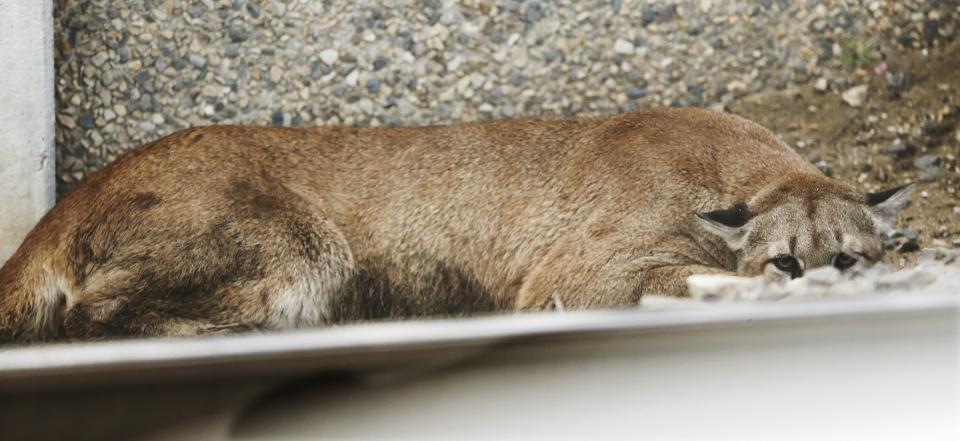
Mountain lion scares shoppers in Utah

SANDY, Utah (AP) — Utah authorities captured a mountain lion Friday that startled people but didn't hurt anybody at a shopping center in a Salt Lake City suburb.

The mountain lion was spotted walking across a street and into Jordan Commons in Sandy, Utah, just before 8 a.m., Sandy police Sgt. Dean Carriger said.

Officers found the female cat hunkered down at the entrance of a steakhouse. Though it was early, there were dozens of people coming and going, many of whom work at a nearby office building, Carriger said.

Monday, 5 May 2014

Animal rights group seeks Utah roadside memorial for dead turkeys

By Laila Kearney May 2, 2014 3:49 PM

(Reuters) - Animal rights activists want to erect a roadside memorial placard to honor hundreds of "terrified turkeys" killed in a tractor-trailer accident on a Utah highway last week, transportation officials said on Friday.

The sign, which an official said was not likely to be approved, would be placed near the crash site in the rural town of Wallsburg, where a truck hauling about 700 live, crated turkeys crashed through a guard rail and landed in a reservoir on April 24.

"In memory of the hundreds of terrified turkeys who died here in a truck crash. Try vegan,” is the proposed message on the sign that would also display the image of a turkey. Placement would be under a standard Utah traffic sign that says “Drive Safely. Buckle Up.”

Tuesday, 12 November 2013

King Of Gore: Super Predator Cousin Of T. Rex Found In Utah

Alan McStravick for redOrbit.com – Your Universe Online

You may have noticed your local paleontologist has had an extra bounce in his step this week. That might have something to do with a monumental find of a new super-predator dinosaur in the Wahweap Formation within the Grand Staircase-Escalante National Monument in south-central Utah. Known as Lythronax argestes, this super predator lived 80 million years ago and is a distant, older cousin to the larger Tyrannosaurus rex.

Measuring almost 30 feet in length, L. argestes (translated: King of Gore) was the largest predator of its day. The findings have been published in the journal PLOS One and the team hopes this new discovery will yield valuable insight into what the climate was like towards the end of the age of dinosaurs.

“It’s always exciting to find new species but what’s really significant is what these species tell us about their ancient world,” said Randall Irmis, co-author of the study at the Natural History Museum of Utah. “This was a very different place 80 million years ago. It was a very lush, wet, tropical environment and there were no polar ice caps at the time.”

The discovery first occurred four years ago when a partial skeleton and bones from the skull and rest of the body were unearthed. They have been the focus of intense study in the lab since that time.

As noted above, L. argestes is very closely related to T. rex. One of the important findings from this discovery is how the two great beasts shared similar features, proving that evolution occurred 10 million years earlier than had been previously thought.

Thursday, 18 July 2013

Big-Nosed, Long-Horned Dinosaur Discovered in Utah: Dinosaur in Same Family as Triceratops

July 17, 2013 — A remarkable new species of horned dinosaur has been unearthed in Grand Staircase-Escalante National Monument, southern Utah. The huge plant-eater inhabited Laramidia, a landmass formed when a shallow sea flooded the central region of North America, isolating western and eastern portions for millions of years during the Late Cretaceous Period. The newly discovered dinosaur, belonging to the same family as the famousTriceratops, was announced today in the British scientific journal, Proceedings of the Royal Society B.

The study, funded in large part by the Bureau of Land Management and the National Science Foundation, was led by Scott Sampson, when he was the Chief Curator at the Natural History Museum of Utah at the University of Utah. Sampson is now the Vice President of Research and Collections at the Denver Museum of Nature & Science. Additional authors include Eric Lund (Ohio University; previously a University of Utah graduate student), Mark Loewen (Natural History Museum of Utah and Dept. of Geology and Geophysics, University of Utah), Andrew Farke (Raymond Alf Museum), and Katherine Clayton (Natural History Museum of Utah).


Wednesday, 26 June 2013

Man believes he found fossilized Bigfoot head

A journalist can go his or her entire life waiting to hear those six magic words. And yet, on a recent weekday afternoon, that very thing happened.

Todd May, of Ogden, dropped by the offices of the Standard-Examiner to see if someone would be interested in a story about a fairly impressive fossil find. After showing off a couple of digital photos, May offered six even more compelling words — “Do you want to see it?” — followed by the motherlode of sentences: “It’s out in the trunk of my car.”

In the trunk of your car? Do I want to see it? Does Bigfoot make in the woods?

May proceeded out to his car, where he popped the hatchback on his Nissan 300 ZX. Peeling back an American flag draped across the cargo area of the vehicle, he hefted a black piece of luggage that resembled an oversized bowling-ball bag, lowering it to the asphalt of the parking lot with a clunk. He struggled to pull a noggin-sized, seemingly ordinary rock out of the bag, held it up and turned it over.

A face.

The rock looks vaguely like a smaller version of one of those Easter Island heads. Pronounced forehead. Large, flattened nose. What could only be described as a chiseled chin and jaw line.

It’s been about six weeks since May found the rock near the mouth of Ogden Canyon.

Wednesday, 13 March 2013

Prairie Dogs Disperse When All Close Kin Have Disappeared


Mar. 7, 2013 — Prairie dogs pull up stakes and look for a new place to live when all their close kin have disappeared from their home territory--a striking pattern of dispersal that has not been observed for any other species. This is according to a new study published in Science by behavioral ecologist John Hoogland, Professor at the University of Maryland Center for Environmental Science's Appalachian Laboratory. He has been studying the ecology and social behavior of prairie dogs in national parks in Arizona, South Dakota, and Utah for the last 40 years.
Photo: Wikipedia

For most animals, individuals leave a territory, or disperse, to avoid competition with nearby relatives, such as mother or sibling. For three species of prairie dogs, however, individuals are more likely to disperse in the absence of nearby close kin. Females are 12.5 times more likely to disperse when close kin are absent for one species, and 5.5 times more likely for another species.

Prairie dogs are large, burrowing rodents of the squirrel family. They live in colonies in grassland ecosystems of western North America, and forage aboveground on grasses and other plants from dawn until dusk. Within colonies, prairie dogs live in territorial, contiguous family groups called clans, which typically contain one mature male, two to five mature females, and one or two adolescent males. Hoogland has been trying to figure out which individuals disperse from the territory of birth, and why.

Thursday, 17 January 2013

Animal protection bills planned in Utah Legislature


Animal safety » Trio of bills originated with Humane Society concerns.

Dogs and roosters will have an ally in state Sen. Gene Davis this upcoming legislative session as the Democrats’ newly chosen minority leader introduces bills aimed at toughening cockfighting laws and tightening restrictions on dog tethering and puppy sales.

The Humane Society of Utah asked Davis to sponsor the trio of measures after learning Utah is one of only 15 states that doesn’t prosecute cockfighting as a felony.

Humane Society Executive Director Gene Baierschmidt said surrounding states have already made it a felony and participants in cockfighting come to Utah because they know the penalties are more lax.

Cockfighting is illegal in all 50 states, and Baierschmidt said the practice of strapping razors to roosters’ legs so they can slash each other to death is "barbaric" and also said it encourages illegal gambling.

Continued:  http://www.sltrib.com/sltrib/politics/55606465-90/animal-bill-davis-dog.html.csp

Wednesday, 9 January 2013

Utah town burns 16-foot mammoth effigy for solstice


BLUFF, San Juan County — A Southern Utah town will burn a 16-foot effigy of a mammoth Friday to celebrate the winter solstice and draw attention to the historical significance of the area.

The town is relying on the wooden mammoth to hopefully catch the attention of researchers. The effigy, built to scale, was built over the course of three weeks by Pachak and Bluff residents, using only sticks and two support poles.

The 8 p.m. ceremony will include drumming, and Gulliford said the effigy won't be set on fire with just matches.

"What's really gonna be fun is they're gonna set it on fire with primitive Native American technology, meaning they're either going to use bows and arrows or they're going to use atlatl spears," Gulliford said. "It'll be fun to see if they can even hit the thing with a flaming atlatl dart."

The mammoth is meant to represent the discovery of mammoth petroglyphs near Bluff, a town of a few hundred people located on the San Juan River. Rock expert and local artist Joe Pachak first discovered the petroglyphs in 1987, but they have been a source of controversy ever since.


Wednesday, 24 October 2012

New road bridges mean fewer deer being killed on roads – So they can be shot?

Deer crossing structures appear to be working

October 2012. Two wildlife crossing structures have allowed more than 300 deer to cross safely under two busy roads so far this year. The two crossings are just two examples of crossings across Utah that are reducing the number of deer that are hit and killed by vehicles. Utah State University (USU) is leading studies to determine the effectiveness of wildlife crossing structures across the state.

Sardine Canyon
U.S. Highway 91 was widened through Sardine Canyon in the mid-1990s. When it was widened, several features, including wildlife culverts, fencing and wildlife escape ramps, were installed to try to reduce the number of deer that were hit by cars.

Initial crossing didn't work
USU has monitored a culvert continuously since 2009 using cameras on both the west and east sides of the culvert's entrance. USU's initial findings indicated that the culvert wasn't as effective as it could be. The way a fence was designed near the culvert, and gaps in the fencing farther away from the culvert, were likely to blame, researchers said.


Continued: http://www.wildlifeextra.com/go/news/deer-bridge-utah.html
Related Posts with Thumbnails

ShareThis