Monday, 26 March 2018

How IVF and stem cell science could save the northern white rhino from extinction

Scientists believe they can bring the species back from the brink after the death of the last male last week


Science editor

Sun 25 Mar 2018 00.05 GMTLast modified on Sun 25 Mar 2018 00.10 GMT


Sudan, the last male northern white rhino, was put down last week because of ill health, leaving only two ageing females. Photograph: Georgina Goodwin/Barcroft Media


The story of humanity’s interaction with the northern white rhino is one of the conservation movement’s grimmest tales of recent years. “In the 60s there were 2,500 northern whites left in central Africa,” said Paul De Ornellas of the Zoological Society of London. “Poaching brought that down to 30 by the end of the 20th century, and now to the last two.”

Last week the species’ last male, Sudan, had to be put down because of ill health, leaving only two ageing females on the planet as representatives of a creature that once roamed in its tens of thousands across Africa. It is a sad history which, most of the world assumes, is nearing its end.

But human ingenuity could yet save a species that has been brought to the brink of extinction. The plan, which involves in vitro fertilisation (IVF), stem cell science and gene editing, could also pave the way to rescue other animals at risk, such as the Sumatran and Javan rhinos.

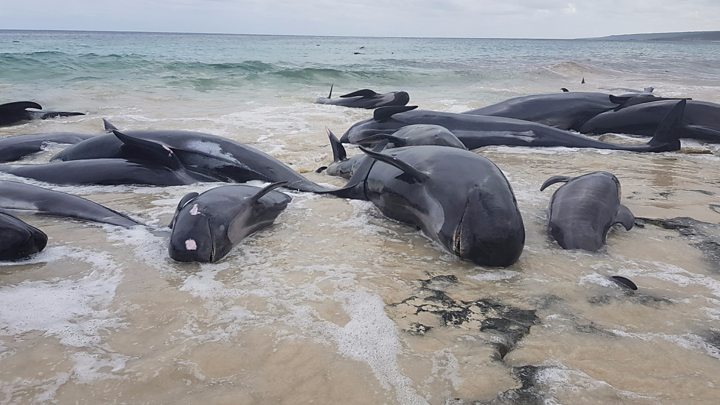
Hamelin Bay: Nearly 150 beached whales die in Australia


23 March 2018


Over 100 whales die in mass stranding in Australia

Only six whales have survived a mass stranding of pilot whales on the coast of Western Australia.

About 150 of the animals were found beached at Hamelin Bay, about 300km (180 miles) south of Perth.

Their discovery by a local fisherman on Friday prompted a major rescue effort to return them to deeper waters.

However, by nightfall, more than 140 of the whales had died, with deteriorating weather conditions and the threat of frenzied sharks impeding efforts.

More than 100 volunteers, wildlife personnel and others came to the aid of the beached pilot whales, a species known to strand en masse.

Wild quolls take bait of cane-toad sausages, offering hope for species


Wildlife managers hope taste aversion technique can help safeguard the endangered northern quoll

Mon 19 Mar 2018 05.19 GMTLast modified on Mon 19 Mar 2018 05.47 GMT

Scientists are a step closer to stopping the devastating march of toxic cane toads across northern Australia, as the introduced species continues to decimate what is left of the native quoll populations.

Field trials of a technique used to turn quolls off the taste of toads has yielded positive results, which were published in this month’s Austral Ecology journal. 

Science is back! To help educate quolls about cane toads. With sausages
The method involves feeding northern quolls sausages made of toad mince laced with a chemical that makes them nauseous.

Cane toads have poison in their glands that kills predators such as quolls and snakes when they eat the toads. The researchers had previously found captive quolls that were fed the sausages showed less subsequent interest in cane toads and were less likely to attack them than those that were not fed the baits.

The latest trial found wild quolls were also attracted to the sausage baits and that almost two-thirds of them ate the baits when they came across them. Between 40% and 68% of the wild quolls that ate the bait developed an aversion to the taste.

Researchers are hoping to use cane toad sausages to create a food aversion in northern quolls to save them from extinction. Photograph: University of Technology Sydney

Cane toads, which were introduced into Queensland in the 1930s to control crop pests, have been responsible for wiping out many native animals, including local populations of the endangered northern quoll, the smallest of Australia’s four quoll species.


Sunday, 25 March 2018

Male loggerhead turtles also go back to their nesting beaches to breed – Herp Digest Date: 3/14/18


Source: Universidad de Barcelona


This new study breaks with the classical view on the breeding behaviour of the loggerhead turtle.
Credit: UB-IRBio

Most male loggerhead turtles go back to the nesting beaches to breed -a common behaviour among female turtles-, according to a study in which the researchers Marta Pascual, Àlex Aguilar, Carles Carreras, Lluís Cardona and Marcel Clusa, from the Faculty of Biology and the Biodiversity Research Institute of the University of Barcelona (IRBio) took part.

Also, experts from the Cyprus Wildlife Society (Cyprus), University of Tripoli (Libya) and the University Adnan Menderes (Turkey), among other institutions, collaborated in the study.

The study, published in the journal Marine Ecology Progress Series, outbreaks the classical view on the breeding behaviour of these marine turtles, and explains how the species could also breed in feeding areas or during their journey towards nesting beaches.

New paradigm: male turtles return to the nesting beach to breed
The loggerhead turtle (Caretta caretta) is a marine species that travels long journeys to tropical and temperate areas around the world. In the eastern Mediterranean, in particular, it nests in the coasts of Greece, Turkey, Cyprus, Libya, Lebanon and Israel, although there have been some sporadic nesting episodes in the western Mediterranean.

It was believed that only female turtles went back to the nesting areas to lay the eggs -philopatric behaviour- after reproducing with male turtles from different areas. Philopatry is a studied phenomenon among female C. caretta turtles. The process of detection, marking, and the chelonian genetic study (for instance, with the mitochondrial DNA, transmitted by maternal inheritance), are easily conducted if females are the ones that go back to the beach of birth to lay the eggs.

However, markers in males are not abundant and results have never been conclusive. Previous studies with few genetic nuclear markers ─microsatellite loci, the biparental inheritance─ suggested male turtles did not show philopatric behaviour and mated with females from different areas.
"Our study reveals the breeding behaviour of the C. caretta marine turtle can be more complex. In most populations, female turtles are not the only ones with philatropic behaviour: males also mate near nesting beaches," says the lecturer Marta Pascual, member of the Department of Genetics, Microbiology and Statistics of the UB and IRBio.

In the study, the UB-IRBio team increased the number of microsatellite markers to analyse the gene flow among loggerhead turtle populations in the Mediterranean. The results show a higher gene differentiation in the nesting beaches in the Mediterranean and suggest the possibility that turtles breed in feeding areas or during their journey towards nesting beaches.
"Therefore, the accepted belief that males do not display philopatry could be due -in some cases- the low number of molecular markers that were used so far," states Marta Pascual. "Also, if we compare mitochondrial and nuclear markers, we can compare the spreading behaviour of male and female turtles in different areas, which shows complex and particular breeding behaviours in each area.”

Higher temperatures, more female turtles in the marine habitat
In most cases, philopatry happens in male and female turtles. However, there are cases of opportunistic breeding patterns between males and females in different areas other than their place of birth. According to the experts, the obtained results could be explained with some hypotheses that have to be tested in future studies.

"The breeding behaviour can change depending on the population; it can even be affected by the amount of male turtles that are born in a specific area," says Pascual. The sex of marine turtles is determined by the temperature of incubation. If the temperature is high, there will only be female turtles: "with global warming, high temperatures would cause a feminization of the populations, a phenomenon that could be balanced through opportunist breeding with males from other areas," concludes the expert.

Although the Mediterranean can be understood as a regional unit to manage globally, when it comes to the loggerhead turtle there are genetically differentiated units that should be protected. In some cases, these are big populations -according to the annual number of nests in their beaches- but there are examples that show a lower balance. In a planet affected by global change, a more comprehensive study of different areas is necessary to identify bottlenecks -which reduce the number of population individuals- and to study the impact of the increase of consanguinity over the viability of the different units.

There are still many unknown issues on the breeding biology of the species C. caretta. Migratory routes that have been observed with telemetry on females in Cyprus show that they feed in Libya and travel near this area's nesting beaches. New studies with genomic scale markers are necessary to get deeper in the biology and ecology of the most abundant marine turtle in the Mediterranean (sporadic nesting, non-philopatric breeding, ect.).

Story Source:
Materials provided by Universidad de Barcelona. Note: Content may be edited for style and length.

Journal Reference:
            1          M Clusa, C Carreras, L Cardona, A Demetropoulos, D Margaritoulis, AF Rees, AA Hamza, M Khalil, Y Levy, O Turkozan, A Aguilar, M Pascual. Philopatry in loggerhead turtles Caretta caretta: beyond the gender paradigm. Marine Ecology Progress Series, 2018; 588: 201 DOI: 10.3354/meps12448

Groups seek to protect unique salamander species in Oregon (The Siskiyou Mountains salamander) – via Herp Digest


Salem, Oregon. (AP) 3/14/18 — Four conservation groups are seeking federal protection for a unique species of salamander that lives in the Klamath-Siskiyou region of Southern Oregon and Northern California.

The petition filed with the U.S. Fish and Wildlife Service Monday said increasing logging of old-growth forests is threatening the Siskiyou Mountains salamander, The Capital Press reported.

The petition by Cascadia Wildlands, the Center for Biological Diversity, Klamath-Siskiyou Wildlands Center and Environmental Protection Information Center said the long-bodied, short-limbed terrestrial salamander deserves immediate protection under the Endangered Species Act.

“Increased logging of mature forests in the Applegate Valley could jeopardize the very survival of the salamander,” said George Sexton with KS Wild.

Two timber industry groups issued a joint statement against the petition. The Oregon Forest Industries Council and American Forest Resource Council accused the groups of overwhelming federal agencies with petitions and litigation, The Press reported.

The Siskiyou Mountains salamander lives only in isolated locations along the Klamath River, on stabilized rock talus in old-growth forests covered with thick moss.


Related Posts with Thumbnails

ShareThis