Showing posts with label New York City. Show all posts

Thursday, 19 September 2019

Scientists in New York City discover a valuable method to track rats


Date:  September 17, 2019
Source:  Oxford University Press USA

A new paper in The Journal of Urban Ecology, published by Oxford University Press, finds that rats can be baited to, or repelled from, locations using pheromones found in the scents of other rats.

Rats cost the world's economy more than $300 billion a year. In addition to causing fines and business closures, rats spread disease, start fires, and disable motor vehicles. In Manhattan alone, rodent activity has been found in 23% of all restaurants. Despite these impacts, little is known about the behavior of urban rats, whose behaviors differ from that of laboratory rats. This lack of information is due to several factors, including the difficulty of releasing pest animals back into cities after capturing and identifying them, the reluctance of property owners to provide access to researchers, and rat control programs.

Over a one year period, researchers trapped and implanted microchips in city rats in a waste recycling center in Brooklyn, New York. To overcome issues in using GPS to track movement in dense urban environments, they utilized radio-frequency identification sensors. Male and female scents were then placed on, or near, these sensors and replaced every two weeks. To determine whether risk impacted the findings, researchers positioned these devices in sheltered, safe areas that rats were familiar with and also in more risky, open environments where rats were vulnerable to predation.

Rats reacted differently to male and female scents. In general, when rats responded to sensors with male-scents, risk was unimportant. Rats briefly visited male scents equally in exposed and sheltered areas, and then stayed away. Female scents, however, were visited significantly more often than male scents (0.2 visits/day compared to 5.02 visits/day). This implies that attractants may be more useful near sheltered areas while deterrent scents may be more useful in exposed areas where animals are vulnerable to predators. These findings address a knowledge gap about rat-scent preference that could assist in urban wildlife management tools, such as the deployment of baits or immuno-contraceptives.

Wednesday, 10 October 2018

Dozens of endangered baby sea turtles hatched in New York City, crawled to the sea (Kemp’s Ridley, Most Northern nesting of Rare Sea Turtle on Record) – via Herp Digest


ABC News By Bopha Phorn ,10/2/18 
In a miniature display of mass determination, 96 rare baby sea turtles hatched and crawled to the ocean from their nest on a New York City beach this week, according to the National Park Service.
The most endangered and the smallest species of sea turtles, known as Kemp's ridley sea turtles, crawled out to sea on the Rockaway Peninsula in Queens on Friday in what experts said was an unprecedented phenomenon.
"This is the furthest north [a Kemp's ridley sea turtle nest has ever been documented], so it's very unusual that this turtle came to a beach in Queens, New York to nest,” Patti Rafferty, chief of resource stewardship for Gateway National Recreation Area, a 26,000-acre U.S. National Park Service area in New York and New Jersey, told ABC News.
“This isn't where she would usually come to nest, and then for the eggs to actually successfully hatch. It's a pretty amazing thing,” she said.
Ninety-six of the world's most endangered sea turtles hatched and crawled onto a beach on New York's Rockaway Peninsula in September, 2018.
A female Kemp’s ridley sea turtle crawled up the beach on the Rockaway Peninsula and built a nest in mid-July, according to Rafferty.
National Park Service (NPS) workers excavated the nest to save it from extreme high tides. Staff were able to save and incubate 110 eggs. Of those, ninety-six have hatched and crawled back to the sea.
Kemp's ridley sea turtles are mainly found in the Gulf of Mexico, according to an NPS statement.
“Juveniles, probably carried by currents, can be found as far north as Nova Scotia along the Atlantic Coast,” Rafferty said in the statement, noting that fishing and human activities are the main causes for the decline in the population of this species of sea turtles.
“It has a very low population, and so a very low population relates back to harvesting the turtle for food or harvesting the eggs for food,” Rafferty said.
The lights associated with development are particularly problematic for female sea turtle who come ashore to lay a nest. Female turtles will avoid well-lit beaches and lights disorient hatchlings.
The Kemp’s ridley sea turtle was listed in the United States as endangered in 1970.

Monday, 10 September 2018

Swarm of 20,000 bees attack New York City hotdog stand


Hordes of people eagerly watched an NYPD officer-turned-beekeeper remove the insects from a stall ... with a vacuum
Tue 28 Aug 2018 22.39 BSTLast modified on Wed 29 Aug 2018 10.14 BST
Productivity came to a halt across New York City offices on Tuesday afternoon, as hordes of people eagerly followed the removal of 20,000 bees from a hotdog stand.
The bees had swarmed the hotdog stand, a block south of Times Square, around 1pm.
Thousands watched a Reuters livestream – the stand is located outside the news agency’s New York headquarters – and followed on Twitter as a police officer was called in to remove the bees. With a vacuum cleaner.
A section of the street at the corner of 42nd Street and 7th Avenue was closed as the delicate procedure took place.
Officers from the New York police department stood guard, some more willingly than others, as one of their colleagues donned a beekeeper’s hat and approached the hotdog stand.
The bees had gathered in a densely packed, roughly 15-square-foot clump, and the unidentified officer, who wore a white jacket, thick gloves and has a moustache, proceeded to vacuum up the bees. The bee cleansing took about 40 minutes, much of which was watched online.
By around 3pm, the officer, who told journalists he “has training”, had removed the bulk of the bees, but many remained in the area, swarming around a selection of soft drinks displayed on the hotdog stall.
Asked if it was safe to remain in the area, a uniformed police officer pointed to his colleague and said: “He’s sucking them up.” He added: “There’ll be no more problems.”

Wednesday, 2 August 2017

Police Seek Quick Recovery of Nonprofit’s Beloved Sulcata Tortoise (Queens, NYC) – via Herp Digest


Wall Street Journal,  by Melanie Grace West, 7/18/17

Police are searching for suspects who made a fast getaway with one of Queens’ slowest residents.

The victim: Millennium, a 95-pound tortoise possibly born in 2000, though nobody really knows for sure.

He went missing from his enclosure at the Alley Pond Environmental Center sometime between Sunday evening and Monday afternoon, according to Carlos Martinez the center’s head of operations.

Officials of Alley Pond say that police have taken security footage from the center and will return Tuesday with a search dog. A spokesman for the New York Police Department said that footage from the surrounding area is also being reviewed.

A priceless, main attraction for the nonprofit educational center, Millennium has lived at the center for over a decade. He shares his summers with another African spurred tortoise named Mini Me in a large, sunny enclosure that abuts the perimeter of the center.

Center officials are convinced that Millennium didn’t get lost, or burrow out and wander off in search of fresh grass. Police are homing in on a one-foot by two-foot section of Millennium’s chain link enclosure that was cut open. Broken foliage and footprints lead from the opening of the fence to public property, according to Mr. Martinez, who noticed that Millennium was missing at 4 p.m. on Monday.

The real head-scratcher is how thieves physically boosted Millennium.

The slot in the chain-link isn’t large enough to slide Millennium out and the “gentle giant” doesn’t like to be tipped on his side, said Mr. Martinez. He figures at least two people were involved in the heist and they likely hoisted the tortoise above the 6-foot fence.

Still, said Mr. Martinez, “he’s not an animal you can just come and pick up and walk him half a block. He’s very awkward, he’s round…you would need a wagon, a hand-truck or a wheelbarrow.”


Sunday, 30 July 2017

Why a New York Bay Is Crucial to Baby Sand Tiger Sharks


By Merry Camhi, Wildlife Conservation Society | July 28, 2017 04:01pm ET

Dr. Merry Camhi is director of the WCS New York Aquarium's New York Seascape Program, an initiative of the Wildlife Conservation Society. She has a doctorate in ecology from Rutgers University. Camhi contributed this article to Live Science's Expert Voices: Op-Ed & Insights.

Yes, it's that special time again — Shark Week, the Discovery Network's celebration of all things chondrichthyan, when sharks are on the air … andin our waters. 

In urban New York City, mention "shark" any other time of year, people might think of lawyers, cards and loans. Most folks are surprised to learn that at least 26 species of sharks and 14 species of skates and rays (sharks' close cousins) ply the coastal and offshore waters of New York, especially from spring to fall.   


Monday, 20 February 2017

Gators in the Sewer? ‘I Want It to Be True’ (New York City) – via Herp Digest


by Corey Kilfannonfeb, 10, 2007, New York Times
 
New York City may have been blanketed with a snowstorm on Thursday, but under those snow-strewn streets, legions of mythical alligators slithered impervious through the city’s swampy sewer system. “I want it to be true,” said Michael Miscione, of the entrenched myth that there are alligators in the bowels of the city.

Because of his passion for this longstanding legend, Mr. Miscione, the official borough historian for Manhattan, has long been observing Feb. 9 as Alligators in the Sewers Day, an unofficial holiday to honor discarded pets or escaped beasts that have grown large below our streets.

The handful of hearty souls who braved the snow on Thursday night to make it to the Greater Astoria Historical Society in Queens were given a rubber alligator and the chance to hear Mr. Miscione discuss the legend of the sewer gator and how it has become a motif in movies, television and books.

“It’s all over the place,” he said. “It’s a legend I happen to love.”

It is also a legend rooted in a true story.

On Feb. 9, 1935, a group of teenagers in East Harlem caught an eight-foot alligator underneath a manhole on 123rd Street.

The next day, The New York Times published an account of the event, headlined “Alligator Found in Uptown Sewer,” which helped fuel the urban legend, Mr. Miscione said.

The article reported that the 125-pound reptile was discovered by a teenager named Salvatore Condulucci as he shoveled snow into a manhole.

“Honest, it’s an alligator!” he shouted to his friends, the article said.

The boys looped a rope around the animal’s neck and pulled it onto the street, but when it snapped at them, they beat the reptile to death.
It was believed the alligator may have escaped from a steamer that had traveled north from the Everglades and swam into the Harlem River and into a sewer outflow, Mr. Miscione said.

Or it could have been brought back from Florida as a live souvenir, or even bought through the mail, he said, displaying advertisements from the 1930s from companies that offered baby alligators through the mail.

Mr. Miscione showed a current United States Postal Service regulation stipulating that alligators “not exceeding 20 inches in length” may be shipped through the mail.

Which means, Mr. Miscione exalted, that “you can still mail a baby alligator.”

The East Harlem alligator was briefly displayed at a local store and then collected by trash removers and left in a dumping ground on Barren Island in Jamaica Bay, he said.

Though the Times article fueled speculation about a wider population of alligators in the sewer, this has been widely debunked by experts. Still, there have been many cases of alligators and similar reptiles being found aboveground, including a four-foot alligator taken out of Kissena Lake in Queens in 1995; an American alligator found in 2003 in Alley Pond Park, also in Queens; and a two-foot caiman caught in Central Park in June 2001.

Mr. Miscione used the alligator legend as a point of departure to recount other urban legends.

“New York City’s been riddled with myths, hoaxes and urban legends,” he said.

He mentioned the Staten Island Ferry Disaster Memorial erected by an artist on Staten Island as a hoax to observe the doomed voyage of a Staten Island Ferry that was pulled under by giant octopus off Lower Manhattan. Of course, this faux tragedy has remained obscure because it was said to have occurred on Nov. 22, 1963, which meant that it got overshadowed by the assassination of President John F. Kennedy.

Then there were several newspaper articles that have promoted hoaxes, including a series in 1874 in The New York Herald reporting a mass escape from the Central Park Zoo that had wild animals rampaging through the city, killing scores of people. It “caused panic in the streets,” Mr. Miscione said.

The historical society then held a quiz on Queens trivia, created and administered by Kevin Walsh, the webmaster and developer of a popular website Forgotten New York.

His questions were tough and culminated with a challenge to spell the Kosciuszko Bridge correctly. Nobody did, not even Phyllis Nittoli, a real estate appraiser from Manhattan, who got the highest score and was honored with an alligator trophy. The award had been purchased from a Florida company that specializes in trophies for the University of Florida, whose athletic teams are known as the Gators, said Bob Singleton, executive director of the historical society.

Mr. Singleton said he told employees of the trophy dealer about alligators in New York sewers, but they did not seem as impressed with the supposed proliferation of alligators as New Yorkers tend to be.

“They reminded us that they have plenty of alligators,” he said, “in the canals, on the golf courses, and even just walking down the street.”

Monday, 9 May 2016

Yes, New York City Has Sea Turtles and Seals, and Some Awesome People Are Rescuing Them – via Herp Digest

Marine wildlife is thriving in the country’s biggest metropolitan area, and a rescue group is working to keep it that way.

4/27/16 by Emily J. Gertz, Take Park Daily

Stranded sea turtles usually start appearing along the Northeast coast of the United States in late November, as the animals that did not make it south in time to avoid falling ocean temperatures become hypothermic and unable to swim or feed. But in the fall of 2015, said marine biologist Rob DiGiovanni, “turtles started to increase more in early December. Maybe because of the climate we had at the time”—it was the world’s warmest November and December on record—“we had animals come in alive on the 23rd of December, still able to be revived.”

As the executive director of the Riverhead Foundation for Marine Research and Preservation, DiGiovanni runs the only organization in New York licensed to assess and pick up stranded seals, dolphins, and sea turtles—all protected species under federal law—from the state’s 2,625 miles of coastlines, beaches, bays, and estuaries. 

Nursing marine animals back to health takes skill, dedication, and money. But the group’s challenge is to get the word out that Long Island’s beaches—despite being nestled in the nation’s most densely populated metropolitan area and best known as a summer party destination—are also habitat for wild animals that need special treatment when they show up onshore.

“Education and outreach are among the biggest things we can do to let people know they’re here, that they’re protected,” said DiGiovanni. “Maybe people are seeing animals but just assuming that they’re not there, so sightings go unreported.”

Walking along a Long Island beach in early February, DiGiovanni pointed to the “wrack line": a jumbled band of seaweed, shells, and trash running parallel to the waterline, thrown dozens of feet inland by the high tide. This was where cold-stunned sea turtles typically turned up, he said, although it takes an attentive eye to spot a brown-green animal lying, probably motionless, in the brown-black tangles of sea kelp and driftwood.

“After high tide, walk the beach and look at the wrack line for something unusual,” said DiGiovanni. “If you find a turtle, don’t move it. Don’t touch it. Make sure it’s secure, and then find a stick to mark where the animal is,” so that rescuers can find it—because each length of beach looks much like another. And always call in the sighting, DiGiovanni stressed, because hypothermic turtles may appear dead but may still be saved, while dead turtles can provide scientists and wildlife managers with valuable information.

We were not spotting any sea turtles on this day—it was late in the stranding season to find survivors, said DiGiovanni. But we were seeing plenty of litter. As we walked and talked, we steadily filled a kitchen can–size garbage sack with cigarette butts, plastic shopping bags, tangles of fishing line, and other plastic trash, along with beer and soda cans.

“This might not seem like it did a lot, but it made a difference,” said DiGiovanni as he tossed the bag into the backseat of his car. “If you weren’t writing this story, that’s one bag of garbage that would still be on this beach.”

In 2002, Riverhead rescuers picked up a seal entangled in four pounds of plastic fishnets and line; a picture of the animal features prominently in the Riverhead Foundation's educational exhibit at the Long Island Aquarium, where it is based.
“Marine debris is something we always see in our animals, and it’s not going away,” said biologist Samantha Rosen, the Riverhead Foundation's education coordinator, who organizes several beach cleanings a month through the group’s new “Pick It Up” program.

Rosen, now in her mid-20s, first got interested in marine mammals when her mother brought her to a whale autopsy “with the people who are now my bosses,” she said. She went on to volunteer with the group, then interned while studying biology at a nearby college, and joined the staff about two and a half years ago.

“You’re excited that you get to work with these animals,” she said, “and nervous because you want to save them.”

The Riverhead Foundation gets an average of 200 hotline calls a year. In 2015 its rescue teams, which include staff and volunteers, responded to calls about 71 stranded seals and 24 cetaceans—dolphins, whales, and porpoises. Less than halfway into 2016, the group has rescued more than a dozen seals.

Of the 34 turtles Riverhead picked up during the 2015–16 stranding season, there are 11 survivors: 10 green sea turtles and one Kemp’s ridley, all endangered species. They swim in two sizable standing pools in the group’s animal care area, a warehouse-size expanse behind the aquarium’s exhibition space that also houses more than a dozen wood-walled enclosures for rescued seals, each with a small tank of circulating water. Plexiglas portholes allow staff to check on the patients without adding to the animals’ stress.

It’s an airy, clean, well-lit space, with the no-frills atmosphere of any veterinary facility: a place optimized for tending injured and traumatized wild animals.

Off to one side, a small exam room fronted by two-way mirrors offers an education opportunity to aquarium visitors, who can observe unseen as animals rescued from the nearby beaches receive care.

Rehabilitating a rescued sea turtle or marine mammal doesn’t come quick or cheap. Seals usually need about two months to recover, at a cost of roughly $10,500 per animal in housing, medicine, and fish. Turtles stay in care for six to eight months, at a cost of about $15,000 per animal, because they cannot be released until summer. Nursing a dolphin back to health also takes months and costs up to $100,000.

The group relies primarily on public donations and grants to meet expenses, along with some funding that the National Oceanic and Atmospheric Administration provides to its marine rescue network.

 “When you look at a species like the Kemp’s ridley, which is so endangered, any animal you can save is important,” DiGiovanni said. “It’s what we do as a society, to care for animals. We don’t want to see them suffer, so if there are things we have introduced to the environment that cause them harm, having a program that can respond to those harms is needed.”

With a staff of 11 employees and two volunteer veterinarians, it’s a lot of ground to cover. But DiGiovanni suspects that many stranded animals are never spotted. “We cover the hot spots,” he said, but “until we can get better coverage of our beaches on Long Island, we’re not going to really know the magnitude of the problem.”

Mendy Garron, the stranding network coordinator for NOAA’s Greater Atlantic Region, which stretches from Maine to Virginia, said that the group accomplishes an impressive amount of work given its size. “Dead animal response, live animal response, and rehabilitation and release. Some organizations might do two of these,” she said, while Riverhead does all three and is also the region’s only marine mammal rescue organization authorized to rehabilitate stranded cetaceans, such as dolphins.

“They don’t just do the response and rehab but also are involved in aerial survey work for population studies,” she said. “They do a lot of tagging work and also have expertise in large whale necropsies—which we utilize both in and beyond the region. They’re not just serving New York but benefiting the national network as well.”

Riverhead’s territory includes New York City’s 520 miles of urban waterfront, where conditions pose sometimes-insurmountable challenges. In 2013, the group experienced a public backlash after opting not to rescue a common dolphin trapped in the Gowanus Canal, a muddy Brooklyn waterway better known as an industrial waste site than as a haven for marine life.

“Whenever we’re going to attempt a rescue, we look at the safety of the animals and the rescuers,” DiGiovanni said. “When we were talking with the police and fire departments, they said they would not be able to rescue us if something happened. It’s very difficult, but I think the people we had there made the calls that needed to be made.” The experience and its aftermath were traumatic for his team.

Garron said that Riverhead made the right call, particularly as common dolphins that show up so far from their typical habitat far offshore are usually too sick or injured to recover. “Most of the outcomes for those situations are not good—the animal dies or has to be humanely euthanized,” she noted. “NOAA Fisheries has to do a better job of getting that message out to the public. There is so much involved in what Riverhead does that people don’t see and understand the whole picture.”

With 16 seals and 11 sea turtles under care, Riverhead is looking forward to a spring and summer of returning animals to the wild. Seals can be freed year-round, and the group intends to release two this week. The turtles will have to wait for the return of summer warmth.

Releases attract hundreds of residents, which helps spread the word about caring for New York’s marine life, DiGiovanni said. “We’ve focused on getting good at this work. Now we need to build the support system with the community.”


Sunday, 26 July 2015

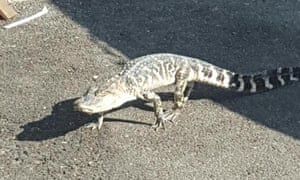
Stray alligator found wandering the streets of New York City has died

Police found the 3ft-long alligator in the Inwood neighborhood of upper Manhattan on Thursday and took it to an animal care center, where it later died

The NYPD’s 34th Precinct tweeted this photo of the alligator on Thursday: ‘So this alligator was crossing 9th Ave in #Inwood...no, really. At 205 Str. Cops took him to Animal Control.’ Photograph: 34th Precinct


Mahita Gajanan in New York


Friday 24 July 2015 20.52 BSTLast modified on Friday 24 July 201521.18 BST

A stray alligator found wandering Manhattan streets has died, according to a statement from animal control officials of New York City.

The New York Police Department’s 34th precinct found the 3ft-long alligator in the Inwood neighborhood of upper Manhattan on Thursday and took it to the animal care center. On Twitter, police posted a photo of the alligator, saying, “So this alligator was crossing 9th Ave in Inwood...no, really.”

The alligator, which staff at Animal Care and Control had named CockadoodleQ, died this morning.

“We have no knowledge of the conditions of CockadoodleQ had lived in prior to his arrival that contributed to his death. Exotic animals such as alligators are illegal to have as pets in New York City,” Alexandra Silver, a spokesperson for Animal Care and Control, said in an email.

Wednesday, 5 November 2014

Urban Legend Debunked: Rats Don't Outnumber People in NYC

by Megan Gannon, News Editor | November 04, 2014 12:08pm ET

An unsettling urban legend claims that there are as many rats as people in New York City. But that's simply not true, according to a statistician who found that a generous estimate for the rat population would actually be 2 million — far fewer than New York's 8 million humans. 

To estimate animal populations, ecologists often use a "capture–recapture" method. First, researchers capture and mark a random sample of a species, and then later, they round up a second random sample of the animals. Based on the percentage of marked animals recaptured in the second batch, ecologists can estimate the species' total population in a given area. But Jonathan Auerbach, a doctoral student in the statistics department at Columbia University, said that the city's Department of Health and Mental Hygiene was not keen on having a large-scale rodent-releasing experiment in New York.

Instead, Auerbach turned to a wealth of data on rat sightingscollected by the 311 information and service hotline, where New Yorkers can file complaints about noise or rodents, get updates on parking regulations, or even request a tree to be planted on their block. 

Thursday, 30 October 2014

New frog species found in the urban jungle of New York City

When thinking about where a new frog species might be discovered, the dense rainforests of Papua New Guinea, the humid jungles of Central Africa or other equally remote and tropical destinations instantly come to mind. But surprisingly, the latest new frog species to have been discovered has been found in the urban jungle of New York City and surrounding coastal areas.

The new species of leopard frog, Rana kauffeldi, was first identified in the New York City metropolitan area, but its range extends to the north and south, following a narrow and predominantly coastal lowland area from central Connecticut to northeast North Carolina.

Continued ...

Wednesday, 13 August 2014

Cleaner New York waters see surge in whale and shark numbers

Humpback whales and great white sharks are surging in numbers in the waters around New York City this summer, in a wildlife bonanza that is delighting naturalists, environmentalists and fishermen – if not necessarily bathers.

Off New York and New Jersey, some of the largest creatures in the ocean are being spotted in greater abundance than has been the case for decades. Paul Sieswerda, head of the Gotham Whale volunteer marine wildlife tracking group, believes the increasing abundance of whales around the Big Apple is largely prompted by cleaner waters that have encouraged huge rises in the populations of fish which the whales eat.

Sieswerda takes boat tours to locations where giant humpback whales can be seen feeding – with the iconic Manhattan skyline in the background.

“I would say it’s only about four miles from the Statue of Liberty,” he told the Guardian.

Gotham Whale counted 29 whales, all humpbacks, in New York waters from the start of the feeding season in the spring to the end of July 2014, compared with 43 for the whole 2013 season, 25 in 2012 and five in 2011.

Thursday, 24 July 2014

New York Squirrels Are Nuts About City Life

July 23, 2014

Megan Meates, Curtin University

Curtin University-led research has shown squirrels have adapted to New York City’s human behavior, allowing them to thrive just as well, if not better, than their fellow squirrels in the woods.

Dr. Bill Bateman, Senior Lecturer at Curtin’s Department of Environment & Agriculture, led the study that proved eastern grey squirrels were able to modify their behavior in urban environments and prevent unnecessary responses when humans acted in a predictable manner, such as staying on the footpath.

“As we rapidly increase the spread of urbanization around the world, urban areas may end up being important places for some wildlife, so it would be good to know what they like about those areas, what allows them to do well and whether humans want them to be there,” Dr. Bateman said.

“If we do want them there, we need to know how we can help their continued success, and perhaps encourage other animals to share our urban spaces.

“After watching the clear-cut behavior of squirrels many times in New York, I decided to take these observations further and determine to what extent squirrels modify their behavior when approached by humans.”

Together with Murdoch University’s Associate Professor Trish Fleming the research team measured alert distance, flight initiation distance, and distance fled to see if they could discriminate between pedestrians who look directly at them and those that did not, as well as how they reacted when pedestrians left the footpath.

According to the research, only five percent of squirrels showed signs of being alerted if the human remained on the footpath and did not look at them, while 90 percent of squirrels moved away, with longer flight distance, when approached by a pedestrian that moved off the footpaths and looked at them.


Tuesday, 7 May 2013

A Tale of Two Ponds: NYC Park After the Storm (Gateway National Park) – via Herp Digest

After Hurricane Sandy, is there a silver lining for Gateway Park? (Home of probably Largest populations of Diamondback Terrapins in Northeast) 

by Cathy Newman, National Geographic News, 4/26/13 

Part of our weekly "In Focus" series—stepping back, looking closer. 

There is a gravel trail that loops around a pond at Jamaica Bay Wildlife Refuge, part of New York City's Gateway National Recreation Area, and in its circumference you can see the richness of nature in the unlikely setting of the largest metropolitan area in the United States. 

Against the silhouette of Manhattan, you might spot 332 species of birds—avocets with upturned needle-like bills, blue herons with sinuous necks, sandpipers, loons, mute swans elegant and pale as moonlight, and sometimes even a snowy owl. 

West Pond, as it is known, is one of a pair (the other being East Pond) along the route of the Atlantic flyway. By grace of their protected shoreline and freshwater, the ponds have always attracted huge numbers of birds and, in turn, bird-watchers. 

Last October 29, the stunning blow that was Hurricane Sandy breached the ponds, opening them to the saltwater marsh, and wrecked much else in Gateway, which is part of the National Park System and encompasses three units: Sandy Hook in New Jersey and Staten Island and Jamaica 

In Sandy Hook, where the Coast Guard tidal gauge broke during the hurricane when the water level topped 13 feet, the storm shifted dunes into parking lots; swept the Tiki Bar in Sea Bright off its foundation and left it in pieces on the beach three miles away; and demolished the stage where Sandy Hook Foundation-sponsored summer concerts were held, leaving only a set of stairs to nowhere to commemorate its existence. Paths were ripped up, and electricity, water, and sewage were knocked out. "It was like a washing machine on an agitator cycle," said Pete McCarthy, Sandy Hook's unit coordinator. 

In the Jamaica Bay section of Gateway, wind and water lifted an entire dock from Riis Landing on Rockaway Peninsula and propelled it a mile and a half across the bay to Plumb Beach, where it came to rest with a deck chair and pair of flip-flops still on board, as if teleported magically through air. The storm flooded the Jacob Riis bathhouse, buried playground equipment in sand, and tossed propane tanks, sailboats, and trees onto the shoreline. In all, the park suffered $180 million in damage, the amount appropriated for repair. 

Sandy, and the wreckage left in its wake, has amplified questions that have dogged the park, which has struggled since its inception with underfunding and an unfocused sense of purpose and identity. And the storm prompts a more immediate and urgent question: Is there a silver lining to Sandy? Can this disaster actually spur the remaking of Gateway, which has been accused of failing by some but is beloved by many? 

A Park for the People 

Gateway National Recreation Area was established in 1972, the same year as its bookend urban counterpart on the West Coast, Golden Gate National Recreation Area in San Francisco, California. The premise behind its founding—that of taking parks to the people—was a departure from the classic National Park Service (NPS) mission of preserving historic and natural resources. Despite a visitor population of more than eight million people a year—nearly all day-trippers (summer is high season because of the beaches)—Gateway is still a work in progress. 

Unlike iconic national parks like Yellowstone with its Old Faithful or Mount Rainer with its eponymous peak, Gateway has no spectacular centerpiece. It spreads over 26,000 acres in parts of New Jersey, Staten Island, the Rockaway Peninsula, and Jamaica Bay, a hodgepodge of beaches, saltwater marsh, and bay, plus defunct forts, barracks, gun emplacements, and other vestiges of its military history (pre-Civil War through the 20th century). Also in the mix are Sandy Hook lighthouse, the oldest working lighthouse in the country, and Floyd Bennett Field, New York's first municipal airport. And there are playing fields, piers, grassland, and 550 buildings, many historic, but many decaying—a process accelerated by wind, water, and the legacy of mold left by Sandy. 

It's a scattered realm, agrees Gateway's superintendant Linda Canzanelli, who argues that diversity is the park's strength. "There are 20 things that could make it a national park," she says, ticking off 60 miles of shoreline, wetlands, marinas, and historic buildings. The NPS, she says, has been working to correct a series of mistakes. "It has to be a destination park, not just a nine-to-five city park. We need things like camping, youth hostels, and hotels. We didn't understand the role of recreation and organized sports in the park, and we didn't focus on the fact that New York City is lucky to have a premier park system; we didn't try to establish a separate identity." 

To which one might add another problem: transportation. "For those New Yorkers without cars," then Senator Harrison A. Williams, Jr., of New Jersey said in the 1970s, "Gateway might as well be in Wyoming." Although the problem is being worked on, the subway stop nearest to the Jamaica Bay Wildlife Refuge nature center is a mile away. Many other parts of the park, like Floyd Bennett Field, are a longer trek, and the only option for getting to Sandy Hook, other than by car, is service by ferry from lower Manhattan at the cost of $45 round trip. 

In 2007, the National Parks Conservation Association (NPCA), an advocacy group, published a report card on the state of the national parks that assigned Gateway dismal marks. "Staffing and funding shortfalls affect all aspects of the park's operations," the report said. "New habitats, restored marshes and modern recreation facilities are needed to create an environment that is suitable for park visitors, native wildlife and plants." 

A follow-up editorial in the New York Times called the park "one of the more discombobulated units in the National Park System." Although the fine print at the bottom of the NPCA report carried the caveat that it represented a snapshot of the park in 2007 and did not necessarily reflect its current state, Alexander Brash, NPCA's northeast coordinator, says not much has changed since then . . . except Sandy, which he calls a gift from heaven. "Sandy wiped the slate clean. Now there is money to repair, fix, and reconstruct. For once there is a better vision in place. It's a golden opportunity to make a great urban park." 

That better vision comes in several guises. In July, the City of New York Department of Parks and Recreation and the NPS signed an agreement allowing the two agencies to cooperatively run 10,000 acres of federal and city-owned parkland around Jamaica Bay. Coordinating habitat restoration and management, creating a seamless network of parkland, and developing new philanthropic sources are among the goals. "Sandy helped galvanize the relationship" between the two agencies, says Giles Parker, chief of staff at the Office of the Commissioner at National Parks of New York Harbor. 

Also in process is a long overdue general management plan, a reimagining of the park that will address sustainability, transportation, and natural and historical resource issues, as well as the relationship between the park and local communities. Buttressing the forward momentum is support from organizations like the Friends of Gateway, Friends of Sandy Hook, National Parks Foundation, Trust for Public Land, Environmental Defense Fund, Rockefeller Foundation, and others. 

Deep affection for Gateway is evinced by comments on Gateway's Facebook page. One post-storm message just said: "Hang in there, Gateway!" Along with post-Sandy complaints ("Slackers! How long do we have to wait for you guys to do something at Great Kills Marina?") are expressions of concern ("How did the holly forest survive?"). Most of all, there is a desire to come to the rescue of an adored, if troubled, resource. One person asked, "Is there any way I can volunteer to help? I may have lost everything but it's important to restore this park for future generations." 

From Moses to Sandy 

"Leave it as it is. You cannot improve on it," President Theodore Roosevelt said of the Grand Canyon in 1908, but the dictum does not apply to the dynamics of a national park in an urban area, like Gateway. 

So much of Jamaica Bay has been impacted and manipulated by man, both within and outside the refuge. There are marshes rebuilt by the Army Corps of Engineers, trails, docks, seawalls, and areas built up by landfill, not to mention four sewage treatment plants. John F. Kennedy International Airport is nearby, with its attendant problems of toxic runoff and the notoriously bad juxtaposition of jet engines and birds. 

The two freshwater ponds were also created by man. They were ordered up by Robert Moses,the revered or reviled (depending on where you stand) master builder of New York City, who in assorted public official roles over the course of 44 years (from 1924 to 1968) oversaw the building of 416 miles of parkway; 13 bridges; 658 parks; numerous beaches, tunnels, civic centers, and pools; and the 1964-65 New York World's Fair. 

Moses was vilified as a bully and destroyer of neighborhoods, but the wildlife refuge owes its existence to him. In 1938 William F. Carey, the city's commissioner of sanitation, wanted to put an incinerator and ash dump in Jamaica Bay. The possibility of a deepwater port was also suggested. Moses thought otherwise and lobbied for a "place within the limits of the city where the strain of our city life can be relieved . . . where the old may rest and the young can play . . . Are we to have another waterfront slum?" he asked. His vision and values prevailed. The incinerator and port were scuttled. Score one for Robert Moses. 

The larger East Pond has been repaired—the tracks for the A train ran on top of its berm—though its water remains brackish. The smaller West Pond was left with a 60-foot-wide gap that erosion will widen. There is debate over whether the pond should be restored or allowed to be subsumed by the surrounding marsh, and even within the NPS you can find adherents to both sides. 

"We would never have built them today," Superintendant Canzanelli says of the ponds. As for restoration: "Rather than making snap judgments, we need to get to people who are knowledgeable, look at peer-reviewed studies, and hear debate." Perhaps, she suggests, the answer lies outside the seesaw question of restore or not; for example, a pond could be built in a less vulnerable place. 

The NPCA advocates restoration. "We believe the breach should be repaired in light of the pond's value in making wildlife accessible in this urban environment," its president, Thomas Kiernan, wrote Jonathan Jarvis, NPS director. Explains NPCA's Brash: "It's one of the few places you can take school kids and have a flight of a hundred snow geese come so close that if you are a sixth grader from Brooklyn, you can practically touch their tail feathers." The idea is that a national park in an urban area should provide what he calls a "wild experience" as a step toward growing a constituency that will support and appreciate other, more iconic parks. 

Another, more long-range concern spotlighted by Sandy is the specter of rising sea levels and climate change. "We have a new reality," says Will Shafroth, acting commissioner at National Parks of New York Harbor. "Sandy has accelerated the pace with which we are going to have to deal with climate change and sea level rise, and it is unthinkable not to make decisions sensitive to those concerns. We can't rebuild without taking that into account." 

Shafroth mentions the bathhouse on Riis Beach, which abuts the water and was beaten up by the storm. In rebuilding, he suggests, the first floor might be left open as a pavilion. "If waves hit, they will wash right through." Among other things, Sandy has refocused the lens as to what gets built and where and how. 

"But how much do you do, and how much political will is there to doing anything other than putting things back to where they were six months ago?" asks Glenn Phillips, executive director of New York City Audubon. "It is pointless, for example, to restore the ponds if they can't be maintained." Chronic underfunding of all national parks has always been a problem, and—in the era of sequestration—will probably remain so. The sustainability of political will is a valid question, particularly in an attention-deficit-disordered world where fading headlines subvert good intentions. The crisis recedes. People forget. 

Should the ponds be allowed to revert back to nature? "Absurd," Phillips says. "There is no such thing as letting it revert. Everything in Jamaica Bay has been altered, from tidal flow to salinity to turbidity. Jamaica Bay is a hugely important wetland, not a square inch of which hasn't been disturbed and altered by human activities. It's an urban system and needs to be managed." 

Prospects that the ponds—and Gateway in general—will be managed correctly never looked better, Brash maintains. He's convinced a seismic shift has occurred, that the players involved finally get it and will move forward toward a vision that incorporates creative partnerships, opportunities for community interaction, private philanthropy, and cooperation between city, state, and federal agencies. As for the sustainability of political will: "I believe everyone will rise to the occasion. If a destination park is created-one that inspires and attracts-people and resources will be on hand to make it work, and the park will more than stand on its two feet." 

Taking Flight 

On the gravel path around West Pond, now interrupted by a tidal flow of saltwater bracketed on each side by orange plastic fencing, you could spot a tree swallow that had made an unseasonably early appearance. An osprey couple had set up housekeeping on one of the nesting platforms. Mute swans glided in tandem. 

Explain the kick of bird-watching, I asked Dave Taft, the NPS coordinator for the Jamaica Bay unit of Gateway and my guide for the morning. Taft, who had a pair of binoculars draped around his neck, thought a bit, and began to talk about a bird he cherishes, a bird with a back as blue as a marlin and a flash of white on its wing. 

"The black-throated blue warbler is a tiny bird, about three or four inches long," he said. "It is one of the miracles of natural history, and I wonder how many mistakes on the way to its evolution it took to make it. 

"Looking at this bird is my way of saying, 'On this day, the state of evolution produced this beautiful thing, and I am also the product of that same process.' It is the period at the end of a sentence . . . only to continue on to the next sentence." In the foreground, a heron alighted on the shoreline. In the distance, a 777 lifted off from one of the runways at JFK airport and turned east toward the Atlantic.
Related Posts with Thumbnails

ShareThis