Showing posts with label Finland. Show all posts

Sunday, 28 June 2020

Are protected areas effective at maintaining large carnivore populations?


JUNE 22, 2020


A recent study, led by the University of Helsinki, used a novel combination of statistical methods and an exceptional data set collected by hunters to assess the role of protected areas for carnivore conservation in Finland.

Overall, protected areas do not harbor higher densities of large carnivore species than unprotected lands. These areas even had declining wolverine densities within their limits while populations outside remained overall stable over a 30-year study period. The study was published in the journal Nature Communications.

The international group of authors, led by Dr. Julien Terraube from the Faculty of Biological and Environmental Sciences at the University of Helsinki, proposes that the results do not indicate that protected areas are unimportant for carnivore conservation, as they may support seasonal habitats and prey for these highly mobile species. However, the outcomes highlight complex socio-ecological pressures on carnivore populations that vary in both time and space and affect the conservation outcomes of protected areas. For example, the largest Finnish protected areas are located in Lapland, and due to their sizes these areas are most suitable for large carnivores. However, the areas seem unable to maintain stable wolverine populations, which may be linked to increased conflicts with herders in the reindeer husbandry area.

Thursday, 1 March 2018

Domestic goat dating back to the Neolithic Corded Ware period identified in Finland


Date:  February 23, 2018
Source:  University of Helsinki

Summary:
Goat hairs have been found in a grave structure that was discovered in the 1930s in Kauhava, western Finland. These are the oldest animal hairs found in Finland. From the perspective of Finnish prehistory, the finding supports the evidence of animal husbandry practised during the Corded Ware period, while also revealing details of burial rituals.


Sunday, 2 July 2017

Finland has far fewer wild wolves than previously thought, census shows


Data reveals there are 150 to 180 animals in Finland, where government awards licences to hunt them

Fiona Harvey Environment correspondent
Monday 26 June 2017 07.00 BST Last modified on Monday 26 June 2017 07.01 BST 

Conservation groups have raised concerns over Finland’s wild wolf population after a new census found numbers far below those regarded as naturally sustainable.

Data from the Finnish National Resources Institute show there are currently only about 150 to 180 wolves living in Finland, where the government awards licences to hunt the animals.
The estimate is much lower than previous estimates, which put the population at more than 230 animals more than a year ago.

It also falls a long way short of the estimated 800 individuals needed to sustain a healthy degree of genetic diversity within the population, according to the Wolf Action Group, a conservation committee within the Finnish Nature League.

This week, the campaigners will meet EU officials to discuss the census data, and the application of Europe’s Habitat Directive to the remaining wolves in Finland. Under the EU rules, wolves – which are classed as endangered – should be accorded special status with measures taken to ensure their viability, but conservationists say these rules have not been followed.

Wednesday, 22 March 2017

No mid-day nap for Finnish flies


Date: March 15, 2017
Source: University of Würzburg

There are more than 2,000 species of fruit flies around the world. Some prefer warmer climates, whereas others are home in northerly latitudes. "We wanted to find out whether the circadian clock of the northern species differs from that of their southern relatives," explains Professor Charlotte Helfrich-Förster from the University of Würzburg's Biocenter. "For this purpose, we compared two fruit fly species from Finland with one from Tanzania."
Long siesta at the equator

In the laboratory, the scientists varied the length of light and dark cycles to which the insects were exposed. In their first experiment, twelve hours of day were followed by twelve hours of night. This rhythm is typical for the equator where day and night are about equally long throughout the year. The African flies exhibited a characteristic pattern of activity under these conditions: Their active phases were limited to the time around dusk and dawn; in the meantime they rested. In nature, such behaviour is highly advantageous as it allows the insects to better cope with the heat of the day.

Being slightly more relaxed in the morning, the Finnish dipterans in contrast had their activity peak in the early afternoon and stayed active until nightfall, mostly without taking a siesta. From a biological point of view, this behaviour makes sense, because even at the height of summer, the northern Scandinavian sun is rarely strong enough to harm the animals.

In the next step, the scientists extended the lab day: They left the lights on for 20 hours before turning them off again for four hours. In response to this, the Tanzanian flies did not extend their resting period, but rather started to bustle about long before dusk. Their activity now peaked at a time of day when it would normally still be scorching hot. If there were 20-hour days in Tanzania, such behaviour would probably be very risky.

Readon  

Sunday, 26 October 2014

Decrease of genetic diversity in the endangered Saimaa ringed seal continues

Date:
October 24, 2014

Source:
University of Eastern Finland

Summary:
Pusa hispida saimensis ca 1956.jpgThe critically endangered Saimaa ringed seal, which inhabits Lake Saimaa in Finland, has extremely low genetic diversity and this development seems to continue, according to a recent study. Researchers analyzed the temporal and regional variation in the genetic diversity of the endangered Saimaa ringed seal. The population is only around 300 individuals divided into smaller sub-populations and with very little migration among between them.

Friday, 13 June 2014

Finland: Elk romps through central Helsinki rush hour

An elk has shocked commuters in the Finnish capital of Helsinki by romping through the streets during rush hour.

Reindeer running through the streetsThe animal was first spotted roaming the streets around 03:00 local time (00:00 BST), the Helsingin Sanomat newspaper reports. Police officers then spent "the rest of the night chasing the erratically-behaved animal," it says.
One man says the elk ran in front of his car on his way to work before dashing into the bushes, nearly causing what's known in Finland as a hirvikolari - a specific type of road accident involving an elk. "My first thought was - there is no way I am going to end up having a hirvikolari in [central Helsinki]," Matti Murtoniemi tells Ilta-Sanomat newspaper. The animal then wandered around Helsinki's famous Kaivopuisto restaurant and the Turkish embassy, the paper adds.

But the elk's city break was short-lived, as police say they had no choice but to shoot it. "They had been hoping to spare the animal by directing him towards the sea so it could swim away," Helsingin Sanomat says. A police spokesman adds that plan became too difficult to implement and was abandoned.

"It just shows what a small rural town Helsinki is," one local woman tells Helsingin Sanomat. Taking a picture of the late elk, she adds: "I've just told my neighbour - make sure your freezer is empty as there is so much fresh meat on offer."

The European elk is known in North America as a moose.

Tuesday, 26 November 2013

Bear Cubs Play 'Ring Around The Rosie,' And We All Fall Down From Cuteness Overload (PHOTOS)

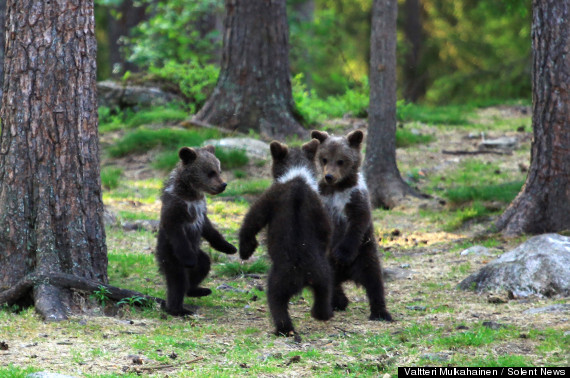
bears2This family of baby brown bears is making our wildest fairytale dreams come true. Just look. These three siblings -- two little guys and their sister -- were photographed playing a game of "Ring Around The Rosie."

Valtteri Mulkahainen, a 52-year-old PE teacher, spotted the bears while traveling in Finland, according to Solent News. He watched the cubs hold each others' hands and dance around in a circle, while Mama bear chaperoned from just a few feet away.

Friday, 15 June 2012

Nordic police close in on rare egg thieves

Officers seized the eggs along with some 300 dead birds, some of which were stuffed and some frozen from a man resident in Österbotten in central Finland.

Police believe that crimes have been committed over a number of years and across several countries in the Nordic region.

"We suspect that this has occurred in Sweden too," said Lars Lundman at Norrbotten police in northern Sweden to the TT news agency.

Most of the eggs seized were from endangered species and many would be expected to net substantial sums from rare egg collectors. 

The arrest came as a result of Finnish police having received a tip from their Swedish counterparts, according to information from the Swedish Ornithological Society (Svensk Ornitologiska Förening - SOF).

The society referred to ongoing police investigations in Sweden concerning three suspects. 

A Swedish prosecutor specialized in environmental law was present at the press conference in Finland and while Finnish police were unwilling to comment further on the Swedish angle, it has been widely reported.

The Swedish police investigations are reported to concern serious hunting violations and involve three suspected egg thieves operating in different parts of the country.

One of the three is also suspected of illegally purchasing, selling or exchanging eggs.

The suspected offences carry a range of penalties extending to prison sentences.

As a result of the spate of egg thefts, the counties of Västerbotten and Jämtland have decided to impose a temporary nature reserve in Stekenjokk mountains in northern Sweden.

The public have been excluded from the area for the month of June, the breeding season for the birds. The ban is being imposed with the help of the police.


http://www.thelocal.se/41334/20120609/

Monday, 11 June 2012

10,000 rare bird eggs seized in Finland


OSTERBOTTEN, Finland, June 9 (UPI) -- Finnish customs officials seized about 10,000 rare bird eggs that are possibly related to a string of thefts stretching across Scandinavia, officials say.

Officers seized the eggs, as well as 300 dead birds, some of which were stuffed and some frozen, from a man at his residence in central Finland, the Swedish news agency TT reported Saturday.

Most of the eggs seized were from endangered species and many were worth a lot of money to rare egg collectors.

Police said the eggs may be linked to a string of rare bird thefts in Sweden, Norway, Finland and Iceland.


Read more: http://www.upi.com/Top_News/World-News/2012/06/09/10000-rare-bird-eggs-seized-in-Finland/UPI-32291339268913/#ixzz1xOAy8Jc6

Tuesday, 14 December 2010

Electric eels light up Christmas

An aquarium in Finland has found an environmentally-friendly way of powering its Christmas lights - by electric eel.


Electric eels can produce 650 volts of electricity, enough to light a tree and a few extra fairy lights - or kill a fully grown man.

Markus Dernjatin, from the Helsinki Sea Life Centre in Findland, explained: "We wanted to conserve energy so we looked around for ways to be more green.

"Then it struck us that we have a free source of natural electricity right here in our tanks.

"Our electrician built a device that uses four plastic-encased steel probes to capture the eel's electrical discharge and feed it to the lights.

"At feeding time though it really powers up. You can hear the voltage increasing and the lights shine bright and steady," he added

http://web.orange.co.uk/article/quirkies/Electric_eels_light_up_Christmas
Related Posts with Thumbnails

ShareThis