Showing posts with label Hainan gibbon. Show all posts

Monday, 30 November 2015

World's rarest ape is teetering on the edge of extinction

A new count suggests there are only 26 Hainan gibbons left in China’s rainforests – is it too late to save them?

By Melissa Hogenboom
27 November 2015

It's not a great title to carry. Being the rarest of anything indicates that you may well soon disappear altogether.

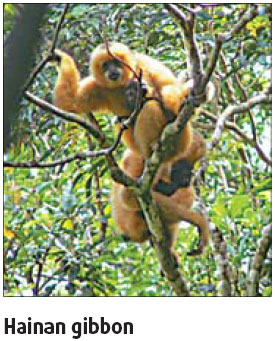
On first sight, prospects do look grim for the Hainan gibbon (Nomascus hainanus). These apes are not only the rarest primate in the world, they are the rarest mammal alive today.

Half a century ago we didn't know much about the Hainan gibbon

There are thought to be as few as 26 individuals remaining, and they all live in a small part of the rainforest in China's Hainan province, an island off the coast of southern China.

Although protected, their habitat shows sign of gradual decline as locals scour the forest for edible or medicinal plants, occasionally hunting the other animals that share the gibbons’ environment. 

Half a century ago we didn't know much about the Hainan gibbon. There were about 2,000 individuals at that point, but it wasn’t clear whether they actually constituted a unique species. By the time we learned that they do, over-hunting and logging in their forests had reduced their numbers dramatically. But new insights into their lives may yet help save this rare, beautiful ape.


Wednesday, 5 August 2015

Hainan gibbon decline charted in Chinese records

By Rebecca Morelle, Science Correspondent, BBC News

5 August 2015 
From the section

There are only 26-28 Hainan gibbons left in the wild

Historical Chinese documents have helped scientists to track the decline of the world's rarest primates.

Today, China has between 26 and 28 Hainan gibbons left, but government records that date back to the 17th Century show that gibbons were once widespread across half of the country.

The apes began to disappear from the documents about 150 years ago, corresponding with population growth.


We looked at the pattern of disappearance of gibbons through time and how that varied from place to placeDr Sam Turvey, Zoological Society of London

Hainan gibbons are now limited to a few isolated patches of forest in the south west of China.

They live in just four social groups, one of which was only discovered a few weeks ago.

Understanding this population crash has been difficult, but the old government documents have helped to reveal when and how the numbers fell.

Monday, 3 August 2015

World's rarest ape: new family group found

The future of the world's rarest apes look just a little bit brighter given the recent discovery of a new family group in Bawangling National Nature Reserve in China.

Until last month, it was thought that there were just 25 Hainan Gibbons (Nomascus hainanus) living in three social groups on an island off the Chinese mainland.

The discovery of a new fourth group, by a team led by international conservation charity the Zoological Society of London (ZSL), has increased the known population by almost 12 per cent.

The group consisted of a mating pair with a young baby, sighted within Bawangling National Nature Reserve, Hainan Province, increases 

The existence of this fourth breeding group increases the reproductive potential of the population, which could be vital for the long term survival of the Critically Endangered gibbons.

ZSL researcher Dr Jessica Bryant, who led the expedition that made the discovery, says: "Finding a new Hainan Gibbon group is a fantastic boost for the population.

Friday, 19 December 2014

Hainan gibbon ‘clinging on’ with 25 left in China

Scientists say a disease outbreak or typhoon could push world’s rarest ape species towards extinction

Jonathan Kaiman in Beijing

Friday 19 December 2014 13.45 GMT

Scientists are racing to save a critically endangered ape species that lives only in the rainforests of southern China’s Hainan island. With 25 known individuals remaining, a disease outbreak or a strong typhoon could “massively impact” the species’s chances of survival, the scientists say.
Samuel Turvey, a senior research fellow at the Zoological Society of London, said the Hainan gibbon was “definitely the world’s rarest ape species, the rarest primate species, and one of the rarest mammal species. They’re kind of clinging on, literally and metaphorically, to patches of forest in the mountains which people haven’t gotten around to cutting down yet.”

He said both the species and its habitat were protected under Chinese law, but “the population is so low now that simply removing the threat isn’t enough … If by chance one or two of them die from disease, or a typhoon, their chance of recovery [would be] massively impacted.”

Turvey added: “The Hainan gibbon can become one of the world’s conservation success stories if everyone works together and the right steps are carried out.”

Hainan is China’s smallest and southernmost province, an island of rainforests, mountains and sandy beaches in the South China Sea. The gibbons – gangly creatures with small black faces and thick beige fur – live in the Bawangling national nature reserve, a 26 sq mile swath of rainforest more than 120 miles from the provincial capital, Haikou.


Thursday, 10 April 2014

Time running out for rarest primate

Rescue bid launched to save Hainan gibbon from becoming first ape driven to extinction by humans.
08 April 2014

Fewer than 30 Hainan gibbons remain today.

China’s wildlife conservation efforts are under scrutiny as scientists battle to save a species found only in a tiny corner of an island in the South China Sea. The Hainan gibbon is the world’s rarest primate and its long-term survival is in jeopardy, according to an analysis.

Only 23 to 25 of the animals are thought to remain, clustered in less than 20 square kilometres of forest in China’s Hainan Island. The species (Nomascus hainanus), which numbered more than 2,000 in the late 1950s, has been devastated through the destruction of habitat from logging, and by poaching. Extinction would give the gibbon the unwelcome distinction of being the first ape to be wiped out because of human actions. To hammer out a plan to save it, international primate researchers convened an emergency summit in Hainan last month.

Related Posts with Thumbnails

ShareThis
