Showing posts with label Interpol. Show all posts

Thursday, 25 December 2014

Elephant ivory smuggling 'kingpin' arrested in Tanzania


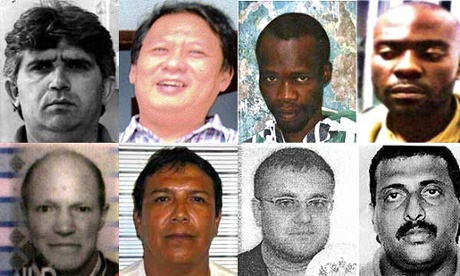
Suspected organised crime boss Feisal Ali Mohammed is arrested following publication of Interpol most-wanted list

Feisal Mohamed Ali, bottom-right, has been arrested in Tanzania following an Interpol most-wanted list. Photograph: Interpol


AFP

Tuesday 23 December 2014 12.19 GMT

A suspected organised crime boss alleged to be a leading figure in the illegal ivory trade has been arrested by Interpol agents in Tanzania, officials said on Tuesday.


The international police organisation last month put Kenyan national Feisal Ali Mohammed on a list of nine most-wanted suspects linked to crimes against the environment.

“Feisal Ali Mohammed was arrested by Interpol officers in Dar es Salaam. He was then booked in Musimbasi police station at 10:42pm last night,” Kenya’s director of public prosecutions said in a statement.

It said he is facing charges in Kenya’s port city of Mombasa for “dealing and possession of elephant tusks” weighing more than two tonnes and equivalent to at least 114 poached elephants, which were found during a raid in June.

Wednesday, 24 December 2014

Tigers, leopards, bears and more seized in Interpol raids


Hundreds of animals have been seized and more than 160 arrests made in Interpol co-ordinated raids across Asia. Under the PAWS (Protection of Asian Wildlife species) programme law enforcement officials from 13 Asian countries moved in on wildlife traffickers.

While the operation led to the seizures of high profile species such as tigers the focus of the operation was on the lesser known but still highly profitable species such as pangolins. The operation did not just cover street traders and markets but also online traders with social media sites also under investigation.

The operation made major seizures of a range of living animals and also dead wildlife products. Included in the haul were:

3.5 tonnes of elephant ivory,
280 kg of pangolin scales,
4 tonnes of red sandalwood,
rhino horns,
tigers,
leopards,
bears,
lions,
red pandas,
crocodiles,
turtles,
tortoises and
a large number of bird species.

Monday, 17 November 2014

Interpol launches most-wanted list of environmental fugitives

International policing agency’s public appeal targets nine dangerous fugitives suspected of crimes involving poaching and illegal logging

Arthur Neslen, Brussels

theguardian.com, Monday 17 November 2014 06.30 GMT

Interpol wanted Operation Infra-Terra (top row from left to right): Adriano Giacobone, Sudiman Sunoto, Bhekumusa Mawillis Shiba and Ben Simasiku; (bottom raw from left to right): Nicolaas Antonius Cornelis Maria Duindam, Ariel Bustamante Sanchez, Sergey Darminov and Feisal Mohamed Ali Photograph: Photograph: Interpol


Suspects wanted for crimes including poaching rhino, trafficking ivory and illegally chopping down forests feature on the first ever Most Wanted-style appeal to catch environmental criminals. 


Interpol’s public appeal hopes to catch nine fugitives suspected of environmental crimes costing hundreds of millions of dollars, in a move to catapult the issue to the forefront of international law enforcement.

Stefano Carvelli, the head of Interpol’s fugitive investigative support unit, said that the offences were only the tip of the iceberg of an environmental crime wave, which agency reports have estimated to be worth $70bn-$213bn annually.

“If we talk about illegal logging, we have many pending cases,” he said. “We also have many serious biodiversity cases. The problem is very big, I can feel it. These are crimes with many, many different parameters.”

Tuesday, 4 June 2013

Online ivory trade worth millions, INTERPOL report reveals

Loopholes in legislation create opportunities for illicit ivory Internet sales

May 2013. An INTERPOL report to identify the drivers and scale of the illegal online trade in ivory has revealed hundreds of items worth approximately EUR 1.45 million for sale on Internet auction sites across nine European countries during a single two-week period.

4,500 KG ivory
During Project Web, supported by the International Fund for Animal Welfare (IFAW), the details of 660 advertisements on 61 auction sites were analysed by specialist national agencies and departments and were estimated to represent a total volume of around 4,500 kg of ivory.

With few obligations on sellers to prove the legality of ivory, and previous IFAW investigations showing that ivory is the most widely traded wildlife product on the Internet, one of the report's key recommendations is the introduction of e-commerce specific legislation and strong collaboration with customs to further investigate and prevent the illegal online sale of ivory.

"Whether in the real or virtual world, the illegal ivory trade poses one of the biggest threats to elephants in the wild, and law enforcement efforts need to be both off- and online if we are to effectively tackle this crime," said David Higgins, Manager of INTERPOL's Environmental Crime Programme.

Monday, 27 May 2013

INTERPOL step up the fight against wildlife crime

INTERPOL and IFAW agreement boosts global fight against wildlife crime
May 2013. The global fight against wildlife crime has taken a step forward with the signing of a Memorandum of Understanding (MoU) between INTERPOL and the International Fund for Animal Welfare (IFAW).

The agreement between the two organizations establishes a formal framework for cooperation, in particular on combating crime related to the illegal killing and trafficking of elephants, rhinoceroses and tigers through regional and global operations.


"This agreement with IFAW will provide further momentum to efforts worldwide in identifying and dismantling the criminal organizations engaged in wildlife trafficking," said INTERPOL's Executive Director of Police Services, Jean-Michel Louboutin who signed the MoU on behalf of the world police body.

Criminal organizations engaged in wildlife trafficking
"Criminal organizations engaged in wildlife trafficking have no respect for our environment and no regard for borders, conducting their illicit activities wherever there is the most profit to be made. Tackling the global problem of wildlife crime cannot be done by any one country or organization, and we look forward to continuing to work closely with IFAW to provide additional support to the police and other enforcers in the field," added Mr Louboutin.

INTERPOL's largest-ever anti-ivory operation
INTERPOL and IFAW have collaborated on numerous projects since 2005, most notably Operation Worthy, INTERPOL's largest-ever anti-ivory operation and more recently on Project Web, an investigation into the illegal online trade in ivory.

"International organized criminal syndicates are wiping out the world's animals. NGOs, law enforcement agencies and governments have to become equally organized, determined and equipped in dealing with this emerging and growing threat which impact species conservation and international security," said Azzedine Downes, IFAW CEO and President.

Friday, 30 November 2012

Interpol’s most wanted wildlife criminals


Interpol are stepping up their drive against wildlife crime
November 2012. Interpol maintain a list of their most wanted criminals from around the world, and they have a section for wildlife criminals. The seven men (They are all men) currently listed include 4 from China and one each from USA, New Zealand and Nepal.
Amongst those wanted are Jason Shaw, a New Zealander who ran was at the centre of the biggest animal-cruelty case in the U.S. US officials issued an arrest warrant for Shaw, 37, owner of the pet and wildlife wholesaler U.S. Global Exotics, where agents seized more than 26,000 animals - many dead or dying.

$10 billion per year industry
Hillary Clinton, U.S. Secretary of State, recently issued a stern warning against illicit trafficking of wildlife products. She announced that the U.S government is keen to pursue a policy on non-trafficking and wildlife security. Clinton said that the global value of illegal wildlife trafficking is as much as $10 billion per year, ranking it as one of the largest criminal transnational activities worldwide along with arms, drugs and human trafficking.


Monday, 25 June 2012

Huge INTERPOL crackdown on wildlife trade in 14 countries

INTERPOL completes largest ever ivory operation while Chinese authorities crack down on wildlife trafficking
June 2012. INTERPOL has arrested more than 200 people, and seized almost two tonnes of contraband ivory, 20kg of rhino horn and military grade automatic weapons in an operation that spanned three months and 14 African countries.
Wide range of wildlife being trafficked
Operation Worthy saw INTERPOL and International Fund for Animal Welfare (IFAW) team up to target criminal organisations behind the illegal trafficking of ivory. Also seized were lion, leopard and cheetah pelts, crocodile and python skins, live tropical birds, turtles and other protected species destined to be illegally trafficked around the world.

Saturday, 13 November 2010

INTERPOL co-ordinated operation targeting illegal trade in endangered reptiles leads to arrests and seizures worldwide

Traffic, 11/8/10- LYON, France - A worldwide operation co-ordinated by INTERPOL and involving 51 countries across all five continents against the illegal trade in reptiles and amphibians has resulted in arrests worldwide and the seizure of thousands of animals as well as of products worth more than 25 million Euros.

Including national wildlife enforcement authorities, police, customs and specialized units from participating countries, Operation RAMP (September - October) focused particularly on illegal activities relating to the trade and possession of endangered reptiles such as turtles and snakes which included Boa constrictors. The operation resulted in thousands of searches and inspections being conducted, and saw hundreds of suspects being investigated or charged as part of an on-going series of investigations. The goods seized included leather products, and illicit firearms and drugs were also uncovered.

During the two month-long operation, which led to investigations into individuals and companies as well as inspections of premises such as seaports and wholesalers, INTERPOL's Environmental Crime Programme unit acted as a key operational communications and intelligence centre, facilitating the exchange of information between the world police body's member countries participating in the operation.

"Our goal in Operation RAMP was to detect and apprehend suspected wildlife criminals, whilst also furthering co-operation and collaboration between agencies and countries in an effort to enhance the fight against organized environmental crime," said the Director of INTERPOL's Specialized Crime unit, Bernd Rossbach.

"While investigations will continue well beyond the conclusion of Operation RAMP, this operation has shown what the international law enforcement community can collaboratively achieve against suspected environmental criminals and their networks."

"The success of this operation would not have been possible without the close co-operation and dedication of the police, customs, wildlife law enforcement agencies and specialized units in all of the participating countries," added Mr Rossbach.

John Scanlon, Secretary General of the Convention on International Trade in Endangered Species of Wild Fauna and Flora (CITES), who was briefed on the results of the operation during a visit to INTERPOL headquarters on Tuesday, said "The fact that INTERPOL helps co-ordinate such worldwide operations illustrates the level of serious criminality that is now commonly linked to illegal trade in wildlife. I congratulate all the national agencies that participated in Operation RAMP, and the INTERPOL officers worldwide who supported them. Such operations reinforce the very close working relationship that exists between CITES and INTERPOL," the head of CITES said on the sidelines of a meeting with INTERPOL Secretary General Ronald K. Noble.

Whilst Operation RAMP focused on detecting and apprehending suspected criminals and criminal groups, emphasis was also placed on ensuring the compliance of lawful traders such as private license holders, public retail outlets and wholesale distributors alongside targeted enforcement actions at national ports where imports and exports transit, collectively resulting in thousands of inspections during the two-month operation.

As the second global operation led by INTERPOL against wildlife crime, results to date from Operation RAMP follow those of its precursor, Operation TRAM (February 2010), which targeted the illegal trade in traditional medicines containing wildlife products and which led to the seizure of products worth more than 10 million Euros.

From: HerpDigest Volume # 10 Issue # 48 11/10/10 (A Not-for-Profit Publication)
Related Posts with Thumbnails

ShareThis