Showing posts with label Butterfly Conservation. Show all posts

Tuesday, 9 December 2014

Exotic butterflies could make 2015 a memorable year, say conservationists

Butterfly Conservation hopes continental swallowtail, scarce tortoiseshell and large tortoiseshell will successfully overwinter

Monday 8 December 2014 10.31 GMT

Next year could be an exciting one for lepidopterists if exotic butterfly species which appeared in the UK in 2014 are able to survive the winter here, conservationists have said.

Species such as the continental swallowtail, the scarce tortoiseshell and the large tortoiseshell were all seen in Britain in 2014 following an unprecedented series of immigration and emergence of exotic butterflies.

Wildlife charity Butterfly Conservation raised the possibility that some of these butterflies may be able to successfully overwinter in the UK and emerge again in 2015.

This year saw the offspring of continental swallowtail butterflies, which had arrived in 2013 in the largest numbers since 1945, emerging in late spring as adults along the south coast from Suffolk to Dorset.


Monday, 15 September 2014

Very rare moth spotted in a Gloucestershire garden

One of the UK’s rarest and most spectacular moths has been spotted in a Gloucestershire garden – the first time it has been seen in the county for eight years, wildlife charity Butterfly Conservation (BC) has revealed.

BC Gloucestershire Branch has only ever received five records of the moth being seen in the county, with the last in 2006.

The oleander hawk-moth was recently recorded in the Cotswolds by Jean Booth, who found it near to her tobacco flowers – a known food plant of the giant moth.

The moth can be identified by the swirling cream and pinkish-brown markings on its green coloured forewing. A white band across the front end of its abdomen is also distinctive.

Saturday, 19 July 2014

Public butterfly count aims to check countryside health

18 July 2014 Last updated at 08:34

By Victoria Gill
Science reporter, BBC News

The charity Butterfly Conservation is calling on the public to help survey the state of Britain's countryside by counting our most colourful insects.

For two weeks from 19 July, the charity is asking people to spend 15 minutes "in a sunny spot" and note how many of 21 common species they spot.

Butterfly Conservation said that the insects were the most visible indicator of whether the countryside was healthy.

The online survey is now in its fifth year.

"Butterfly numbers go up and down with the weather, so it's important to keep this survey running in the long term," said Butterfly Conservation's surveys manager Richard Fox.

"[But] we also want people to engage with the natural world. Everyone should know the names of a small tortoiseshell, a comma and a red admiral.

Tuesday, 8 April 2014

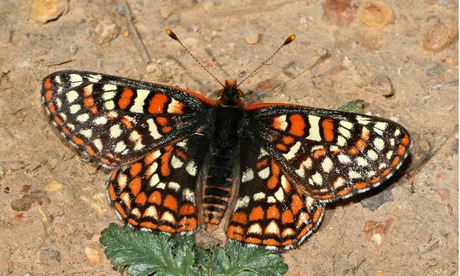
Endangered butterfly defies climate change with new diet and habitat

Quino checkerspot, native to Mexico and California, shifts to higher altitude and chooses new species of plant for laying eggs


theguardian.com, Monday 7 April 2014 11.03 BST

A butterfly species whose population collapsed because of climate change and habitat loss has defied predictions of extinction to rapidly move to cooler climes and change its food plant.

The quino checkerspot (Euphydryas editha quino), found in Mexico and California, has shifted to higher altitudes and surprisingly chosen a completely different species of plant on which to lay its eggs, according to research presented at the Butterfly Conservation's seventh international symposium in Southampton.

Its rapid adaption offers hope that other insects and species may be able to adapt unexpectedly quickly to climate change.

Friday, 10 January 2014

Butterflies in your house this winter?

Richard Fox from Butterfly Conservation offers his guide to giving butterflies a sucessful and safe transition to spring.

It is only the small tortoiseshell and peacock butterfly that regularly overwinter inside houses. They come in during late summer or early autumn, when it is still warm outside and our houses appear to provide suitably cool, sheltered, dry conditions. However, come Christmas, when the central heating is cranked up, these butterflies may be awoken prematurely by high indoor temperatures. This presents a major problem for the butterfly as the outside weather conditions may be very hostile and there is little nectar available in gardens.


Monday, 12 August 2013

Tiger moths – Have you seen any near you?

Is there a tiger in your garden?
August 2013. Nature lovers are being asked to check their gardens for tigers in a bid to help conservationists studying the effects of climate change on moth distribution. Tiger moths are amongst the most colourful of the UK's 2,500-plus moth species, but some members of the tiger family have experienced dramatic fluctuations in distribution and population over the last 40 years.

Butterfly Conservation and Lepidoptera journal Atropos are asking the public to send in records of their tiger sightings during Moth Night 2013 - the annual celebration of moths and moth recording, to help gather vital information about this charismatic family.

Garden & Jersey tigers
Two species in particular, the Garden Tiger and the Jersey Tiger, have experienced widely differing fortunes.

The Garden Tiger, known for its distinctive ‘woolly bear' caterpillar, was once widespread across much of the UK and was commonly found in gardens. But this brightly coloured species has suffered a severe population fall of 92% over the last 40 years. It is thought that climate change in the form of warmer, wetter winters has reduced the survival of the Garden Tiger's caterpillar stage with the adult population decreasing as a result. The warmer, wetter weather may have increased the incidence of diseases which would not normally be present in colder, drier conditions.

Benefitted from climate change - Common in London
But climate change has benefitted some species. The beautifully patterned Jersey Tiger, first recorded as an immigrant in Devon in 1880, has experienced a dramatic upsurge. The Jersey Tiger remained confined to an isolated pocket of Devon but in the last 20 years began to dramatically spread across southern England with regular sightings now recorded in Dorset, Hampshire, Sussex, Kent and as far north as Hertfordshire.

Monday, 22 July 2013

Will UK butterflies recover from 2012 washout? You can help find out.

Can our butterflies bounce back?

July 2013. Sir David Attenborough has warned that UK butterfly numbers are at a historic low and is urging the public to take part in the world's largest butterfly count to assess if species are recovering after their worst year on record.

Butterfly emergence delayed by 3 weeks
This spring, the coldest for 50 years, saw butterfly emergence delayed by around three weeks. The cold start followed washout 2012 - the worst year on record for UK butterflies with the majority of species suffering declines. These difficult conditions, coupled with long-term declines in abundance and population, leave UK butterflies at a historically low ebb with many species struggling in our gardens and the wider countryside.

Help the count
The warm start to July has given many species a much needed boost and Butterfly Conservation is calling for nature lovers everywhere to take part in the Big Butterfly Count to help assess if UK butterflies can recover this summer.

Sir David, President of Butterfly Conservation explained: "The washout weather of 2012 proved a disaster for our butterflies; these conditions, coupled with long-term declines, means there are probably fewer butterflies in the UK than at any point during my lifetime.


Sunday, 19 May 2013

Late show for rare spring butterflies

Coldest spring for 50 years has delayed butterfly emergence 

May 2013. The coldest start to spring for half a century has led to many butterflies emerging weeks later than usual, Butterfly Conservation has revealed. March, the second coldest since records began, followed a chillier than average winter with snow on the ground in places well into April (And the weather is still cold, wet and rotten). 

Grizzled skipper - a month late
The emergence of many rare spring species was typically delayed by a fortnight and in some cases by three or more weeks, with one species - the Grizzled Skipper, emerging a month later than last year. 

Other late butterflies 

· Last year the endangered Pearl-bordered Fritillary was on the wing by April 1st but this year the butterfly didn't emerge until April 27th. 

· The endangered Wood White was first seen on April 10th in 2012 but this year was not seen until early May. 

· Similarly, Duke of Burgundy didn't put in an appearance until late April, around three weeks later than last year.

Monday, 7 January 2013

5 butterfly species spotted in UK on January 1st!


2013 butterfly sightings
January 2013. Remarkably, 5 different species of butterfly were recorded in the UK on January 1st, some in several locations according to Butterfly Conservation. There are always a few early sightings, but we think it is very unusual to have 5 different species on January 1st.

The species and locations are:

A Brimstone was spotted in Bedfordshire
Red admirals were spotted in Hampshire Gloucester & Surrey
Painted Lady were seen in Dorset, Isle of Wight and Sussex
Small Tortoiseshell in Dorset and Sussex
Peacock in Staffordshire and Sussex

If you think you might have seen a first butterfly of the 2013, let Butterfly Conservation know.

Friday, 7 December 2012

Butterfly survival blueprint unveiled


December 2012. Restoring and joining up habitat will prevent the UK's threatened butterflies and moths from becoming extinct in the future, a ground-breaking report has revealed.

For the first time, the report by Butterfly Conservation provides concrete evidence that projects aimed at conserving butterflies and moths at a landscape-scale have enabled threatened species to flourish after decades of decline.

Whole landscape conservation
A landscape-scale approach works by improving and connecting land for wildlife by the coordinated conservation management of numerous sites for a range of species across a large natural area. The report, Landscape-scale conservation for butterflies and moths: lessons from the UK, also shows that measures to conserve rare butterflies and moths have helped other threatened species as well as the habitats in which they live.

Butterflies in decline
Butterflies are the most threatened wildlife group; more than three-quarters of Britain's 57 resident species are declining and over 40% are listed as Priorities for Conservation. More than 80 moth species are also at risk. Most threatened species are now confined to small patches of habitat that have been left isolated within the modern intensively managed countryside.

12 landscape scale projects
For over a decade, Butterfly Conservation has adopted a landscape-scale approach to conserving these areas in order to manage existing habitats more effectively and link them with newly restored habitats. This combination of targeted management and restoration has allowed many species to flourish in each of the 12 landscapes covered in the report.

Small blue
Examples include the Small Blue in Warwickshire which has increased from a low of three to eight colonies in just three years.

Tuesday, 17 July 2012

UK butterflies suffering from wet weather - Attenborough asks "How much?"

Butterfly warning as deluge takes toll
July 2012. Butterfly Conservation President Sir David Attenborough has warned that butterflies could suffer serious population crashes this year following record-breaking wet weather.
Sir David is urging the UK public to take part in the world's biggest butterfly survey - The Big Butterfly Count - to see how species have fared following several exceptionally damp months.
April, the wettest for a century, was followed by the dampest June on record which saw flooding across parts of the UK, and the start of July is, if anything, looking even worse. It is feared butterflies may have suffered poor breeding seasons as a result, which could lead to population crashes later this year or next spring.
2007 wet summer caused butterfly numbers to plummet
Conservationists are drawing parallels with the wet summer of 2007 which resulted in widespread flooding across parts of the UK and saw butterfly numbers plummet. Prolonged cold, wet weather delays emergence periods, reduces butterflies' life span and hampers mating and egg laying leading to fewer offspring.
Big Butterfly Count
The results of this year's Big Butterfly Count will help assess the impact of the wet weather on our butterflies.

Wednesday, 27 June 2012

Waste land or 'brownfield' sites are vital for wildlife


Wasteland or "brownfield" areas are vital but overlooked habitats for UK wildlife, according to the charity Butterfly Conservation.
These sites are home to unusual, hardy plants and their patches of bare ground become warm "microclimates".
Experts say these features allow many rare insects to thrive.
One moth, the small ranunculus, which disappeared from the UK before World War II, has now recolonised brownfield habitats throughout England and Wales.
The conservation group and and the wildlife magazine the insect journal Atropos are encouraging people, where safe and legal access is possible, to explore their local quarries, disused railway lines, gravel pits and spoil tips in search of unusual moths this weekend.
This call for public participation is part of the charity's annual "moth night".
Richard Fox from Butterfly Conservation said that many of the sites were under threat from by redevelopment and "bland landscaping schemes".

Sunday, 27 May 2012

Butterflies move north due to hot summers


Once rare UK butterflies have been moving further north due to a pattern of hot summers, say researchers.
The brown argus, one of Britain's smallest butterflies, was limited to sun-loving shrubs on chalk grassland.
But since the 1990s the species has been expanding its range, using different plants to host their eggs.
Scientists from the University of York attribute this to rising summer temperatures.
Analysing records made by volunteers with the charity Butterfly Conservation, Rachel Pateman and colleagues at the University of York and the NERC Centre for Ecology and Hydrology identified that populations of the butterfly have spread 79km (49 miles) further north in 20 years.
"The butterfly is now present throughout much of the south and east of England as far north as South and East Yorkshire," explained Ms Pateman whose study was published in the journal Science.
"This is unusual for species which are considered fairly scarce and specialised and so we were interested to discover what might have caused this rapid range expansion."

Thursday, 17 May 2012

Butterfly Conservation launch appeal to acquire important butterfly site

Cotswold site could become flagship Large Blue reserveMay 2012. Butterfly Conservation needs support to acquire a site that could become a flagship home for the Large Blue Butterfly, once extinct in the UK.

Rough Bank, as the reserve is known, lies in the heart of the Cotswolds - a landscape brought alive by the evocative writing of Laurie Lee. The reserve, a beautiful grassland hillside, teems with butterflies and wildflowers.
Large Blue
The Large Blue butterfly became extinct in the late 1970s but a long-running conservation programme has restored the butterfly to a handful of locations in southern England. Efforts to secure the Large Blue's future are focussed on two landscape areas - the Polden Hills in Somerset and the Cotswolds in Gloucestershire.
Butterfly Conservation hope Rough Bank reserve will support this magnificent butterfly once again, alongside the spectacular Adonis, Chalkhill, Small and Common Blues already thriving on-site.

Butterfly Conservation has launched an appeal to acquire Rough Bank. To help them secure the future of the Large Blue visit Just Giving.

Thursday, 29 March 2012

10 percent of Europe’s butterflies threatened with extinction

How to save Europe's threatened butterflies
March 2012. Managing habitats correctly is the key to saving Europe's most threatened butterflies, new guidelines have revealed. Butterfly Conservation Europe has published a list of "dos" and "don'ts" for conserving 29 species listed on the EU Habitats Directive - European guidelines protecting wildlife. Two of these species - the Large Blue and the Marsh Fritillary are found in the UK.
10% Europe's butterflies threatened with extinction
The new report provides crucial information on how to conserve these species and acts as a guide for EU countries to help meet international biodiversity targets. Almost 10% of European butterflies are threatened with extinction. A report on population trends of grassland butterflies revealed the abundance of 17 typical grassland species declined by over 70% in the last 15 years.
These declines are driven by habitat loss and incorrect management. Many habitats are either abandoned from agriculture, allowing them to become overgrown with scrub, while others are too intensively managed. The new guide will help ensure remaining habitats on key sites are better managed.
Lead author, Chris van Swaay of Dutch Butterfly Conservation said: "Managing habitats in the correct way is the single most important issue affecting the survival of European butterflies.
"This is the first time that practical information has been brought together to address the issue. We hope the advice will be taken up urgently across Europe to help save these species from extinction."

First butterfly of 2012

First butterflies of 2012.
March 2012. Whilst others have been lucky to spot butterflies earleir this year, we at Wildlife Extra had seen none until the last 2-3 days. However the first 2-3 we saw were not good enough to sit still and let us identify them, let alone photograph them. So with the current hot weather we determined to get out and record our first sighting. Having spent a good 45 slogging uphill through brambles, we eventually spotted the peacock butterfly below. In fact there were 2 together their, on top of Credenhill in Herefordshire.
So we headed back down through the brambles and across the fields, to find the Peacock below about 15 yeards from our front door.
More worryingly, the pond that is usually full of frogs spawn at this time of year, and is a good source for damselflies, is bone dry, without even a hint of dampness. See image below.
Butterfly Conservation - First sightings of each species

Friday, 16 March 2012

Butterfly conservation project success

A conservation project underway in Cornwall aimed at securing the future of one of Britain’s rarest butterflies is proving to be a success, thanks to the creation of special ‘butterfly corridors’ and the revival of traditional woodland management.
The results from a survey of Heath Fritillary butterflies, carried out last year, has revealed that the butterflies look to be making a comeback in Cornwall as a result of conservation work underway in the Tamar Valley.
The Heath Fritillary is a highly restricted species, occurring in only four areas of England: Blean Woods in Kent, The Tamar and Lydford Valleys and south Essex. In the last 25 years this attractive butterfly has declined due to changes in woodland and heathland management.
The Heath Fritillary prefers sunny woodland glades where it flies close to the ground with characteristic flits and glides. The butterfly has historically been linked with the traditional practice of coppicing of woodland, giving it the local name of the ‘Woodman’s Follower’ [1].
Cornwall was once a stronghold for the Heath Fritillary but the population has plummeted here too. Although a small population of Heath Fritillaries has clung on in the Tamar Valley, the future was looking so bleak for the species that local conservation organisations, land owners and volunteers joined forces in a bid to save the area’s butterflies.
The project - which is a partnership between Butterfly Conservation, The Duchy of Cornwall, Natural England and the Tamar Valley AONB - is currently focusing its work on an area north of Kit Hill on the Cornish side of the river. Here scrub control, coppicing and conifer removal is being carried out at three main sites. The aim is to expand the areas currently occupied by the Heath Fritillary and link these sites to new areas of suitable habitat by creating special ‘butterfly corridors’ through the valley.
At Greenscoombe Wood, which is owned by The Duchy of Cornwall, a coppicing programme is underway to create more havens for the butterflies. Rotational annual coppicing is carried out to provide continuous areas of suitable butterfly habitat.
Similar work is planned at Deer Park Wood, where coppice compartments are being managed by the Duchy of Cornwall. Funding to carry out the management work is coming from the Duchy and from Natural England’s Environmental Stewardship Higher Level Scheme (HLS).
The creation of a new ‘Fritillary Flyway’ has been created on Deer Park Farm under a separate HLS agreement. The work helps to connect both Greenscoombe and Deer Park Wood, increasing the likelihood of the butterflies extending their current territory still further.

Wednesday, 14 March 2012

New hope for rare butterfly

WORK is taking place to make the Malvern Hills a better habitat for an increasingly rare butterfly species.
The Grayling butterfly has experienced a 50 per cent decline over the past 25 years, leading to it being classified as a UK Biodiversity Action Plan species.
Butterfly Conservation considers Malvern to be an “important, but isolated stronghold” for the species, and so field staff and volunteers from Malvern Hills Conservators have been working hard to open up areas around rocky outcrops on the northern hills.
The butterfly needs rocky outcrops in sunny, sheltered positions as it is dependent on the fine grasses that grow on the shallow soil to lay its eggs. Such habitats also help it camouflage itself from predators.
Over the years though the scrub has crept up the hills and the Grayling butterfly’s range has contracted.

Friday, 20 January 2012

Saving Devon's Precious Pearls

One of the UK's most threatened butterflies is being given a helping hand to expand its range through targeted conservation in Devon.
Work is underway at three Forestry Commission sites in the Haldon Forest, Kennford, to improve habitat for the Pearl-bordered Fritillary.The butterfly has been declining dramatically across Britain - two thirds of colonies have become extinct over the last 25 years. But their fortunes have been given a boost through a Butterfly Conservation-led project, in partnership with the Forestry Commission, to expand the area of suitable habitat.Pearl-bordered Fritillaries, with their striking orange and black chequered markings and kaleidoscopic underwings have fallen dramatically due to a decline in traditional woodland management.
The butterfly can be found along woodland rides and clearings, feeding on spring flowering plants like bugle, and lays its eggs near wild violets - the caterpillar's foodplant.The project aims to expand the areas already occupied by the Pearl-bordered Fritillary and link sites where it is already thriving to other sites of suitable habitat - helping the species spread more effectively.
Around 1.5 hectares of scrub control is being carried out across three sites, along with coppicing and conifer clear-felling. This 'linking' work is also underway at the nearby site of North Wood, where half a hectare of conifer has been clear-felled providing a direct link to connect two excellent areas of breeding habitat. Further scrub control has taken place at North Wood by the Forestry Commission, who are supporting efforts to improve habitat by undertaking bracken management in key areas.
Ben Phillips, Area Forester for the Forestry Commission, said "Modern forest management is about a lot more than just producing timber. "These are working forests, producing around 10,000 tonnes of timber every year, but it is also managed to provide excellent recreation opportunities to the public and sympathetically to look after the many different species that live within it.
"We have a long standing relationship with Butterfly Conservation, and we are so pleased to have been able to work with them on this important project to improve habitats for the Pearl-bordered Fritillary."
Volunteers have been involved in habitat assessments, butterfly monitoring and practical management at the three sites. Last summer volunteers collected wild violet seeds which have been sent to a violet specialist nursery for propagation.Young plug plants will be planted in the spring at Great Plantation and North Wood to provide an immediate food source in the newly managed areas. Butterfly Conservation's Project Officer, Jenny Plackett, said: "It's fantastic to see the management work getting underway, and we are hopeful that the habitat improvements will soon show a positive impact on butterfly numbers - the Pearl-bordered Fritillary tends to respond very quickly to management."Funding was granted by the SITA Trust last April, which will support management over three years until 2014.

Wednesday, 4 January 2012

Equestrian conservation group voice fears over plans to dig up Epsom Downs

An equestrian conservation group has savaged plans to dig up part of Epsom Downs to level the racecourse and create a wildlife habitat for the threatened small blue butterfly.
Epsom Racecourse submitted plans earlier this year to flatten the land at Tattenham Corner using 'fill material' from the downs to reduce their costs when erecting a temporary derby marquee each year. The plans were approved by the Epsom and Walton Downs Conservators on December 5, a decision which the Epsom Equestrian Conservation Group (EECG) claim is against byelaws governed by the Epsom and Walton Downs 1984 regulation act. As part of the plans, fill material, will be sourced from three sites at Ashtead Park Garden Centre, an area off Langley Vale Road, and 1,500m3 from the foot of Walton Downs which the EECG fear will cause disruption and damage to the Downs.
More than 100 20 tonne lorry loads are expected to travel from the foot of Walton Downs to Tattenham Corner Road down a narrow bridle way, currently used by walkers, riders and cyclists, for an estimated two month period. Hugh Craddock, BHS bridleway officer for Epsom and Walton Downs said: “Our primary concern is the impact of 113 lorry loads driving across the foot of Walton Hill.
“If you are riding, walking or jogging down there what are you going to do when you meet a 20 tonne lorry?
“It’s a narrow track and it’s not wide enough to accommodate a lorry.
“At the meeting nobody even discussed that point.”
The Epsom Downs is not a public space and is owned largely by Epsom Racecourse which is subject to regulation by the Epsom and Walton Downs Conservators and the 1984 act.
However while plans have been approved by the Conservators, the EECG say the extraction of material from the downs goes against the spirit of the act which empowers them to may byelaws: “For preventing any digging or taking of stone, chalk, soil or other materials or the taking of turf, sods, trees, flowers, shrubs, plants or grass.”
Caroline Baldock, chair of the Epsom Equestrian Conservation Group said: “We are completely amazed that they want to this when it is against the byelaws.
“We are going to lobby the planning committee.”
After material has been extracted from the Downs, the land will be made ‘permanently unusable’ by horse riders and will be turned into a habitat for the small blue butterfly, which although they are spread across the UK, are few in number.
A spokesperson for the Epsom and Walton Downs Conservators said: “The Conservators were informed that both the Racecourse and the Lower Mole Countryside Management Project had identified the proposed location for sourcing that fill material as being one which would benefit in terms of ecology if fill material was taken from it.
“This area therefore would help create a more ‘natural’ Downs through the establishment of Kidney Vetch and thus a provision of a habitat for the small blue butterfly - not necessarily a ‘necessity’, but certainly a positive outcome for protecting the biodiversity of our environment.
“The Conservators were also assured that that the Racecourse would appoint a reputable contractor to undertake the transportation of materials, and it was emphasised that it was in the Racecourse’s own interests that the process was properly managed and carried out in accordance with the Ecological Assessment and Design and Access Statement.
“Frequent review meetings will be taking place between the racecourse and the Conservators to ensure that all requirements are being complied with.”
No date for the work has currently been set with plans now subject to approval by planning officers and the leisure committee at Epsom and Ewell Council.
FACT FILE: Small blue butterfly- Cupido minimus • Britain’s smallest resident butterfly with a wing span that can be a little as 16mm.
• Colonies are isolated and it is only found in small pockets of sometimes less than 30 adults • Numbers have plummeted in recent years due to loss of chalk grassland habitats.
• It feeds on kidney vetch plants, which only grow on poor nutrient, alkaline soils.
• Despite its name it is not particularly blue as its wings are a dark smokey-brown.

Related Posts with Thumbnails

ShareThis