
Why do three-toed sloths often have a green tinge to their fur?
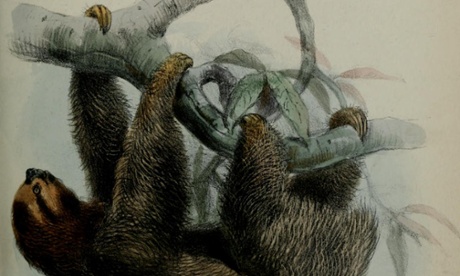 |
Berthold Seeman’s three-toed sloth
from Nicaragua. Internet Archive.
Photograph:Internet Archive
|
This engraving of a pale-throated sloth appears in an article on three-toed sloths by zoologist John Gray published in 1871. He had just received an interesting letter from German botanist Berthold Seemanwho was fascinated by the “greyish-green colour” of a specimen he’d brought back from Nicaragua. He fancied it was camouflage, the sloths blending in with the similarly coloured Spanish moss Tillandsia usneoidesthat festooned the trees. Observing that the green hue faded when he dried the animal’s skin out over a fire, Seeman speculated that the greenness might be “owing, at least in part, to the fact that the hair becomes covered with minute cryptogamic organisms, the damp climate and thick gloomy forests favourable to their growth.”


 Posts


