Showing posts with label Arizona. Show all posts

Wednesday, 5 February 2020

Rare Gila monster sighting in Arizona - via Herp Digest


Rumble 1/31/20
Go to https://yhoo.it/2uR2DgR for short video of a Gila monster.

Biologists who ventured out into the desert in Arizona in the middle of the night were in search of several different species of lizards and snakes to record and study, hoping to gain valuable information that would help with conservation efforts. But they did not expect to happen upon a very rare and intriguing lizard, the gila monster. These lizards are seldom seen in the wild and some biologists will go their entire career without sighting one. This team of scientists from Canada were well aware of their good fortune and one of them can be heard calling another biologist on his phone to share the news. In typical Canadian fashion, he apologizes to his friend for the fact that he has missed this amazing encounter.
     
The biologists photographically record, estimate measurement, and collect data from the sighting and then allow the lizard to continue on its way. The animals are not physically handled or restrained at any time. But the meeting caused Steve, a very accomplished researcher, to hyperventilate from excitement. His rapid breathing can be heard as the animal retreats into the brush. These scientists take their job seriously and they make every effort to ensure that animals are disturbed as little as possible. Their data will be very useful in many areas of conservation and preservation of threatened species.

Gila monsters have enjoyed legal protection in order to prevent them from slipping into the threatened species category by the IUCN but myths and misunderstanding by humans is still one of the biggest challenges that these "monsters" face. They are famous for being venomous and it is true that their saliva contains a powerful toxin, but it is not sufficiently powerful enough to seriously harm a human. A bite from a gila monster would make a healthy person ill for a few days, at most. But gila monsters are unlikely to ever attack a human, unless they were handled carelessly, or provoked. They are not fast moving and could almost never approach and bite a human who was actively trying to avoid it.

Gila monsters have sharp teeth and could inflict a painful bite if given the opportunity. They can also hold on tenaciously, if need be. Keeping a respectful distance prevents this sort of incident in all cases. Perhaps the biggest risk for humans is passing out from the excitement of seeing a live one in the wild.

As is true of most venomous creatures, they are of great interest to the medical community and their venom has been found to inhibit the growth of lung cancer. It has also been used to treat diabetes, and research is being conducted because of possible benefits in the treatment of Alzheimer's disease, schizophrenia, and other diseases.

Habitat destruction and irrational fear by humans continues to present a risk to the survival of this species. Their loss would be accompanied by the loss of potentially life-saving medicines and treatments. As well, gila monsters play a vital role in the delicate balance of nature.

Sunday, 17 November 2019

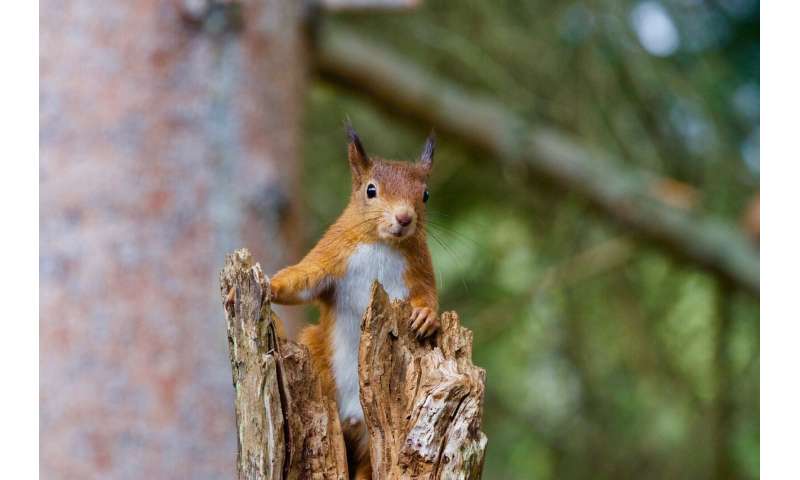
Survey finds gain in endangered red squirrel population

NOVEMBER 16, 2019

Credit: CC0 Public Domain

Wildlife officials say an endangered squirrel subspecies in southeastern Arizona is fighting its way back after much of its mountain habitat was burned by a 2017 wildfire.

The Arizona Game and Fish Department says the Mount Graham red squirrel's population is stabilizing, with a 4% increase recorded in September during an annual survey that produced an estimate of 78 squirrels, up from 75 in 2018.

According to the department, the population peaked at about 550 in the late 1990s. Before the 2017 wildfire, the population ranged between 200 and 300.

Terrestrial wildlife specialist Tim Snow says the results are encouraging though much work remains to help protect the squirrel population.

The squirrel is found only in upper elevation conifer forests of the PinaleƱo Mountains.

Wednesday, 27 March 2019

Translocation of bighorn sheep in Arizona has positive genetic outcomes


Date:  March 6, 2019
Source:  University of Wyoming
Translocation is an important management tool that has been used for more than 50 years to increase bighorn sheep population numbers in Arizona and to restore herds to suitable habitat throughout their historical range. Yet, translocation also can alter the underlying genetic diversity and spatial structure of managed wildlife species in both beneficial and detrimental ways.
A University of Wyoming researcher led a seven-year study to evaluate the long-term impact of translocation actions on bighorn sheep. From 2005-2012, the research group characterized statewide genetic structure and diversity by using microsatellite and mitochondrial DNA data in 16 indigenous and translocated bighorn sheep populations in Arizona.
"Our study showed that it is possible to re-establish bighorn sheep populations without a reduction of gene diversity over a short period and without erosion of ancestral lineage," says Holly Ernest, a UW professor of wildlife genomics and disease ecology, and the Wyoming Excellence Chair in Disease Ecology in the Department of Veterinary Sciences and the Program in Ecology.
Ernest was the senior and corresponding author of a paper, titled "Genetic Outcomes of Translocation of Bighorn Sheep in Arizona," that was published today (March 6) in the Journal of Wildlife Management. The journal publishes manuscripts containing information from original research that contributes to basic wildlife science. Suitable topics include investigations into the biology and ecology of wildlife and their habitats that have direct or indirect implications for wildlife management and conservation.

Wednesday, 2 January 2019

Lawsuit urges feds to protect snakes in Arizona, New Mexico – via Herp Digest


The Associated Press Dec 21, 2018 Updated Dec 21, 2018
A conservation group is suing the Trump administration over the protection of critical habitat for garter snakes in Arizona and New Mexico.
The Center for Biological Diversity filed a lawsuit Thursday in federal court in Tucson, accusing the U.S. Fish and Wildlife Service of endangering the Northern Mexican garter snake and the narrow-headed garter snake.
In the filing, the organization says the populations of both snakes are at lower densities in both states.
Both became listed as threatened in 2014 under the Endangered Species Act.
The Trump administration needs to safeguard the rivers the snakes rely on, an attorney for the Center for Biological Diversity says.
A spokesman for U.S. Fish and Wildlife Service did not immediately a message and email seeking comment.


Friday, 6 April 2018

Snake season gets underway in Arizona, as temperatures begin to rise – via Herp Digest


3/23/18 Phoenix, AZ, KSAZ-TV - Spring weather means snake season in Arizona, and there's already a casualty.

On Thursday, a man was bitten by a rattlesnake while doing some work outside in Surprise. The man was taken to the hospital, and is expected to be OK.

The sound of a rattlesnake is something people may be familiar with, but it may be a sound people hope to never hear in their own home. As the weather warms up, however, rattlesnakes are making more guest appearances in Valley homes.

"Snakes have been spending the winter in a nice place where they can stay warm, and now that it's getting warm at night, they're feeling a little more adventurous," said Bryan Hughes, owner of Rattlesnake Solutions.

Hughes makes house calls to properly relocate snakes away from homes.

"Sometimes, homes have things that snakes like," said Hughes. "Water sources, rock piles, rodents, that kind of thing. Snakes are going to start showing up at those places.”

Phoenix is home to six different species of rattlesnake, and a bite isn't anyone's idea of a good time

"There's not a lot of deaths that happen in Arizona from it," said Hughes. "Doctors know what they're doing, but you're probably looking at a helicopter ride and a lot of money going to it."
A lot of bites are accidental, but sometimes, people just need to be smart

"A lot of people are bitten because they're doing something they shouldn't," said Hughes. "Parks like this, people see a rattlesnake, they toss pebbles at it, pick it up to get a picture, don't do that stuff that's what gets you in the hospital.”


Sunday, 21 January 2018

Arizona pet store thieves caught stuffing snakes into their shirts on video - via Herp Digest


Kfvs12.com-Pheonix, Arizona —1/14/18 - Two people were caught on camera robbing an Arizona pet shop Wednesday and the thieves were apparently after snakes.

How they tried to get two very pricey reptiles out of the store surprised the shop's staff.

"It looked like there was collaboration, like they knew what they were doing, and what they wanted, which ones they wanted," said Matthew Benedict, a store employee at Custom Creatures.

Surveillance video shows a young man and woman checking out the store's selection of reptiles. But what they did next had store employees at a loss for words.

"They just jammed their key into the lock and just kept wiggling it until the lock finally broke," Benedict said.

In the video the guy reaches in and immediately shoves a $500 albino red tailed python in his shirt. But the couple wasn't done yet. Moments later, the woman grabs a $450 blue-eyed lucy python and puts it in her purse.

The video shows one of the snakes wasn't too thrilled about being manhandled, slithering out of his shirt as the thief stuffs it back in.

"Jordan confronted them when they were leaving and he just stood there dumbfounded," Benedict said.

The crooks pushed their way out the door, but a photo shows shop owner Jordan Moore's wrestling one of the snakes away before their escape.

Surveillance video posted to their Facebook page was shared thousands of times. Eventually someone came forward and identified the thieves.

And Moore gave them an ultimatum: Return the other snake in 24 hours or he'd call the police.

"Posted on Facebook, a lot of people have seen that, they know what you look like, it's time to do the right thing now," Benedict said.


The second snake was returned to the store just before they closed Thursday night, allowing the thieves to avoid formal charges.

Monday, 28 August 2017

Bubonic plague-carrying fleas found in parts of northern Arizona

AUGUST 15, 2017

by Chuck Bednar
Fleas in some parts of northern Arizona have tested positive for the bubonic plague, a now-rare disease believed to have been responsible for millions of deaths during the Middle Ages, health officials confirmed to ABC NewsNewsweek and other media outlets over the past week.

The infected parasites were first detected in Coconino County and have since also been found in Navajo County, according to published reports. While the insects have indeed tested positive for Yersinia pestis, the bacteria that causes the plague, thus far, no illnesses have been reported.

In a statement, the Navajo County Health Department said that it was “urging the public to take precautions to reduce their risk of exposure to this serious disease, which can be present in fleas, rodents, rabbits and predators that feed upon these animals.” They added that the illness “can be transmitted to humans and other animals by the bite of an infected flea.”

Humans can also catch the disease through bodily fluids (such as respiratory droplets), as well as through direct contact with infected animals (including handling tissues or fluids from a creature that has contracted the disease), Newsweek noted. People living, working or visiting the affected areas are also advised to keep their pets from roaming free, ABC News added.

Sunday, 14 May 2017

Native fish project, 25 years in making, comes to fruition

GAME AND FISH NEWS


In mid-May, the Arizona Game and Fish Department (AZGFD) will stock Gila topminnow into Arnett Creek, near Superior, with the expectation that the species will establish a population. The addition of Gila topminnow will be the final step in a project that has been in the works for more than two decades.

Back in 1992, AZGFD, Tonto National Forest (TNF), and U. S. Fish and Wildlife Service identified an opportunity to re-establish a native fish community in Arnett Creek.

After environmental planning, a fish barrier was built to deter re-entry of non-native fishes, the stream was chemically treated to remove nonnative fishes, and in the late-1990s a few native fish were stocked. Those fish did not establish populations, and a subsequent drought greatly reduced the amount of perennial water habitat in the system.

The partners re-evaluated the stream in 2007 and determined that the small amount of habitat was most suitable for longfin dace and endangered Gila topminnow. The plan was to stock longfin dace first, and if they established a population, to move forward with Gila topminnow. Longfin dace were stocked in 2007, and they have established a population. So the partners continued to plan for introducing Gila topminnow.

Finally, all of the environmental planning has been completed, and Gila topminnow will be stocked.

“Hopefully they will establish populations, because establishing new populations is necessary to recover the species so that it will no longer need protection under the Endangered Species Act,” said Tony Robinson, AZGFD’s Gila River Basin Native Fishes Lead.

Historically, topminnow were the most abundant fish species in the Gila River basin from western New Mexico to southern and western Arizona. Over time, habitat loss and degradation brought the topminnow to the brink of extinction. Habitat improvement and reintroductions, such as at Arnett Creek, are contributing to substantial, recent advances in the species’ recovery.

AZGFD will be collecting the topminnow from a pond near Amado owned by one of its partners in topminnow conservation under the Safe Harbor Agreement for Topminnows and Pupfish.

Native fish are just one part of the Arnett Creek story. During the last year of planning, Tonto National Forest has also partnered with AZGFD and other local groups to help protect and restore Arnett Creek.

Arnett Canyon is used by horseback riders and hikers. There were many trails in the riparian area, so TNF and its partners improved the main trail and fenced the riparian area to focus people and riders onto the main trail. TNF and AZGFD also worked collaboratively on repairing fencing and installing drinkers for the local rancher’s livestock.


Did you know?
The Arizona Game and Fish Department receives NO Arizona general fund tax dollars? We hold the state’s wildlife in trust for the public without a dime from Arizona taxpayers. 

Wednesday, 11 January 2017

How Big Of A Problem Is Reptile Poaching In Arizona? – via Herp Digest


By  Mark Brodie, Published: Friday, January 6, 2017 -KJZZ.00rg

For full story on audio

Arizona law generally prohibits taking, possessing, buying or selling wildlife, except in certain circumstances. But, that doesn’t stop poachers from capturing and selling reptiles and other exotic animals. Russ Johnson is president of the Phoenix Herpetological Society, and he talks about how big of a problem reptile poaching is in Arizona. 

The Maricopa County Attorney’s Office tells us they’ve only received two submittals for prosecution in the past 12 months under the part of state law dealing with Game and Fish violations.

MCSO spokeswoman Amanda Jacinto says the office generally doesn’t get a lot of cases, and those it does get are most often misdemeanors — that’s the charge for someone caught illegally taking reptiles from wildlife. She says if prosecutors can prove a poacher’s trying to sell the reptile, that becomes a felony.

"Proving possession, for the most part, for our prosecutors is pretty easy – most of the time we have Game and Fish agents that are out there and able to verify that these people were in possession of these animals illegally. The hardest thing, of course, is that burden of proof – trying to figure out where they actually obtained them, and trying to prove whether or not they were trying to sell them those animals, as well, because it is such an underground community," she said. 

And, Jacinto says, the punishments don’t always seem like big deterrents to poachers.

"In a lot of cases, they would rather go in there, and plead to the Class 2 felony and accept the fines and charges of that, knowing that they can turn around and perhaps do it again and make more profit out of this illegal activity," she said. 

Jacinto says most of these cases come from Game and Fish agents, like Tyler VanVleet. He’s law enforcement program manager with Arizona Game and Fish. VanVleet talks about how easy or difficult it is to catch poaches.

Sunday, 8 January 2017

How Big Of A Problem Is Reptile Poaching In Arizona? - via Herp Digest


By  Mark Brodie, Published: Friday, January 6, 2017 -KJZZ.00rg

For full story on audio

Arizona law generally prohibits taking, possessing, buying or selling wildlife, except in certain circumstances. But, that doesn’t stop poachers from capturing and selling reptiles and other exotic animals. Russ Johnson is president of the Phoenix Herpetological Society, and he talks about how big of a problem reptile poaching is in Arizona. 

The Maricopa County Attorney’s Office tells us they’ve only received two submittals for prosecution in the past 12 months under the part of state law dealing with Game and Fish violations.

MCSO spokeswoman Amanda Jacinto says the office generally doesn’t get a lot of cases, and those it does get are most often misdemeanors — that’s the charge for someone caught illegally taking reptiles from wildlife. She says if prosecutors can prove a poacher’s trying to sell the reptile, that becomes a felony.

"Proving possession, for the most part, for our prosecutors is pretty easy – most of the time we have Game and Fish agents that are out there and able to verify that these people were in possession of these animals illegally. The hardest thing, of course, is that burden of proof – trying to figure out where they actually obtained them, and trying to prove whether or not they were trying to sell them those animals, as well, because it is such an underground community," she said. 

And, Jacinto says, the punishments don’t always seem like big deterrents to poachers.

"In a lot of cases, they would rather go in there, and plead to the Class 2 felony and accept the fines and charges of that, knowing that they can turn around and perhaps do it again and make more profit out of this illegal activity," she said. 
Jacinto says most of these cases come from Game and Fish agents, like Tyler VanVleet. He’s law enforcement program manager with Arizona Game and Fish. VanVleet talks about how easy or difficult it is to catch poaches.

Wednesday, 27 April 2016

Desert dolphins: plan to bring animals to Arizona for show outrages activists

More than 100,000 people signed a petition against a plan for Dolphinaris, which would house dolphins in pools and allow people to swim with and ride them

Oliver Milman 

Monday 25 April 201618.07 BSTLast modified on Monday 25 April 201618.20 BST 

A plan to transport a group of dolphins to the Arizona desert so tourists can pay to frolic with them has come under fire from animal welfare activists who claim the attraction will be harmful to people as well as the dolphins.

More than 100,000 people have signed a petition against a plan for a Dolphinaris to be established on tribal land near Scottsdale, Arizona. The facility would house dolphins in pools and allow people to swim with and ride the marine mammals.

Dolphinaris is already established in five locations in Mexico. Its parent company, Ventura Entertainment, is looking to expand to the US with the Arizona attraction, which will be near OdySea in the Desert – a 35-acre complex featuring sharks, turtles and penguins.

OdySea has denied that it is affiliated with the Dolphinaris project. According toreports in the Mexican media, the $20m Dolphinaris development is set to open in July. A protest against the attraction is planned for 7 May.

Opponents of the Dolphinaris argue the hot, dusty environment is no place for dolphins, which would be expected to swim in small, repetitive circles in an area vastly smaller than their natural marine habitat.

The Humane Society said swimming-with-dolphins attractions are also risky for people. There have been reports of confined dolphins biting people and even incidents that resemble sexual assault.

“These animals are used to an environment where they can roam, swimming hundreds of miles a day in a rich environment,” said Sharon Young, marine issues field coordinator at the Humane Society. “Once you put them in a tank, it’s an impoverished existence. It would be like if someone never let you out of your bedroom. There has been some sexual aggression towards swimmers. It’s not a good environment for anyone.”


Wednesday, 10 February 2016

Video shows only known wild jaguar in US at home in Arizona mountains

The big cat, known as ‘El Jefe’, has been living in 25 miles south of downtown Tucson – half a century after the last verified US jaguar was killed by a hunter

Associated Press in Tucson, Arizona
Wednesday 3 February 2016 21.31 GMTLast modified on Thursday 4 February 201615.53 GMT

The only known wild jaguar in the United States is seen roaming around a creek and other parts of a mountain range just south of Tucson, Arizona in the first publicly released video of the big cat.

 “El Jefe” – Spanish for “the boss” – has been living in the Santa Rita mountains 25 miles south of downtown Tucson for over three years, according to the Center for Biological Diversity.

El Jefe is about seven years old and is the only documented wild jaguar in the country. He is one of only four or five jaguars that have been spotted in the US in the last 20 years.

“A lot of people have no idea that we have jaguars in the United States or that they belong here,” said Randy Serraglio of the Tucson-based Center for Biological Diversity. “In bringing this video, we hope to inspire people to care about these animals and support protection for their homes.”

Conservationists say El Jefe’s habitat is threatened by a proposed open-pit copper mine in the Santa Ritas. The proposed Rosemont mine has been in the works for several years but is tied up in the permitting phase. A spokeswoman for the company that owns the mine, Hudbay Minerals, said she was working on a statement on Wednesday.


Wednesday, 17 June 2015

Man survives 500 to 1,000 stings by swarming Arizona bees

By David Schwartz
June 12, 2015 10:38 PM


PHOENIX (Reuters) - A man is lucky to be alive after having been stung between 500 and 1,000 times by tens of thousands of swarming bees near Kingman in northwestern Arizona on Friday, authorities said.

The unidentified man was in stable condition at Kingman Regional Medical Center following the attack after he apparently disturbed a large hive in the backyard of a home, said Mohave County sheriff’s spokeswoman Leslie DeSantis.

"The number of bees in the shed was unbelievable," DeSantis said. "The deputy who arrived said it was it was like something you’d see in the movies. It was just amazing."

Authorities said the man was working on the property when he was stung and ran to his vehicle, getting help from two passersby who were also stung. They were not hospitalized.

Sunday, 18 January 2015

Giant beaver captured at Phoenix-area lake

January 16, 2015 4:10 PM

TEMPE, Ariz. (AP) — A giant beaver is on the mend after getting captured near a Phoenix-area lake this week.

The beaver drew the attention of joggers and onlookers in recent weeks at Tempe Town Lake because of its more than 40-pound size. Wildlife workers captured the animal with a net this week and took it to the Southwest Wildlife Conservation Center, where the beaver will stay until it gets healthy again and is released back into the wild. The animal was lethargic when it came in.

Thursday, 25 December 2014

Elusive black bear spotted again in Phoenix suburb

MESA, Ariz. (AP) — A black bear that caused a stir when it ran through a field in a Phoenix suburb has been spotted again, a state wildlife official said Tuesday.

Residents reported seeing the bear twice between 3:30 a.m. and 4:30 a.m. in east Mesa, Arizona Game and Fish spokeswoman Amy Burnett said.

Wildlife personnel had been searching near the Mesa airport, but the animal hasn't been located. The agency is halting the search for now, she said.

"It's called off until we have another confirmed sighting," Burnett said.

Bears typically move around in the evening and morning, so a sighting in the middle of the day would be unlikely, she added. Anyone who does see the bear is advised to call Game and Fish or local police.

"Do not approach it," Burnett said. "Don't try to feed it."

Tuesday, 25 November 2014

Lone Wolf Traveled More Than 450 Miles to Grand Canyon, DNA Confirms

by Megan Gannon, News Editor | November 24, 2014 07:26am ET

A DNA test has confirmed that a lone gray wolf is roaming Arizona, just north of the Grand Canyon, a long way from its home in the northern Rockies.

The animal, which is protected under the Endangered Species Act, is the first known gray wolf to visit Arizona in about 70 years. The species disappeared from the state in the 1940s, which makes this development exciting news for conservationists who want to see wolves spread back into their former habitats.

After repeated sightings of the wolf over the last month, the U.S. Fish and Wildlife Service (FWS) collected a sample of the animal's feces in Kaibab National Forest, near the north rim of the Grand Canyon. 

Related Posts with Thumbnails

ShareThis