Showing posts with label Indonesia. Show all posts

Friday, 13 March 2020

Researchers discover the Sulawesi hairy-tailed shrew

MARCH 11, 2020

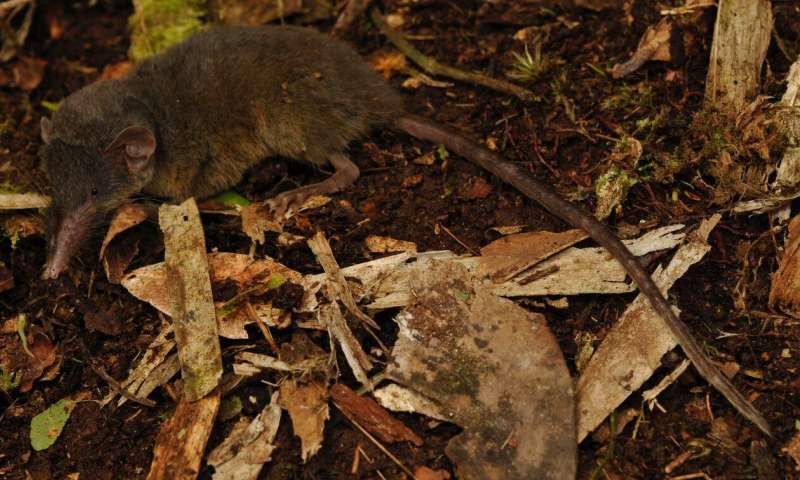
Researchers at Louisiana State University discovered this new species, the Sulawesi hairy-tailed shrew, in Indonesia. Credit: Kevin Rowe, Museums Victoria.

Researchers at Louisiana State University have discovered a new species of shrew, which they have named the hairy-tailed shrew, or Crocidura caudipilosa.

"There was no doubt that this was a new species," said LSU Museum of Natural Science Mammal Curator Jake Esselstyn whose work on Sulawesi Island in Indonesia led to the discovery published in the Journal of Mammalogy. "There isn't another species on the island that has as much hair on its tail, in terms of shrews."

The newly discovered shrew is slender with gray-brown fur on its back and silver-gray fur on its belly. Its tail is slightly longer than the combined length of its head and body and is covered with long bristles and hair, which make the distinctive tail very hirsute. In fact, no other shrew species in Indonesia, Malaysia or the Philippines is known to have such thick, long hair on its tail; however, some shrew species in Africa have very hairy tails. The scientists were also surprised to discover that this shrew climbs trees whereas most shrews live primarily on the ground, as far as anyone knows.

The Sulawesi hairy-tailed shrew was found on nine mountains across Sulawesi at various elevations from 1,500 feet to 4,800 feet.

"Tropical diversity is still not well documented even for mammals with a wide distribution on this island. This discovery shows how little we still know about mammal diversity," Esselstyn said.

Monday, 24 February 2020

Rare bats in decline

Date: February 14, 2020
Source: City College of New York

A study led by Susan Tsang, a former Fulbright Research Fellow from The City College of New York, reveals dwindling populations and widespread hunting throughout Indonesia and the Philippines of the world's largest bats, known as flying foxes.

Unfortunately, hunting not only depletes the flying foxes, which are already rare, but also potentially exposes humans to animal-borne pathogens (a process known as zoonosis). "For instance, the current case of Wuhan Coronavirus is thought to have been spread from wild bats to humans through an intermediate host at a wildlife market," said CCNY biologist and Tsang's mentor David J. Lohman, an entomologist and two-time Fulbright recipient.

The CCNY experts found that flying foxes originated in a group of islands in Indonesia called Wallacea. They diversified into different species by flying to other islands that presumably lacked competitors and established themselves. Thus, islands are critical to the evolution and conservation of this large group of around 65 mammal species.

"This study provides insight into biodiversity conservation and public health. Islands are frequently home to endemic species found nowhere else," noted Tsang, who earned a PhD in biology from the Graduate Center, CUNY.

Thursday, 28 November 2019

Manta rays and whale sharks consuming massive amounts of plastics near Indonesia

NOVEMBER 20, 2019 REPORT

by Bob Yirka , Phys.org 

Various sizes and types of plastic debris found in manta ray vomit material (n = 1) from Nusa Penida, Indonesia. Larger debris are photographed under high (A,B) and low (C) magnification, and smaller debris (D) under high magnification. Credit: Frontiers in Marine Science (2019). DOI: 10.3389/fmars.2019.00679 

A team of researchers from Australia, the U.S., Indonesia and New Zealand has measured the amount of plastics that manta rays and whale sharks are ingesting off the coast of Indonesia. In their paper published in the journal Frontiers in Marine Science, the group describes how they measured the ingestion of plastics by the marine animals. 

There is a large amount of plastic in the ocean due to a variety of human activities. In recent years, scientists have been trying to better understand the impacts of the plastic on marine life. In this new effort, the researchers focused on manta rays and whale sharks, and plastics in the ocean off the coast of parts of Indonesia. 

The work began after one of the team members went swimming off the coast of Indonesia and found the waters teeming with plastics. Curious about the impact of so much plastic on marine creatures that sift plankton for their survival, they undertook a study to learn more. 

The work involved tossing fine-meshed nets over the side of a boat and trolling to mimic the way mantas and whale sharks feed—they noted the mesh was fine enough to collect both plankton and very tiny bits of plastic. They noted also that they trolled areas that were known to be feeding grounds for both marine animals.


Sunday, 1 September 2019

Indonesia to close giant lizard island leaving guides, villagers in the lurch (Komodo Dragon) - via Herp Digest

KOMODO, Indonesia by Tommy Ardiansyan,(Reuters) 8/26/19 - Almost every day 20-year-old Rizaldian Syahputra puts on his blue uniform, laces up his high boots and leaves his wooden house on stilts for a job many nature-lovers would envy.
But by next year, he may no longer be employed.

Syahputra works as a wildlife guide at Komodo National Park on the eastern Indonesian island of Komodo, taking visitors around the park on foot to get up close to the leathery Komodo dragons, the world’s largest living lizard species.

The Indonesian government plans to close the island to the public from January next year in a bid to conserve the rare reptiles.

The scheme also involves moving about 2,000 villagers off the island. Authorities are holding talks with community leaders on how to relocate the residents, Josef Nae Soi, deputy governor of the province of East Nusa Tenggara, told Reuters recently.

It is hoped that closing the island to tourists will cut the risk of poaching and allow a recovery in the numbers of the animals’ preferred prey, such as deer, buffalo and wild boar.

The island could reopen after a year, but the plan is to make it a premium tourist destination, Soi said.

Syahputra, who says he enjoys his job because of his passion for nature and conservation, shares the fears of many others on the island who rely on tourism for a living.

“The closure is definitely something that makes us unhappy,” he said.

“If we really have to do it, I hope we can find a middle ground on the solution, not closing the whole island but just a certain area.”

More than 176,000 tourists visited Komodo National Park, a conservation area between the islands of Sumbawa and Flores, in 2018. The whole area was named a UNESCO World Heritage Site in 1991.

About 1,700 Komodo dragons are estimated to live on Komodo island. Other islands in the national park that are home to more than 1,400 of the giant lizards, such as nearby Rinca and Padar, will remain open to tourists.

Villagers who have lived on Komodo island for generations are unsurprisingly opposed to the idea of having to leave.

We have been living as one for years with this village,” said resident Dahlia, who gave only one name.

Sunday, 28 April 2019

Komodo considers tourist ban to help boost dragon numbers


Indonesian authorities want to protect endangered lizard from smugglers and restock its island food supply
Thu 4 Apr 2019 17.34 BSTFirst published on Thu 4 Apr 2019 02.32 BST
Authorities are considering banning tourists from Komodo, the island home of the ancient Komodo dragon, to allow for conservation efforts amid concerns over animal-smuggling.
The island, in Manggarai Barat, Indonesia, is a major tourist destination, with many people making the trip to see the lizard which has a venomous bite, can grow up to three metres long and weigh more than 150kg.
Authorities are considering a temporary closure so they can plant native vegetation and help to restock the dragon’s food supply, thereby increasing the population, reported the Tempo newspaper. Dates for the closure have not been confirmed but earlier discussions have suggested it could last a year.
The talks come amid efforts to tackle the illegal market in endangered species. Police in East Java arrested five people in March accused of smuggling Komodo dragons and other protected animals. Police said the suspects had already sold more than 41 Komodos through Facebook, supposedly for medicinal use. Tempo reported the lizards sold for 500m rupiah (£27,000) each.


Thursday, 21 March 2019

World's biggest bee found alive


By Helen Briggs BBC News, Science and Environment
22 February 2019
The world's biggest bee has been re-discovered, after decades thought lost to science.
The giant bee - which is as long as an adult's thumb - was found on a little-explored Indonesian island.
After days of searching, wildlife experts found a single live female, which they photographed and filmed.
Known as Wallace's giant bee, the insect is named after the British naturalist and explorer Alfred Russel Wallace, who described it in 1858.
Scientists found several specimens in 1981 on three Indonesia islands. It has not been seen alive since, although there was a report last year of two bee specimens being offered for sale online.
In January, a team followed in Wallace's footsteps on a journey through Indonesia in an attempt to find and photograph the bee.
"It was absolutely breathtaking to see this 'flying bulldog' of an insect that we weren't sure existed anymore, to have real proof right there in front of us in the wild," said natural history photographer, Clay Bolt, who took the first photos and video of the species alive.
"To actually see how beautiful and big the species is in life, to hear the sound of its giant wings thrumming as it flew past my head, was just incredible. "


Monday, 25 February 2019

Climate change: 'Future proofing' forests to protect orangutans


By Helen Briggs BBC News
7 February 2019
A study has identified key tree species that are resilient to climate change and support critically endangered apes.
Planting them could help future proof rainforests, which are a key habitat for orangutans, according to the International Union for Conservation of Nature - IUCN.
Researchers surveyed 250 plants in Indonesia's Kutai National Park.
Over 1,000 orangutans are thought to inhabit the park, as well as other rare animals such as the Malayan sun bear.
"Selecting which species to plant is a significant contribution to restoring the health of this ecosystem," said study co-author Douglas Sheil.
"Of course, the reasons why forest cover was lost in the first place must also be addressed for reforestation efforts to succeed."
Kutai National Park is located on the east coast of Borneo Island, in the East Kalimantan province of Indonesia.
The forest faces threats from logging, fires and mining, and was once considered a conservation wasteland.


Wednesday, 9 January 2019

Indonesia tsunami raises fears for endangered Javan rhino


December 28, 2018 
The latest killer tsunami in Indonesia has put pressure on conservationists to ramp up a longstanding plan to find a suitable secondary habitat for the Javan rhino
Indonesia's tsunami has raised fears that another deadly wave could wipe out the few dozen Javan rhinos still living in the wild, conservation authorities said Friday.
There are believed to be fewer than 70 of the critically endangered species in a national park not far from a rumbling volcano that triggered Saturday's killer wave.
None of the animals are believed to have been killed in the disaster—which left more than 400 people dead—but officials are warning that another deadly wave could slam into the stricken region.
That is putting pressure on conservationists at Ujung Kulon National Park, on the western tip of Indonesia's main island of Java, to ramp up a longstanding plan to find a suitable secondary habitat for the rhinos.
"It's become our duty to work harder to find a second habitat because the danger is real," national park chief Mamat Rahmat told AFP.
"We're lucky that the tsunami did not affect the Javan rhinos this time. But the threat is there and we need to act accordingly."
Widodo Ramono, head of the Rhino Conservation Foundation of Indonesia, added: "If you've only got one habitat and there's another tsunami, the rhinos could be wiped out completely."
Plans to find a second home for the species have been in the works for about eight years, with conservationists surveying areas all over Java and neighbouring Sumatra but so far without success, he said.

Sunday, 6 January 2019

Indonesia tsunami: volunteers rescue dozens of stranded turtles


After a harrowing week of human tragedy, rescuers find a moment of hope as they return more than 30 turtles to the sea
Jamie Fullerton in Banten province, Indonesia
Fri 28 Dec 2018 04.10 GMTLast modified on Fri 28 Dec 2018 15.30 GMT
For the officials and volunteers aiding rescue efforts after the tsunami that killed at least 430 people in Indonesia, it has been a grim week.
After deadly waves hit the coasts of Java and Sumatra in the Sunda Strait, they know they are more likely to find bodies than survivors. Amidst the horror, volunteers are clinging to any victories, however small, to keep them going.
One bright moment in an otherwise horrific week has been the rescue of more than 30 turtles that the tsunami washed up on the west coast of Banten.
The majority were at Tanjung Lesung resort, where more than 106 people died. As volunteers were attending to the bodies they noticed the turtles, some weighing almost 200kg, stranded around the resort. After the human casualties had been attended to, volunteer Eko Sulistio, 45, organised a seven-person turtle rescue group.
Since then more than 20 turtles have been carried to the ocean and released by the team. They included loggerhead sea turtles plus rare hawksbill and green sea turtles, according to volunteers and experts. Another 13 turtles were rescued by a second team from the locally based Serang Nature Conservation Agency.

Thursday, 29 November 2018

Indonesia: dead whale had 1,000 pieces of plastic in stomach


Sperm whale washed up in Sulawesi had flip-flops, bottles, bags and 115 drinking cups in its stomach
Associated Press in Jakarta
Tue 20 Nov 2018 10.27 GMTLast modified on Tue 20 Nov 2018 10.42 GMT
A dead whale that washed ashore in eastern Indonesia had a large lump of plastic waste in its stomach, including flip-flops and 115 drinking cups, a park official has said, causing concern among environmentalists and government officials in one of the world’s largest plastic polluting countries.
Rescuers from Wakatobi national park found the rotting carcass of the 9.5 metre (31ft) sperm whale on Monday near the park in Southeast Sulawesi province after receiving a report from environmentalists that villagers had surrounded the dead whale and were beginning to butcher the rotting carcass, park chief Heri Santoso said.
Santoso said researchers from wildlife conservation group WWF and the park’s conservation academy found about 5.9kg (13lbs) of plastic waste in the animal’s stomach containing 115 plastic cups, four plastic bottles, 25 plastic bags, two flip-flops, a nylon sack and more than 1,000 other assorted pieces of plastic.
“Although we have not been able to deduce the cause of death, the facts that we see are truly awful,” said Dwi Suprapti, a marine species conservation coordinator at WWF Indonesia.
She said it was not possible to determine if the plastic had caused the whale’s death because of the animal’s advanced state of decay.
Indonesia, an archipelago of 260 million people, is the world’s second-largest plastic polluter after China, according to a study published in the journal Science in January. It produces 3.2 million tons of mismanaged plastic waste a year, of which 1.29m tons ends up in the ocean, the study said.
Luhut Binsar Pandjaitan, Indonesia’s coordinating minister of maritime affairs, said the whale’s discovery should raise public awareness about the need to reduce plastic use, and had spurred the government to take tougher measures to protect the ocean.

Monday, 26 November 2018

Sumatran elephant found dead with missing tusks in Indonesia


November 17, 2018
Rampant deforestation has reduced the species' natural habitat and brought them into conflict with humans
A Sumatran elephant has been found dead with its tusks removed in an apparent poaching case targeting the critically endangered animal, an Indonesian conservation official said Friday.
The 10-year-old male's rotting corpse was found in Blang Awe village in Aceh province earlier this week.
"His tusks were missing and there were traces of blood in the location where he was found," Aceh conservation centre head Sapto Aji Prabowo told AFP.
Officials estimated the animal had been dead for at least a week when the carcass was discovered.
The cause of death was not immediately clear because the body was badly decomposed, Prabowo said.
Tissue samples will be analysed for signs of poisoning.
Rampant deforestation has reduced the species' natural habitat and brought them into conflict with humans, while their tusks are prized in the illegal wildlife trade.
At least 11 wild elephants died in Aceh last year, most of them killed by humans.
In July, a Sumatran elephant was found dead from apparent poisoning in a palm oil plantation.
The environment ministry estimates only around 500 Sumatran elephants remain in Aceh.


Thursday, 19 April 2018

Indonesian conservation bill is weak on wildlife crime, critics say


by Basten Gokkon on 6 April 2018

Lawmakers in Indonesia have submitted for review to President Joko Widodo’s administration a bill that would overhaul the country’s 28-year-old conservation law.

While environmental advocates have long pushed for updates to the law, the new draft has alarmed many with its various provisions that critics say represent a regression from the existing legislation.

Problem articles include a “self-defense” clause that would waive criminal charges for killing protected wildlife; a more nebulous definition of wildlife crime that some fear could make it harder to crack down on traffickers; and the opening up of conservation areas to geothermal exploration and other “strategic development” projects.

The ball is now in the court of the government, which is required to review the bill before sending it back to parliament for final passage. However, a minister says the government will “hold off” on its review, and suggests the existing conservation law is sufficient.

JAKARTA — Environmental advocates have warned that proposed revisions to Indonesia’s conservation act could provide new loopholes for wildlife traffickers, who already enjoy a thriving trade in one of the world’s most biodiverse countries.

The revision of the conservation act, formally the Natural Resources Conservation Law of 1990, was widely anticipated to help authorities crack down harder on the illegal wildlife trade. And the latest draft submitted by parliament to the government for review does make some moves toward that goal: it would ban the trade in species not mentioned on Indonesia’s list of protected species but that are regulated by CITES, the main international treaty on endangered animals and plants. For instance, it could help close a loophole that allows traffickers to move items such as African elephant ivory through the Southeast Asian country with impunity.

Read on  


Friday, 16 February 2018

Borneo orangutan found riddled with gunshots in latest attack


Indonesian authorities say male orangutan was found with 130 airgun pellets and machete wounds in the second known killing this year

Agence France-Presse
Wed 7 Feb 2018 12.27 GMTLast modified on Wed 7 Feb 2018 22.00 GMT

The body of a Borneo orangutan has been found riddled with some 130 airgun pellets, Indonesian authorities have said, the second known killing this year.

The male orangutan, which also showed signs of machete wounds, was found by villagers in Borneo’s East Kutai district this week, police said, adding that an autopsy had been carried out.

“We found pellets all over its body. There were also a number of cut wounds that could have been caused by a machete,” said local police chief Dedi Agustono, who added that the killer had not been caught.

“It is the most bullet wounds we have ever seen on an orangutan,” he added. Most of the pellets were lodged in the animal’s head and around its eyes.

The killing comes about a week after Borneo police arrested two rubber plantation workers and accused them of shooting an orangutan multiple times and then decapitating it.

Another orangutan was found last week floating in a river after being shot and decapitated. 

The orangutan’s headless body had been found floating in a river on the island, which is shared with Malaysia.


Sunday, 10 September 2017

80% of Bornean orangutans live outside protected areas


by Hans Nicholas Jong on 5 September 2017
The finding is part of a new report led by the Indonesian government.
The study confirms that orangutan populations have plunged over the past decade.
It recommends several strategies for protecting the primates, including working with plantation companies to preserve forests within lands they have been licensed to develop.
Four fifths of wild orangutans in Kalimantan, the Indonesian portion of Borneo, live outside national parks and other protected areas, according to a new study by the Indonesian government.
The study, called the 2016 Orangutan Population and Habitat Viability Assessment, was led by the Ministry of Environment and Forestry. Released last month, it is the third of its kind, with the last one done in 2004.
The study confirms that orangutan populations have plummeted as their forest habitats continue to be flattened by the expansion of industry. So too has an illegal pet trade taken its toll on remaining populations.
The study estimates that 57,350 critically endangered Bornean orangutans (Pongo pygmaeus) remain in Kalimantan. That’s 13-47 individuals per 100 square kilometers, down from around 45-76 in 2004.


Sunday, 28 May 2017

Monkey mafia steal your stuff, then sell it back for a cracker

25 May 2017

By Brian Owens

Long-tailed macaques living near an Indonesian temple have figured out how to run a ransom racket on visiting tourists.

The monkeys grab valuables, such as glasses, hats, cameras or, in one case, a wad of cash from the ticket booth, then wait for temple staff to offer them food before dropping their ill-gotten gains and dashing off with the tasty prize (see video below).

Although this behaviour has been reported anecdotally at Uluwatu Temple on the island of Bali for years, it had never been studied scientifically in the wild. So Fany Brotcorne, a primatologist at the University of Liège in Belgium, and her colleagues set out to discover how and why it has spread through the monkey population.

“It’s a unique behaviour. The Uluwatu Temple is the only place in Bali where it’s found,” she says, which suggests it is a learned behaviour rather than an innate ability.

Brotcorne wanted to determine whether it was indeed cultural, which could help us better understand the monkey’s cognitive abilities, and even human evolution.

Robbing and bartering
She spent four months observing four different groups of monkeys that live near the temple. The two groups that spent the most time around tourists had the highest rates of robbing and bartering, supporting the idea that they were learning the behaviour by watching each other. Groups with more young males, who are more prone to risky behaviour, also had higher rates than other groups.

Although this study is based on only a small sample, Brotcorne believes her team has found the first preliminary evidence that the behaviour is a cultural one, transmitted across generations by monkeys learning from each other.

In the years since these observations, she has gathered more evidence: the members of a fifth group of macaques that moved into the area around the temple have also started to learn that they can barter stolen goods for snacks.

Serge Wich, a primatologist at Liverpool John Moores University in the UK, says Brotcorne’s work provides “a novel and quite spectacular example of flexibility in primate behaviour in response to environmental changes”.

Read more

Sunday, 14 May 2017

Australia Maintains Strict Quarantine Regulations As Traveler Brings Dead Black-Spined Toad In His Shoe Back From Indonesia - via Herp Digest

(Authorities believe the passenger was unaware that he was carrying the amphibians and were not smuggling wildlife.)

The Science Times, by Earth Das, 5/12/17

Australia urged travelers to check their luggage, after the discovery of hitchhiking toads in the baggage of some passengers. The quarantine authorities take this step to maintain strict quarantine regulations.

The quarantine authorities in Australia have recently asked the travelers to check their luggage and belongings properly. Just a few days ago the authorities detected one dead Indonesian toad in the shoe of a passenger after he arrived at the airport. It is believed that the authorities want to avert any kind of biohazards.

Phys.org reported that toads from Thailand and Indonesia were found very recently at three important airports in Australia. The Department of Agriculture of Water Resources warned all the travelers to check their belongings after these recent incidents. Authorities believe the passengers were surely unaware that they were carrying these amphibians and were not smuggling wildlife.

A biosecurity officer at the Cairns Airport in Australia discovered a black-spined dead toad from the shoe of an Australian. Most probably the toad was earlier alive and later died only when the passenger wore the shoe in Indonesia. Lyn O'Connor, department's head of biosecurity, stated the fact.

Another similar incident happened at the Perth Airport in Australia when a flight came from Thailand. Officers detected one live banded bullfrog in the shoe of that passenger. So far no official words are available about whether the passenger was actually wearing the shoe or packed it in the luggage.

A black-spined toad was also found in a woman's luggage when she arrived at the Melbourne Airport in Australia. The passenger was coming from Thailand and interestingly, this time the amphibian was alive. According to Lyn O'Connor, this kind of toad could carry the exotic parasites and can damage the Australian environment.

The Mail Online reported that the black-spined toad is actually related to the cane toad, and this amphibian has no natural predators in Australia. The Department of Agriculture revealed that the toad can create potential damage. This carnivore amphibian could compete with the native toads and frogs for the habitats and food. In a word, their presence can create severe environmental problems.

Australia always maintains strict quarantine regulations to prevent the infiltration of the pests and the diseases that can destroy the unique wildlife of the country. Several past incidents have proved this fact. Now the recent incident once again shows the existence of the tough quarantine policies.

Sunday, 7 May 2017

Komodo dragon bites Singaporean tourist in Indonesia - via Herp Digest

JAKARTA, Indonesia - AP 5/5/17- A Komodo dragon has bitten an overly inquisitive tourist in Indonesia who ignored warnings about getting too close to the enormous reptile while it was eating, a national park official said.

The tourist from Singapore was bitten on his leg Wednesday morning while taking pictures of the Komodo dragon, the world's largest lizard, said the chief of the Komodo National Park, Sudiyono.

Sudiyono said the man was rescued by locals and rushed to a hospital in Labuan Bajo on Flores Island, near Komodo Island, for treatment.

Endangered Komodo dragons are found in the wild on several eastern Indonesian islands. They can grow to 3 meters (10 feet) or more in length.

Attacks on humans are rare but may increase as Indonesia is promoting the Komodo National Park as a tourist destination. In 2013, a guide and a park ranger were attacked in separate incidents.

Experts say the Komodo dragon population in the wild is less than 4,000 but stable.

Friday, 3 March 2017

Baby orangutan rescued after being kept as a pet

February 23, 2017
Seven-month-old Vena was rescued by wildlife officals and environmentalists from someone who had illegally kept her as a pet


Baby primate Vena shyly turned her head away from a bottle as two vets tried to feed her, the latest Bornean orangutan rescued in Indonesia after being kept as a pet.


Villagers on the Indonesian part of jungle-clad Borneo island often keep the critically endangered apes as pets even though the practice is illegal.

Wildlife officials and environmentalists rescued seven-month-old Vena earlier in February from someone in Kendawangan district who had been looking after her.

Vena is now being cared for at a centre run by NGO International Animal Rescue (IAR), whose staff ensure she stays clean by regularly changing her diapers and feed her bottles of milk mixed with vitamin supplements.

Last year IAR saved 22 orangutans that were either kept as pets or whose natural jungle habitat had been destroyed by huge forest fires started to clear land for plantations.

Even when they are well looked after, such as in Vena's case, environmentalists stress keeping orangutans as pets is bad because it means they will later struggle to survive in the wild.

"Many people don't realise that keeping orangutans as pets is illegal and could make them lose their instincts for living in the wild," said Ruswanto, an official from the wildlife protection agency who like many Indonesians goes by one name.
  Villagers on the Indonesian part of jungle-clad Borneo island often keep orangutans as pets even though the practice is illegal

Vena was being kept as a pet by a lady called Bariah, who found the ape in a neighbouring village. She was rescued after villagers reported the case to authorities.

It was the second time Bariah, a mother of seven, was caught illegally caring for a baby ape—she already had to give one up to IAR in 2016.

Read more at: 

Monday, 24 October 2016

Indonesia turtles find new freedom as they scurry into sea

October 17, 2016


A group of turtles scurried down a beach and glided into the sea, enjoying their newfound freedom after being cared for at an Indonesian conservation centre.

The sea turtles were released by local tourists in Pariaman city, on western Sumatra island, in front of the Turtle Conservation Technical Operating Unit.

Turtles, which are under threat due to poaching and habitat destruction, are protected under Indonesian law and the government-run facility mainly focuses its work on olive ridley, hawksbill and green turtles.

The centre typically finds newly hatched baby turtles and looks after them for several months to ensure they will survive, before releasing them into the wild.

Once brought to the facility, they are kept in small pools which contain filtered sea water. The water is changed daily to ensure it stays fresh and the turtles' shells are given a scrub.

Around 1,000 baby turtles and about 50 adults are currently at the centre, which was set up in 2009.

There is also a breeding facility where unhatched eggs are sometimes taken and kept in incubators.

The centre has handled more than 30,000 sea turtles since its establishment. Visitors can pay 10,000 rupiah (70 US cents) to release a turtle into the sea.
Turtles, which are under threat due to poaching and habitat destruction, are protected under Indonesian law

Six of the world's seven turtle species can be found in Indonesia, an archipelago of more than 17,000 islands that is home to a dizzying array of exotic wildlife.

Almost all turtle species are endangered. Their eggs are considered a delicacy and they are also slaughtered for their meat, skin and shells.
Six of the world's seven turtle species can be found in Indonesia, an archipelago of more than 17,000 islands that is home to a dizzying array of exotic wildlife

Source

Friday, 2 September 2016

Indonesia seizes hundreds of frozen pangolins


Authorities find more than 650 critically endangered pangolins hidden in freezers in Java

Agence France-Presse
Friday 26 August 201610.44 BST

Indonesian authorities have seized more than 650 critically endangered pangolins found hidden in freezers and arrested a man for allegedly breaking wildlife protection laws, police said on Friday.

Police discovered the pangolins, known as “scaly anteaters”, when they raided a house in Jombang district on the main island of Java after local residents became suspicious about the large number of freezers in the property.

A total of 657 pangolins, which are consumed as a luxury dish in China and used in traditional medicine, were found wrapped in plastic and stored in five large freezers, East Java province police spokesman Raden Prabowo Argo Yuwono told AFP.

The house owner, a 55-year-old man whose identity was not disclosed, was arrested and has been named a suspect, a step in the Indonesian legal system meaning that authorities believe they have enough evidence to consider filing charges.

He could face five years in prison and a fine of 100m rupiah ($7,500) for breaking wildlife protection laws.

“The suspect insisted the Pangolins were not his, a friend asked him to store the animals because he has freezers,” Yuwono said, adding the friend named by the suspect was also being sought.

The suspect, who was arrested during the police raid on 15 August, insisted he had not sold any of the pangolins and refused to tell police where they were to be sent, the spokesman said.

Pangolins are sought after in China and other parts of Asia for their meat, skin and scales. The meat is considered a delicacy, while the skin and scales are used in traditional medicine and to make fashion items such as make boots and shoes.

Protection group the International Union for Conservation of Nature classifies the pangolin species found in Indonesia as critically endangered.

Source  
Related Posts with Thumbnails

ShareThis