Showing posts with label sulawesi. Show all posts

Friday, 13 March 2020

Researchers discover the Sulawesi hairy-tailed shrew

MARCH 11, 2020

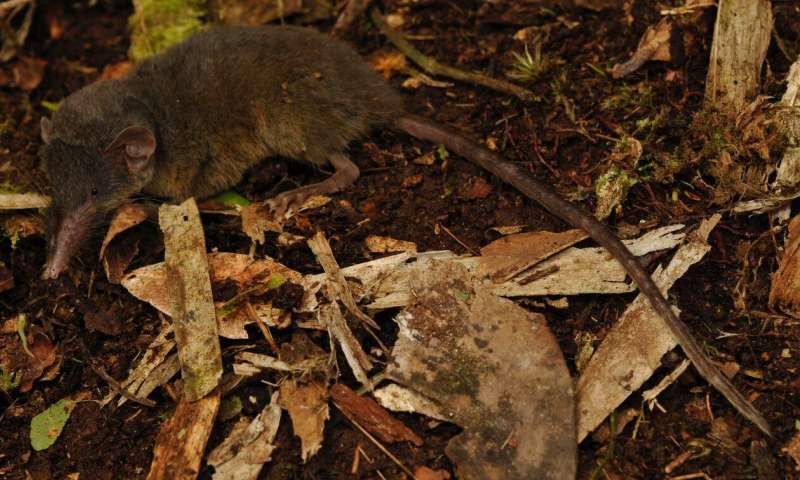
Researchers at Louisiana State University discovered this new species, the Sulawesi hairy-tailed shrew, in Indonesia. Credit: Kevin Rowe, Museums Victoria.

Researchers at Louisiana State University have discovered a new species of shrew, which they have named the hairy-tailed shrew, or Crocidura caudipilosa.

"There was no doubt that this was a new species," said LSU Museum of Natural Science Mammal Curator Jake Esselstyn whose work on Sulawesi Island in Indonesia led to the discovery published in the Journal of Mammalogy. "There isn't another species on the island that has as much hair on its tail, in terms of shrews."

The newly discovered shrew is slender with gray-brown fur on its back and silver-gray fur on its belly. Its tail is slightly longer than the combined length of its head and body and is covered with long bristles and hair, which make the distinctive tail very hirsute. In fact, no other shrew species in Indonesia, Malaysia or the Philippines is known to have such thick, long hair on its tail; however, some shrew species in Africa have very hairy tails. The scientists were also surprised to discover that this shrew climbs trees whereas most shrews live primarily on the ground, as far as anyone knows.

The Sulawesi hairy-tailed shrew was found on nine mountains across Sulawesi at various elevations from 1,500 feet to 4,800 feet.

"Tropical diversity is still not well documented even for mammals with a wide distribution on this island. This discovery shows how little we still know about mammal diversity," Esselstyn said.

Thursday, 28 March 2019

Star Wars and Asterix characters amongst 103 beetles new to science from Sulawesi, Indonesia


Date:  March 7, 2019
Source:  Pensoft Publishers
The Indonesian island of Sulawesi has been long known for its enigmatic fauna, including the deer-pig (babirusa) and the midget buffalo. However, small insects inhabiting the tropical forests have remained largely unexplored.
Such is the case for the tiny weevils of the genus Trigonopterus of which only a single species had been known from the island since 1885. Nevertheless, a recent study conducted by a team of German and Indonesian scientists resulted in the discovery of a total of 103 new to science species, all identified as Trigonopterus. The beetles are described in the open-access journal ZooKeys.
"We had found hundreds of species on the neighboring islands of New Guinea, Borneo and Java -- why should Sulawesi with its lush habitats remain an empty space?" asked entomologist and lead author of the study Dr Alexander Riedel, Natural History Museum Karlsruhe (Germany).
In fact, Riedel knew better. Back in 1990, during a survey of the fauna living on rainforest foliage in Central Sulawesi, he encountered the first specimens that would become the subject of the present study. Over the next years, a series of additional fieldwork, carried out in collaboration with the Indonesian Institute of Sciences (LIPI), managed to successfully complete the picture.


Thursday, 29 November 2018

Indonesia: dead whale had 1,000 pieces of plastic in stomach


Sperm whale washed up in Sulawesi had flip-flops, bottles, bags and 115 drinking cups in its stomach
Associated Press in Jakarta
Tue 20 Nov 2018 10.27 GMTLast modified on Tue 20 Nov 2018 10.42 GMT
A dead whale that washed ashore in eastern Indonesia had a large lump of plastic waste in its stomach, including flip-flops and 115 drinking cups, a park official has said, causing concern among environmentalists and government officials in one of the world’s largest plastic polluting countries.
Rescuers from Wakatobi national park found the rotting carcass of the 9.5 metre (31ft) sperm whale on Monday near the park in Southeast Sulawesi province after receiving a report from environmentalists that villagers had surrounded the dead whale and were beginning to butcher the rotting carcass, park chief Heri Santoso said.
Santoso said researchers from wildlife conservation group WWF and the park’s conservation academy found about 5.9kg (13lbs) of plastic waste in the animal’s stomach containing 115 plastic cups, four plastic bottles, 25 plastic bags, two flip-flops, a nylon sack and more than 1,000 other assorted pieces of plastic.
“Although we have not been able to deduce the cause of death, the facts that we see are truly awful,” said Dwi Suprapti, a marine species conservation coordinator at WWF Indonesia.
She said it was not possible to determine if the plastic had caused the whale’s death because of the animal’s advanced state of decay.
Indonesia, an archipelago of 260 million people, is the world’s second-largest plastic polluter after China, according to a study published in the journal Science in January. It produces 3.2 million tons of mismanaged plastic waste a year, of which 1.29m tons ends up in the ocean, the study said.
Luhut Binsar Pandjaitan, Indonesia’s coordinating minister of maritime affairs, said the whale’s discovery should raise public awareness about the need to reduce plastic use, and had spurred the government to take tougher measures to protect the ocean.

Thursday, 26 April 2018

Wildlife haven of Sulawesi much younger than first thought, according to new research


Date:  April 11, 2018
Source:  University of Oxford

Summary:
New research has shed light on the origins of some of South East Asia's most iconic and unique wildlife; the 'deer-pig' (Sulawesi Babirusa), 'warty pig' and the 'miniature buffalo.' In doing so, the research has revealed that Sulawesi, the island paradise where they were discovered, is younger than previously thought.

Read on  

Tuesday, 6 October 2015

Bizarre hog-nosed rat discovered in Indonesian jungle

Hog-nosed rat discovered in Indonesia has unique features including big ears, tiny mouth and long pubic hair believed to assist with mating, scientists say

By Jonathan Pearlman, Sydney
Hog-nosed rat
 Photo: Victoria Museum/EPA

10:12AM BST 06 Oct 2015

Scientists have discovered a new species of rat in Indonesia with a strange mix of features never seen before, including a hog-like snout, big ears, a tiny mouth and "curiously" long pubic hair.

The rat, first discovered by scientists in 2013 in the remote mountain jungles on the island of Sulawesi, has been named Hyorhinomys stuempkei, or hog-nosed rat.

Scientists said the creature was so unique it has been listed as an entirely new genus.

"I am still amazed that we can walk into a forest and find a new species of mammal that is so obviously different from any species, or even genus, that has ever been documented by science," said Dr Kevin Rowe, a researcher from Museum Victoria in Australia.


Sunday, 12 October 2014

Cave paintings change ideas about the origin of art

8 October 2014 Last updated at 18:05

By Pallab Ghosh, Science correspondent, BBC News

Scientists have identified some of the earliest cave paintings produced by humans.

The artworks are in a rural area on the Indonesian Island of Sulawesi.

Until now, paintings this old had been confirmed in caves only in Western Europe.

Researchers tell the journal Nature that the Indonesian discovery transforms ideas about how humans first developed the ability to produce art.

Australian and Indonesian scientists have dated layers of stalactite-like growths that have formed over coloured outlines of human hands.

Early artists made them by carefully blowing paint around hands that were pressed tightly against the cave walls and ceilings. The oldest is at least 40,000 years old.

Tuesday, 27 March 2012

'King of Wasps' found in Indonesia: Two-and-a-half inch monster has jaws longer than its legs


A new species of wasp discovered on the Indonesian island Sulawesi is two-and-a-half inches long, and has jaws so vast that its discoverer admits, 'I don't know how it can walk.'

Lynn Kimsey, professor of entomology at the University of California, Davis, says ‘Its jaws are so large that they wrap up either side of the head when closed. When the jaws are open they are actually longer than the male’s front legs.'


Kimsey discovered the warrior wasp on the Mekongga Mountains in southeastern Sulawesi.
She says its enormous size and ferocity makes it like 'the Komodo Dragon of wasps'.

‘I’m going to name it Garuda, after the national symbol of Indonesia,’ Kimsey said.


Read more: http://www.dailymail.co.uk/sciencetech/article-2119343/King-Wasps-Indonesia-Two-half-inch-monster-jaws-longer-legs.html#ixzz1qDcg71Y8
 

Friday, 26 August 2011

Huge new wasp discovered in Sulawesi

Wasp has jaws bigger than its head
August 2011. The new species of wasp, discovered by Lynn Kimsey, director of the Bohart Museum of Entomology and professor of entomology at the University of California, Davis, on the Indonesian island of Sulawesi, is one of the world's largest wasps.

2.5 inches long
The jaw-dropping, shiny black wasp appears to be the "Komodo dragon" of the wasp family. It's huge. The male measures about two-and-a-half-inches long, Kimsey said. "Its jaws are so large that they wrap up either side of the head when closed. When the jaws are open they are actually longer than the male's front legs. I don't know how it can walk. The females are smaller but still larger than other members of their subfamily, Larrinae."

Front view of male wasp. (Photos by Andrew Richards, Bohart Museum of Entomology)

 Kimsey discovered the warrior wasp on the Mekongga Mountains in south-eastern Sulawesi on a recent biodiversity expedition funded by a five-year grant from the International Cooperative Biodiversity Group Program.

The insect-eating predator belongs to the genus Dalara and family Crabronidae. "I'm going to name it Garuda, after the national symbol of Indonesia," Kimsey said. Garuda, a powerful mythical warrior that's part human and part eagle, boasts a large wingspan, martial prowess and breakneck speed.
The first time I saw the wasp I knew it was something really unusual," said Kimsey, a noted wasp expert who oversees the Bohart Museum's global collection of seven million insect specimens, including 500,000 wasps. "I'm very familiar with members of the wasp family Crabronidae that it belongs to but had never seen anything like this species of Dalara. We don't know anything about the biology of these wasps. They are only known from Sulawesi."


Discovered 300 new species
In her entire career as entomologist, she's discovered close to 300 new species. But on three trips to Sulawesi, she's brought back to the Bohart Museum "hundreds, maybe thousands of new species."

"It will take years, maybe generations, to go through them all," Kimsey said. "I consider Sulawesi one of the world's top three islands for biodiversity - along with Australia and Madagascar."

Sulawesi
Sulawesi, a large Indonesian island located between Borneo and New Guinea, is known not only for its endemic biodiversity, but also its rainforest and its proximity (three degrees) to the equator. However development now threatens plant and animal life.

Lynn Kimsey said "The terrain was steep, slippery and overall, physically challenging. This part of Sulawesi gets about 400 inches of rain a year. We were told that Sulawesi has a dry and rainy season. But the only difference we could see between the dry and rainy season is that during the dry season, it rains only in the afternoon."

2 acre spider web
Kimsey expressed amazement at the biodiversity of the flora and fauna. "We saw a colonial spider web that stretched across two acres. The adult spiders were about two inches long. We saw evidence of wild cows, anoa, found only in Sulawesi, and found the first record in that region of a Sulawesi palm civet, a weasel-like predator."

Director of the Bohart Museum since 1989, Kimsey is an insect taxonomist, specializing in bees and wasps and insect diversity. She received her doctorate in entomology from UC Davis in 1979 and joined the faculty in 1989.

Collected a millions specimens
Over the last four years, the international team of scientists has collected about a million specimens. Among the new species are: 1 bat, 2 frogs, 2 lizards, 2 fish, a land crab and many insects.

Kimsey is a collaborator of a five-year $4 million grant awarded to UC Davis scientists in 2008 to study the biodiversity of fungi, bacteria, plants, insects and vertebrates on Sulawesi, all considered threatened by logging operations and mining developments. Much of the mountain was logged two decades ago and now there are plans for an open pit nickel mine, Kimsey said.

"There's talk of forming a biosphere reserve to preserve this," she said. "There are so many rare and endangered species on Sulawesi that the world may never see."

Monday, 8 August 2011

Without Competition, Island Frogs Evolve Rapidly

ScienceDaily (Aug. 1, 2011) — Scientists led by Ben Evans of McMaster University have documented the rapid evolution of new fanged frog species on the island of Sulawesi, near the Philippines.


The team found 13 species of fanged frog on the island, nine of which hadn't previously been described. The species differ in body size, amount of webbing in their feet, and even how they raise their young -- all in accordance with the demands of their distinct ecological niches. Sulawesi has the same number of fanged frog species as the Philippine archipelago.


"We would expect to find more species on the archipelago because it's so much larger, but that's not the case," Evans said.

Why such diversity on the smaller island? There's less competition on Sulawesi, the researchers say. Fanged frogs in the Philippines have to compete with another genus of frogs, Platymantis. Platymantis never made to hop over to Sulawesi, leaving the fanged frogs free to spread out into new habitat niches, to which they eventually adapted. The rapid evolution of these frogs is a striking example of adaptive radiation -- a concept Charles Darwin famously recorded in Galapagos finches.

The research appears in the American Naturalist
http://www.sciencedaily.com/releases/2011/07/110727164711.htm

Related Posts with Thumbnails

ShareThis