Showing posts with label fin whale. Show all posts

Sunday, 30 October 2016

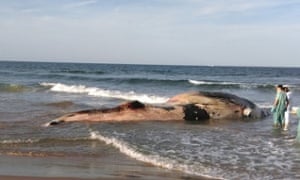
Rare fin whale stranding in Norfolk puzzles scientists


Experts say fin whales are normally found on south or west coasts of UK, not on east coast
Staff and agencies

Friday 21 October 2016 16.37 BST Last modified on Monday 24 October 2016 18.00 BST 

Mystery surrounds how a rare 12-metre (40ft) fin whale came to be washed up on a beach in Norfolk.

The enormous creature was already dead when it was washed up on Holkham beach on the north Norfolk coast on Thursday afternoon. 

Evolutionary biologist Dr Ben Garrod from Anglia Ruskin University in Cambridge said it was very unusual for a fin whale to be found on the east coast of Britain.

Fin whales sometimes seen in North Sea
“It should not be in those waters,” he told the BBC. “We see fin whales occasionally on the southern coast or more the west coast of the UK, so Ireland, right up to Scotland. But you never get them in the North Sea, so what it was doing there, we have no idea at the moment.”

It was not clear why the whale died, he added.

A postmortem is expected to be carried out by the Cetacean Strandings Investigation Programme.

The death comes after a spate of whale strandings along the Norfolk region’s coastline this year, with dozens having died in other parts of the North Sea.

A spokeswoman for the Holkham Estate said the picturesque beach remained open and added: “Plans are in place to remove the whale from the beach. Holkham beach remains open, but we advise the public not to venture close to the carcass and to keep dogs on leads.”


Friday, 26 June 2015

Blue and fin whale distribution in waters off Southern California

Date: June 25, 2015

Source: University of California - San Diego

Summary: A new study indicates a steady population trend for blue whales and an upward population trend for fin whales in Southern California.

Scripps marine acoustician Ana Širović and her colleagues in the Marine Bioacoustics Lab and Scripps Whale Acoustic Lab intermittently deployed 16 High-frequency Acoustic Recording Packages (HARPs)--devices that sit on the seafloor with a suspended hydrophone (an underwater microphone)--to collect acoustic data on whales off Southern California from 2006-2012.

Blue and fin whales are common inhabitants of the Southern California Bight, the curved region of California coastline with offshore waters extending from San Diego to Point Conception (near Santa Barbara, Calif.), but little is known about their use of the area.

Wednesday, 13 May 2015

Mystery surrounds dead whale discovered on Spanish beach

Experts in Valencia investigate death of six-tonne fin whale, which showed no sign of collision with vessel or being caught in net

Ashifa Kassam in Madrid

Wednesday 13 May 2015 13.54 BSTLast modified on Wednesday 13 May 201514.42 BST

Whale beached on a Spanish beachZoologists in Valencia are investigating the death of a six-tonne whale that washed up near the shore this week.

Guardia Civil agents patrolling the area spotted the whale in shallow waters on Monday morning. They said it was floating lifelessly towards the shore and deployed a boat to protect the animal from oncoming vessels.

Five hours later, the whale washed up on a beach in Cullera, a town about 30 miles south of Valencia. Police at the scene confirmed it was dead.

Zoologists from the University of Valencia have been investigating the animal’s death. They confirmed it was a fin whale, one of the most common species in the Mediterranean.

Saturday, 22 June 2013

Fin whale killed by ship strike off Washington

Dead Fin whale washes up at Ocean City - June 2013

June 2013. Biologists from Cascadia Research and the Washington Department of Fish and Wildlife have conducted an examination of a dead Fin whale found on a beach in Washington State.

Ship strike
The 68-foot adult male Fin whale had been in fairly good health prior to death with a healthy oily blubber layer and evidence of having fed recently based on stomach contents. There was substantial bruising in the blubber and underlying tissues on the left side of the head and the upper and lower left jaw indicating severe blunt force trauma consistent with having been killed by collision with a ship.

Ship strikes
This is the 11th Fin whale to have stranded in Washington State since 2002, and the 2nd Fin whale to strand this. Ship strike has been indicated in 9 of the 11 cases. Ship strikes are a growing concern with several west coast species of whales, particularly Blue and Fin whales. In addition to these documented cases, scientists suspect that these may only represent a tenth or less of the true number occurring since most whales that die never wash ashore and either sink or drift offshore.

Fin whales are the 2nd largest animal that has ever lived, only surpassed by the slightly larger Blue whale. Several thousand Fin whales feed off the US West Coast, generally in deeper waters 30 or more miles offshore, feeding on small fish and krill. Their populations have been generally increasing as they recover from commercial whaling.

Thursday, 30 May 2013

Fin whales being turned into dog treats

Iceland is killing endangered Fin whales for Japanese pet treats
May 2013. Although the use of Japanese-caught whale and dolphin meat in pet food in Japan has been well documented, the discovery that Japanese pet food company Michinoku Farms is now producing dog snacks using meat from endangered North Atlantic Fin whales, killed by the Icelandic whaling company Hvalur hf, is alarming. 

Icelandic Fin whale has been sold in Japan for human consumption since 2008, but its use in pet food suggests that new markets are being explored. As Iceland prepares to hunt more than 180 Fin whales in 2013 for this export market, NGOs question the environmental and economic logic of using meat from an endangered species for the manufacture of dog treats.

Desperate
Susan Millward, executive director of the US-based Animal Welfare Institute (AWI), said: "Turning an endangered whale species into pet snacks is deplorable and seems to be nothing more than a desperate attempt to keep a cruel and unnecessary industry alive at any cost."

Tuesday, 21 May 2013

Fin whale research poses more questions than answers

Using earthquake sensors to track endangered whales. By Hannah Hickey, University of Washington

May 2013. The Fin whale is the second-largest animal ever to live on Earth. It is also, paradoxically, one of the least understood. The animal's huge size and global range make its movements and behaviour hard to study. 

A carcass that washed up on a Seattle-area beach this spring provided a reminder that sleek Fin whales, nicknamed "greyhounds of the sea," are vulnerable to collision when they strike fast-moving ships. Knowing their swimming behaviours could help vessels avoid the animals. Understanding where and what they eat could also help support the Fin whale's slowly rebounding populations (As would Iceland stopping their Fin whale hunt. Ed.). 

Fin whales sound like earthquakes
University of Washington oceanographers are addressing such questions using a growing number of seafloor seismometers, devices that record vibrations. A series of three papers published this winter in the Journal of the Acoustical Society of America interprets whale calls found in earthquake sensor data, an inexpensive and non-invasive way to monitor the whales. The studies are the first to match whale calls with Fine-scale swimming behaviour, providing new hints at the animals' movement and communication patterns.


Saturday, 18 May 2013

Using Earthquake Sensors to Track Endangered Whales

May 13, 2013 — The fin whale is the second-largest animal ever to live on Earth. It is also, paradoxically, one of the least understood. The animal's huge size and global range make its movements and behavior hard to study.

A carcass that washed up on a Seattle-area beach this spring provided a reminder that sleek fin whales, nicknamed "greyhounds of the sea," are vulnerable to collision when they strike fast-moving ships. Knowing their swimming behaviors could help vessels avoid the animals. Understanding where and what they eat could also help support the fin whale's slowly rebounding populations.

University of Washington oceanographers are addressing such questions using a growing number of seafloor seismometers, devices that record vibrations. A series of three papers published this winter in the Journal of the Acoustical Society of America interprets whale calls found in earthquake sensor data, an inexpensive and non-invasive way to monitor the whales. The studies are the first to match whale calls with fine-scale swimming behavior, providing new hints at the animals' movement and communication patterns.

The research began a decade ago as a project to monitor tremors on the Juan de Fuca Ridge, a seismically active zone more than a mile deep off the Washington coast. That was the first time UW researchers had collected an entire year's worth of seafloor seismic data.


Thursday, 28 February 2013

Dead whale washed up in Wigtown Bay


A 60-foot whale found washed up on the Solway coast has been buried close to where it died.
The carcass of the male Finn Whale was examined by experts from the Scottish Marine Animals Strandings Unit.

Investigators took samples to try to establish if was diseased. The mammal was underweight and that may have been why it sought shelter in the shallow water of Wigtown Bay.

Investigators said the cause of death was probably drowning.

Dumfries and Galloway Council staff were among those helping to deal with the incident at the bay near Carsluith.

Thursday, 13 December 2012

Whale Rotting On Malibu Celebrities' Beach


A 40-foot whale carcass has washed ashore on one of Southern California's most pristine beaches and has begun to rot while authorities try to decide who should remove it.

The 40,000-pound (18,143kg) male fin whale washed up in Malibu on Monday, not far from homes owned by singers Barbra Streisand and Bob Dylan.

Los Angeles County lifeguards had the idea of trying to pull the carcass out to sea but were unsure if they could manage the job.

County fire inspector Brian Riley said: "Our lifeguards think this probably exceeds our capabilities. You would need a tug boat to drag it out to sea."

In that case, the city was not sure who would do it, said spokeswoman Olivia Damavandi.

The Los Angeles County Department of Beaches and Harbours was not responsible for disposing of the whale because "it's on a private beach", said spokeswoman Carol Baker.

The beach is controlled by homeowners down to the high tide line; the state is responsible for the tidelands, she added.

The California Wildlife Centre examined the carcass on Tuesday and found a gash on the young whale's back and a damaged spine, indicating it may have been hit by a ship.

Such accidents have become more common as increasing numbers of migrating blue, fin and humpback whales swim to California's shore to feast on krill.

The endangered fin whale is the second-largest animal in the world and can grow up to 85 feet (26 metres), weigh up to 80 tons and live to be 90 years old.


Thursday, 15 November 2012

Fin whale beached in Dorset


November 2012. Steve Trewhella, of UK Coastal Wildlife, has sent us these images of a beached whale in Dorset. The whale washed up at the beginning of November at the bottom of the sea cliffs near Kimmeridge.


Juvenile Fin whale
It is thought that the whale is a juvenile Fin whale, though this has not been verified. The whale measured some 13.5 metres long, and is decaying rapidly.

Can live for 90 years
Fin whales can grow up to around 25 metres long, with the average at around 20 metres, and a female whale can weigh up to 120,000 kg, making them the second largest whale after the mighty Blue. Remarkably, they can live for up to 90 years. Although they are inaudible to the human ear, the whales' low frequency calls can be heard by other whales some 850 kilometres away.

Fin whales are seen most winters off Cornwall
Since the 1990s they have been seen during most winters off the coast of Cornwall and other parts of south-west England. Their vertical blows are easily visible from some two miles away without binoculars, and they may stay close to the surface for about a minute and a half minutes each time they surface. They then dive to depths of up to 250 metres, although they are also known to enter shallow water, and each dive can last between 10 and 15 minutes. They have a varied diet of fish and squid, but may also eat krill and copepods. With their huge mouths, which make up about 25% of their body length, they can take in up to 70 cubic meters of water in one gulp.


Monday, 15 October 2012

Choreography of Submerged Whale Lunges Revealed


ScienceDaily (Oct. 11, 2012) — Returning briefly to the surface for great lungfuls of air, the underwater lifestyles of whales had been a complete mystery until a small group of pioneers from various global institutions – including Malene Simon, Mark Johnson and Peter Madsen – began attaching data-logging tags to these enigmatic creatures.
Knowing that Jeremy Goldbogen and colleagues had successful tagged blue, fin and humpback whales to reveal how they lunge through giant shoals of krill, Simon and her colleagues headed off to Greenland where they tagged five humpback whales to discover how the animals capture and consume their prey: krill and agile capelin. Attaching individual tags behind the dorsal fin on three of the whales – to record their stroke patterns – and nearer the head in the remaining whales – to better measure head movements – the team successfully recorded high resolution depth, acceleration and magnetic orientation data from 479 dives to find out more about the animals' lunge tactics. Simon, from the Greenland Institute of Natural Resources, Madsen, from Aarhus University, Denmark and Johnsen from the University of St. Andrews, UK, report how whales choreograph their foraging lunges at depth in The Journal of Experimental Biology at http://jeb.biologists.org.

Continued:  http://www.sciencedaily.com/releases/2012/10/121011090641.htm

Saturday, 18 August 2012

WHALE GETS STUCK AGAINST CORK PIER WALL

A 40ft fin whale has tried to beach and is stuck against a pier wall in west Cork.

The creature came in to the harbour in Baltimore on a low tide and initially moved 328-437 yards (300m-400m) off shore before coming back to the small port.

The Irish Whale and Dolphin Group (IWDG) said from the description it is a young fin whale and maybe sick or starving.

Brendan Cottrell, assistant coxswain on the Baltimore lifeboat and owner of the Cape Clear ferry, said they were doing their best not to panic the creature further.

"We've been told to keep all the boats back and try not to stress the animal," he said.

"It looks as though he's stuck by the pier wall and there's a crowd of about 200 or 300 looking on. We've had dead whales on the beaches before but never a live one in this spot."

Fin whales are the second-largest species of whale and can grow up to 85ft.


Continued:  http://www.eveningecho.ie/2012/08/14/whale-gets-stuck-against-cork-pier-wall/

Thursday, 16 August 2012

Beached 65ft-Long Whale Dies In Cornwall


A 65ft-long whale has died after being washed up on a Cornish beach on Monday evening.
Hundreds of holidaymakers flocked to the scene at Carlyon Bay in St Austell, which was cordoned off to prevent more distress to the female fin whale.


Vets from the British Divers Marine Life Rescue (BDMLR) were unable to save the mammal, which had suffered injuries to its head and was severely undernourished.

The group scotched earlier reports that its vets had euthanised the endangered animal.

"Locals reported that it had already stranded earlier, so the prognosis was not good and the decision was taken by the attending vets that it would be more humane to euthanise the animal rather than let it suffer a slow and lingering death," said a spokesman.
"However, the whale died naturally and this was not necessary."

Tuesday, 31 July 2012

The Fin Whale, Under More Threat in the Mediterranean Than Thought

ScienceDaily (July 26, 2012) — Until now it was thought that fin whales in the Strait of Gibraltar and the Alboran Sea made up part of the distribution of this species of whale in the Mediterranean. However, an international team of scientists led by a Spaniard has revealed that their population has been overestimated by including specimens from the Atlantic that visit at certain times the western Mediterranean, where the noise generated by human activity affects their survival.

In 1991 the fin whale (Balaenoptera physalus) population in the Mediterranean Sea was estimated at 3500 specimens. A new study, published in Marine Mammal Science, now shows that this record included specimens from the Atlantic, and suggests that the distribution and size of the current population of this whale, which is threatened with extinction, should be reconsidered.

"The Mediterranean population has easily been overestimated, as the census included the whole of the southeast Mediterranean, incorporating Atlantic fin whales within the Mediterranean census", reported to SINC Manuel Castellote, the lead author of the study and researcher in the National Oceanic and Atmospheric Administration (NOOA), Seattle (USA).


Continued:  http://www.sciencedaily.com/releases/2012/07/120726101727.htm
Related Posts with Thumbnails

ShareThis