Showing posts with label destroyed. Show all posts

Thursday, 26 September 2019

Dorian washed out the most sea turtle nests in at least 10 years in Cape Hatteras National Seashore - via Herp Digest


by Jeff Hampton, The Virginian-Pilot, 9/19/2019, Buxton, NC


Hurricane Dorian did its dirty work on Outer Banks sea turtles as well as humans.

The storm raked up the beaches, washing away 30 sea turtle nests in the Cape Hatteras National Seashore. Another 35 were at least partially damaged.

It is the greatest loss of nests since at least 2009 when the online record begins, according to seaturtle.org, a website that tracks North Carolina sea turtles. Three nests were lost before the storm from other causes for a total of 33.

The last time it was this bad was in 2011 after Hurricane Irene struck in August before many nests could hatch. The record shows 32 were lost in large part because of the storm, said William Thompson, lead biological science technician for the park.

Dorian could have been more destructive had it struck earlier in the nesting season, Thompson said.

Still, the destroyed nests amount to only 7 percent of the record 471 nests laid this year, the record shows. In 2011 there were only 147 total nests, so Irene’s impact was 22 percent.

The park service keeps close track of the threatened sea turtles. Each day during the summer, rangers patrol the beaches looking for new nests. The most recent one came Tuesday, but at this late date it is unlikely to survive, said Tracy Ziegler, chief of resource management and science for the national parks of eastern North Carolina.

Three days before Dorian struck, rangers counted 166 viable nests. Most of the rest had already hatched for the season, Ziegler said.

Counts after the storm found that 83 nests remained. Thirty were completely gone, 35 were at least partly damaged and 18 had hatched, he said.

High tides and predators such a raccoons and ghost crabs can also destroy a nest. Rangers relocate some nests laid in the tide zone where the surf can drown the baby turtles. During this record year, park staff relocated 127 nests, at least double the number in past years.

Of the 471 nests this year in Cape Hatteras National Seashore, 438 were loggerheads, 32 were green sea turtles and one was a Kemp’s Ridley.

Nesting is a laborious process. Female sea turtles weighing around 300 pounds crawl onto the beach in the summer and dig holes with their rear flippers where they lay about 100 eggs. Afterward, they return to the sea.

The nest incubates under the warmth of the sand for about two months. Sea turtles are known to return to the same beach for generations, and a single female can create more than one nest.

The numbers of the threatened sea turtle nests have surged in recent years. Between 2000 and 2007, sea turtle nest numbers averaged 77 a year, according to the Cape Hatteras National Seashore website. Numbers peaked in 2010 at 153 and then hit records in 2012, 2013, 2015, 2016 and this year.

Friday, 3 May 2019

Council accidentally bulldozes roadside nature reserve


13/04/2019
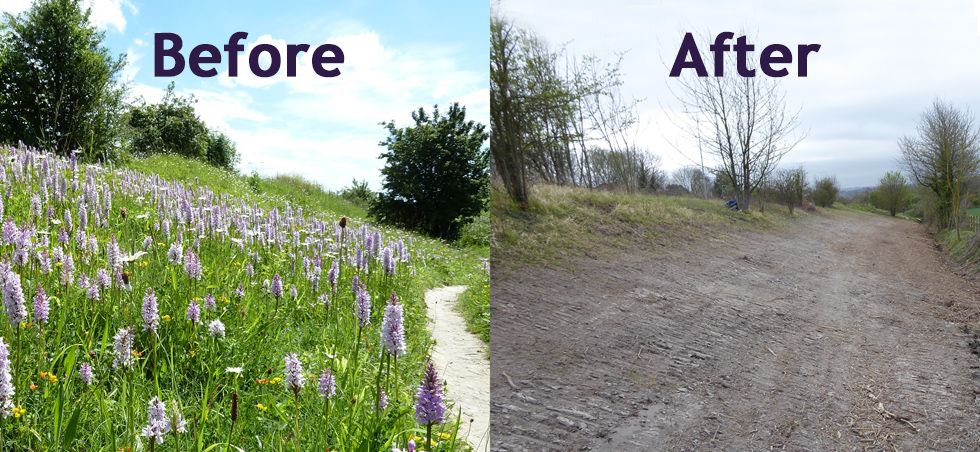
Kent County Council has unwittingly destroyed a nationally important roadside nature reserve (RNR), home to tens of thousands of orchids, as it carried out drainage ditch clearance works.
Verges at Blue Bell Hill RNR, just north of Maidstone, were churned up by heavy vehicles working on the site, in some places down to the chalk. 
Owned by Kent County Council, the verge has been managed by volunteers from Kent Wildlife Trust for 15 years. As well as 9,000 Pyramidal Orchids and nearly 8,000 Common Spotted Orchids, it was also home to Bee Orchids, the scarce Man Orchid and a wide range of other special chalk downland flowers. These attracted a host of pollinating bees, butterflies (20 species, including Chalkhill Blue) and other insects, which helped support a thriving population of small mammals as well as Common Lizards and Slow-worms.

A stark contrast: Blue Bell Hill RNR in summer 2018 and spring 2019 (Plantlife).
After removing some trees from the ditch, the council scraped the bank smooth. Such intensive works will inevitably mean that much of this wildlife is lost for good from the site; other species will take years to recover. At this time of year, the Common Spotted Orchids will have been beginning to show above ground, ahead of flowering from late May onward.
Dr Trevor Dines of Plantlife said: "I worry that I've become immune to 'bad stuff' happening to wild flowers over the years. But the destruction a few days ago of 17,000 orchids on a road verge in Kent proved that I'm not.
"This mistake highlights just how vulnerable and threatened the fragments of our species-rich grassland have become – whether in a farmers' field or on a road verge – and the importance of raising our management across the entire network of road verges rather than just a few vulnerable 'jewels'."

Monday, 8 July 2013

Bolton man fined for destroying a bat roost

Fined for destroying a bat roost
July 2013. A Chorley Magistrates Court heard a case against Mr David Dalton, 33, of Bolton, who had been charged with destroying a bat roost. Following a guilty plea Mr Dalton was fined £540 with £100 costs and a £54 surcharge (Maximum penalties for destroying a bat roost are six months imprisonment and or a £5000 fine).

Offences against bats are one of the UK's wildlife crime priorities of identical standing to the illegal trade in endangered species and the persecution of birds of prey.
Brown long-eared bats are particularly loyal to their roost sites and will return
 to the same site each year for many years so retaining and protecting
 bat roost sites is essential for the survival of the species.
 The Bat Conservation Trust is the only national organisation solely
 devoted to the conservation of bats and their habitats in the UK.
 It runs a national helpline to provide advice and information on bats.
 The Bat Helpline receives more than 9,000 calls a year.
Tel: 0845 1300 228 or visit www.bats.org.uk .

Demolished building he knew contained bats
Mr Dalton is the owner of property in Rivington Lane that he wished to develop. He engaged the services of an ecological consultant who surveyed the buildings and found a roost of brown-long eared bats. To allow the building to be developed a licence would have been required outlining how the needs of bats were being considered. Mr Dalton demolished the building without a licence and destroyed the bat roost.

‘Ignored the law'
Wildlife Crime Officer for Lancashire Police Mark Thomas said: Lancashire Police take every report of wildlife crime very seriously. "We have worked hard to bring this case to court, people can't just start carrying out building renovation work and think they don't have to have the correct surveys and licences to cover the work they intend to do. The reason they have to do this is to protect certain species in this case bats and their roosts. Working together with the Bat Conservation Trust, we put together a package for criminal proceedings against a local land and property owner Mr Dalton from the Rivington area who chose to ignore the law and the codes of practice. It is the responsibility of property owners and developers to ensure all building work has had appropriate ecological surveys undertaken."

Pete Charleston Investigations Officer for the Bat Conservation Trust explains: "Bat roosts are very important sites for conservation. The loss of bat roosts is thought to be one reason why bat populations declined dramatically in the 20th Century. By following conditions set out in a license the impact of building, development and demolition on bats can be minimized. If you plan works and follow the mitigation measures as outlined in the license, projects can run smoothly; if you don't it is a serious offence that puts bat populations at risk." The Bat Conservation Trust have provided support to Lancashire Police during this investigation and are very grateful both to the Police and the Crown Prosecution Service for their efforts in bringing this case to court.

Related Posts with Thumbnails

ShareThis