Showing posts with label cloning. Show all posts

Sunday, 26 February 2017

8 Mammals That Have Been Cloned Since Dolly the Sheep


By Stephanie Bucklin, Live Science Contributor | February 22, 2017 10:13am ET

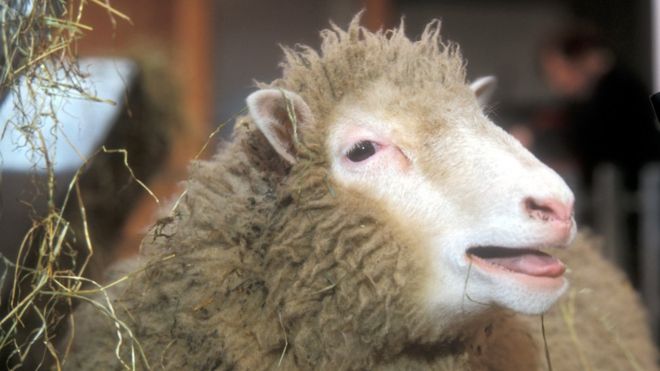
It was 20 years ago this week that scientists announced the first successful cloning of a mammal — the now-famous sheep Dolly — from a cell taken from an adult animal. 

The cloning of Dolly by the team at The Roslin Institute, at the University of Edinburgh in Scotland, paved the way for researchers to try cloning a number of other mammals. Prior to Dolly, scientists had been able to clone mammals only by splitting growing embryos.
Since the announcement of Dolly's birth, dozens of other species have been cloned from adult body cells, including many mammals. Here are eight of the mammals that have been cloned in this manner since Dolly:


It was 20 years ago this week that scientists announced the first successful cloning of a mammal — the now-famous sheep Dolly — from a cell taken from an adult animal. [Full story: 20 Years After Dolly the Sheep, What Have We Learned About Cloning?]
The cloning of Dolly by the team at The Roslin Institute, at the University of Edinburgh in Scotland, paved the way for researchers to try cloning a number of other mammals. Prior to Dolly, scientists had been able to clone mammals only by splitting growing embryos.
Since the announcement of Dolly's birth, dozens of other species have been cloned from adult body cells, including many mammals. Here are eight of the mammals that have been cloned in this manner since Dolly:

In 2000, PPL Therapeutics, the same company that worked with The Roslin Institute to clone Dolly the sheep, announced that it had cloned five female piglets from adult pig cells. The piglets were named Millie, Christa, Carrel, Dotcom and Alexis. The findings were published in a 2000 paper in the journal Nature.

Monday, 12 December 2016

Cow gene study shows why most clones fail


Date: December 9, 2016
Source: University of California, Davis

It has been 20 years since Dolly the sheep was successfully cloned in Scotland, but cloning mammals remains a challenge. A new study by researchers from the U.S. and France of gene expression in developing clones now shows why most cloned embryos likely fail.

Dolly was cloned using the technique of "somatic cell nuclear transfer," when a nucleus from an adult cell is transferred into unfertilized egg that has had its nucleus removed, and is then shocked with electricity to start cell growth. Embryos are then transferred to recipient mothers who carry the clones to birth.

Cloning cattle is an agriculturally important technology and can be used to study mammalian development, but the success rate remains low, with typically fewer than 10 percent of the cloned animals surviving to birth. The majority of losses are due to embryonic death, a failure during the implantation process, or the development of a defective placenta.

Tuesday, 5 July 2016

Twenty years on from Dolly the sheep

By Pallab Ghosh
Science correspondent, BBC News

4 July 2016 

The birth of Dolly the sheep seemed one of those moments in scientific research that would change the world forever.

The cloning of the first animal from an adult cell was a remarkable scientific achievement. It promised new treatments for debilitating diseases. But it also raised fears of cloned human beings, designer babies and a dystopian future.

Twenty years on, neither the hopes nor the fears have been realised. So what is Dolly's legacy?

I first saw Dolly in 1997 at the Roslin Institute just outside Edinburgh. She stood apart from the other sheep in the pens at this agricultural research centre. She stood prouder, her fleece seemed like a lion's mane and there was an aura about her.

Dolly's creation had echoes of Mary Shelley's classic novel Frankenstein, in which inanimate tissue was brought to life by electricity.

Dolly was created from DNA taken from a cell taken from an sheep. The technique involved putting the DNA into an empty eggshell and then zapping it with electricity. This created an embryo.

Researchers at Roslin then implanted the embryo into the womb of a sheep which grew into Dolly - an exact genetic copy of the sheep from which the skin cell was taken.

It took 277 attempts to clone Dolly and there were many miscarriages on the way.

Tuesday, 29 December 2015

Dead dog lives again after British owners successfully clone him


DECEMBER 28, 2015

by Emily Bills

After losing their beloved pet dog Dylan to a brain tumor in June, this British couple successfully had him cloned by a company in South Korea for $100,000.

The first-of-its-kind boxer puppy was born on Boxing Day and was cloned from Dylan two weeks after his death—the previous record for dog cloning was held at five days after death, according to the Guardian.

Laura Jacques, 29, and Richard Remde 43 of West Yorkshire, England enlisted the help of the controversial cloning company Sooam Biotech Research Foundation to bring back their pup. The only laboratory of its kind, it can bring back your pet for a cool price of $100,000 per procedure.

The newborn puppy's name isn't Dylan like his predecessor, but the couple named him Chance after a character in the Disney movie Homeward Bound. Chance is expected to have a brother in just a few short days—another clone puppy named Shadow also after a character in the movie.


Wednesday, 11 February 2015

Are cloned white Angus cattle the answer to world hunger?

Christopher Pilny for redOrbit.com – Your Universe Online

Move over pageant girls: Researchers at Climate Adaptive Genetics (CAG) believe they’ve found the real answer to world hunger.

Or, at least, the partial answer to it.

Dr. James West, associate professor of medicine at Vanderbilt University and chief science officer of CAG, has developed a way to produce white Angus cattle, an innovation he asserts will double the world’s production of beef in the next ten years. The reason being: an increased tolerance to heat.

“Black angus are by far the most productive breed of cattle that exists,” said West. “They grow to 1,400lbs in maybe 13 months. And they taste good. There’s a reason you’ve heard of Black Angus Steakhouse, and not Charolais or Hereford Steakhouses.”

If you can’t take the heat, get a new coat

The problem is, he continued, Black Angus don’t handle heat and humidity well, namely because their heavier coats are black or dark red, two colors that absorb a massive amount of solar energy and raise the cattle’s body temperature to dangerous levels.

Because of this, farmers in high-beef-production areas like Brazil and Southeast Asia tend to use Brahma (or Nellore cattle) instead, which are shorthaired and white, making them more heat resistant.


Sunday, 16 November 2014

Can the Long-Extinct Woolly Mammoth Be Cloned?

by Tia Ghose, Staff Writer | November 16, 2014 09:20am ET

A woolly mammoth carcass recently unearthed in Siberia could be the best hope yet for scientists aiming to clone the massive, long-extinct beast.

The mammoth specimen, which was discovered in 2013 in a remote part of Siberia, oozed a deep red liquid when it was first discovered. Scientists have now analyzed the mammoth to understand how it lived and died — and whether it will yield enough undamaged DNA to makecloning the extinct creature a reality.

Details from the mammoth autopsy will air in the Smithsonian Channel special called "How to Clone a Woolly Mammoth," on Nov. 29 at 8 p.m. ET/PT. (Warning: This story contains some spoilers about the Smithsonian Channel special.)

Sunday, 29 June 2014

US company in Iowa churns out 100 cloned cows a year

In the meadow, four white-haired Shorthorn heifers peel off from the others, raising their heads at the same time in the same direction. Unsettling, when you know they are clones.

From their ears dangle yellow tags marked with the same number: 434P. Only the numbers that follow are different: 2, 3, 4 and 6.

The tag also bears the name of the company that bred them and is holding them temporarily in a field at its headquarters in Sioux Center, Iowa: Trans Ova Genetics, the only large US company selling cloned cows.

A few miles away, four Trans Ova scientists in white lab jackets bend over high-tech microscopes in the company's laboratories. They are meticulously working with the minute elements of life to create, in Petri dishes, genetically identical copies of existing animals.

Each year, the company gives birth, using the cloning technique, to about 100 calves. It also clones pigs and horses.


Monday, 14 April 2014

Mini Winnie - Britain's first cloned dog

Britain's first cloned dog has been born after a West London cook won a £60,000 contest to have her pet reproduced.

Rebecca Smith's 12-year-old dachshund Winnie was cloned as a puppy - called 'Mini Winnie' - in a laboratory in Seoul, South Korea.

Ms Smith, 29, has had Winnie since when she was 18 and says the pet helped her overcome bulimia.

"Winnie is the best sausage dog in the whole world. She is desperate to be cloned because the world would be a better place with more Winnies in it," she said.

After winning the competition, a sample of Winnie's skin tissue was taken and stored in liquid nitrogen before being transported to South Korea.

In Seoul, her cells were put into eggs from a donor dog of the same breed. A spark of electricity then created a cloned embryo which was transferred into a surrogate dog.

Mini Winnie was born via caesarean from a mongrel dog much bigger than itself and weighed just over 1lb.

"I saw it being born and it looks exactly like Winnie," Ms Smith said.

Tuesday, 18 March 2014

Russian scientists: We have a "high chance" of cloning a wooly mammoth

An exquisitely preserved wooly mammoth is currently undergoing an autopsy in Siberia. Some experts believe they'll be able to extract high quality DNA and cells from the remains which could conceivably be used to clone the extinct mammal. The question now is, should we?

Back in May of last year, Russian scientists discovered the remains of the mammoth partially embedded in a chunk of ice at an excavation site on Lyakhovsky Island, the southernmost group of the New Siberian Islands in the Arctic seas of northeastern Russia.

Sunday, 2 June 2013

Cloning Contest Seeks Worthiest UK Dog

Michael Dhar, LiveScience Contributor
Date: 31 May 2013 Time: 07:39 AM ET

Puppy lovers in the United Kingdom may soon get a chance to extend their dog years, thanks to an odd new contest: A South Korean company wants to clone the most beloved U.K. pooch — again raising ethical questions about the practice of pet cloning.

Headed by a former stem-cell researcher named Woo-Suk Hwang, the Sooam Biotech Research Foundation has been cloning dogs and other animals for years, mostly for U.S. customers. Now, in an effort to expand into the British market, the lab has asked U.K. canine owners to submit a 500-word essay, along with photos and videos, demonstrating why their best friend's genes should live on, Sooam researcher Hanna Heejin Song wrote in an email to LiveScience.

The chosen dog owner gets 70 percent off the usual $100,000 price tag for replicating Rufus. 

Tuesday, 21 May 2013

Could Humans Be Cloned?

Rachael Rettner, LiveScience Senior Writer 

Date: 16 May 2013 Time: 05:57 PM ET 

The news that researchers have used cloning to make human embryos for the purpose of producing stem cells may have some people wondering if it would ever be possible to clone a person. 

Although it would be unethical, experts say it is likely biologically possible to clone a human being. But even putting ethics aside, the sheer amount of resources needed to do it is a significant barrier. 

Since the 1950s when researchers cloned a frog, scientists have cloned dozens of animal species, including mice, cats, sheep, pigs and cows. 

In each case, researchers encountered problems that needed to be overcome with trial and error, said Dr. Robert Lanza, chief scientific officer at the biotech company Advanced Cell Technology, which works on cell therapies for human diseases, and has cloned animals.

Related Posts with Thumbnails

ShareThis