Showing posts with label increase in numbers. Show all posts

Friday, 20 March 2020

Win for conservation as African black rhino numbers rise

Slow recovery due to relocating groups and stronger protection through law enforcement

Numbers of African black rhinos in the wild have risen by several hundred, a rare boost in the conservation of a species driven to near extinction by poaching.

Black rhinos are still in grave danger but the small increase – an annual rate of 2.5% over six years, has swollen the population from 4,845 in 2012 to an estimated 5,630 in 2018, giving hope that efforts put into saving the species are paying off.

The painstaking attempts to save the black rhino have included moving some individuals from established groups to new locations, increasing the species’ range and ensuring viable breeding populations, as well as protecting them through stronger law enforcement efforts. Numbers of all of the three subspecies of black rhino are now improving.

“The continued slow recovery is a testament to the immense efforts made in the countries and a powerful reminder that conservation works,” said Grethel Aguilar, acting director general of the International Union for Conservation of Nature, which compiles the global red list of species under threat.

“[But] there is no room for complacency as poaching and illegal trade remain acute threats. It is essential that the ongoing anti-poaching measures and intensive, proactive population management continue, with support from national and international actors.”

The outlook for the other African rhino species is still troubled, according to the update to the red list published on Thursday.


Monday, 24 June 2019

Green sea turtle nests could beat record highs on the Space Coast this season. Here’s why. – via Herp Digest


Orlando Sentinel, 6/21/19

The number of green turtle nests on the Atlantic coast have been on the upswing, surpassing the loggerhead turtle. Scientists are thrilled by this development.

During this time of year, sea turtles emerge from the ocean to lay eggs on the sand at night on Florida’s beaches.

The state accounts for 90 percent of the nation’s loggerhead nests, but another species also listed as threatened, the green turtle, has blown past the loggerhead on the Space Coast and is expected to post another record number of nests this year.

“So, this season is particularly exciting because this is the 'up’ year for green turtle nests,” said Ashley Lord, interpretative park ranger who leads turtle tours at Canaveral National Seashore.

Since Canaveral began protecting turtle nests from animal predators with metal screens in 1984, the female hatchlings that survived are now of reproductive age, returning to the beaches where they were hatched. There is also no light pollution and no housing development along 24 miles of beach.

During the last reproduction year for green turtles in 2017, the species surpassed loggerhead nests at Canaveral National Seashore. There were 7,736 green turtle nests to 4,556 loggerhead nests even though many of the green turtle nests later in the season were wiped out by Hurricane Irma.

Green turtles reproduce every other year. The nest screening program started in 1984, and the hatchlings that survived at higher rates would have returned to the same beaches 25-30 years later. Leatherback turtles also nest at Canaveral but result in fewer than 35 nests a year.

Female green turtles reproduce every other year and so far point-in-time counts for 2019 are higher compared to the same week in 2017 for Canaveral National Seashore as well as the nearby Archie Carr National Wildlife Refuge.

Turtle nests face obstacles in addition to hurricanes.

Last year, 1,000 nests were wiped out at Canaveral National Seashore due to predators including raccoons and feral hogs, said Kristen Kneifl, chief of resource management. So far this season, the raccoons got into about 250 nests. Canaveral has taken steps to eradicate the problem raccoons.

To protect turtles from prey, volunteers and a team of four biological technicians cover nests with 4-by-4-foot metal wire screens with holes large enough for hatchlings to crawl out of as they emerge into the world. The screens are anchored into the sand with pieces of bent rebar.

“Our numbers are getting more than our staff can handle on every given day,” Kneifl said. “They’ve got to place the screen. They’ve got to pound the rebar. And with over 100 nests a day, it’s too much.”
Volunteer Patty Lillie of Winter Park spent many years alongside staffers, locating nests at Canaveral National Seashore, riding in an all-terrain vehicle under the moonlight.

“It’s a workout — the most I’ve ever done is 28 [nests] in one night and I was toast," she said.

These days, she guides small groups at night so they can see loggerheads lay eggs.

“I love doing that part, too,” Lillie said of the tours, “because the more people experience something with an animal, the more they’re going to care about that animal.”

Visitors aren’t allowed to view green turtles laying eggs along Florida’s shorelines because it is not a permitted activity by the Florida Fish and Wildlife Conservation Commission. But scientists see them.

“To have a day when there are more green turtles nesting than loggerheads is very surprising because they were doing poorly for so long,” said Jane Provancha, an ecologist who has studied Florida’s sea turtles extensively.

But as the climate gets warmer, there is concern there won’t be enough male sea turtles to sustain long-term population growth. The warmer the sand temperature, the more likely the hatchling will be a female.

It’s a subject Provancha researched in the late 1980s with the late Nicholas Mrosovsky. They discovered that loggerhead hatchlings from 1986-1990 at Cape Canaveral Air Force Base were more than 90 percent female. Green turtles develop similarly to loggerheads, she said. Their differences can be found in migratory patterns and diet, among other factors.

“We believe there are more females to start off in the ocean when animals are released from their nest," she said, but experts still don’t know a lot about the gender ratio in the adult stage because the males tend to stay in the water while the females show up on the beach.

In Australia, she said, studies have estimated the gender ratio of turtles in the water is two or three females to one male.

“We could assume the same” for the Atlantic population, she said.

Warmer sand temperatures can also speed up when the eggs will hatch. They also can cause sea turtles to lay their eggs further north where it might be cooler, although green turtles will nest within five to 10 miles of where they were born. Loggerheads seem to nest within a 40-mile range.

Atlantic green turtles were listed as endangered only as recently as 2016, when they were downgraded to threatened under the Endangered Species Act. Loggerheads in this area also are listed as threatened.

The idea that there would be this many green turtles today couldn’t have been predicted 15, 20 or 30 years ago, Provancha said.

Friday, 29 September 2017

Protected waters foster resurgence of West Coast rockfish


September 20, 2017
West Coast rockfish species in deep collapse only 20 years ago have multiplied rapidly in large marine protected areas off Southern California, likely seeding surrounding waters with enough offspring to offer promise of renewed fishing, a new study has found.
The research published in Royal Society Open Science shows that protecting important ocean habitat promotes the long-term recovery of rockfish such as cowcod and bocaccio that have long been a staple of West Coast fishermen. Favorable ocean conditions also played a role, according to the study by scientists from NOAA Fisheries' Southwest Fisheries Science Center (SWFSC), University of San Diego, and the University of Massachusetts Amherst.
"The larvae of several species of rockfish that were once heavily fished increased in number within protected areas over the past decade," said Andrew Thompson, a research scientist at the SWFSC in La Jolla, Calif., and lead author on the study. "The larvae have the potential to drift outside the protected region. That's good for fisheries because it can build populations beyond the protected waters too."

Wednesday, 19 April 2017

Foxes surge into England's towns and cities

Researchers estimate there are 150,000 urban foxes in England, with Bournemouth having the highest concentration

 
Charlie Brinkhurst-Cuff

Sunday 16 April 2017 17.26 BST Last modified on Sunday 16 April 2017 22.55 BST

The number of urban foxes in England has quadrupled in the past 20 years, according to a study that estimates there are nearly 150,000 in England, or about one for every 300 urban residents.

While the number of foxes is declining overall in the UK, the study by Brighton and Reading universities has found that Bournemouth tops the charts with the highest concentration of urban foxes in the UK at 23 per square kilometre.

London was not far behind with 18, followed by Bristol with 16 and Newcastle with 10.

The researchers, headed by the mammalian biologist Dawn Scott and the behavioural zoologist Phil Baker, tagged foxes with transmitters to track their interactions and territories, and asked residents from eight cities to report sightings during July and August from 2013 to 2015.
Scott said the abundance of suburban greenery may have led to the higher density in Bournemouth“Housing types and the suburban structure in Bournemouth might be slightly more suitable than the areas in London we surveyed to support higher fox numbers,” she said.

Through combining the sightings with models constructed from the tagging, they were able to make calculations of the density of foxes in towns and cities across the country.

It is thought there were only 33,000 foxes living in towns and cities during the 1990s, and a 2014 study found that 91% of urban areas previously predicted to support few or no foxes in the early 2000s now have them.


continued

Monday, 14 November 2016

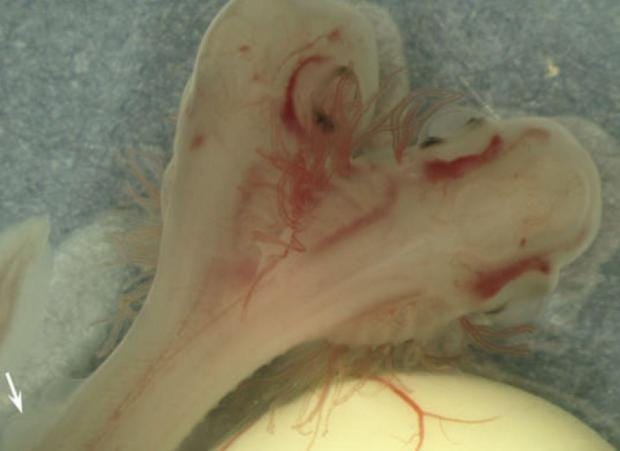
Two-headed sharks are becoming more common and no one knows why

A large reduction of the gene pool caused by overfishing is blamed for the deformity 
A two-headed catfish shark embryo discovered in a Spanish laboratory
 
Matt Payton
Thursday 3 November 2016


An increasing number of two-headed sharks are being reported in the wild, leaving scientists unable to explain why.

Over the last few years, a growing number of these genetic aberrations have been discovered and examined by scientists.

Professor Valentín Sans Coma, from the University of Malaga, studied the embryo of a two-headed catfish shark in a laboratory condition alongside 800 other shark embryos.

He has claimed a genetic disorder is the most reasonable explanation for the mutation as the unborn fish were not exposed to any infection, chemicals or radiation, reports the National Geographic.

Regarding wild sharks, scientists have blamed the mutation on a cocktail of factors including viral infections, metabolic disorders and pollution.

After studying a two headed smalleye smooth-hound shark and a two-headed blue shark, marine scientist Nicolas Ehemann claimed overfishing was probably to blame.
 

Thursday, 8 September 2016

Large blue butterfly thriving in UK since reintroduction

Numbers of the endangered butterfly, once pronounced extinct in the UK, have reached their highest level in 80 years, according to conservationists

Press Association
Saturday 27 August 201608.01 BST

A butterfly once pronounced extinct in the UK has been seen in record numbers this year, according to conservationists.

There were over 10,000 adult large blue butterflies in Gloucestershire and Somerset – the largest concentration of the species known in the world.

Conservationists said the findings contradicted widely reported warnings that2016 could be the worst year on record for British butterflies.

In total more than 250,000 eggs were laid by large blue butterflies this summer on the abundant thyme and marjoram flowers at the Daneway Banks reserve in Gloucestershire and the Green Down reserve in Somerset.

Prof Jeremy Thomas, chairman of the Joint Committee for the Restoration of the Large Blue Butterfly, said the numbers of the butterfly, which was reintroduced to the UK in 1984, were its highest for 80 years.

“The success of this project is testimony to what large scale collaboration between conservationists, scientists and volunteers can achieve,” he said.

“Its greatest legacy is that it demonstrates that we can reverse the decline of globally-threatened species once we understand the driving factors.”

The large blue has a bizarre life-cycle.
Having fed for three weeks on the flowerbuds of wild thyme or marjoram, the caterpillar produces scents and songs that trick red ants into believing it is one of their own grubs and is carried underground into the ants’ nest and placed with the ant brood.


Thursday, 1 October 2015

Global swarming: invasion of the daddy long-legs on the way thanks to Britain's warmer weather

The world's most stupidest creatures are set to invade British homes as chilly nights leave them looking for shelter


9:49AM BST 01 Oct 2015

They are perhaps the world's stupidest creatures - they blunder around breaking their legs and they're perfectly happy to dance around a flame.

Yet it may send a shiver down your spine to hear that experts predict an explosion in the number of crane flies this month.

The insects, Tipula paludosa, better known as the daddy-long-legs, have been emerging earlier than usual because of recent warm weather.

And, as the nights get colder, they are expected to start invade homes looking for shelter.

Entomologist Barry Warrington, from Hull, said: "It is definitely a bumper year this year, simply due to the nice weather.

"It has not been as cold, there is a lot more for them to prey on.

Tuesday, 11 August 2015

Short-haired bumblebee numbers on the rise in the UK

Tuesday 11 August 2015 06.01 BSTLast modified on Tuesday 11 August 201509.32 BST

New sightings of short-haired bumblebees show a scheme to reintroduce the vanished species to the UK is proving successful, conservationists have said.

Three short-haired bumblebee workers were spotted at the RSPB’s Dungeness nature reserve in Kent, where the reintroduction scheme is taking place, on four consecutive days.

The short-haired bumblebee vanished from the UK in 1988, having suffered declines over the previous 60 years as its habitat was lost, and was officially declared locally extinct in 2000.

A scheme to reintroduce the species has seen experts collecting short-haired bumblebee queens from Sweden, where they are found in good numbers, and releasing them at the Dungeness reserve each year since 2012.

There have now been consistent sightings of workers bees over the past three years, showing the queens have successfully nested and produced young and indicating the bees are finding enough food to build colonies, experts said.


Thursday, 2 April 2015

UK's most endangered butterfly back from the brink

The critically endangered high brown fritillary had its best summer in a decade in 2014, with numbers rising 180% in a year thanks to conservation efforts


Thursday 2 April 2015 06.01 BST
Last modified on Thursday 2 April 201509.28 BST

The most endangered butterfly in Britain enjoyed its best summer for a decade last year after highly focused conservation efforts on its 30 remaining sites.

Numbers of the critically endangered high brown fritillary increased by 180% last year compared with 2013 according to the UK Butterfly Monitoring Scheme (UKBMS), with warm spring weather also helping its caterpillars survive.

Its recovery, which builds on an increase in numbers in 2013, raises hopes that this large, dynamic butterfly is no longer heading towards extinction.

As recently as 50 years ago, the high brown fritillary was a common sight in large woods across England and Wales. In recent decades, lepidopterists have puzzled over its dramatic disappearance, fearing it would become the first butterfly species to fall extinct in Britain since the large blue was lost in 1979.

Sunday, 1 March 2015

China's wild panda numbers have increased by 17% since 2003, new census reveals

But their habitat is still under threat from fragmentation, caused by physical barriers such as roads

Sunday 01 March 2015

They have acquired a reputation as being rather picky when it comes to sex, but giant pandas in the wild appear to have been busy. According to a new census in China, the population of the animals has gone up by 268 since 2003, taking their total numbers to 1,864 – an increase of nearly 17 per cent. The bears have also extended their territory to more than 2.5m hectares – a 12 per cent increase.


Nicola Loweth, conservation group WWF UK’s regional officer for India and China, said: “The increase in population is due to the implementation of a number of successful conservation actions by the Chinese government, nature reserve staff and local communities.”

She said that the panda population’s growth had wider benefits. “This news is not just about giant pandas. We’re also talking about their habitats. It means that very important eco-systems are being protected for a whole range of other species.”

Their numbers are thought to have been boosted by the establishment of the Giant Panda Nature Reserve Network, measures to ban logging in certain areas and steps to reduce poaching. The number of designated nature reserves has also been increased from 40 to 67 since 2003, so that about two-thirds of the wild panda population now live in protected areas.

Thursday, 31 July 2014

British turtles are booming

Posted by: Kevin Heath / 1 day ago

It may take more than a day trip to the coast to see the booming turtle population but the numbers of green turtles on British dependency Ascension Island are booming. The latest survey shows that turtle numbers on the main beaches now total 24,000 nests – an increase of 500% since records began in the 1970′s

The increase means that the beaches around the Ascension Island are now the second largest breeding population in the Atlantic Ocean. The future could be even brighter for the turtles and other wildlife as the governor signed in to existence 7 new nature reserves yesterday (28th July 2014) which included 3 main green turtle nesting sites. The new sites means a fifth of the Island is now protected as nature reserves.

The new sites which were signed of by Island’s Governor Mark Capes will also secure the future of nesting sites for over 800,000 sea birds. The sites were part of a biodiversity action plan that was developed by the Ascension Island Government and the University of Exeter. The new action plan followed on from over 2 years of research on the island.

Wednesday, 22 January 2014

Animal shelters expecting surge in abandoned pets

Animal shelters have reported a significant rise in the numbers of pets that were abandoned in the run-up to Christmas – and are now braced for another surge in the coming months as households struggle to cope with new animals as they get bigger.

Dublin Society for Prevention of Cruelty to Animals (DSPCA) spokeswoman Gillian Bird said the group’s shelter in Rathfarnham, Dublin, is “full of animals” of an age which would indicate they were bred for Christmas 2012 but were subsequently discarded.

She said the DSPCA has already taken in five abandoned puppies – but that this trend does not normally begin until a month or two has passed after Christmas.

Monday, 4 November 2013

Aboriginal Hunting Practice Increases Animal Populations

Oct. 24, 2013 — In Australia's Western Desert, Aboriginal hunters use a unique method that actually increases populations of the animals they hunt, according to a study co-authored by Stanford Woods Institute-affiliated researchers Rebecca and Doug Bird. Rebecca Bird is an associate professor of anthropology, and Doug Bird is a senior research scientist.

The study, published today inProceedings of the Royal Society B, offers new insights into maintaining animal communities through ecosystem engineering and co-evolution of animals and humans. It finds that populations of monitor lizards nearly double in areas where they are heavily hunted. The hunting method -- using fire to clear patches of land to improve the search for game -- also creates a mosaic of regrowth that enhances habitat. Where there are no hunters, lightning fires spread over vast distances, landscapes are more homogenous and monitor lizards are more rare.

"Our results show that humans can have positive impacts on other species without the need for policies of conservation and resource management," Rebecca Bird said. "In the case of indigenous communities, the everyday practice of subsistence might be just as effective at maintaining biodiversity as the activities of other organisms."

Friday, 13 September 2013

Humpback Whale Populations Increase Off British Columbia

Humpback whale populations are on the rise in a small coastal area of British Columbia, a new estimate reveals, but researchers remain cautious about the whales' safety in the face of several human threats.

In the summer, the whales share space with a shipping channel that goes through the Caamaño Sound area, which is just south of the port city of Prince Rupert and midway up the province's coast. Whale collisions with freighters sometimes happen, and ship noise interferes with the feeding calls the humpbacks emit. Humpbacks can also get tangled in fishing gear and drown, or starve if the gear interferes with their ability to eat.

Canadian gas company Enbridge is considering a pipeline in the area that would bring oil from the tar sands in a neighboring province, Alberta, and pump it several thousand miles to the coast for shipping.

Saturday, 3 August 2013

Tiger numbers increase by 63% in Nepal in 4 years

Nepal records remarkable growth in tiger numbers
July 2013. An encouraging announcement from the Government of Nepal on put the number of wild tigers in the country at 198, though there may be anywhere from 163 - 235 tigers allowing for errors. This marks an increase in the population by 63% from the last survey in 2009. 

"Nepal's results are an important milestone to reaching the global TX2 goal of doubling the number of wild tigers by the year 2022," stated Megh Bahadur Pandey, Director General of Nepal's Department of National Parks and Wildlife Conservation. "Tigers are a part of Nepal's natural wealth and we are committed to ensuring these magnificent wild cats have the prey, protection and space to thrive."

Cross border populations
Tigers are found in the Terai Arc Landscape stretching 600 miles across 15 protected area networks in Nepal and India. The two countries embarked on the first-ever joint tiger survey using a common methodology in January 2013. In Nepal, the field survey was carried out between February and June 2013 followed by two months of data analysis to arrive at the final estimates. It was agreed by the two governments that each country could release its national estimates and that a joint report will be released later in the year to provide a landscape-wide estimation of tiger populations and a better understanding of tiger movements in the trans-boundary landscape.

Thursday, 6 June 2013

Jellyfish surge in Mediterranean threatens environment – and tourists

A project is tracking the phenomenon as global warming and overfishing boost numbers of the venomous sea creature

Scientists across the Mediterranean say a surge in the number of jellyfish this year threatens not just the biodiversity of one of the world's most overfished seas but also the health of tens of thousands of summer tourists.

"I flew along a 300km stretch of coastline on 21 April and saw millions of jellyfish," said Professor Stefano Piraino of Salento University in southern Italy. Piraino is the head of a Mediterranean-wide project to track the rise in the number of jellyfish as global warming and overfishing clear the way for them to prosper.

"Citizen scientists" armed with smartphones and a special app are now tracking them along thousands of miles of Mediterranean coastline. Population growth has continued over the four years of the project, and appears to be part of a global phenomenon, with most coastal areas studied around the world also reporting a rise in numbers.

"There are now beaches on the island of Lampedusa, which receives 300,000 tourists a year, where people can only swim for a week in the summer," said Piraino.

Josep María Gili, a veteran jellyfish researcher at the Institute of Marine Sciences in Barcelona, said: "It is a growing problem in the Mediterranean, as it is in the rest of the world. But the problem is at its greatest in the open sea."

The institute has detected a surge this spring in one of the most poisonous species, the mauve stinger or Pelagia noctiluca, along the coast of Catalonia and Valencia. "We have seen banks several kilometres long and with a density of 30 to 40 jellyfish per square metre," the institute's Verónica Fuentes told Spain's ABC newspaper. "The ones we have found this spring are particularly big."

Gili said this was mostly surprising because the mauve stingers were close to beaches. "Normally, that size of jellyfish does not reach the coast because of the temperature of the water," he said.

Other badly hit coastlines include Sardinia, Sicily, Malta and the eastern Mediterranean beaches of Israel and the Lebanon.

Piraino said at least 150,000 people were treated for jellyfish stings around the Mediterranean each summer.

Saturday, 20 April 2013

Patagonian deer brought back from the brink


Resurgence of endangered deer in Patagonian ‘Eden' highlights conservation success
April 2013. The Huemul, a species of deer found only in Patagonia, is bouncing back from the brink of possible extinction as a result of collaboration between conservationists and the Chilean government, according to a new study.


Controlling cattle farming and poaching
By controlling cattle farming and policing to prevent poaching in the Bernardo O'Higgins National Park - a vast "natural Eden" covering 3.5 million hectares - conservation efforts have allowed the deer to return to areas of natural habitat from which it had completely disappeared.

Researchers are hailing the findings as an example of collaborations between local government and scientists leading to real conservation success, and a possible model for future efforts to maintain the extraordinary biodiversity found in this part of Chile.

99% reduction - Just 2,500 deer left
A national symbol that features on the Chilean coat-of-arms, Huemul deer are estimated to have suffered reductions of 99 per cent in size since the 19th century, according to the International Union for the Conservation of Nature. Researchers believe 50 per cent of this decline has come in recent years, with only 2,500 deer now left in the wild.

Easy prey
The Huemul is a naturally tame and approachable animal, which led to it becoming easy prey for hunters, particularly with the arrival of European colonists in the area who would hunt Huemul for meat to feed their dogs. Recent increases by local farmers in the practice of releasing cattle indiscriminately into national parkland for retrieval later in the year has damaged the habitats of endemic wildlife such as the Huemul, and, coupled with continued hunting of the species, deer populations plummeted.

The joint efforts of conservationists and researchers with government and private initiatives created a small number of field stations in this remote natural paradise on the tip of South America - one of the least populated areas of the world, requiring a boat trip of two days along the region's stunning fjords to reach.

This created a base for monitoring endangered species and natural habitats, as well as a team of park rangers enforcing conservation laws that - although they had been in place since the late sixties - had never been policed on the ground.

The impact was almost immediate, within five short years - from 2004 to 2008 - the Huemul population in the national park not only stabilised but also began to increase, with deer coming down from the hostile mountain areas it had sought refuge in and back to the sea-level valleys where it naturally thrives.

National parks must exist on more than paper
"National parks are at the heart of modern conservation, but there has to be an investment in management and protection on the ground. You can't just have a ‘paper park', where an area is ring-fenced on a map but physically ignored," said Cristóbal Briceño, a researcher from Cambridge's Department of Archaeology and Anthropology, who co-authored the study.

"Our results suggest that synergistic conservation actions, such as cattle removal and poaching control, brought about by increased infrastructure, can lead to the recovery of species such as the threated Huemul."


Saturday, 26 January 2013

Very remote, high altitude haven proving a saviour for wild yak


Once decimated by hunting, wild yaks may be returning
January 2013. A team of American and Chinese conservationists from the Wildlife Conservation Society and University of Montana recently counted nearly 1,000 wild yaks in a remote area of the Tibetan-Qinghai Plateau. The finding may indicate a comeback for this species, which was decimated by overhunting in the mid-20th century.

990 yaks in Hoh Xil National Nature Reserve
The team counted 990 yaks in a rugged area called Hoh Xil - a national nature reserve nearly the size of West Virginia but devoid of people. The remote region lies in the mid-eastern Tibetan-Himalayan highlands, home to some 17,000 glaciers - an area sometimes called the "3rd pole" due to its Arctic-like conditions.

Third largest mammal in Asia
Wild yaks are the third largest mammal in Asia, second only to elephants and rhinos. Adults are estimated to be the size of bison, but - because the area where they occur is so isolated - wild yaks have never been officially weighed. Fifty years ago, the Tibetan steppe was dotted with wild yak much in the way that bison once stretched across vast North American prairies. Like bison, wild yaks were slaughtered. Yak skulls still litter high elevation haunts up to 17,500 feet.

Wild yak population estimates across the Tibetan-Qinghai Plateau are unknown, though conservationists believe they may be making a comeback due to conservation efforts by Chinese park officials and provincial governments. Recently, the Qinghai provincial government has launched several conservation related policies and regional projects in order to develop a sound basis for wildlife and environmental conservation in this region.

"Wild yaks are icons for the remote, untamed, high-elevation roof of the world," said Joel Berger who led the expedition for WCS and the University of Montana. "While polar bears represent a sad disclaimer for a warming Arctic, the recent count of almost 1000 wild yaks offers hope for the persistence of free-roaming large animals at the virtual limits of high-altitude wildlife."

Wednesday, 2 January 2013

Number of crocodiles in Australian waters soars

A record haul of man-eating saltwater crocodiles was removed from waterways in the "Top End" of Australia last year, confirming that numbers of the feared reptiles are ballooning.
Wildlife rangers captured 314 of the estuarine crocodiles – or "salties" – in 2012, the equivalent of more than six a week in the northernmost section of the Northern Territory. Of those, 215 were fished out of Darwin Harbour, in the centre of a city that is home to nearly 130,000 people. The largest was a 16ft male, caught in a swamp in outer Darwin back in April.

The figures, which emerged yesterday, were released by the Northern Territory Parks and Wildlife Commission a month after a 12-year-old boy was killed by a crocodile near Port Bradshaw, 400 miles east of Darwin. Two weeks earlier, human remains were found in a crocodile's stomach after a seven-year-old girl was attacked while swimming in a waterhole.

Hunted almost to extinction last century, saltwater crocodiles have been a protected species since 1971 and since then their numbers have soared. There are now believed to be about 150,000 roaming the Top End. Despite their name, they are found in rivers and creeks miles from the sea.

Under a management programme, wildlife rangers trap creatures considered to pose a particular risk to humans, usually because they are close to populated areas. The two fatal attacks sparked renewed calls for the crocodiles to be selectively culled.

http://www.independent.co.uk/news/world/australasia/number-of-crocodiles-in-australian-waters-soars-8434295.html

Monday, 31 December 2012

Call of the wild


After millennia spent exterminating them, humanity is protecting wolves. Numbers have risen again—and so have ancient resentments

IN AUGUST 2011 Desiree Versteeg, a Dutch mortuarist, was driving home in the suburbs of Arnhem in the eastern Netherlands when she saw an animal in the road. “At first I thought it was a dog. Then I thought it was a fox. Then—I couldn’t believe my eyes—I saw it was a wolf.” She got out of the car to take a picture. “I was seven or eight metres away from him. He couldn’t get away because a fence was blocking his path. He turned and stared at me. That was a frightening moment.” Both she and the wolf fled.

From Ms Versteeg’s photographs, and from the carcass of a deer found nearby—its throat torn out in classic wolf fashion—scientists verified that she was the first person to have seen a wolf in the Netherlands since 1897. Having talked to the experts, she now understands that the wolf was probably more frightened than she was. “But all you know at the time is: it’s a wolf, it’s a predator and I’m in its way.”

Ms Versteeg’s experience illustrates a dramatic reversal that has taken place in the West over the past couple of decades. Economic change has led to a fundamental shift in humanity’s attitude to wolves. For the first time since man first sharpened a spear, he has stopped trying to exterminate them and taken to protecting them instead. The effort has been so successful that wolves are recolonising areas from which they disappeared as much as a century ago. As they do so, they are forging revealing divisions over whether mankind can live side-by-side with the species it replaced as the Western world’s top predator.

State v wolf
Most man-made extinctions have been accidental—the result of over-hunting, or importing predators or diseases. Wolves are different. Through most of human history, killing them has been regarded as a public good. As soon as anything that looked like a state developed, it set about exterminating wolves.

In England King Edgar imposed an annual tribute of 300 wolf skins on Idwal, king of Wales, in 960; monarchs made land grants on condition that the beneficiaries carried out wolf hunts; King Edward I employed a wolf-hunter-in-chief to clear central and western England of wolves. By the end of the 15th century they seem to have disappeared from England, though in Scotland they hung on a little longer: in 1563 Mary Queen of Scots had 2,000 Highlanders drive the woods of Atholl for a hunt that bagged 360 deer and five wolves.

Continued:  http://www.economist.com/news/christmas/21568656-after-millennia-spent-exterminating-them-humanity-protecting-wolves-numbers-have-risen?fsrc=nlw

Related Posts with Thumbnails

ShareThis