Showing posts with label giant panda. Show all posts

Sunday, 29 September 2019

Outrage in China as giant panda on loan to Thailand zoo dies


Chuang Chuang reportedly collapsed after eating bamboo in Chiang Mai Zoo
Erin Hale in Hong Kong
Wed 18 Sep 2019 13.44 BSTLast modified on Wed 18 Sep 2019 14.27 BST
The sudden death of a giant panda on loan to a zoo in Thailand has sparked outrage in China and calls for no more of the bears to be lent to the country.
Chuang Chuang, a 19-year-old male, reportedly collapsed on Monday afternoon after eating bamboo in Chiang Mai zoo in northern Thailand, according to Thai media.
While the death will be investigated by experts from the China Conservation and Research Centre for the Giant Panda, according to Chinese state media, the news has not placated social media.
Many in the online community say they still have questions about Chuang Chuang’s death and the quality of food and facilities at the Chiang Mai zoo, with his death a top trending topic on the Chinese social media platform Sina Weibo.
One user wrote: “Please don’t rent any more pandas to Thailand! No! Chuang Chuang is probably the most bitter panda in the world! What kind of bamboo he was given eat? If you can’t afford [a panda], don’t rent it.”
 “You must take good care of our national treasures loaned to you, Thailand,” another user wrote. “Now Chuang Chuang is gone. It’s no use saying anything. If you can’t take care of our national treasures, don’t borrow them. I’m so sad.”

Monday, 22 April 2019

UK's only female giant panda artificially inseminated at zoo


APRIL 1, 2019
Britain's only female giant panda has been artificially inseminated in a bid to produce a cub.
Officials at Edinburgh Zoo in Scotland said Monday it's "far too early" to know if the procedure was a success. The zoo said Tian Tian had her annual health check on Sunday and was artificially inseminated "under expert veterinary care."
Tian Tian, 15, has had cubs in China but not in Britain, where she and male companion Yang Guang have lived since 2011. Her name means "sunshine."
There have been attempts to breed a cub every year since then, thus far without success. The zoo says the gestation period for a giant panda is typically about five months.

Monday, 25 February 2019

Ancient pandas weren't exclusive bamboo eaters, bone evidence suggests


Date:  January 31, 2019
Source:  Cell Press
The giant pandas we know and love today live only in the understory of particular mountains in southwestern China, where they subsist on bamboo alone. In support of their tough and fibrous bamboo diet, they've got distinctive teeth, skull, and muscle characteristics along with a special pseudo-thumb, the better to grasp and hold bamboo stems, leaves, and shoots with. But according to new evidence reported in Current Biology on January 31, extinct and ancient panda species most likely had a more varied and complex diet.
"It has been widely accepted that giant pandas have exclusively fed on bamboo for the last two million years," says Fuwen Wei of Chinese Academy of Sciences. But, "our results showed the opposite."
It's impossible to know exactly what extinct animals ate. But researchers can get clues by analyzing the composition of stable isotopes (different forms of the same element that contain equal numbers of protons but different numbers of neutrons) in animal teeth, hair, and bones, including fossil remains. In the new study, the researchers first analyzed bone collagen of modern pandas (1970s-2000s) and other mammals from the same mountains.

Sunday, 15 July 2018

What's giant panda conservation worth? Billions every year, study shows


Date: June 28, 2018
Source: Cell Press

Summary:
In China, the giant panda is clearly a cultural icon. And yet panda conservation, and the panda itself, is often criticized because of the associated cost. But a new analysis shows that panda conservation has great value that extends far beyond protection of pandas themselves.

In China, the giant panda is clearly a cultural icon. And yet panda conservation, and the panda itself, is often criticized because of the associated cost. But an analysis reported in Current Biology on June 28 shows that panda conservation has great value that extends far beyond protection of pandas themselves.

According to the new findings, the panda's protection as an umbrella species yields 10 to 27 times as much value as it costs to maintain the current reserves. In fact, the findings suggest it might be worth expanding those panda reserves and other investments in natural capital in China.


Wednesday, 11 July 2018

Giant panda population research shows new challenges


Long-term data provides scientific evidence of conservation success

Date: July 2, 2018
Source: San Diego Zoo Global

Summary:
Scientists report results of a large-scale study examining giant panda habitat use trends and changing threats to their survival. This benchmark study is based on nearly 70,000 person-hours of survey work by China's State Forestry Administration throughout the panda's range in Sichuan, covering three-quarters of the entire species range.


Friday, 22 June 2018

The Oldest DNA from Giant Pandas Was Just Discovered in a Cave in China


By Rafi Letzter, Staff Writer | June 18, 2018 05:28pm ET

Scientists in China found a fossil from a giant panda that lived 22,000 years ago. Until they excavated the fossil, reassembled it and analyzed its mitochondrial DNA, biologists had no idea this panda lineage even existed.

It's now considered the oldest DNA from giant pandas to date, the researchers said.

The panda fossil turned up in Cizhutuo Cave in the Guangxi region of China. No pandas live there today, the researchers from the Chinese Academy of Sciences wrote in a paper published today (June 18) in the journal Current Biology. An unexpected giant-panda fossil find was exciting, they wrote, because researchers don't have a good sense of the history of the 2,500 giant pandas alive in the world today. Researchers know that 20 million years ago, the current batch of living giant pandas split from all other bears. They don't know much about their lineage since.


Thursday, 15 March 2018

Edinburgh zoo halts giant panda breeding programme


Keepers to suspend efforts for at least a year and reassess strategy after five failed attempts

Severin Carrell Scotland editor
Tue 13 Mar 2018 11.09 GMTLast modified on Tue 13 Mar 2018 11.47 GMT

Edinburgh zoo has suspended its giant panda breeding programme for at least a year after failing five times to produce cubs through artificial insemination.

The zoo, run by the Royal Zoological Society of Scotland (RZSS), said it needed to reassess its strategies before making a final decision on whether to again put its female Tian Tian through artificial insemination.

“We will not attempt to breed our giant pandas this year because we want to further assess the incredibly complex and unpredictable breeding process,” a spokeswoman said.

“This pause, which is supported by our giant panda team and other key specialists, will allow us further time to consider the scientific data, our own experiences and those of colleagues around the world, including the latest thinking on giant panda accommodation.”

The RZSS loaned Tian Tian and Yang Guang from China for 10 years in 2011, for a fee of $1m (£720,000) a year, as part of a £2.6bn trade deal.

Tian Tian had had twins in China in 2009, but the RZSS tried natural mating only once, in 2012. It subsequently used artificial insemination with Yang Guang’s semen and defrosted semen from a bear that had successfully bred at Berlin zoo.


Friday, 10 November 2017

The first ancestors of giant pandas probably lived in Europe

27 October 2017

By Jasmin Fox-Skelly

A bear very similar to a panda lived in what’s now Hungary 10 million years ago. The creature ate a similar diet to modern giant pandas, suggesting their unusual bamboo-chewing lifestyle has survived through evolutionary time. The finding also adds to the evidence that pandas originated in Europe, not Asia.

The giant panda (Ailuropoda melanoleuca) is only found in forested mountain ranges in central China. It famously eats little but indigestible bamboo, despite having the digestive system of a carnivore, and is one of the world’s most iconic vulnerable species. This black-and-white bear is the only surviving member of the Ailuropodinae subfamily, part of the larger Ursidae family.

Nobody really knows how the giant panda evolved. Few fossils of its relatives have been found, so its lineage is almost as hotly debated as that of humans.

Now palaeoanthropologist David Begun at the University of Toronto in Canada has found a set of fossil teeth in the town of Rudabánya, Hungary. The site previously yielded the remains of an ancient great ape called Rudapithecus, a possible ancestor of African great apes and humans.
Begun was looking for ancient hominid bones when he spotted the teeth trapped beneath a rhino’s shoulder blade. The teeth are 10 million years old, placing them in the late Miocene.

Suspecting they belonged to a panda, based on their shape, Begun enlisted the help of Louis de Bonis at the University of Poitiers in France and Juan Abella at the State University Santa Elena Peninsula in Ecuador.


Sunday, 1 October 2017

Panda's habitat 'shrinking and becoming more fragmented'


By Helen BriggsBBC News
25 September 2017

Despite signs that numbers of giant pandas are rising, suitable habitat has shrunk, according to satellite data.

The forests where the panda lives are in worse shape than in 1988, when it was first listed as endangered, scientists say.

Last year, the giant panda was downgraded from endangered to vulnerable on the IUCN Red List.

Habitat loss is the most serious threat to the animal, which is seen as an icon of global extinction efforts.

"What's new in this study is our ability to assess the status of the giant panda by using satellite imagery and then use that information to come up with recommendations of how better to manage this iconic threatened species," said Prof Stuart Pimm, of Duke University, North Carolina, US, who is a researcher on the study.

The news last year that the giant panda had been taken off the endangered list made headlines around the world.

The decision was made because numbers of wild pandas had risen in surveys. However, with only around 1,800 left in the wild, establishing new reserves and extending existing ones is crucial for the animal's survival.

"I think we now understand we've got to keep an eye on the habitats where pandas live," said Prof Pimm.

"But it also points to the need to try and re-connect isolated panda habitats by building what we call biological corridors."


Thursday, 21 September 2017

Farewell, Basi: World's Oldest Captive Panda Dies at 37

By Sarah B. Puschmann, Staff Writer | September 14, 2017 12:45pm ET

The oldest giant panda in captivity died yesterday (Sept. 13) at the advanced age of 37, according to the state-run Chinese news outlet Xinhua News Agency.
The panda, named Basi, died of multiple causes, including cirrhosis of the liver and kidney failure, the animal's keepers said.
"Basi has left, but her beautiful image and Basi spirit will forever be in our hearts," said Chen Yucun, director of the Straits Giant Panda Research and Exchange Center in Fuzhou, China, which housed Basi, according to Agence France-Presse. (In Fujian province, where Fuzhou is the capital, "basi" has come to mean "beautiful," according to Pandas International, a Colorado-based nonprofit organization.) 

Sunday, 14 September 2014

Giant San Diego panda gets chipped tooth fixed

SAN DIEGO (AP) — Bai Yun, the San Diego Zoo's giant female panda, has been known to chew on bamboo up to 12 hours a day, so when she chipped a lower tooth, veterinarians had to fix it.

The 23-year-old panda went to the dentist Wednesday, got a shot to make her numb and got the chip repaired, a cleaning and X-rays.

The Los Angeles Times reports (http://lat.ms/1whka7u ) a dental composite was used to fill the damaged tooth.

Bamboo is chewy but to get enough nutrition out of it, a panda has to break it apart and chew a lot.

Thursday, 28 August 2014

Giant panda fakes pregnancy to get more food


A giant panda is believed to have faked her pregnancy in order to get better food, The Independent has reported.

Six-year-old panda Ai Hin began to show signs of being pregnant, which included reduced appetite and mobility, in July, but after two months of observation, experts have told state news agency Xinhua that she wisn't pregnant as her behaviour and physiological tests showed her to be normal

Her keepers at Chengdu Giant Panda Breeding Research Centre in China’s Sichuan province believe she has learned that exhibiting this behaviour will earn her better food. This is because captive pandas have difficulty in successfully giving birth and are therefore treated to round the clock care and attention.

Wednesday, 21 May 2014

Panda restoration efforts look at digestive systems

Date:
May 19, 2014

Source:
Mississippi State University, Office of Agricultural Communications

Summary:
Scientists have discovered that giant and red pandas have different digestive microbes, a finding with important implications for conservation efforts and captive animal rearing. The giant panda is an endangered species, while the red panda is considered a vulnerable species


Tuesday, 7 January 2014

The ‘first’ giant panda and how it ended up in Paris

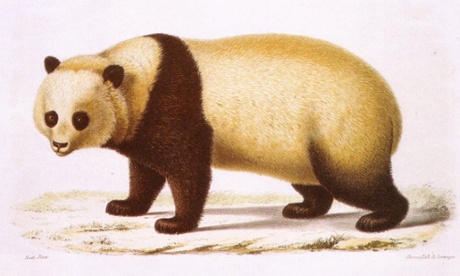
Engraving of the giant pandaPandas are such a common sight in today’s busy world (cute pandas,sneezing pandas, Kung Fu pandas, humans dressed as pandas) that it’s hard to imagine a time when this beast was not known. Yet as recently as 150 years ago, this was the case for all but a handful of people.

The first westerner to clap eyes on a panda is thought to have been a French priest and naturalist known as Armand David. He’d been posted to China in 1862 to spread the Christian word, but was a keen naturalist too (“all science is dedicated to the study of God’s works and glorifies the Author”) and went on several collecting trips over the course of his stay, sending specimens back to the MusĂ©um National d’Histoire Naturelle in Paris.

Saturday, 22 December 2012

Scientists Discover Evidence of Giant Panda's Population History and Local Adaptation


Dec. 16, 2012 — A research team, led by Institute of Zoology of Chinese Academy of Sciences and BGI, has successfully reconstructed a continuous population history of the giant panda from its origin to the present. The findings suggested whereas global changes in climate were the primary drivers in panda population fluctuation for millions of years, human activities were likely to underlie recent population divergence and serious decline.

The latest study was published online in Nature Genetics.

The giant panda is the rarest member of the bear family. Sometimes considered the ambassador for all endangered species, it is a well-recognized symbol of international wildlife conservation. The giant panda is currently threatened by continued habitat loss, human persecution, and other threats. Its dietary specialization, habitat isolation, and reproductive constraints have led to a perception that this is a species at an "evolutionary dead end," destined for deterministic extinction in the modern world.

In this study, researchers carried out whole genome resequencing of 34 wild giant pandas and found the current six geographic populations of giant panda could be divided into three genetic populations, including Qinling (QIN), Minshan (MIN) and Qionglai-Daxiangling-Xiaoxiangling-Liangshan (QXL). Through reconstructing giant panda's population history, they found several important evolutionary events such as two population expansions, two bottlenecks and two population divergences.

Continued:  http://www.sciencedaily.com/releases/2012/12/121216132511.htm

Thursday, 1 December 2011

Giant pandas coming to Edinburgh Zoo. What is the point?

Pandas at Edinburgh ZooNovember 2011. The Scottish Government has been taken to task over advertisements placed to coincide with the arrival of two Giant Pandas at Edinburgh Zoo. Although the Scottish Government turned down requests from the Zoo for funding towards the cost of leasing the animals from the Chinese authorities it now appears the Government is keen to capitalise on the media interest in the new arrivals.


Huge cost to lease pandas
In the advert, placed by Government Department Natural Scotland, it is claimed that "the Chinese are gifting two giant pandas to live in Scotland ...". In fact the bears are being leased from the Chinese by Edinburgh Zoo. Although the Zoo has not disclosed the fee they are paying it is described on a Chinese Government website as "substantial" and is thought to be between £1 million and £1.4 million per year for the ten years of the leasing agreement. A complaint has been made to the Advertising Standards Authority (ASA) on the grounds that, by suggesting the animals are being supplied free of charge by the Chinese Government, the advert is untrue and misleading.

Complaint to Advertising Standards Authority by Animal Concern
In a Freedom of Information request the Scottish Government has been asked to disclose who initiated and authorised this advertising campaign and how much public money has been spent on it. The complaint to the ASA and the Freedom of Information request have been made by Animal Concern, an organisation which opposes bringing the Giant Pandas to Scotland.

John Robins of Animal Concern states; "These bears are being brought to Scotland in a desperate bid to solve a financial crisis at Edinburgh Zoo. Similar initiatives at other zoos have ended badly with the huge costs of leasing and caring for the pandas outstripping the extra income they generate.

Little or no conservation value
There is little conservation or educational value in the project and the vast sums of money being paid to the Chinese authorities would be better spent improving conditions for other animals at the Zoo or in buying large areas of the natural habitat of the Giant Panda and protecting it from human encroachment and commercial exploitation. It is quite sickening to see both the Scottish and Chinese Governments desperately trying to generate positive publicity on the back of the cute and cuddly image of the two pandas which are being transported half-way across the globe for nothing more than very unsavoury financial and political reasons. Instead of sucking up to Chinese politicians, Edinburgh Zoo would do more for conservation by taking them to task on the environmental damage and loss of habitat being caused in China by uncontrolled expansion of polluting industries. Alex Salmond should be criticising the Chinese human rights record instead of selling them cheap factory farmed salmon. These adverts are untrue and misleading and an extremely dubious waste of public money."

Edinburgh Zoo made a loss of circa £1.5 million last year and borrowed £2 million from Lloyds Bank this March to help pay for the new enclosure for the two pandas. Since January several staff and Trustees have left the Zoo.

http://www.wildlifeextra.com/go/news/edinburgh-pandas.html

Monday, 18 July 2011

Male and female giant pandas prefer different habitats

Male and female giant pandas prefer to use different habitats, say scientists.

Female pandas frequent high altitude conifer forests and mixed forests on steeper slopes, whereas males roam more widely, researchers found.

Females prefer these areas as they provide den sites for birthing and dense bamboo cover in which baby pandas can hide.

The discovery could inform strategies for conserving wild pandas and releasing them back into the wild.

Details are published in the Journal of Zoology.

Dunwu Qi and Fuwen Wei of the Institute for Zoology at the Chinese Academy of Sciences in Beijing and colleagues studied the movements of giant pandas within the Liangshan Mountains of south central China.

They conducted transect surveys recording the presence of pandas by sight or by their droppings.

By studying the DNA in fecal samples, the researchers could determine the sex of the pandas encountered.

Giant pandas are solitary animals confined to highly fragmented montane forests in remote China.


Scientists well understand the basic type of habitat pandas need to survive, which tends to be forests above 1500m rich in bamboo, the pandas' main food.

The animals generally avoid higher peaks lacking bamboo and lower areas dominated by people.

But the specific requirements of males and females has been largely ignored until now.

The scientists' study confirmed that both sexes prefer to live in areas at higher altitudes and with high forest cover.

But female pandas are more picky than males.

They tend to limit their movements to within high altitude conifer forests and mixed forests, as well as historically clear-felled forest.

They also prefer habitat that slopes at between 10 and 20 degrees.


Such areas are better for raising young. Female pandas are selective about their den sites and often make dens in stands of large conifer trees more than 200 years old.

That also suggests that den sites may be limited in logged areas.

Males, in contrast, range more widely, covering areas that overlap the ranges of several females.

This segregation of the sexes should be accounted for in conservation and management efforts to safeguard the giant panda, say the researchers.

In particular, it should be recognised that female giant pandas have a narrower habitat preference than males.

That means they are likely to be disproportionately affected by habitat loss and people exploiting the forest.

It should also be taken into account when breeding programmes release giant pandas back into the wild.

Roads don't appear to have as great an impact on the movements of giant pandas as previously thought, say the researchers.

Females are often found near abandoned logging trails, though this could be an artefact of the number of roads of this type that crisscross the region.

Males tend to frequent habitat close to roads used by vehicles, perhaps due to their need to move greater distances to find prospective female mates.

By Matt Walker

Editor, BBC Nature
http://www.bbc.co.uk/nature/14153997

Tuesday, 22 February 2011

Chinese pandas leave for Japan

Female panda Xian Nu looks out of the cage at Shanghai Pudong Airport in Shanghai, east China, Feb. 21, 2011. A pair of giant pandas left their home in southwest China's Sichuan Province Monday for a 10-year stay in Japan, under a joint research agreement on the endangered species. Female panda Xian Nu and male Bi Li, accompanied by two keepers from the China Giant Panda Protection and Research Center in Wolong, stopped in Shanghai before heading to Tokyo's Narita International Airport. They are scheduled to arrive Ueno Zoo at around 9 p.m.. (Xinhua/Chen Fei)
CHENGDU/TOKYO, Feb. 21 (Xinhua) -- A pair of giant pandas left their home in southwest China's Sichuan Province Monday for a 10-year stay in Japan, under a joint research agreement on the endangered species.

Female panda Xian Nu and male Bi Li left Chengdu, Sichuan's capital, on board a Sichuan Airlines passenger flight at 7:50 a.m., said a spokesman with the China Giant Panda Protection and Research Center in Wolong.

The pandas, accompanied by two keepers from Wolong, stopped in Shanghai before heading to Tokyo's Narita International Airport. They are scheduled to arrive Ueno Zoo at around 9 p.m., the spokesman said.

Panda keepers prepared 80 kg of fresh bamboo and 8 kg of dim sum for the animals to eat on the 13-hour journey.

Xian Nu and Bi Li are both aged 5 years. Pandas born in captivity can live up to 25 years.

Tokyo is rolling out the red carpet for the pair's arrival.

The Ueno Zoo was closed Monday, but a giant panda poster at its entrance caught the attention of many locals.

Read more at:
http://news.xinhuanet.com/english2010/china/2011-02/21/c_13741684.htm
http://news.xinhuanet.com/english2010/china/2011-02/21/c_13741684_2.htm
http://news.xinhuanet.com/english2010/china/2011-02/21/c_13741684_3.htm
http://news.xinhuanet.com/english2010/china/2011-02/21/c_13741684_4.htm
http://news.xinhuanet.com/english2010/china/2011-02/21/c_13741684_5.htm

Sunday, 5 December 2010

Giant panda breeding breakthrough in China (via Dawn Holloway)

A critical breakthrough has been made in efforts to save the giant panda, one that could kick-start attempts to reintroduce the animals to the wild.


Conservationists say they have perfected the difficult task of reproducing pandas, having reached their target of successfully raising 300 of the bears in captivity.

The breakthrough, mainly by scientists at the Chengdu Panda Breeding Research Centre, China, should lead to the first panda being reintroduced into the wild within 15 years.

The revelation comes after documentary makers were given unprecedented access to the research centre to film captive breeding activity over two years.


Just a few thousand wild pandas survive at best, and the species is classified as being Endangered.

In a bid to protect the animal, scientists have attempted to breed captive pandas since the first such cub was born in 1963.

But many obstacles stood in the way of achieving a stable captive panda population.

The first was the very short window of opportunity provided in the panda's natural reproductive cycle.

Female pandas are only on heat for 72 hours a year, and can only actually become pregnant during a 12 to 24 hour window during this time.


In order to correctly interpret the bears' breeding potential, caring for captive female pandas required close observation including daily urine samples to monitor hormone levels.

Understanding the giant panda's natural patterns of reproduction was only the start of the challenge.

'Turned off'
Despite conservationists' best efforts to encourage mating, pandas were seemingly "turned off" by captivity.

In Chengdu, the world's most successful panda breeding centre, researchers attempted to entice male pandas with the scent of suitable females on bamboo poles, mimicking wild scent-marking behaviour.

Rare interactions between aroused pairs often ended in disappointment, however.

Male pandas have proportionately short penises meaning pairs must adopt a very exact position in order to mate.

During their observations, researchers found that pandas demonstrated poor knowledge of this position.

Researchers then employed methods ranging from sex education videos to viagra in order to stimulate natural behaviour.


Most techniques failed, and many encounters between pandas turned aggressive and violent.

Scientists therefore had to rely upon artificial insemination, but their efforts were again subject to the pandas' peculiar reproductive cycle.

Panda pregnancies can last anything from 11 weeks to 11 months and can remain undetected until shortly before birth.

So researchers had to pay close attention to pandas following insemination procedures, ready to perform a crucial intervention whenever cubs were born.

Crucial intervention
The boon in panda numbers at the Chengdu centre has largely been attributed to the innovative "twin swapping" technique.

More than half of pandas give birth to two cubs at a time but only care for one.


It is assumed that as pandas cannot store fat, they lack the milk or energy to care for more than one cub at a time.

Whenever a cub was abandoned after birth, keepers at the Chengdu centre swiftly moved it to an incubator.

Panda mothers were tricked into caring for twins as staff stealthily rotated them between their mother and the incubators.

The survival rate of cubs rose to 98% through this combination of maternal care and artificial support.

By the end of last year, the Chengdu Panda Breeding Research Centre alone had raised 168 cubs since its inception in 1987.

Hopes of reintroduction
Conservationists now believe captive numbers are strong enough to seriously consider wild reintroduction programmes.

Using the profits made from loaning their pandas to zoos worldwide, pioneers have purchased precious panda habitat in the Sichuan mountains, southwestern China.

With the goal of 300 captive pandas achieved, construction has started on the country's first dedicated panda reintroduction facility.

Panda Makers is broadcast on BBC TWO at 2000 GMT, Tuesday December 7th.


By Ella Davies

Earth News reporter

http://news.bbc.co.uk/earth/hi/earth_news/newsid_9225000/9225918.stm

Friday, 27 August 2010

Panda-keeper contest attracts thousands

More than 17,000 candidates seek to be panda keepers for a month in China
By AFP

Published Friday, August 27, 2010

More than 17,000 people from around the world have entered a contest to become a panda keeper for a month in China, organisers said Friday, less than two weeks after the competition was launched.

"Project Panda," launched by the Chengdu Panda Base in the southwestern province of Sichuan and the WWF, aims to give the contest's six winners a chance to study panda behaviour for one month.

The keepers will witness the birth of baby pandas and trek in the mountains around Chengdu, Sichuan's capital, to study wild pandas.

They will also have to keep a blog about their experiences, to help raise awareness of the endangered animal's plight.

According to pandahome.com, the website where animal lovers can apply for the position, a total of 17,114 people have so far entered the contest, ahead of the September 6 deadline.

A panel of experts will select 12 finalists, which they will then whittle down to six winners at the end of September.

Videos posted on the website by applicants who want the position show they come from countries such as the Netherlands, South Africa and Japan -- as well as China.

There are just 1,600 pandas left in the wild and nearly 300 others are in captive-bred programmes worldwide, mainly in China, according to official reports.

http://www.emirates247.com/offbeat/this-is-life/panda-keeper-contest-attracts-thousands-2010-08-27-1.284303
Related Posts with Thumbnails

ShareThis