Showing posts with label panda. Show all posts

Thursday, 12 December 2019

Boy oh boy! Twin male pandas charm Berlin zoo

DECEMBER 9, 2019

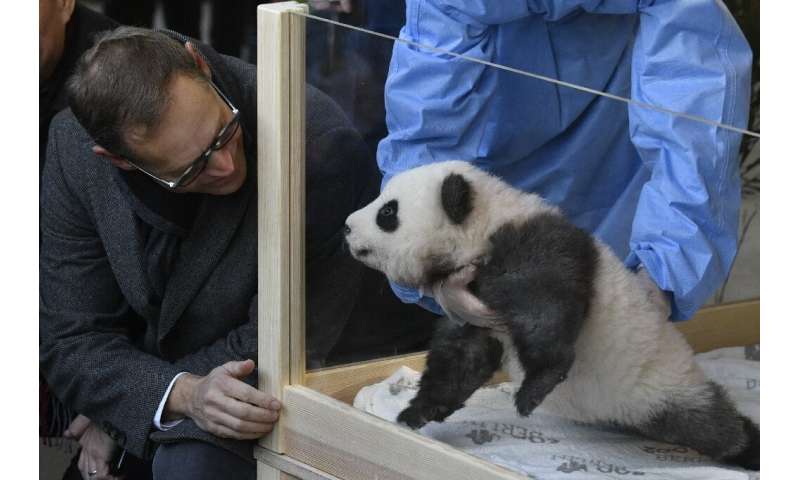
Berlin's Mayor Michael Mueller with "Meng Yuan"

The cuteness level at Berlin Zoo doubled on Monday when a pair of twin panda cubs made their public debut, with the zoo revealing the cuddly bundles of fur were both boys.

The little ones were born at the zoo on August 31 but in keeping with Chinese tradition they were only named after 100 days.

Speaking before a crowd of excited reporters at the Panda Garden, zoo director Andreas Knieriem announced that the cubs would go by the names of Meng Xiang, meaning "long-awaited dream" and Meng Yuan, or "dream come true".

The twins, weighing around six kilos (13 pounds) each, then made their long-awaited first appearance before the world's media.

Wheeled out in a glass-cased "panda bed", they were seen lounging close together on a heated mattress.

One of the cubs appeared half-asleep and unfazed by the attention, while his more active brother repeatedly turned his back on the press pack, prompting coos and laughter.

But the general public will have to wait a little longer for their own glimpse of the zoo's newest stars.

The cubs will be kept away from visitors "until they can walk properly" and are more familiar with their surroundings, Knieriem said, expected to be sometime in early 2020.

Thursday, 28 November 2019

US-born Bei Bei settles into new home at Chinese panda base (Update)

NOVEMBER 21, 2019 

by Yanan Wang 

Giant panda Bei Bei explores his surroundings on his first day at the Ya'an Bifengxia Base of the Giant Panda Conservation and Research Center in Ya'an in southwestern China's Sichuan Province, Thursday, Nov. 21, 2019. After a transcontinental flight on the "Panda Express," a furry American darling arrived early Thursday in his new Chinese home. The Washington-born giant panda Bei Bei was a beloved figure at the National Zoo, where he spent the first four years of his life. (Chinatopix via AP) 

After an intercontinental flight on the "Panda Express," a furry American darling arrived early Thursday in his new Chinese home. 

Giant panda Bei Bei was a beloved figure at the National Zoo in Washington, where he was born and spent the first four years of his life. By agreement with the Chinese government, the zoo had to return Bei Bei to China this year. 

He is now settling into the Ya'an Bifengxia Base of the Giant Panda Conservation and Research Center in southwest Sichuan province. Bei Bei will be quarantined for one month while he adjusts to the time difference, learns to eat local foods and picks up Sichuanese dialect, state broadcaster CCTV reported. 

Bei Bei was conceived through artificial insemination and born to the National Zoo's Mei Xiang and Tian Tian in 2015. His name, which means "treasure" in Chinese, was jointly selected by then-first lady Michelle Obama and Chinese President Xi Jinping's wife, Peng Liyuan. Bei Bei quickly became a favorite on the zoo's Panda Cam, and fans bid a bittersweet farewell to the cub online with the hashtag #byebyebeibei. 

With his handler, a veterinarian and 23 kilograms (66 pounds) of bamboo in tow, Bei Bei flew on a private jet provided by the shipping company FedEx and with a panda painted on its fuselage. 


Monday, 12 August 2019

Rare baby panda twins born at Belgian zoo


AUGUST 9, 2019

A Belgian zoo announced Friday the "extremely rare" birth of twin baby giant pandas, three years after the arrival of a young male, which was a first for Belgium at the time.

The Pairi Daiza zoo said the safe delivery of the twins, one male and one female, on Thursday represented a "new hope" for the charismatic black and white bear, of which fewer than 2,000 now live in the wild, according to the World Wildlife Fund.

The mother Hao Hao showed signs of going into labour on Wednesday evening and gave birth to the 160-gram male baby on Thursday afternoon, under careful monitoring by Belgian and Chinese experts, followed by the female, weighing 150 grams, two hours later.

"This double birth is marvellous news for this extraordinary species," said Eric Domb, president of the zoo.

"We are very proud... the birth of these two babies is a tremendous reward for the huge work carried on every day by all our teams."


Thursday, 30 May 2019

Rare albino panda caught on camera in China: state media


MAY 26, 2019

A rare all-white panda has been caught on camera at a nature reserve in southwest China, showing albinism exists among wild pandas in the region, state media reported.
The spotless, red-eyed animal was photographed while trekking through the forest mid-April in southwestern Sichuan province, said official news agency Xinhua on Saturday.
The panda is an albino between one to two years old, said Li Sheng, a researcher specialising in bears at Peking University, who was quoted in Xinhua's report.
The Wolong National Nature Reserve—where the animal was spotted—told AFP it had no further details about the albino panda.
More than 80 percent of the world's wild pandas live in Sichuan, with the rest in Shaanxi and Gansu province.


Thursday, 31 August 2017

Keeping pandas off endangered list ledge


Date: August 28, 2017
Source: Michigan State University

Summary:
Things aren't all black and white for giant pandas. The beloved Chinese icons have basked in good press lately -- their extinction risk status downgraded from 'endangered' to 'vulnerable,' their good fortunes have shown to rub off on their less charismatic forest neighbors that benefit from panda-centric conservation efforts.

Continued

Thursday, 15 June 2017

Cool retreats are needed to save giant panda from warmer weather


14 June 2017

By Lou Del Bello

Building a network of artificial, cool retreats in the forest may be the last resort for China’s vulnerable giant pandas, as climate change threatens the iconic mammal with extinction.

New data about habitat temperature and panda distribution, collected across six mountains along the Chinese edge of the Tibetan plateau, confirm what climate models have been suggesting for a while: the animal is struggling to survive as its natural habitat gets hotter.

Researchers found that areas within the pandas’ habitat, that were exposed to a potential heat stress of up to 30 °C had increased from 332 to 4482 square kilometres over the past 40 years.

Guozhen Shen of the Chinese Academy of Sciences in Beijing, says previous studies showed that 25°C is the threshold for giant pandas to suffer heat stress, since they are adapted to cool mountain climes.

A consistently warm environment can cause dehydration and metabolic problems in giant pandas, also affecting their reproduction abilities and their cubs’ health. To escape the heat, they have to move to cooler mountainous areas where foraging becomes more difficult.
Bamboo boom or bust?

Their specific bamboo diet could be affected too, although scientists are not sure how this will pan out. While there is a risk that the bamboo might mass-bloom and die, there is also a chance that it will simply grow stronger and more abundant, says Shen.

Artificial microhabitats could shield pandas, at least in the short term, from these and other heat related impacts. According to the researchers, they could look like a patchwork of retreats and maternity dens built close to streams.

The constructions would take advantage of the natural features of each forest patch to protect the animals from the sun and enhance the number and comfort of cool spaces. For example, they could have narrow entrances to keep the heat out and interior chambers offering respite to adults and cubs, which are particularly prone to illness under extreme heat.

The researchers added that planting more trees and bamboo in selected areas could also provide additional food and canopy cover. Building a significant number of such oases around the pandas’ distribution area would also allow them move more easily across vast areas.

Friday, 3 March 2017

Scientists who answered why zebras have black and white stripes pose the question to pandas


March 3, 2017

The scientists who uncovered why zebras have black and white stripes (to repel biting flies), took the coloration question to giant pandas in a study published this week in the journal Behavioral Ecology.

The study, a collaboration between the University of California, Davis, and California State University, Long Beach, determined that the giant panda's distinct black-and-white markings have two functions: camouflage and communication.

Deconstructing A Giant Panda
"Understanding why the giant panda has such striking coloration has been a long-standing problem in biology that has been difficult to tackle because virtually no other mammal has this appearance, making analogies difficult," said lead author Tim Caro, a professor in the UC Davis Department of Wildlife, Fish and Conservation Biology. "The breakthrough in the study was treating each part of the body as an independent area."

This enabled the team to compare different regions of fur across the giant panda's body to the dark and light coloring of 195 other carnivore species and 39 bear subspecies, to which it is related. Then they tried to match the darkness of these regions to various ecological and behavioral variables to determine their function.

Read more at: 

Monday, 16 March 2015

Chinese man wins payout over panda bite

Chinese man attacked by wild panda wins £56,000 compensation

12:26PM GMT 16 Mar 2015

A Chinese man who sued local government officials over an attack by a wild panda has won more than £56,000 in compensation, his lawyer said on Monday.

The animals are renowned for their lovable appearance but despite their placid, bamboo-chewing image they are members of the bear family and have a fearsome bite.

The animal wandered into Liziba village, in the northwestern province of Gansu, where local officials trying to capture it chased it onto Guan Quanzhi's land, the Lanzhou Evening News reported.

"I saw a panda jump out in front of me, its body completely covered in mud," he told the newspaper.

The creature bit him in the leg and only released its grip when another villager covered its head with a coat, the report said, and the incident in March last year left Guan with injuries requiring seven hours of surgery.

The panda escaped.

Guan's son sued local forestry officials and the nearby Baishuijiang National Nature Reserve, which is home to more than 100 wild pandas.

Following "negotiations", officials agreed to pay compensation of 520,000 yuan (£56,000), his lawyer Wang Chaohui told AFP.

Friday, 28 March 2014

Bamboo-loving giant pandas also have a sweet tooth

Date:
March 26, 2014

Source:
Monell Chemical Senses Center

Summary:
Despite the popular conception of giant pandas as continually chomping on bamboo, new research reveals that this highly endangered species also has a sweet tooth. Behavioral and molecular genetic studies demonstrate that the panda possesses functional sweet taste receptors and shows a strong preference for natural sweeteners.


Monday, 3 March 2014

Livestock beating pandas to the bamboo buffet

Date:
February 27, 2014

Source:
Michigan State University

Summary:
Pandas, it turns out, aren't celebrating the Year of the Horse. Livestock, particularly horses, have been identified as a significant threat to panda survival. The reason: they're beating the pandas to the bamboo buffet. A paper by panda habitat experts explores an oft-hidden yet significant conflict in conservation. “Livestock affect most of the world's biodiversity hotspots,” an author said. “They make up 20 percent of all of the earth's land mammals and therefore monopolize key resources needed to maintain the earth's fragile ecosystems.”


Sunday, 2 March 2014

Panda invasion: Thousands of pandas invade Taipei streets to raise awareness of the need to protect the species

It's not every day you see over a thousand of pandas settling down at a theatre.

But don't panic, the giant black and white bears aren't rising up and becoming a more cultural animal, it's all part of an art exhibition in Taiwan.

Artist Paulo Grangeon designed and created the 1,600 pandas out of papier mache.

But this isn't just an arts and crafts show - there is a serious motive behind it all.

The World Wildlife Fund (WWF) set up the Pandas on Tour exhibition back in 2008 as a way of highlighting the need to act to save the endangered species.


Friday, 19 July 2013

Rare Panda Twins Born at Zoo Atlanta

The world may be awaiting the birth of a little royal, but in the animal kingdom, it's baby panda season. Last night (July 15), a giant panda at Zoo Atlanta gave birth to two cubs, the first panda twins to be born in the United State since 1987.

The newborns are also the first pandas to be born in the country this year. They are fourth and fifth babies for 15-year-old mom Lun Lun, according to the zoo. The female last gave birth in 2010, to a male cub named Po.

"We're thrilled to welcome Lun Lun's and Yang Yang's twins," Raymond B. King, the zoo's president and CEO, said in a statement. "This is a success we share with all of our fellow zoological organizations working to understand and protect this iconic species, and we share our joy with our local community and with our colleagues in China."

- See more at: http://www.livescience.com/38202-panda-twins-born-zoo-atlanta.html#sthash.n3vebxte.dpuf

Wednesday, 17 July 2013

New Retroviruses Found in Polar Bear 'Knut' and Panda 'Bao Bao'

July 15, 2013 — Endogenous retroviruses (ERVs) are viruses that at some point in the past inserted themselves into the nuclear genome of a host's germ cell. Once integrated in a germ cell the virus would be passed on from one generation to the next and the endogenous retroviral genome would therefore be inherited to new species that evolve from the original host. 'ERV sequences and fragments make up about eight per cent of the human genome,' explains Professor Jens Mayer from the Department of Human Genetics at Saarland University. Endogenous retroviruses are found not only in humans, but also in other mammals such as horses, cattle, apes, koalas and, as has now been shown, in polar bears and giant pandas.

Working in collaboration with Professor Alex D Greenwood and Kyriakos Tsangaras from the Leibniz Institute for Zoo and Wildlife Research in Berlin, Jens Mayer has been taking a closer look at the DNA sequences from polar bears and great pandas. 'We have characterised endogenous retroviral sequences in both bear species and found a strong similarity between the two, which indicates that these two virus species are closely related,' says human geneticist Mayer. The researchers also identified ERV sequences in other bear species such as the brown bear, the black bear and the spectacled bear. 'Using molecular dating methods we have now been able to show that the retrovirus became integrated into the genetic material of an ancestor of today's bear species around 45 million years ago,' explains Greenwood. The research team also showed that the original retrovirus was closely related to those found in the genomes of bats and cattle. Interestingly, the viruses found in bears exhibit strong similarity with several endogenous retroviruses found in the human genome. 'Some of these sequences are suspected of playing a role in the occurrence of cancer, neurodegenerative or autoimmune diseases,' says Mayer.


Thursday, 24 January 2013

Panda Boot Camp Teaches Cubs Survival Skills


Panda cubs have the cuteness thing down pat, but rough-and-tumble? Not so much. Now scientists are hoping to teach the roly-poly bears survival skills they'll need for living in the wild.

The new mission is partly the result of a panda cub being released into the wild without the proper training. Xiang Xiang, a male cub, wasreleased into Wolong Nature Reserve, located high in the mountains of western China's Sichuan Province, in April 2006. Unfortunately, Xiang Xiang wasn't prepared for the harsh reality of the wild. After less than a year of wandering the mountains, the cub was killed by neighboring males during turf wars.

Enter Tao Tao, a 2-year-old male panda currently roaming in Lipingzi Nature Reserve in southwestern China. The cub went through a boot camp of sorts, and now scientists are monitoring the furball with GPS.

Tuesday, 20 November 2012

Oldest Panda Fossils Found in Surprising Place


All giant pandas may come from China, but fossils reveal that the oldest known ancestor of the lineage dwelled in Spain, researchers say.

The giant panda (Ailuropoda melanoleuca) is known worldwide for its black-and-white fur. The giant panda is unique among bears for dining almost entirely on bamboo — other members of the bear family are omnivorous or mostly carnivorous.

Genetic evidence suggests the ancestors of giant pandas diverged from other bears 18 million to 22 million years ago. However, much remains uncertain about what early giant pandas were like and how this lineage of bears changed over time — before the new find, the earliest undisputed giant panda fossils recovered were about 8.2 million years old at most, and were from China.

Thursday, 18 October 2012

National Zoo Panda Cub Died of Lung and Liver Damage


The week-old giant panda cub that died at the Smithsonian National Zoo last month suffered lung and liver damage, veterinarians announced Thursday (Oct. 11).
The female cub, born Sept. 16, likely had an oxygen deficiency from inadequately formed lungs, which would have affected the newborn's liver function, according to a statement from the zoo.
Joy turned to heartbreak at the Washington, D.C., zoo on the morning of Sept. 23 when 14-year-old panda mom Mei Xiang let out a distress call. Panda keepers found her cub unresponsive and immediately performed CPR, but they couldn't revive the newborn. The 4-ounce (100-gram) panda had no outward signs of trauma or infection, zoo officials said at the time, though they later found abnormalities in its liver.

Wednesday, 17 October 2012

China releases 'survival trained' second panda into the wild


China has released a second giant panda bred in captivity into the wild after giving it special survival training, state-run media say.
The release of male panda Taotao, from a nature reserve in Sichuan province, follows that of Xiang Xiang in 2006, says Xinhua news agency.
Scientists are hoping that the two-year-old has enough skills to survive and help increase the panda population.
Xiang Xiang died in 2007 after he got into a fight with wild pandas.
Taotao's mother fed him and taught him basic skills. But scientists at the Wolong Nature Reserve also drew up a survival training schedule for Taotao.
Part of this involved handlers wearing panda suits to prevent familiarity with humans.
Zhang Hemin, a director at China's giant panda conservation centre, told Xinhua that Taotao "has lived and grown in semi-wild conditions since he was very little", compared to Xiang Xiang.
"This means its fighting capability and survival skills both improved significantly," he said.
However he said that nothing was certain, as Taotao would be facing natural enemies like other wild animals.

Monday, 9 July 2012

Panda-monium as pandas invade London Underground


The cuddly creatures, performers dressed in costumes, clambered into Charing Cross Tube Station before shuffling along to Trafalgar Square on Wednesday.


The costumed pandas performed a tai-chi inspired dance in the square before attending a Panda Party in nearby Covent Garden. 

Promoting Panda Awareness Week, the 108 'pandas' represented the number of bears currently living at the Chengdu Panda Base, in China.

Panda Awareness Week is part of a bid to raise awareness about the plight of the giant panda, one of the world's most threatened species.


Continued:  http://www.metro.co.uk/weird/904264-panda-monium-as-pandas-invade-london-underground

Tuesday, 15 May 2012

A 'Cousin' of the Giant Panda Lived in What Is Now Zaragoza, Spain


ScienceDaily (May 9, 2012) — A team of Spanish scientists have found a new ursid fossil species in the area of Nombrevilla in Zaragoza, Spain. Agriarctos beatrix was a small plantigrade omnivore and was genetically related to giant pandas, according to the authors of the study.

The fossil remains of a new ursid species, Agriarctos beatrix, have been discovered in the Nombrevilla 2 site in the province of Zaragoza, Spain. Researchers from Spain's National Museum of Natural Sciences (MNCN-CSIC) and the University of Valencia suggested that this plantigrade lived during the Myocene period some 11 million years ago.

"This bear species was small, even smaller than the Sun bear -- currently the smallest bear species. It would not have weighed more than 60 kilos," as explained by Juan Abella, researcher at the Department of Paleobiology of the MNCN-CSIC and lead author of the study, published in the journal Estudios Geológicos.

Although it is difficult to determine its physical appearance given that only pieces of dental fossils have been found, scientists believe that it would have had dark fur with white spots mainly on the chest, around the eyes and possibly close to the tail.

Wednesday, 2 May 2012

Female Panda Recovering After Artificial Insemination


The "black-and-white rock star" of the Smithsonian's National Zoo, female panda Mei Xiang, is recovering tonight (April 30) after being artificially inseminated with up to 800 million sperm.

This was the Washington, D.C.-based zoo's second try at inseminating the 13-year-old panda, after a first attempt on Sunday when scientists determined the semen they had collected from the male Tian Tian wasn't high enough quality for artificial insemination.

The scientists decided to try this technological intervention in the first place after a natural attempt fell flat.

"Veterinarians performed an artificial insemination Sunday night after they determined no competent natural breeding had occurred between Mei Xiang and male giant panda, Tian Tian (tee-YEN tee-YEN)," zoo officials wrote in a statement.

Related Posts with Thumbnails

ShareThis