Showing posts with label Michigan. Show all posts

Monday, 11 March 2019

'We want to live with them': wolves airdropped into US to tackle moose problem


With the wolf population dwindling in a Michigan park, four were trapped in Ontario and transported by helicopter
Katharine Gammon
Wed 6 Mar 2019 11.00 GMT Last modified on Wed 6 Mar 2019 11.02 GMT
At a remote national park, four Canadians were recently airdropped into a dizzying new life in America.
They are expert moose hunters, accustomed to cold climates, and covered in fur.
A quartet of Canadian wolves was transported by helicopter from their home in Ontario to Isle Royale national park, covering an 894-square-mile island in the US Great Lakes, to deal with the burgeoning moose population. Scientists also hope to bolster a dwindling population of wolves that already exists on the island.
Historically, ice bridges have connected Isle Royale to the mainland for more than 50 days a year, allowing wolves ample time to migrate. But over the last two decades, these bridges have been far less common and consistent, in effect stranding the two last wolves at Isle Royale and preventing newcomers. The four new ones will join two others introduced in 2018. The National Park Service is planning to introduce 20 to 30 wolves to the park over the next five years.


Friday, 24 August 2018

Martens recolonized Isle Royale in the '90s, showing island's dynamism


After decades of trapping, the last known American marten was spotted on Isle Royale in 1917. Fifty years later, in 1966, the National Park Service planned to reintroduce martens to the national park situated in Lake Superior, but nobody knows if the agency ever followed through. Then, in 1993, martens were confirmed on the island for the first time in 76 years.

Whether these small, forest-dwelling carnivores—valued historically for their fur—had been hiding there the whole time, found their way back, or were introduced in the 1960s without any records has remained a mystery for the last quarter century.

But in new research published today (Aug. 23, 2018) in the journal Scientific Reports, University of Wisconsin-Madison researchers in the Department of Forest and Wildlife Ecology, collaborating with the National Park Service, traced the recolonization to martens likely arriving in the 1990s, shortly before they were spotted.

Genetic studies of martens from Isle Royale and nearby populations in America and Canada showed that the contemporary population came from nearby Ontario, Canada. The animals likely wandered over on an ice bridge in the winter, the researchers speculate.

The results provide much-needed context about the natural history of an island long considered an unspoiled wilderness, but one with a long history of ecological disruptions and recoveries. The island park may be best known for the ebb and flow of its wolf and moose populations, which have been tracked for 60 years.

With additional wolves set to be relocated to Isle Royale in the coming months, the new research provides ecologists and land managers with a fuller picture of how dynamic even seemingly isolated island ecosystems can be.

After all, say the researchers, if the house-cat-sized marten can find its way over, islands like Isle Royale may be less isolated and static than we think.

Jonathan Pauli, a professor of forest and wildlife ecology at UW-Madison, has studied martens for years as part of efforts to understand how communities of wild animals respond to human disturbance. In 2015, his group provided evidence that martens had long escaped detection on islands in southeastern Alaska prior to deliberate reintroduction efforts in the 20th century. And in work published in 2016 with graduate student Phil Manlick, Pauli called into question the effectiveness of periodic augmentations of reintroduced marten populations in Wisconsin, where the once-extirpated carnivore remains an endangered species.


Monday, 5 March 2018

To build up mussels, you need to know your fish


February 27, 2018, Michigan State University

Times are tough for 31 of Michigan's 45 varieties of freshwater mussels. Sporting evocative names like wavy-rayed lampmussel and round pigtoe, these residents of the state's rivers are imperiled by habitat disruption and pollution and are also threatened by climate change.

Michigan State University (MSU) scientists' recommendation to figure out the best places to focus conservation efforts: Worry about fish.

In this month's journal Hydrobiologia, researchers say that if you care about those wavy-rayed lampmussels and round pigtoes, then you also must care about Michigan's johnny darters and rosyfaced shiners.

This research group for the first time creates models that acknowledge how tightly the fate of mussels and fish are entwined in the state's ecosystems and helps chart a path for conservation managers to save the mussels. Mussels filter water - a single one can clean up 20-30 gallons a day - as they eat, and excrete nutrients upon which other water organisms can feast. Their shells are important terrain for algae and insect larvae to attach, and mussels are an important food source for some aquatic critters.


Friday, 15 December 2017

New discovery, more bees mark Michigan's first, full bee census


Date:  December 7, 2017
Source:  Michigan State University
     
The first complete bee census, led by Michigan State University scientists, confirmed a new species and revealed that the actual number of bee species in Michigan exceeded earlier estimates.

Identifying potential pollinators, including the 38 new bees recorded in the state, is crucial, especially in the face of declining honey bee populations. All pollinators make an estimated $14 billion annual contribution to U.S. agriculture, so it's imperative to understand wild bee populations and their benefits to crops and the environment.

"Pollinator conservation is not possible without a good understanding of what bees we have and where they are found," said Jason Gibbs, former MSU graduate student now with University of Manitoba. "We need better and more thorough sampling of our wild bee communities and an increased emphasis on understanding their basic taxonomy and natural history."


Tuesday, 16 August 2016

'Vegetarian Piranhas' With Human-Like Teeth Found in Michigan Lakes


By Mindy Weisberger, Senior Writer | August 12, 2016 05:57pm ET

A South American fish with uncannily human-like chompers has been unexpectedly showing up on Michigan anglers' hooks.

The fish are red-bellied pacus (Piaractus brachypomus) and are piranha relatives, though their diet is mostly vegetarian. Pacus are popular with aquarium owners for their unusual square teeth that look remarkably human —rather disturbingly so, in fact. But recently, pacus have been sighted in places where they shouldn't be: Lake St. Clair and Port Huron in southeastern Michigan, where three pacus were caught during the month of July.
The pacus were almost certainly introduced into the lakes by former owners who kept them as pets, according to a statement released Aug. 9 by the Michigan Department of Natural Resources (DNR).

Pacus are native to the Amazon and Orinoco river basins and flood plains. Their flattened bodies resemble those of their sharp-toothed piranha cousins, but their own distinctive teeth are used for crushing seeds and nuts. Pacus can grow to be about 35 inches (89 centimeters) in length, and pet owners may be dismayed to find that their exotic pet can outgrow its tank, which can prompt them to release the fish in the wild, according to the DNR.

Warm temperatures are vital to the pacus' survival, so they are unlikely to become established as an invasive species in Michigan's seasonally cold waters. However, releasing pets in the wild is not only harmful to the animals and likely to result in their death, but could have severe implications for native wildlife and ecosystems, DNR officials said in the statement.

Pacus have been found in Michigan waters before, but this is the first time that people have caught three of them in one week, according to Nick Popoff, a biologist with the Fisheries Division at the DNR. Popoff told Live Science that it's possible the three fish came from a single tank that was dumped in a public access site.

Sunday, 4 October 2015

Michigan farmer uncovers Mammoth skeleton


OCTOBER 4, 2015
by Susanna Pilny

On Monday, a farmer named James Bristle made a "mammoth" of a find while he was was digging in a soybean field with a friend-- and we don't mean that figuratively. They discovered what they thought was an old wooden fence post—but it actually turned out to be a mammoth rib.

Although they didn’t figure that much out until later, after contacting the University of Michigan and being directed to Professor Dan Fisher, the director of the Museum of Paleontology. The university sent Fisher who confirmed the discovery.

“We get calls once or twice a year about new specimens like this,” Fisher told The Washington Post. However, most of those calls relate to mastodon fossils—to date, only 30 mammoths have been found in Michigan.


A rare discovery
This find was quite unusual. Adding to its peculiarity, Fisher and his team was given only one day to excavate the bones; Bristle had just recently purchased the farm, and was running on a tight schedule thanks to the harvest.

Which means the dig became a mad dash to complete the work all on Thursday.

“We didn’t stop to eat or drink,” Fisher told the Detroit Free Press. “It was a hard, hard day of work, but every bit worth it.”

“We don’t just want to pull the bones and tug everything out of the dirt,” Fisher added. “We want to get the context for how everything was placed at the site.” Context—like where the bones are relative to each other and what layer of sediment they are in—yield mounds of data researchers couldn’t get otherwise.


Read more at

Tuesday, 21 April 2015

Down to three wolves on Isle Royale


Date:
April 20, 2015

Source:
Michigan Technological University

Summary:
Only three wolves seem to remain in Isle Royale National Park. Researchers observed the wolves during their annual Winter Study, and the lone group, at an unprecedented low, is a sharp decline from nine wolves observed last winter.


Friday, 26 December 2014

Judge rules to keep gray wolves on endangered species list

Order affects wolves in Michigan, Minnesota and Wisconsin after US Fish and Wildlife Service dropped federal protections from those animals in 2012

Associated Press in Traverse City, Michigan

Friday 19 December 2014 22.24 GMT

A federal judge on Friday threw out an Obama administration decision to remove the gray wolf population in the western Great Lakes region from the endangered species list – a decision that will ban further wolf hunting and trapping in three states.

The order affects wolves in Michigan, Minnesota and Wisconsin. The US Fish andWildlife Service dropped federal protections from those wolves in 2012 and handed over management to the states.

US District Judge Beryl Howell in Washington, DC, ruled Friday the removal was “arbitrary and capricious” and violated the federal Endangered Species Act.

Unless overturned, his decision will prohibit further wolf hunting and trapping in the three states, all of which have had at least one hunting season since protections were removed. More than 1,500 Great Lakes wolves have been killed since federal protections were removed, said Jonathan Lovvorn, senior vice president of the Humane Society of the United States. The group filed a lawsuit that prompted Howell’s ruling.

Wednesday, 8 October 2014

Asian carp DNA found in southwestern Michigan

TRAVERSE CITY, Mich. (AP) — Genetic material from Asian carp has been found in the Kalamazoo River in southwestern Michigan, but there's no indication the invasive fish have become established in the river that flows into Lake Michigan, officials said Tuesday.

DNA from silver carp was detected in one of 200 water samples taken in July from the river in Allegan County, this one from below the Caulkins Dam about 24 miles from Lake Michigan, the state Department of Natural Resources and the U.S. Fish and Wildlife Service said.

Saturday, 9 August 2014

Dying man crashes into house, releasing 60,000 raging bees

Published time: August 01, 2014 13:34 
Edited time: August 04, 2014 05:12

A freak accident involving 60,000 bees took place when a man in dire need of medical attention accidentally crashed into an empty house where the insects had built a giant hive, releasing them. The enraged bees took over the neighborhood instantly.

Patrick Lee Muirhead, 54, was driving his car along a Saginaw County road in Michigan at about 3:30pm when he failed to take a turn and crashed into a vacant house, the impact killing him as a result.

But the collision was only the start of the story, as an estimated 60,000 bees whose home had just been disturbed became free to terrorize the neighborhood, encircling cars and the walls of neighboring homes, according to the local Sheriff’s office speaking to the local Michigan Live news.

"The house, we're being told, has not been occupied for many years” Lt. Randy Pfau told the news source.

"There were thousands and thousands of bees," Tri-Township Chief Pat Harley also said. "Just masses of them."

Although a team of firefighters were called to the scene, the house was so infested, they could not get to the man.

The only way forward was to attach a tow strap to the crashed vehicle and try to pull it away from the battered home. A number of Sheriff Deputies and Tri-Township firefighters were at the scene.

As part of the measures to stop the neighborhood infestation, the firefighters sprayed the bees with foam, killing almost all of them instantly.

It later turned out the man had died on impact and there was nothing they could have done, but an autopsy is also being carried out as part of the investigation.

Wednesday, 23 April 2014

Young Boy Accidentally Finds Fossilized Tooth Of Ancient Mastodon

April 22, 2014

Brett Smith for redOrbit.com – Your Universe Online

Mothers often tell their kids not to pick up any strange objects, but one young boy from Michigan is probably glad he doesn’t follow that advice.

Phillip Stoll, a 9-year-old boy from Windsor Township, Michigan, was playing in a creek behind his house last summer when he literally stumbled upon a fossilized mastodon tooth.

“I was walking down at the creek last summer. I felt something that I stepped on so I picked it up and everybody in the neighborhood thought it was pretty cool,” Philip Stoll told CNN last week.

The boy known as “Huckleberry Phil” around the neighborhood brought the object home to show his mother and begin an analysis on his discovery. After washing off the rabbit-sized object, Stoll said he checked to see if it was magnetic – it wasn’t.


Friday, 3 January 2014

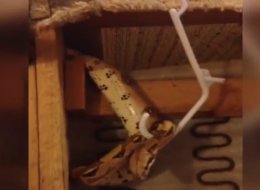
Holly Wright Finds Python In Secondhand Sofa


Now here's a story guaranteed to make you squirm.

A woman in Michigan recently got the surprise of her life when she discovered a large reptile coiled in the folds of her couch.

According to ABC News, Grand Rapids resident Holly Wright made the shocking find over the weekend, when she spotted a large snake slithering around in a secondhand couch she had picked up.

"I picked this couch up off the street and it's been in my bedroom for a couple months, and today we found a python inside the couch," Holly Wright said in a video obtained by ABC News' Grand Rapids affiliate WZZM-TV.


Tuesday, 5 November 2013

Carp Running For City Council In Michigan Has Our Vote

There's something fishy going on in Ann Arbor.

Just take a look at one of the candidates for city council -- it goes by the name Twenty Pound Carp.

Last November, the Michigan fish made a name for itself when it was removed from West Park for being "destructive" to the pond's vegetation. At the time, the 20-pound carp was relocated to a nearby river. But it seems he had greater aspirations.

After establishing a Twitter account last year, the carp -- and whoever's behind the tongue-in-cheek account -- announced its intentions to run for a seat on Ann Arbor's city council.

Friday, 11 October 2013

Pig and bird virus now being found in dogs


A virus that was once thought to affect only pigs and birds is now being found in dogs.

Dogs in Ohio, California, and southeast Michigan have been getting sick, and in some cases dying, due to the virus called the circovirus.

Because the symptoms are similar to other common viruses seen in dogs, veterinarians like Dr. Craig Brakeman at the Banfield Pet Hospital believe dogs may not be getting tested for circovirus.

He said pet owners don't need to be worried about the virus just yet, but should use "common sense" and should educate themselves on what to look out for.

He suggests making sure your dog is up to date on vaccines.

"If your dog is sick, don't take him to the park," said Dr. Brakeman. "The dogs that are to be the most likely to pick this up are the dogs that are not healthy."

Dr. Brakeman said he first became aware of the virus in dogs last summer. He says he has not heard of any cases in northern Michigan yet, but as of right now, there is no vaccine for the virus if any area dogs do become infected.


Tuesday, 3 September 2013

Michigan Black Bear Shot By DNR Isn't Same Animal That Attacked 12-Year-Old Abby Witherell

Authorities from the Michigan Department of Natural Resources trapped and killed a black bear after it mauled a 12-year-old girl in an attack earlier this month. Or so they thought: the stage agency admitted Monday that they bagged the wrong bear.

DNA evidence showed that the black bear shot and killed by DNR officers in Wexford County, Mich. on Aug. 18 wasn't the samebear who attacked 12-year-old Abigail Wetherell of Haring Township while she was jogging on an unpaved road in the woods near her grandparents' home Aug. 15. She was attacked twice by the bear, and it took 100 stitches to close her puncture wounds and deep cuts.

Sunday, 18 August 2013

Wolves at Risk? Michigan Allows Hunting of Protected Species (Op-Ed)

Wayne Pacelle is the president and chief executive officer of The Humane Society of the United States (HSUS). This Op-Ed first appeared on the blog A Humane Nation, where it ran before appearing in LiveScience's Expert Voices: Op-Ed & Insights.

I went to Lansing, Mich., earlier this week to stand with leaders of Native American tribes, environmentalists and local humane organizations to announce a new referendumin Michigan to protect wolves and other wildlife. Over the weekend, we barnstormed the state and talked to HSUS supporters, Audubon society members, hunters and other concerned citizens about the state's reckless plans to allow trophy hunters, and in future years, trappers to kill wolves from the small, still recovering population of fewer than 700 animals in Michigan.

Hunters won't be targeting problem wolves , but randomly killing animals in national forests and other wilderness areas in the Upper Peninsula of the state.

Wednesday, 2 January 2013

Dog, cockfighting in Mich. now get big fines, prison time

DETROIT — Michigan has enacted what one lawmaker calls the toughest laws in the country prohibiting dogfighting and cockfighting.

As of this month, dogfighting and cockfighting in the state can be prosecuted as a criminal enterprise, much like large drug and prostitution operations, with penalties of up to 20 years in prison and fines of $100,000.

The new law is part of the state Legislature's crackdown on blood sports. Gov. Rick Snyder signed the bill and two others into law Dec. 12. They became effective immediately.

Vicki Deisner of the American Society for the Prevention of Cruelty to Animals said the package sets a national standard.

"Michigan is out ahead on this one," said Deisner, that ASPCA's state director for the Midwest.

The new laws also allow police to seize homes and vehicles associated with animal fighting; shut down any venue associated with animal fighting and declare it a nuisance; and add animal fighting, shooting and baiting to the list of racketeering crimes.

State Sen. Rick Jones, a Republican from Grand Ledge, Mich., and one of the sponsors of the legislation, said the bills send the message that "Michigan is not a good place to bring dogfighting: 20 years in prison, $100,000 fine, lose your house, your barn, your property, cars, anything involved with this crime.

"It's sweeping legislation that has been noticed nationwide as a real example of getting tough on a terrible blood sport."

Wayne County Sheriff Benny Napoleon said it is a "welcome punishment for those who are caught ... if you're going to profit from this, we're going to take your profit from you."


Read on: http://www.usatoday.com/story/news/nation/2012/12/31/dogfighting-cockfighting-laws-michigan/1800745/?utm_source=feedburner&utm_medium=feed&utm_campaign=Feed%3A+UsatodaycomNation-TopStories+%28News+-+Nation+-+Top+Stories%29

Sunday, 23 December 2012

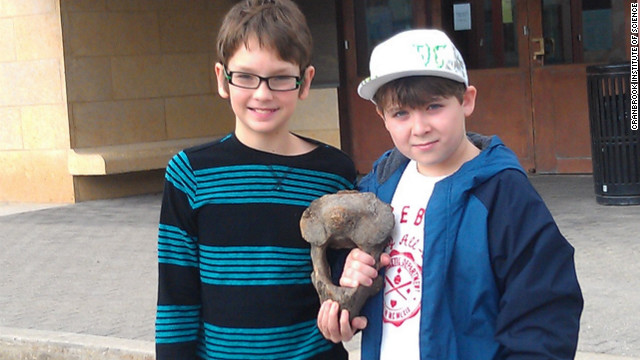
Michigan cousins go after crayfish, hook a mastodon – via D R Shoop

(CNN) -- An 11-year-old from Michigan said he is going to really wow his schoolmates Friday with the "coolest" show-and-tell item anyone's ever brought to the sixth grade.

After all, it's not every day you get to show off a 13,000-year-old mastodon bone you and your cousin found in a stream behind your backyard.

"I thought it was a rock at first, but a couple minutes later I looked more at it, and I didn't think it was a dinosaur bone, but I wasn't sure," Eric Stamatin of Shelby Township Michigan told CNN on Thursday.

He and Andrew Gainariu, 11, from Troy, Michigan, were hunting for crayfish in the stream that extends from the middle branch of the Clinton River, as they often did, when they "got bored" and decided to build a dam.

They made an extraordinary discovery that June day.

John Zawiskie, a geologist and paleontologist at the Cranbrook Institute of Science confirmed in early November that what the "kids just being kids outside" discovered was not a rock at all, but an axis, a specialized second vertebrae behind the skull in the spinal column of an American mastodon.

Continued:  http://edition.cnn.com/2012/12/13/us/michigan-dinosaur-find/index.html?hpt=hp_t4

Watch this video

Monday, 26 November 2012

What Should Be Done About the Wolves at Isle Royale National Park, U.S.?


ScienceDaily (Nov. 16, 2012) — The number of wolves at Isle Royale National Park has dipped to nine -- the lowest seen since Michigan Technological University's wolf-moose predator-prey study began 54 years ago. What should be done if this furry icon of wilderness culture dies out altogether?

Michigan Tech researchers John Vucetich and Rolf Peterson and Michigan State University environmental ethicist Michael Nelson are willing to tackle this controversial subject.

The issue is a prickly one because there is conflict among environmentalists and ethicists about how we should -- or should not -- relate to nature and the environment. Some say, "let nature take its course." Others believe humans should work to maintain ecosystem health, and that may on some occasions require intervention.

"The appropriate approach is to acknowledge and understand all the values at stake, and then develop a perspective or position that would least infringe upon that set of values," say Vucetich, Peterson and Nelson.

Thursday, 20 September 2012

City tweaks rewrite of animal ordinance

Dog and cat owners in Battle Creek could get a break on the forced sterilization of their impounded pets under a new plan for the city’s stray animal ordinance.

The ordinance, which must still be drafted and voted on, would require sterilization after an animal was impounded a third time. If the owner agreed to have the pet spayed or neutered after the first impound, the owner would get a warning instead of being ticketed. A second offense would come with an increased fine, the cost of which could go toward sterilization.

The city’s current ordinance says animals over the age of six months must be sterilized before being released by the shelter, unless a veterinarian says it would jeopardize the animal’s health. The standards for age and the health exemption remained in sample wording prepared by City Attorney Eileen Wicklund for a commission workshop Monday.


Continued: http://www.battlecreekenquirer.com/article/20120917/NEWS01/309170021/1002/NEWS01?nclick_check=1
Related Posts with Thumbnails

ShareThis