Showing posts with label ohio. Show all posts

Sunday, 16 April 2017

Thousands in Ohio Ask State to Ban Unlimited Wild Commercial Traders That Now Sell as Many Turtles as They Can Catch - via Herp Digest

COLUMBUS, Ohio— 4/10/17, Press Release

As of today, the Center for Biological Diversity and Sierra Club Ohio have sent more than 3,800 letters asking the Ohio Department of Natural Resources to end unchecked commercial collection of the state’s wild turtles.

Turtle traders in Ohio can now legally collect unlimited numbers of common snapping and softshell turtles to process and sell domestically or export for Asian food and medicinal markets. The letters support a petition seeking a ban on for-profit turtle trading filed by the Center for Biological Diversity and several Ohio-based conservation organizations in January. 

The state agency has not yet responded to the letters or petition.
“For-profit turtle traders should not be allowed to put the state’s turtles at risk,” said Collette Adkins, a Center biologist and senior attorney who authored the January petition. “Ohio desperately needs limits on the number of snapping and softshell turtles trappers can take from the wild. Selling so many turtles for meat is bad for the turtles, of course, but also for all of us who care about the health of the state’s waterways and wetlands.”
Under current regulations in Ohio, anyone with an annual fishing license may trap and sell unlimited numbers of common snappers, spiny softshells and smooth softshells. Although Ohio law prohibits live export of turtles, traders can sell live turtles within the state or process the animals to sell across state lines or overseas for meat and medicinal markets. 

Also, because turtles bioaccumulate toxins from prey and burrow in 
contaminated sediment, turtle meat is often laced with mercury, PCBs and pesticides, posing a health risk. Adult turtles are also taken from the wild to breed hatchlings for the international pet trade.

“All of our neighboring states ban or limit for-profit turtle trapping, and Ohio should too,” said Aaron Acus-Souders, a clean water advocate from the Ohio Chapter of the Sierra Club.

None of the states that share a border with Ohio allow unlimited commercial collection of turtles. Kentucky, Michigan, Indiana and West Virginia prohibit all commercial collection of turtles, and Pennsylvania enforces strict bag limits.  
  
During its April 12 meeting, the Ohio Wildlife Council will accept public comment on the state’s turtle regulations. The meeting will be held at 6:30 p.m. at the Wildlife District One Office in Columbus.

Contact: 
Collette Adkins, Center for Biological Diversity, (651) 955-3821, cadkins@biologicaldiversity.org 
Aaron Acus-Souders, Sierra Club (Clean Water Campaign), (937)-903-5396, Aaron.AcusSouders@SierraClub.org

Monday, 26 December 2016

Salamanders brave miles of threatening terrain for the right sex partner


Mini treadmill helps scientists understand mysteries of amphibian mating

Date: December 20, 2016
Source: Ohio State University

Most salamanders are homebodies when it comes to mating. But some of the beasts hit the road, traversing miles of rugged terrain unfit for an amphibian in pursuit of a partner from a far-away wetland.

And when those adventurers leave home, they travel an average of six miles -- and as far as almost nine miles -- to new breeding sites, a new study has found.

That's a long haul on four squatty legs.

The scientists who unlocked this evolutionarily important information got there by cross-referencing genetic details from salamanders in various Ohio wetlands with the distance the animals would walk on a treadmill before tiring out.

The research, published online this month in the journal Functional Ecology, is the work of scientists at The Ohio State University who want to better understand how and where salamanders procreate and how that fits into work to preserve the animals, including land conservation efforts.

It is a mystery what prompts a salamander to cross rocks, fields, streams and roads to mate and, in the process, mix up the genetics of another salamander outpost far from home, said lead author Robert Denton.

"It has to be incredibly intimidating for these tiny salamanders. They could get eaten by a crow or a raccoon. They could dry out," said Denton, a presidential research fellow in Ohio State's Department of Evolution, Ecology and Organismal Biology.

"This is the first study to connect physiological factors -- particularly how fast they get tired of walking -- with genetics showing animal movement in the field."

Understanding these connections is critical to predicting how environmental and other changes can harm species, Denton said. Dispersal -- leaving the birthplace for a new habitat -- is a key element of keeping a species genetically healthy, he said.

Animal travel for breeding is a complex area of research, he said. There are a lot of factors to consider, including how they decide to move, why only certain animals hit the road and how they actually complete the journey -- in a series of shorter trips or all at once, for instance.

Monday, 5 January 2015

Strange Gray Creature Spotted in Ohio

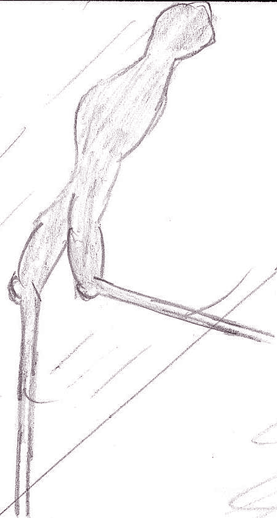
Not much of a creature, i'd say, just two really, really long legs joined somewhere above, making a little pustule of a head, but that, believe it or not, is the creature reportedly seen by a man in Ohio this 12 December. Could it be a mutant? A gray alien? A mutated gray alien? I'll leave the speculation out for the readers.


The 60-year-old man who had allegedly seen the creature this 12th December, was contacted by the Mutual UFO Network (MUFON), who say that it'll be interesting to find out about similar sightings in the locality. The Highland County Press published an account of the man's bizarre encounter, mentioning that it was while driving along Carmel Road in Ohio that he spotted this gray creature.

According to his account, the creature had long, muscular legs, no hands, no face and knees fitted backwards! The anonymous man is also a former U.S. Marine, and a (former?) skeptic, according to his wife. She says:


My husband saw it. He is a skeptic -- almost 60 years old -- and a proud Marine. He wouldn't have admitted to seeing it if he hadn't been in shock. I had him draw it for me when we got to the house. He says it was asphalt gray (our asphalt is gray) and about seven feet tall, no arms that he could see, but muscular in the legs area; no jawline, and its legs were bent backward and it leaned forward as it ran.

Monday, 19 May 2014

Teen catches 40lb fish in flooded street


A US teenager caught a 40lb carp on his flooded street with his bare hands.

Jake Sawyer, 16, stalked the big fish through ankle-deep water before eventually grabbing hold of it in North Royalton, Ohio.

"I just slowly put my hand on it and then, once it got comfortable with me, I just kind of bear-hugged it and lifted it up," he said.

"And I had this whale of a giant fish. My arms were falling asleep once I was walking back. It was a good 40 pounds."

Heavy rains that day had caused flash flooding, and he suspected the 3ft carp had swum out of a nearby pond as the water rose.

Mr Sawyer said he wanted to ensure the fish didn't become trapped and die in the street, so he carried it back to the pond.

"I think our only option was to put it in the pond," he said. "I mean, I could've put it in my pool, but it would've died."

His mother caught his bizarre catch on video and uploaded it to YouTube.

Thursday, 30 January 2014

Permits required for Ohio exotic animal owners in 2014 - via Herp Digest

Jan 01, 2014, COLUMBUS, Ohio —Owners of certain snakes and dangerous wild animals in Ohio must have a permit to keep their creatures beginning Wednesday, though the state has issued none.

Just seven applications returned to the state had been completed as of Tuesday, while another 30 are in progress, according to Ohio's Department of Agriculture.

The permits are among the last pieces of the state's exotic animal crackdown to take effect, following the 2011 release of dozens of wild animals by a suicidal owner at his eastern Ohio farm. Authorities killed most of the animals, including black bears, African lions and Bengal tigers, fearing for the public's safety.

While the law allows for state officials to seize animals that are kept without a permit, that's unlikely to start immediately in the new year. The agriculture department expects to receive applications into the new year, said agency spokeswoman Erica Hawkins.

"It's not like we can show up and take the animals," Hawkins said in an interview. "There's a due process that is followed."

Once applications are submitted, the agency has 90 days to decide whether potential permit holders have met the state's new caging standards and other rules for keeping certain snakes and animals. And Hawkins said the department is eager to work with owners who want to comply with the law.

The new restrictions are being challenged by several animal owners, who have asked a federal appeals court in Cincinnati to strike down the law. They are suing the state's agriculture department and its director over the rules, claiming they infringe on their constitutional rights. Their appeal comes after a federal judge in Columbus upheld the law.

Several of the owners in the case believed they were exempt from the law, only to be notified recently by the state that they are not, said Polly Britton, a lobbyist for the Ohio Association of Animal Owners. The group boasts more than 8,000 members, whose animals range from domestic cats to Bengal tigers.

"We kind of feel like this is a bullying tactic," Britton said in an interview.

According to the agriculture department, a couple of the owners didn't have the correct species to qualify them for certain exemptions.

Owners applying for permits must pass background checks, pay fees, obtain liability insurance or surety bonds, and prove they can properly contain the animal and care for it. They also had to register their animals with the state.

Ohio has 888 dangerous wild animals registered by 150 entities. That includes creatures kept at zoos, sanctuaries and other facilities that are exempted from the law. It's not clear how many of the animals are privately owned. But the agriculture department believes the majority of those registered belong to the zoos and other exempted facilities.

Still, some owners have not notified the state about their animals. Others have transferred their critters to another home without contacting the state, in violation of Ohio's new law. And officials do not know how many owners fall into those categories.

The agriculture department has two full-time staffers dedicated to enforcing the law, along with four others that split time between the program and another. Hawkins said the agency believes that's enough people to enforce the law.

"If there's a huge influx (of permits), we'll bring more people on," Hawkins said. "We think given the number we saw through registration, this team should be able to cover it."

Other pieces of the law, such as a ban on buying new animals, have been in place since 2012.

Ohio constructed a roughly $3 million building to temporarily keep animals surrendered to the state, should owners find they cannot keep the creatures or comply with the new rules.

Since opening in March, the taxpayer-funded facility has held at least 24 animals, including 20 alligators, three bears and a cougar. None were euthanized. The state has worked to find them new homes.

Friday, 11 October 2013

Pig and bird virus now being found in dogs


A virus that was once thought to affect only pigs and birds is now being found in dogs.

Dogs in Ohio, California, and southeast Michigan have been getting sick, and in some cases dying, due to the virus called the circovirus.

Because the symptoms are similar to other common viruses seen in dogs, veterinarians like Dr. Craig Brakeman at the Banfield Pet Hospital believe dogs may not be getting tested for circovirus.

He said pet owners don't need to be worried about the virus just yet, but should use "common sense" and should educate themselves on what to look out for.

He suggests making sure your dog is up to date on vaccines.

"If your dog is sick, don't take him to the park," said Dr. Brakeman. "The dogs that are to be the most likely to pick this up are the dogs that are not healthy."

Dr. Brakeman said he first became aware of the virus in dogs last summer. He says he has not heard of any cases in northern Michigan yet, but as of right now, there is no vaccine for the virus if any area dogs do become infected.


Wednesday, 9 October 2013

Woman shares her home with 50 skunks


A US woman who shares her home with 50 skunks says they are "wonderful, beautiful animals".

Deborah Cipriani, 55, of North Ridgeville, Ohio, runs America's only rescue centre for domestic skunks.

And they are given free reign of the five-bedroom home - even sleeping on Ms Cipriani's bed.

She said: "A lot of people think we're weird to like pet skunks and they always say: 'Why do you want a pet skunk?' and I ask them: 'Why do you want a pet dog?'

"Because skunks aren't the smelly little creatures that people think they are - they're wonderful, beautiful animals."

Ms Cipriani, who lives with partner Kevin, 51, bought her first skunk in 2000 to help her through the death of her mother.

Since then, she's become so attached to the animals that she's dedicated her life to caring for them - getting up at 4.30am every morning to make sure they're all fed in time.

Her home, called Skunk Haven, has become well known throughout America and she even has fans in the UK, France and the Netherlands.

Ms Cipriani even set up her own event - called Skunk Fest - which attracts fellow animal lovers from all over America every September.

Thursday, 12 September 2013

Mystery Disease Killing Ohio Dogs

Veterinarians, health officials and dog owners are alarmed by the mysterious recent deaths of four dogs in Ohio. Some experts suspect that the dogs may have died a few days after exposure to a virus that's normally found in pigs.

Three dogs in the Cincinnati area and a fourth dog near Akron died in August after exhibiting symptoms that included vomiting, bloody diarrhea, weight loss and lethargy, according to the Columbus Dispatch.

"We feel obligated to make sure pet owners are aware this is happening," Erica Hawkins, communications director for the Ohio Department of Agriculture, told the Dispatch. "Supportive therapies can be helpful if started early enough."

The three dogs from Cincinnati died last month after staying in the same kennel. The Akron dog that died was one of several in the Akron-Canton area that showed the same symptoms. A stool sample from the Akron dog tested positive for canine circovirus, a recently isolated virus.

Sunday, 14 July 2013

Ohio Exotic animal holding center should get busier Jan. 1 – via Herp Digest

by Alan Johnson, The Columbus Dispatch Sunday June 30, 2013 

The state’s $2.9 million exotic-animal containment facility in Reynoldsburg hasn’t been used much in the four months since it opened, with five alligators and two black bears briefly calling it home.

But business is expected to pick up in six months when Ohio’s exotic-animals law takes full effect on Jan. 1.

Ohio Agriculture Director David Daniels says the state is ready.

“We’ve learned a lot. We’ve had to go out and make pickups (of animals),” he said. “Every time that we go through one of these, we learn something new.

“A lot of times the animals are not in the best of health. They’ve had a poor diet, and some are malnourished.”

The seven animals were kept briefly at the Dangerous Wild Animal Temporary Holding Facility, 8995 W. Main St., before being moved to out-of-state sanctuaries. Most were relinquished by owners who said they could no longer keep them, but one alligator was seized during a drug raid in Guernsey County.

State records obtained by The Dispatch show what it takes to feed the animals. Receipts from Walmart and Kroger show facility employees purchased chicken breasts, corn, peaches, bananas, walnuts, mangoes, lettuce, blueberries, watermelon and doughnuts.

Daniels said some animals had terrible diets. One owner sent along a note saying he fed his alligator dog food, doughnuts, pizza, Mountain Dew and chocolate milk. State animal workers transitioned the animal to a more-nutritious diet but had to throw in doughnuts at first to get the animal to eat.

Taxpayers also paid for a kiddie pool for the alligators and a $225, 30.5-pound bouncy ball for the bears.

The exotic-animals law, enacted last year, bans private owners from acquiring, selling and breeding restricted species in Ohio as of Jan. 1. On the restricted list: lions, tigers, bears, elephants, certain monkeys, rhinos, alligators, crocodiles, anacondas and pythons longer than 12 feet, certain vipers and all venomous snakes.

Thus far, private owners have registered 361 animals, mostly primates, tigers, bears and alligators. Beginning Oct. 1, and before Jan. 1, owners must obtain and pay for a permit to keep their animals. “Wildlife shelter” permits cost $250 for one to three animals and up to $1,000 for 11 to 15 animals. Owners also must obtain liability insurance or a surety bond of $200,000 to $1 million.

The law was passed after Terry W. Thompson, from near Zanesville, released his menagerie of exotic animals before committing suicide on Oct. 18, 2011. Forty-eight animals, including lions, tigers and bears, were killed by law enforcement to protect the public.

The law still could be put on hold as a result of a lawsuit pending in the 6th U.S. District Court of Appeals in Cincinnati. The suit filed by seven animal owners, including Terry Wilkins, owner of Captive Born Reptiles in Columbus, argues that the law infringes on their constitutional rights and would result in an unfair taking of their property, the animals. U.S. District Judge George Smith sided with the state in upholding the law last year.

Delaware lawyer Robert Owens, who is representing the owners, said the permit process is “a sham” and the requirements forced on owners are “more stringent and astronomically more expensive” than standards required by national associations for small zoos and menageries.

“The hangman’s noose is there for these owners,” Owens said. “No member of the public has ever been hurt by these animals. Why are we destroying businesses and seizing personal property?

“Some of these animals live for a long time. ... They are as much of a loved member of the family as any pet. In addition to tearing apart families and businesses, it’s emotionally devastating.”

Polly Britton, of the Ohio Association of Animal Owners, said her members — some of whom are involved in the lawsuit — are “extremely concerned” about the impact of the law.

“People feel like they are in real danger of having their animals taken from them.”

Tim Harrison, a retired firefighter and paramedic from the Dayton area who runs an animal-rescue group called Outreach for Animals, has been busy helping to find animals and relocating them to new homes outside Ohio.

“A lot of the good people who have these animals have stepped forward,” he said. “But there are some people who are thumbing their nose at the law, saying, ‘Come and get me.’  ”

Information on the law and permits is available at www.agri.ohio.gov//TopNews/DangerousWildAnimalAct/.

People reporting a dangerous wild animal can call 1-855-392-6446 toll-free.


Thursday, 3 January 2013

Colo the western lowland gorilla celebrates her 56th birthday at Columbus zoo


A gorilla, which was the first to be born in a zoo, has celebrated her 56th birthday.

Colo, from Columbus Zoo in Ohio, decided to mark the occasion by snacking on tomatoes at her sanctuary in the US.

Visitors sang happy birthday to the western lowland gorilla, who was born at the animal park in 1956.

She also received presents, which she managed to open by herself and also feasted on a cake made by her zookeepers.

Tuesday, 13 November 2012

Nearly frozen alligator rescued


CLEVELAND — Was someone trying to avoid registering their exotic animal by dumping it down a sewer drain?  That’s what the Ohio Department of Agriculture will be investigating. 
A two-foot alligator was rescued from the shallow waters of Big Creek in Cleveland on Thursday, near Steelyard Commons.
A surveyor noticed it by a sewer outfall and alerted Northeast Ohio Regional Sewer District crews who were doing maintenance at the agency’s Jennings Road Pump Station.
The alligator was not moving, so to revive the nearly frozen animal, crews put her in a tub with warm water.
The alligator was being cared for at a Sewer District facility in Cuyahoga Heights until the Ohio Department of Agriculture provides instructions.
According to Jeannie Chapman, the public information specialist for NEORSD, there is speculation the reptile may have been released to avoid the cost of new exotic animal regulations. 
Ohio’s exotic ban registration deadline was just this past Monday, Nov. 5.  Owners of lions, tigers, bears, certain snakes and alligators are required to register with the state, pay fines, undergo background checks, get insurance and post signs on their property – warning of dangerous animals.


Monday, 12 November 2012

Pet Lions, Tigers, and Bears: Should They Be Microchipped?


Many pet owners use microchips to ensure that if their animals are lost or stolen, they can be found. It’s a technology that has been used by humane societies, rescue groups, and clinics.
But what about exotic pets? Should tigers or lions be chipped?
The epicenter of this debate is Ohio, where four exotic animal owners have filed a lawsuit against the Ohio Department of Agriculture and its director David Daniels claiming that a new law which would mandate them to microchip exotic animals violated their First Amendment and personal property rights.
Represented by Attorney Robert OwensCaptive Born Reptiles’ owner Terry Wilkins, USDA-inspected Stump Hill Farm’s owner Cyndi Huntsman,  Paws and Claws Animal Sanctuary owner Mike Stapleton, and Sean Trimbach of the USDA-licensed Best Exotics LLC, were successful in delaying the enforcement of the new law until a hearing in mid-December
According to a Columbus clerk in the United States District Court of the Southern District of Ohio, a restraining order was also filed on November 6 and a conference is scheduled to meet November 28.  The clerk couldn’t comment on the details of the restraining order.
With all the exotic animal headlines since the tragic 2011 Zanesville, Ohio incident, it seems human rights would be less of an issue in this lawsuit; however, by “a violation of personal property rights,” the exotic animal owners mean that their animals will face health risks due to microchipping, which is lithium-based in Ohio because the state does not have readers to detect non-lithium chips. 
Continued:  http://news.yahoo.com/pet-lions-tigers-bears-microchipped-004208168.html;_ylt=Alcbum9Z2xG02czM_jvq5S94hMgF;_ylu=X3oDMTRhMmtwOThsBG1pdANUb3BTdG9yeSBTY2llbmNlU0YgQW5pbWFsUGV0c1NTRgRwa2cDMGFmN2NlMGUtMmI5Zi0zZmMwLThiYzUtNzc2MjQ3M2M3NDdjBHBvcwMzBHNlYwN0b3Bfc3RvcnkEdmVyAzdmNjAwYjMwLTI5NDEtMTFlMi1hZjFhLWUwNWNjNzk1MWFlOQ--;_ylg=X3oDMTI0MmNvNGRoBGludGwDdXMEbGFuZwNlbi11cwRwc3RhaWQDBHBzdGNhdANzY2llbmNlfGFuaW1hbHNhbmRwZXRzBHB0A3NlY3Rpb25z;_ylv=3

Wednesday, 3 October 2012

Florence Lenahan Killed By Falling Llama In Ohio


DELAWARE, Ohio — An Ohio sheriff's department says a woman has been struck by a pet llama that was trying to greet her and has died.

A report by the Delaware County Sheriff's Office says former coroner Florence Lenahan apparently had a heart attack as she was being taken to a hospital.

The report says the 74-year-old Lenahan called for help Tuesday after a llama named Baby Doll slipped on wet grass while running to greet her and knocked her down, causing her to hit her head on concrete. It says there's no evidence the llama was acting maliciously.

Lenahan's family is working with the Delaware County Humane Society to find homes for the animals on her property.

Tuesday, 18 September 2012

Cat survives 1,000 mile trip via airplane, in suitcase


ORLANDO, Fla. — A pet owner got quite a surprise when she opened her suitcase after a trip out-of-town. Ethel Maze found her 14-month-old cat Bob-Bob in her bag.

The cat traveled almost 1,000 miles from Ohio to Florida after climbing in Maze’s suitcase.

“I thought how in the world did this happen?” Maze said.

Maze’s friend Mike Groleau was helping pack for the group’s annual trip to Disney World when he thought he saw something move in the suitcase. He says he didn’t give it a second thought.

“It was early in the morning, I’m not fully up yet so maybe my eyes are just playing tricks on me, it never dawned on me,” he said.

Maze was scared that her cat didn’t survive when she found it in the bag.

“Well, I’m just amazed that he made it because he was just soaked when I got him,” she said.

The cat’s trip will home will be in a pet carrier. Maze will have to pay $65. As for Bob-Bob he is safe and healthy. His owner says he has a healthy appetite and things are getting back to normal.

A spokesman for the TSA said the technology used to scan bags is programmed to pick out explosives and weapons, but not animals.

Continued:
  http://wtvr.com/2012/09/16/cat-survives-1000-mile-trip-via-airplane-in-suitcase/

Wednesday, 23 May 2012

Gorilla patriarch of Columbus Zoo surrogacy program dies


CLEVELAND (Reuters) - A gorilla known for being the patriarch of a renowned gorilla surrogacy program at the Columbus Zoo and Aquarium in Ohio died on Friday at an estimated age of 47, the zoo said.

The popular gorilla, Mumbah, was eating breakfast with his family when he collapsed, the zoo said in a statement. The animal care team was unable to resuscitate him.

Mumbah was born in equatorial Africa around 1965 and brought to the Columbus zoo from England in 1984. He was well past a male gorilla's average life expectancy of 31 years.

The Columbus zoo is one of the leading facilities in gorilla breeding, with 30 gorillas born there since 1956.

The zoo currently houses 15 gorillas, including 55-year-old Colo, the first captive-born gorilla and the oldest gorilla in captivity.

Mumbah was a fundamental component of the zoo's gorilla surrogacy program, the zoo said. He acted as a father figure to young gorillas unable to be cared for by their birth mothers.

"He was a gentle giant who readily accepted youngsters into his family," the zoo president, Dale Schmidt, said in a statement. "He was patient but effective at teaching them how to be vital members of a gorilla social group. His legacy will live on through all of the gorillas he helped to raise."

The zoo's Facebook page has received more than 300 comments mourning Mumbah's death.

(Editing by Mary Slosson and Peter Cooney)

Related Posts with Thumbnails

ShareThis